
When You Shouldn’t Use Your Car Horn
Only to Insure Safe Operation
Do you know how to use your car horn properly?
It may not be on your DMV written test, but it is essential knowledge for everyday driving and the driving skills test.
By law, you must only use your horn when reasonably necessary to ensure safe operation. It means you must only use your horn to avoid an accident.
In some states, the law may also require you to use the horn when approaching any curve obstructing the view within 200 feet.
There are several situations when using horns is discouraged and even illegal. If there is a question about horns on your DMV test, it will usually focus on these situations.
Let us have a look at some of them.

Horses and Other Animals
Horses and livestock are easily scared by fast-moving vehicles and the sudden sound of a horn.
When approaching horse-drawn vehicles or horseback riders, you must slow down and proceed cautiously. When a rider signals you to stop, you must stop. And most importantly, never use your horn. It is dangerous and typically illegal.
Blind Pedestrians
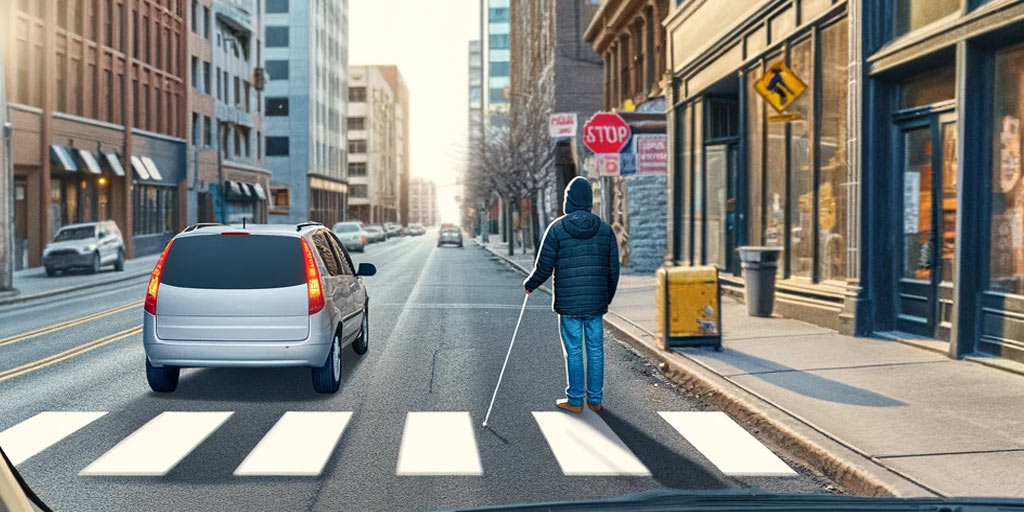
Some drivers think it is a good idea to honk at a blind pedestrian standing at a crosswalk. It isn’t.
You must always yield to blind pedestrians with guide dogs or white canes. It is usually best to stop with your engine on. Don’t honk your horn. A blind person has no idea what you are honking at or how to react.
Bicyclists
It is best to be extremely careful before tapping your horn around bicyclists. Use your horn lightly and only when it is necessary to avoid an accident or when it is necessary to let the bicyclist know you are near.
Always avoid using the horn when the bicyclist is a child. They are easily startled, and their behavior is unpredictable. Honking your horn may cause them to make a mistake, swerve, or fall.
Greeting a Friend
Never use your horn to greet or get a friend’s attention. It is improper use of the horn and may result in a ticket.
Other drivers may also think you are honking at them and get frustrated.
Encourage Someone to Get Out of the Way
Never use your horn to encourage someone to drive faster or get out of the way.
Tapping the horn at the driver in front of you the second a traffic light turns green is not only bad manners but may also trigger road rage with a stressed-out driver on edge.
What if you are stuck in traffic? Honking the horn does not help. Be patient.
Aggressive Honking
Please do not use your horn to tell other drivers they made a mistake. Your honking may cause them to make more mistakes. Remember, nobody is perfect. Do not take another driver’s errors or misjudgments personally.
Never use your horn when upset, angry, or in a hurry. Honking the horn won’t let your anger go away. It may increase your frustration and won’t get you to your destination faster.
A traffic officer may interpret unnecessary use of the horn as a sign of aggressive driving and give you a ticket.
What You Should Do Instead
Remember, it is safer to slow down or stop in many situations instead of using your horn.
Be patient and courteous.


DMV Practice Tests by State
| Alabama |
| Alaska |
| Arizona |
| Arkansas |
| California |
| Colorado |
| Connecticut |
| Delaware |
| District of Columbia |
| Florida |
| Georgia |
| Hawaii |
| Idaho |
| Illinois |
| Indiana |
| Iowa |
| Kansas |


Is it usually considered legal to honk at a pedestrian if they are walking on the road instead of on the sidewalk next to it?
No state law prohibits honking in this specific situation. The law, however, usually says that you must not use your horn unless it is necessary.
If there is little room and you believe that the pedestrian does not not see or hear you, a light tap on the horn is justified. If there is plenty of room and no immediate risk of an accident, it is probably best to just slow down and allow the pedestrian more space.
This still didn’t fully answer my question. I am not ttrying to sound narcissistic, but I am honked at frequently as an attractive female. Is that legal? I wwould assume that it is considered I feel harassed, and I’m a minor.
Thank you, tabitha