
2026 Alaska DMV Test & Permit Practice Tests
Results
Well done! This is a passing score.
This is not a passing score but you will get there!


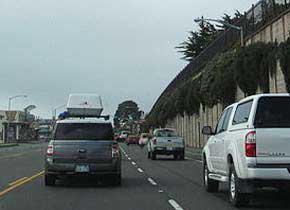
#1. Following closely behind another vehicle:
Most rear end accidents are caused by following too closely. It is one of the major crash problems. Traffic experts are convinced that rear end crashes can be prevented if drivers will observe a few simple precautions when following other vehicles.

#2. Safe and courteous driving on a controlled access highway or freeway includes all of the following except:
If you drive slower than other traffic, use the right, outside lane, except when passing. Avoid frequent lane changes.

#3. If the rear of your vehicle starts to skid left, you should:
If you start to skid: ease off the gas pedal, stop braking, and turn the steering wheel in the direction of the skid.
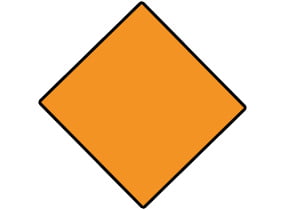
#4. An orange sign with black letters means:
Orange is used for construction and maintenance warnings.
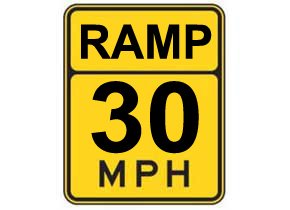
#5. This sign tells you:
This is an advisory speed sign. It shows the recommended speed, at which the exit ramp from an expressway may be traveled safely.

#6. When you park on a hill headed uphill, and there is a curb, you should turn your front wheels:
This how you park on hills:
- If you park facing uphill where there is a curb, you should set the parking brake and turn the wheels away from the curb.
- In any other situation turn the wheels toward the curb or edge of the road.
See illustration in the DMV Driver Manual.

#7. During an enforcement stop by a police officer, you should:
After receiving a visible or audible signal from a law enforcement officer to bring your car to a stop, you should acknowledge the officer’s presence by turning on your right turn signal. Move your vehicle to the right shoulder of the road. Set the emergency brake, turn off the engine, and activate the hazard warning lights. Roll down your window and keep your hands in clear view. Remain inside your vehicle unless otherwise directed by the officer.

#8. Which lane is closed for traffic going straight ahead?
Do not use the lane. Opposing traffic is permitted to use the lane.

#9. What does this arrow sign mark?
The sign means you make sharp turn to right in front of this sign. It is used either as a supplement or alternative to the Chevron signs.

#10. When should you not use your horn?
You should use your horn when it is reasonably necessary to ensure safe operation. Meaning, use your horn if it is necessary to avoid accidents. Going on a narrow road with limited space for cars to meet, and limited sight can be such a situation.
Do not use your horn:
- If a driver is going slowly, and you want him or her to drive faster. The driver may be ill, lost, or having problems with the vehicle.
- If slowing or stopping your car will prevent an accident. It is safer to use the brakes than honk the horn.
- To show other drivers that they made a mistake. Your honking may cause them to make more mistakes.
- Because you are angry or upset.
- When passing bicyclists, unless to avoid an accident
- When passing a horse-drawn vehicle or horseback rider.
This question asked when you should NOT use your horn.

#11. You want to make a right turn at an intersection ahead. The traffic light displays a flashing red arrow. What should you do?
At a flashing red arrow, you must stop behind the crosswalk, stop line, or if none, before entering the intersection. Look in all directions for approaching traffic and pedestrians and proceed only when it is safe to do so.

#12. If a yellow center line is solid on your side of the road, it means:
If the solid yellow line is on your side of the road, do not pass. Pass only if there is a dashed (broken) line on your side.

#13. To avoid getting tired on a long trip, you should try NOT to:
You should not drive late at night when you normally sleep.
There are several things you can do to help from getting tired on a long trip:
- Try to get a normal night’s sleep before you leave.
- Do not leave on a trip if you are already tired.
- Do not take any medicine that can make you drowsy.
- Eat lightly. Do not eat a large meal before you leave. Some people get sleepy after they eat a big meal.
- Take breaks. Stop every hour or so when you need to.
- Plan for plenty of time to complete your trip safely.
- Try not to Drive late at night when you normally sleep. Your body thinks it is time to go to sleep and will try to do so.
This question asked what you should not do.

#14. Under the Alaska point system, your driving privilege will be taken away if you accumulate:
Accumulating 12 points in 12 months or 18 points in 24 months requires the mandatory suspension or revocation of the driving privilege, regardless of the hardships involved.

#15. Why should you exercise extraordinary caution when backing up in residential areas?
Exercise extraordinary caution when backing up in residential areas. Children often play behind and between parked vehicles. Back slowly and keep your eyes moving to all sides of your car. Always yield to vehicles or people on the street or sidewalk and be prepared to stop.

#16. It can be dangerous to leave a motor running in a garage because of:
Carbon monoxide is a colorless, odorless, poisonous gas from vehicle exhaust can make you a dangerous driver and even cost you your life. It paralyzes before it kills. Symptoms include headache, dizziness, nausea, and vomiting.
Never run a vehicle in a closed garage

#17. Who must yield when several vehicles approach an uncontrolled T-intersection?
If you are the driver on a road that ends at a T-intersection with no signs or signals, you must yield to any driver on the through road.
#18. Driving skills are often impaired by:
Alcohol, prescription drugs and emotions can all impair concentration, judgment, and the sensory and perceptual skills needed for careful driving

#19. Under Alaskan law, seat belts must be used:
Alaska law AS 28.05.095 requires everyone in a motor vehicle to use a safety belt. A child less than 16 years of age who does not exceed certain height and weight requirements must be properly secured in a child safety device or in a safety belt, whichever is appropriate for the particular child.
The law applies to any passenger vehicle (rental or privately-owned), taxi, or limousine.
Exception exists for vehicles built prior to 1965 which did not have safety belts as original equipment and are not classified as a custom collector vehicle.

#20. What is true about signaling before making a sudden stop?
Always signal to other drivers when you plan to turn left, right, slow down, or stop. Signals may be given by hand-and-arm positions or by using the vehicle’s signal lights
Quick Facts about the Alaska DMV Permit Exam
| What You Should Know | |
|---|---|
| Number of questions on exam: | 20 |
| Passing score: | 80 percent |
| Correct answers to pass: | 16 |
| Allotted time to complete test: | 25 minutes |
| Wait time before retest: | 1 day |
| Number of questions on each practice test: | 20 (randomized) |
| Question pool: | 500+ |
Alaska Permit Practice Tests
Each practice test has 20 random questions based on the Alaska Driver Manual and actual Alaska DMV tests.
After each question, you will get instant feedback. If you miss a question, there is also a brief comment to help you study.
The Alaska Driver Manual Matters
Before you start practicing, you should get the latest version of the Driver Manual . The manual introduces you to the principles of a motor vehicle’s safe and lawful operation. It gives you all the information you need to pass the knowledge test.
After studying the manual, use the practice tests to check your progress and whether you are ready for the examination.
The passing score in Alaska is 80 percent, which means you must answer at least 16 questions correctly.
On a practice test, you should aim higher. Try to reach a perfect score of 100%. This way, you will know if you have learned all the contents of the manual or not.
Read more about practicing and acing the real DMV test .

Who Must Pass Alaska Written Test?
First-time applicants.
When you apply for your first permit or driver’s license, you must pass the written knowledge test.
If your license has expired.
If you let your license in Alaska or any other state expire for more than one year, you must take and pass the written exam again.
If your license has been revoked.
When the DMV revokes your license, you can only get the license back by applying for a new license and passing all tests again.
If you hold a license from another state or country.
Drivers with a valid out-of-country or out-of-state driver’s license may drive in Alaska for 90 days before converting their license to an Alaska license.
Unlike many other states, applicants must pass the written knowledge test before DMV issues an Alaska driver’s license.
Drivers with a driver’s license from a country other than the United States, Canada, or a US Territory must also pass the road skills test in addition to the written test.

What is on the Alaska Written Test?
DMV bases all questions on the driver’s manual information, including traffic laws, safe driving practices, and common highway signs and signals.
There may also be questions about permit restrictions and the dangers of drinking and driving.
If you are under 21, your first driver’s license expires 90 days after your 21st birthday. Before DMV renews your license, you must pass an alcohol awareness test.
What Languages are Available?
DMV offers online examinations in several languages.
If you need an interpreter or have difficulty reading, you may bring someone to read the questions. You must independently answer the questions. Contact DMV ahead of your test for guidance.
What if You Fail the Test?
If you fail the knowledge test, you can try again the next day.
Alcohol and Drug Awareness Knowledge Test
If you are 21 years or older, you must also pass an alcohol awareness test. The test is mandatory after your 21st birthday when you want to renew or upgrade from a permit to a license.
Exemptions exist for applicants 21 and older who are transferring their license from another state.


Thank you
Super easy its literally common sense, still study because they randomize questions
It is my first time doing this Neva brown