
Alabama Practice Tests for Permit & Driver’s License – 100% Free
Results
Well done! This is a passing score.
Not a passing score, but you will get there!


#1. You must use your headlights when you cannot see clearly for at least:
Turn on your headlights when you cannot see clearly for at least 500 feet.

#2. What does this sign mean?
Left Turn Only. This sign tells you that you can only a make left turn from this lane.
Lane-Use Control signs are used where turning movements are required or where turning movements are permitted from lanes as shown.

#3. A three-point turn should only be used:
A three-point-turn must be made without endangering other traffic.
They are normally permitted where your vehicle can be seen for a great distance and where traffic is such that making a three-point-turn would not constitute a hazard.
Three-point turns are not permitted on interstate freeways, on curves, or near the top of hills where you cannot be seen by drivers of other vehicles approaching from either direction within 500 feet.

#4. What does this sign mean?
Winding road ahead.
The road ahead winds back and forth. Slow to a safe or indicated speed.

#5. If your car starts to skid, do not:
Do not overreact or slam on the brakes.
Instead, take your foot off the accelerator and brakes. Slow down gradually.

#6. What does this sign mean?
A stop sign has eight sides and is red with white letters. It means that you must come to a complete stop before entering the intersection ahead and yield to traffic close enough to be an immediate hazard.

#7. Where is it illegal to park a vehicle?
Parking is not allowed in front of a driveway.

#8. When may you drive faster than the maximum speed limit?
In addition to the basic speed law, the traffic laws set up speed limits for normal driving conditions. Speeds in excess of such limits are prima facie evidence that they are unlawful, and you may be arrested.

#9. Which is an appropriate restraint system for a child who is three years old and weighs less than 40 lbs.?
The new Alabama law requires children to be in rear-facing infant car seats until they are one year or weigh 20 pounds. After that, they must be in forward-facing child car seats until they are five or weigh 40 pounds, in booster seats until they turn six, and in regular seat belts until they turn 15.

#10. Passing a motorcyclist in the same lane:
Don’t share the lane with a motorcycle. Motorcycles are entitled to the same full lane width as all other vehicles. A skilled motorcycle operator is constantly changing positions within a lane to maximize being seen, to see the roadway better, and to compensate for objects on or near the road. Drivers should never move into the same lane alongside a motorcycle even if the lane is wide and cyclist is riding far to one side. It is not only illegal, but extremely hazardous.

#11. When a traffic officer is directing you to drive against a red light, you should:
The only exceptions to obeying all traffic control devices are emergency situations when directions from a police officer or other emergency personnel take priority. Uniformed school patrol members also have the authority to direct traffic at locations near schools. You must also respect and obey a flagger in a work zone.

#12. If you find yourself on a roadway marked with a yellow line on the right edge and a white line to your left:
If you ever find yourself with yellow to your right and white to your left, you are going the wrong way.
Remember, solid yellow lines are used on the left of the roadway edge of divided streets or roadways. When driving, a yellow line should always be to your left.

#13. After a train has passed a railroad crossing with more than one track, you should:
Watch out for the second train. When the last car of the train passes, do not proceed until you are sure no train is coming on another track, especially from the other direction.
If there is more than one track, a sign below the crossbuck indicates the number of tracks.

#14. For how long will your driver's license be suspended if you within two years accumulate 24 points?
The following schedule is used to determine the length of a suspension period:
- 12-14 Points in a two-year period 60 days.
- 15-17 Points in a two-year period 90 days.
- 18-20 Points in a two-year period 120 days.
- 21-23 Points in a two-year period 180 days.
- 24 and above points in a two-year period 365 days.
After a traffic conviction is two years old, it loses its point count for suspension purposes but remains on a driver’s record.

#15. Your car must have the following equipment in proper working order:
Motor vehicles must be equipped with at least two headlights (white lights), a rear license plate light, a brake light, and at least one red taillight.

#16. When should you use your horn?
It is unlawful to use a motor vehicle horn for any purpose except in giving warning when reasonably necessary to insure safe operation. Needless use of your horn may result in an arrest.
There are several situations when you should not use your horn. They include:
- Announcing arrival or calling your passengers.
- Encouraging someone to drive faster or get out of the way.
- Letting other drivers know they made a mistake.
- Around blind pedestrians.
- Passing bicyclists.
- Approaching horses.

#17. You approach an intersection. The traffic signal light is flashing red. What should you do?
A flashing red light means the same as a stop sign.
Come to a complete stop, yield to vehicles and pedestrians who reach the intersection before you, and proceed when the intersection is clear.

#18. When a pedestrian is crossing at an intersection with no marked crosswalk, you must:
Drivers must yield the right of way to pedestrians.
Be especially alert for pedestrians:
- On streets on which cars are parked.
- During the hours of darkness or poor visibility.
- At places where people cross – near mailboxes, institutions, churches, play areas, bus stops, etc.
- During morning and afternoon when children are going to and from school or at play.
Be especially alert for older people who move slowly and cannot see or hear well.

#19. The legal blood alcohol level at which drivers under 21 violate DUI laws is:
If you are under 21 and found driving with a BAC of .02 percent or more, you will be convicted of underage driving while under the influence.
Under state law, it is unlawful for any of the following persons to operate or be in actual physical control of a vehicle:
- A person who is under the influence of alcohol or drugs.
- A person who is under the influence of a drug to a degree which renders him incapable of safely operating a motor vehicle.
- A person whose blood contains .08 percent or more concentration of alcohol.
- A person under the combined influence of alcohol and a drug to a degree which renders him incapable of safely driving.
- Commercial vehicle operators whose blood alcohol content is .04 percent or more.
- Persons under 21 years of age whose blood alcohol content is .02 percent or more.
- School bus and daycare drivers whose blood alcohol content is .02 percent or more.

#20. When is passing another vehicle on the right allowed?
Passing on the right is permitted when the vehicle in front of you is making or about to make a left turn or when the road is marked for two or more lanes of traffic moving in the same direction.
Note: a dashed yellow line does not indicate that you may pass to the right!

#21. Always allow extra room in front of your vehicle when:
You should increase your following distance if you have a heavy load, or are driving vehicles with longer lengths than cars.

#22. Which is the background color on signs that guide you to parks and recreation areas?
Brown signs are used for points of public recreational or cultural interest.

#23. When entering a freeway:
Even if drivers on the freeway should allow room for those entering, you must yield to traffic on the freeway.
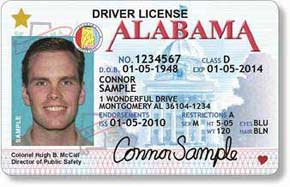
#24. A driver's license is:
Having a driver’s license is a privilege that comes with great responsibility.

#25. What does this sign mean?
Road curves. Note the difference between Curve and Sharp Turn signs.

#26. When stopping behind a school bus with red lights flashing, you must stop:
You must stop your vehicle at least 20 feet before reaching a school bus that is stopped with its red lights flashing whether it is on your side of the road or the opposite side of the road.

#27. The following are true about large trucks except:
It is not true that trucks gain speed quicker than cars.
Trucks require more time than a car to accelerate and reach normal speed.

#28. Driving under the influence of a drug that impairs your ability to drive safely is:
There are many drugs, which interfere with your ability to drive safely. These may be contained in prescriptions written by your doctor, or may be found in some of the remedies which you can buy without prescription.
Remember, it is illegal to drive when you are under the influence of a drug to a degree that makes you incapable of driving safely.

#29. On a country road at night, a vehicle with high beams comes toward you. What should you do?
Dimming headlights when meeting or following is required by law. If another driver fails to do dim the headlights, make sure yours are dimmed. You prove nothing by keeping your lights on high beam and blind the approaching driver. To avoid glare, look down to the right-hand edge of the pavement and concentrate on the white striped line.

#30. Before turning left or right, you must signal during the last:
At least 100 feet before making the turn, signal your intentions. Be certain your signals are discontinued after completing a maneuver.
| Alabama Permit Practice Test | |
|---|---|
| Questions per test: | 30 |
| Question pool: | 500+ |
| Type of test: | Random multiple-choice |
| The Official Alabama Knowledge Test | |
|---|---|
| Questions: | 30 |
| Passing score: | 80% |
| Correct answers: | 24 |
| Allotted time: | – |
| Wait time before retest: | None |
Study for Your Alabama Learner License
These sample test questions help you study for your Alabama Learner License.
The Learner License is the first step in the Alabama Graduated Driver’s License (GDL) program.
With this license, you can practice driving with a supervising parent, legal guardian, certified driving instructor, or a person who is at least 21 years old and holds an Alabama driver’s license. The supervising person must always sit in the front seat beside you.
Before You Study with the Practice Tests
Always get a copy of the latest version of the Alabama Driver Manual. Get it online or from your Driver’s License District Office.
Study the manual until you understand the content well. Then, use the practice tests to check your progress and determine whether you are ready for the exam.

These free Alabama practice tests have 30 random questions based on the Alabama Driver’s License Manual and real examination questions.
After each question, you’ll receive instant feedback and a short explanation. The explanation will help you locate the information in the Alabama Driver Manual.
The passing score in Alabama is 80 percent. On a practice test with 30 questions, you must answer at least 24 questions correctly. A rule of thumb is to take enough tests to answer at least 28 questions correctly.
Who Must Take the Written Knowledge Test
If you have not been licensed in Alabama before or if you let your driver’s license expire for more than three years, you must pass the required driver’s examination.
With an out-of-state license that has not expired over one year, tests are waived, and you don’t have to take the exam.
New residents with a driver’s license from a country other than the United States, Germany, South Korea, or Puerto Rico must pass the written knowledge test before getting a license.

Things You Should Know about the Alabama Exam
There is a fee for each test. If you fail the first time and must retake the knowledge test, you must pay the fee again.
The written knowledge test is available in the following languages:
| Languages |
|---|
| Arabic |
| Chinese |
| English |
| Farsi |
| French |
| German |
| Greek |
| Japanese |
| Korean |
| Russian |
| Spanish |
| Thai |
| Vietnamese |
All tests are now computerized. The automated tests are available to all driver’s license knowledge test applicants.
If you are hard of hearing, tests are available in American Sign Language. Contact your local Driver’s License office to ensure they offer this type of examination. It may not be available at all locations.
If you cannot read and comprehend a written test, the test stations have audio support. Ask for an oral examination.

How Many Questions are on the Alabama Knowledge Test?
The Alabama knowledge test has 30 questions. To reach a passing score of 80%, you must correctly answer 24 out of the 30 questions.
Read more: Passing Scores in other States
The test has questions on Alabama traffic laws, road signs, and safe driving rules. You can find the answers to all test questions in the Alabama Driver Manual. So, don’t try to pass the exam without reading the manual.
Read more: Risky Study Tactics
If you are applying for a motorcycle license, you must study the material in the motorcycle manual.
Frequently Asked Questions – FAQ
Who may drive a motor vehicle in Alabama without a Driver License?
- Any person in the employ or service of the United States Federal Government while driving or operating a motor vehicle owned or leased by the United States Federal Government.
- Any person while driving any farm tractor or implement of husbandry temporarily operated or moved on the highway.
- A non-resident at least 16 years old whose home country does not require licensing of drivers may operate a motor vehicle as a driver of not more than 90 days in any calendar year, if the vehicle operated is duly registered for the current year in the home country of the non-resident.
Who may drive a motor vehicle in Alabama without an Alabama Driver License?
- A non-resident at least 16 years old who has in his immediate possession a valid driver's license issued to him in his home state or country. This includes military personnel from other states and their families stationed in Alabama, even though their assignment in Alabama may be of long duration.
- A non-resident who has a valid driver's license from the state of previous residence may drive without an Alabama license for 30 days after becoming a resident of the state.
- Any non-resident full-time student, properly enrolled and registered in a school, college, university, or trade school in this state, who holds a valid license from his home state or country.
How long can you drive in Alabama without getting an Alabama Driver License?
- If you move to Alabama, you may drive without an Alabama license for 30 days after becoming a resident of the state. After 30 days, you must get an Alabama license.
- If you are a resident of another state or country, there is no time limit. You may drive as long as you hold a valid driver license.
At what age can you get an Alabama Learner License?
In Alabama, teenagers may apply for a learner permit or learner license at age 15.
With a learner license, a teenager may drive a motor vehicle only while accompanied by a parent, legal guardian, certified driving instructor, or licensed driver who is age 21 or older. This person must occupy the seat beside the driver.
What is a restricted Graduated Driver License?
A restricted driver's license is step 2 of the Alabama graduated licensing program. It is issued to teens who are 16 years or older and have passed the road skills exam.
It comes with night-time restrictions (no driving between midnight and 6 a.m.) and passenger restrictions (no more than one passenger in the vehicle other than parents, legal guardians or family members).
A restricted driver's license must be held for at least six months, before proceeding to step 3 at age 17.
What are the Graduated Driver License restrictions?
The Alabama stage II restricted license has 3 restrictions:
- Night time curfew: The holder must not drive during the hours of midnight to 6 a.m. unless:
- accompanied by a parent or legal guardian
- accompanied by a licensed driver who is age 21 or older with parent or legal guardian’s consent
- going to or from an event sponsored by school or religious organization
- going to or from place of employment
- driving for the purpose of a medical, fire or law enforcement related emergency.
- Passenger restriction: The holder must not have more than one passenger in the vehicle other than parents, legal guardians or family members.
- Handheld devices restrictions: The holder must not use any handheld communication devices while driving.
What are the penalties for not obeying the Graduated Driver License restrictions?
Violations of any of the Alabama graduated driver's license law restrictions will result in the restrictive period being extended by six months or until the teenager is 18 years old.
Is a Learner License always required?
No. If you are 18 years or older, you may apply an unrestricted (stage III) driver license.
If you are 17 years and have held a valid license from another state for more than 6 months, you may also apply for an unrestricted Alabama license.
Is the written knowledge test hard?
Alabama does not record knowledge test failure rates. Compared to other states, the Alabama knowledge test is generally considered easy.
Video with Common Road Sign Questions


