
2026 Arizona Driver’s License Test & Permit Practice
Results
Well done! This is a passing score. Do you want to take another test with new questions?
This is not a passing score. Do you want to take another test with new questions?


#1. What does this sign mean?
Slippery when wet. In wet weather, drive slowly. Do not speed up or brake hard. Make sharp turns at a very slow speed.

#2. In this situation (approaching a bicyclist from behind), you should:
Be patient when passing a bicyclist. Moderate your speed and pass only when it is safe. Do not squeeze the bicyclist off the road. In this situation passing on the other half of the roadway is not allowed.
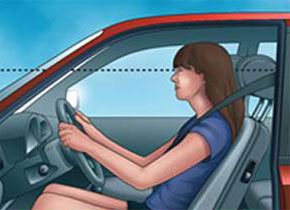
#3. The main reason for having a properly adjusted head restraint is to:
Seat-back head restraints are designed to reduce the chance of whiplash injury in rear-end collisions. If they are adjustable, they should be positioned to fit against the back of your head and to line up with the middle of the ear.

#4. The minimum amount your insurance must cover for property damage is:
Minimum levels of financial responsibility for private passenger vehicles are $25,000 bodily injury liability for one person, $50,000 for two or more persons, and $15,000 property damage liability.

#5. Which of the following would be indicated by a diamond-shaped road sign?
Four-sided diamond-shaped signs warn you of a possible danger ahead.
The shape of a traffic sign can give you as much information about the meaning of a sign as the sign’s color or wording. When visibility is poor, such as in heavy rain, dust storms, or fog, you may be able to make out only the shape of a particular sign.

#6. Which of the following results from drinking alcohol?
Driving requires skill and judgment, both of which are diminished through consumption of alcohol. Alcohol also seriously reduces your reflexes, physical control over the vehicle and ability to recognize dangerous situations. Your ability to drive can be affected even after one drink.

#7. The blood alcohol level at which it is illegal for any person 21 years or older to drive is:
If you are stopped for driving under the influence and a test shows that you have an alcohol concentration of 0.08 percent or more, you will lose your driving privilege on the spot. If you are under 21, your license may be suspended if there is any alcohol concentration.

#8. When you approach a school bus with flashing red lights that has stopped on the other side of an undivided roadway with two lanes, you must:
When approaching a school bus that is picking up or dropping off passengers, you must come to a complete stop before reaching the bus, regardless of your direction of travel.
You are not required to stop for a school bus on a divided roadway when traveling in the opposite direction. A divided roadway is one in which the road is separated by physical barriers such as a fence, curbing or separation of the pavement. Roadway striping by itself does not constitute a physical separation of the roadway.

#9. For the first 6 months, a driver with a graduated driver's license may drive after midnight:
For the first 6 months, a driver with a graduated driver’s license cannot drive a motor vehicle between the hours of midnight and 5:00 a.m.
This applies unless a parent or legal guardian with a valid class A, B, C or D license occupies the front passenger seat or driving directly to or from a sanctioned school-sponsored activity, place of employment, a sanctioned religious activity or a family emergency.

#10. At an intersection where there are no signs or signals, a driver should always yield the right-of-way to:
If two vehicles arrive at the intersection at about the same time, both must stop and the driver of the vehicle on the left must yield the right-of-way to the driver on the right.

#11. Arizona's Safety Belt Laws require adult car passengers to buckle up:
Each front seat occupant of a motor vehicle subject to the federal motor vehicle safety standards must either:
- Have the lap and shoulder belt properly adjusted and fastened while the vehicle is in motion, or
- If only a lap belt is installed where the occupant is sitting, the lap belt must be properly adjusted and fastened while the vehicle is in motion.

#12. The wrong way sign means:
The wrong way sign supplements the Do not Enter sign. It is placed along the exit ramp or the one-way roadway farther from the crossroad. It tells you that the road is closed to traffic going in your direction and you are driving in the wrong direction. When safe, back out or turn around and return to the road you were on.

#13. What should you do if you approach a stopped police vehicle with activated emergency lights on a multi-lane roadway?
The Move Over Law requires motorists to move over one lane to create a safe margin of space when driving by any vehicle with flashing lights pulled to the side of a road or highway. If it is not safe or possible to move over, motorists must slow down and use caution.
This law pertains to all vehicles pulled over with flashing lights, including emergency-response and law-enforcement vehicles, tow trucks, highway maintenance vehicles and private vehicles. It applies to all freeways and other multiple lane highways, city roads and streets.

#14. You drive behind a gasoline tanker that slows down before a railroad crossing. What is the best thing to do?
Watch for vehicles such as buses and gasoline tankers, which must stop at railroad crossings. Slow down and be prepared to stop.

#15. When should you use your high-beam headlights?
Use high beams on highways outside cities and towns when no other vehicle is coming toward you within 500 feet. Switch to low beams whenever you meet oncoming traffic to avoid blinding the other driver.
Use low beams when driving on city or town streets, in fog, heavy rain or snowfall.

#16. To back your vehicle safely, you should:
Turn around so you can look directly through the rear window. Do not depend only on your mirrors or a back-up camera. Back up slowly.

#17. This hand signal means:
Right turn – left arm extended, with elbow bent upward, at about a 90-degree angle.

#18. If your vehicle breaks down on a highway, you should always:
Provided there has been no serious physical injury or fatality, the vehicles involved in the crash must be removed from the main traveled portions of the roadway.
Turn off the ignition of vehicles involved in the crash. Do not smoke. Do not stand or walk in traffic lanes.

#19. On a four-lane divided highway:
White lines separate lanes of traffic moving in the same direction.

#20. When you park on a hill headed downhill, and there is no curb, you should turn your front wheels:
When you park on a downhill grade, turn your wheels toward the curb and set your parking brake.

#21. If you rear-ended the car in front of you, you were probably:
Most rear end crashes are caused by following too closely. If you are following too closely, you may not be able to stop in time.

#22. A truck's blind spots:
A truck’s blind spots, the no-zone, are danger spots because truck drivers cannot see vehicles in these areas.
Typically, the larger the vehicle, the larger the blind spots. Be safe and do not hang out in the no-zone.

#23. Defensive driving means that you should:
Defensive driving means being constantly aware of the driving conditions, planning ahead, anticipating dangers and taking the right action so as not to come in contact with any obstacle or another vehicle. You have a great financial stake in your own good driving record. Driving defensively will help protect your life and your driving record.

#24. Driver perception time can be defined as the time:
Driver perception time is the length of time it takes to see and recognize a dangerous situation.
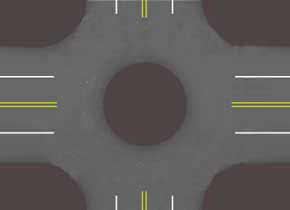
#25. Traffic in a roundabout:
All vehicles in the roundabout travel in one direction (counterclockwise). Always enter a roundabout to the right of the central island.

#26. What should you do at the first sign of rain or snow?
Slow down and increase following distance at the first sign of rain, drizzle, or snow. Turn on your windshield wipers, headlights, and defroster.

#27. You approach this road sign. What should you expect ahead?
Start of Divided Highway ahead. The highway ahead is divided into two one-way roadways.

#28. What should you do when overtaking a motorcycle?
When passing, go all the way into the other lane. Besides having the legal right to an entire lane, the motorcyclist may need to swerve to avoid something on the road. Once you have passed, wait until you are well down the road before moving back into the other lane. Returning to the original lane too soon can force the rider to swerve into traffic or off the road.

#29. If an advisory speed sign isn't posted before a curve:
If a speed limit is not posted before a curve, you must judge how sharp the curve is and change your speed. Slow down before you enter the curve. Braking and turning at the same time may cause your car to skid.

#30. A traffic signal with a flashing yellow arrow means:
A flashing yellow arrow means you should slow down and turn with caution if the roadway is clear.
This is known as an unprotected turn. Oncoming traffic is not stopped by a red light.
Key Facts Arizona MVD Permit Examination 2026
| What You Should Know | |
|---|---|
| Number of questions on exam: | 30 |
| Passing score: | 80 percent |
| Correct answers to pass: | 24 |
| Allotted time to complete test: | 30 minutes |
| Wait time before retest: | 7 days |
| Test at Home: | If under 18 years |
| This Practice Test | Number of questions on each practice test: | 30 |
|---|---|
| Question pool: | 1,000+ |
| Each test is random and different from the previous | |
What are Arizona MVD Permit Practice Tests?
Each Arizona permit practice test at Driver’s Prep has 30 questions picked randomly from an extensive database, meaning each practice test will be different. When you take the real AZ MVD exam, you are likely to see questions that are, if not identical, at least similar to the ones in this practice test.
We have designed all our tests to help you study and pass the written test. The focus is on learning. You should know that we have offered free prep tests since 2007 and give you sample tests you can trust.
You can find the answers to all test questions in the Arizona Driver’s License Manual.
We, however, also stretch it a bit. Hopefully, we can help you not only to pass the test but also to be a safe and knowledgeable driver.
After each question on the practice test, you get instant feedback. If your answer is wrong, you will get a brief explanation. This will help you learn faster and pass the real exam the first time.
All practice tests at driversprep.com are 100% FREE. No gimmicks and no registration is necessary.
How Should I Study for the AZ MVD Test?
That is an excellent question.
Start by getting the latest version of the Arizona Driver’s License Manual . Study the manual and get a feel for everything you need to know for your exam. Sometimes, you need to study important chapters more than once.

Then, use these permit practice tests to check your progress and see what you have missed in the driver’s handbook. Don’t use the test as a replacement for reading the manual; the tests are intended as a supplement only.
What is the Passing Score on the Arizona MVD Exam?
The passing score in Arizona is 80 percent, which means you must correctly answer at least 24 of 30 questions.
When you study and practice for the permit exam, aim higher. To be on the safe side, it is always a good idea to strive for the perfect score of 100%.
Focus on learning and understanding, not memorizing.
Exam questions are drawn from a large pool of questions. AZ MVD asks questions in many ways, and choices are not always worded identically. Memorization without proper understanding can trip you up on the test, but more importantly, it doesn’t make you a good driver.
Read more about: Risky Study Tactics

When Do I Need to Take the Arizona MVD Knowledge Test?
When you apply for your first original driver’s license or an instruction permit, you must always pass a written knowledge test, a vision test, and a road test.
You must also take the written test after Arizona MVD has revoked your driver’s license.
A revocation is a complete withdrawal of your Arizona driving privilege. The termination is indefinite, and there is no guarantee that you will get your license back. After a specified time, you may apply for a new license, and you must pass all tests again.
This is different from a license suspension. If your driver’s license has been suspended, your privilege is not terminated – it is just put on hold. It is a temporary action, after which you will get your license back.
What if I have a License from Another State?
If you have a driver’s license from another state and want an Arizona license, MVD usually waives both the written and the driving tests.
There are, however, some situations when Arizona officials can ask you to pass a knowledge test, even if you have a valid driver’s license. If you are in doubt, it’s a good idea to contact your local MVD office before you visit.

How Many Questions are on the Arizona MVD Test?
The actual driver’s license test (permit exam) has 30 multiple-choice questions. You can miss six questions and still pass (80%).
You take the test at a computer workstation using a touch screen. The test has random questions from a larger pool of questions based on the content of the Arizona Driver’s License Manual.
Like all DMV exams, each test is random and different than what another test taker gets.
Can I Take the Arizona Test at Home?
If you are under 18 years old, AZMVD offers the option to take the test online in your home with the supervision of parents or legal guardians.
To qualify as a test administrator in the Permit Test @ Home program, a parent or legal guardian must:
- Have a State-issued driver’s license or ID card
- Certify that they are the test taker’s parent/guardian
- Commit to administering the exam in a room or facility where access can be limited
- Ensure test taker don’t have access to other mobile or electronic devices, documents, notes or writing materials during the exam

The parent or legal guardian registers the Permit Test @ Home account.
Like the official test at an AZMVD location, the test is scored as it progresses. You will see the results immediately with an on-screen notification. You need 24 correct answers to pass.
Should you fail, you can retake the test without waiting time and with no extra fees. When you take the test at the MVD office, you must wait one day before you can retake it.
An Arizona Professional Driving School can also offer the online test.
Can I Ask for an Oral Test?
If you have trouble reading, you should ask for an oral test at one of MVD’s locations. They will offer oral tests in the following situations:
- You cannot read, or your reading competency is low.
- You have incorrectly answered many questions on a previous test or have failed a second or third attempt.
- You read in a foreign language, and a written test in the foreign language is not available.

What If I Fail the First Time?
MVD gives you three attempts to pass the written test within 12 months from the date of the application.
Should you fail the test at MVD, you can retake it the next day if there are available appointments. You will not get the same test again since all tests are random.
After failing three times, you must pay for a new application.
Note that this doesn’t apply if you are under 18 years and use the Permit Test @ Home program.
What is the GDL Process?
Like all states, Arizona has a Graduated License Program. The purpose is to allow teen drivers to gain driving experience and skills gradually.
The program has three steps:
1 Graduated instruction permit (learner’s permit)
2 Graduated restricted driver’s license (provisional license)
3 Unrestricted driver’s license (class D)
Step 1: Graduated Instruction Permit
You can apply for the Instruction Permit if you are at least 15 years and six months but under 18 years.
Bring a completed Driver’s License Application (Form 40-5122) to the licensing office or start the application online.
If you are under 18, a parent or legal guardian must sign the application, and the signature must be witnessed. This is usually done when you visit the MVD office.
You must show proof of your identity and age. MVD must also verify your legal U.S. presence. [ Read More ]
Then, before MVD issues the permit, you must pass both the written test and a vision test.
When you have your instruction permit, you can start practicing. You must be accompanied by a licensed driver who is at least 21 years and sits beside you whenever you drive.
The permit is valid for 12 months.
Step 2: Graduated Driver’s License
When you are 16 years and have had an instruction permit for at least six months, you can apply for a Graduated Driver’s License, often called a provisional license or intermediate license.
MVD will ask for a log of 30 hours of supervised driving practice. You must have completed 20 hours of daytime driving and 10 hours of nighttime driving.
With your restricted driver’s license, you can drive alone. But you can only drive between 5 a.m. and midnight. If you want to drive at night (midnight to 5 a.m.), you must drive with a parent or legal guardian who has a valid driver’s license and is sitting in the front passenger seat.
You can drive unsupervised after midnight if you driveto or from a sanctioned school-sponsored activity, sanctioned religious activity, or place of employment, or must drive because of a family emergency.
The nighttime restriction is lifted after the first six months with a graduated driver’s license.
The license also has a passenger restriction. You cannot drive with more than one passenger under the age of 18 unless one of these conditions is met:
- The passengers are your siblings.
- You are accompanied by a parent or legal guardian with a valid driver’s license who occupies the front passenger seat.

Wireless Communication Restrictions
The instruction permit and provisional license come with a new (2018) wireless device restriction.
While you hold the instruction permit, you cannot use a wireless communication device for any reason except during an emergency when stopping the vehicle is impossible or will create an additional emergency or safety hazard.
During the first six months with the class G license, you may not drive using a wireless communication device for any reason except:
- During an emergency in which stopping the vehicle is impossible or will create an additional emergency or safety hazard.
- When using an audible turn-by-turn navigation system under specified conditions.
The New Cellphone Law for All License Holders
In 2019, using handheld devices while driving was banned for all license holders.
The new law prohibits:
- Holding a cell phone in any way while talking.
- Writing, sending or reading any text-based communication, including a text, instant message, or email.
- Watching any video or recording video.
Unlike some states, you may use a handheld cell phone while stopped at a traffic light or stop light.
You are also allowed to:
- Swipe a phone screen to make or accept a phone call.
- Talk on the phone if using an earpiece, headphone device, or device worn on a wrist.
- Use a GPS system.
- Talk on a handheld cellphone when calling 911.
Step 3: Class D Operator License
If you want, you can continue using your Class G graduated driver’s license even after you turn 18.
But you probably want a new license reflecting the Class D operator status. Visit ServiceArizona.com to replace your current graduated license.
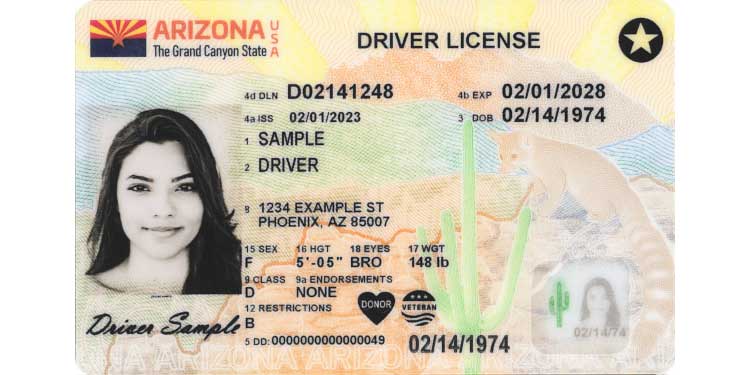
If you are under 21 years, the unrestricted license retains the particular vertical orientation. It indicates that you are still under 21.
When you turn 21, you are eligible to (but not required to) get a replacement license with the regular horizontal orientation. This license will not have the under-21 designation.

Photo by Taryn Elliott
Activate your AZ MVD Now account and see if you can get the service you need online.
Other Common Questions (FAQ)
How do I change address on my Arizona Driver License
You must report any change of address to MVD within 10 days. You can change your address online. Register at AZ MVD Now and update your personal information.
You may also visit a Arizona MVD service office. Please call 602.712.2700 to schedule an appointment.
Note that you need to replace your driver's license if you want the license to reflect your new address.
Is the Arizona Permit Test hard?
Arizona Driver Services don't record failure rates. It is, however, estimated that about one third of all new applicants fail the knowledge test the first time. It is slightly below average in United States.
Due to the use of home tests, estimates are less reliable.
Can I keep a digital Arizona license on my phone?
Yes. Arizona was the first state to offer four options to keep your digital license or ID in your smartphone. Arizona first offered the mobile driver license (mID) in 2021, then in 2022 was the first state to add Apple Wallet. In 2023 they added Google Wallet for Android devices.
Arizona Study Videos


Video 1: Arizona Driver’s License Test – 30 questions
Video 2: Arizona MVD Written Test – 30 questions
Video 3: Arizona MVD Written Test – 30 questions


Has the test changed now?? or can I still study this for my drivers test in a few weeks?
Taking my test tomorrow for the third time hope I pass kinda nervous e been using this all day.
were these questions on the test?
https://driversprep.com/questions-real-dmv-test/
What are the documents that i will need for my Arizona driver’s license? Do i need actual paper bills because i do paperless billing. Also will only one bill with my name on it work or do i need 2?
To prove AZ residency you need TWO documents with your name and address (the same in most states)
The documents MUST be mail issued from a business, organization or government agency. They must also be originals or certified copies, in English, certified by the issuing party. This will probably be changed in the future, but these are the rules right now.
Some suggest that you call your cable company, utility provider, bank, credit card company, or similar and ask them to send a one-time paper bill or contract.
Why the fuck wouldn’t you pull over if you had a blowout see that’s the kind of shit that pisses me off
If you have a blowout, you take your foot off the gas and keep going straight. If you pull off the road when you still have speed, you can easily lose control.
Don’t pull over until after you have stopped or when your speed is down to a crawl.