
Minnesota Knowledge Test & Permit Practice – 20 Questions
Results
Good job! This is a passing score. Do you want to try another test?
This is not a passing score. Do you want to try again?


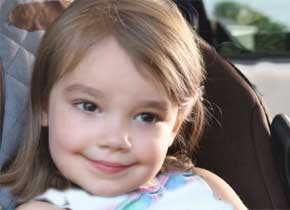
#1. What is a suitable restraint system for a child three years old and weighing less than 40 pounds?
Children older than 1 year of age and who weigh at least 20 pounds may ride facing forward in a high-back booster seat with the harness straps positioned at or above shoulder level. Children should use a forward-facing harnessed seat until they outgrow the weight limit (typically 40-60 pounds, depending on the seat).

#2. Traffic signs that show construction and maintenance warnings are:
Orange is used for construction and maintenance warning. The signs are usually diamond shaped. They notify drivers of unusual or potentially dangerous conditions near work areas.

#3. What does this sign mean?
Deer crossing.
Crossing signs warn drivers to watch for animals, humans, and vehicles crossing the road.
This sign tells you that you are near an area where wild animals might cross the street. Slow down and be prepared to stop.
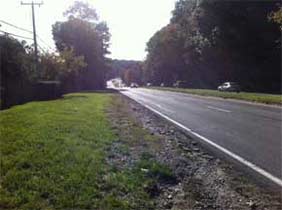
#4. If there are no sidewalks, a pedestrian should:
If it is necessary to walk on the road, a pedestrian should stay on the left side, or face oncoming traffic.

#5. If a vehicle is traveling toward you in your lane, do not:
If a vehicle is traveling toward you in your lane, brake and move to the right. Do not use the left lane to avoid the vehicle. The driver may return to the correct lane and will then be in your path.
This question asked what you should not do.

#6. When are you most at risk of drowsy driving?
You are most at risk when you are sleep deprived, driving long distances without rest breaks or taking medicine that increases sleepiness.
#7. If you approach an intersection with a green light at an unlawful speed:
If you approach an intersection at an unlawful speed, you lose the right-of-way privilege associated with driving at a lawful speed.

#8. Which pavement marking separates traffic traveling in opposite directions?
Yellow lines separate traffic moving in opposite directions.

#9. This sign tells you:
Regulatory Speed Limit sign.
Speed limit signs indicate the maximum speed at which you may drive on an area of road. Minimum speed limits are usually posted on interstate free-ways with controlled access. Do not drive slower than the minimum posted limit unless bad weather or poor road conditions make it necessary.

#10. Exceeding the speed limit by 10 mph when passing another vehicle:
In Minnesota, the speed limit on two-lane highways with a posted speed limit of 55 mph or higher is increased by 10 mph when the driver is lawfully passing another vehicle in the same direction.
Remember, in most states it is against the law to exceed posted speeds at any time.

#11. A flashing yellow X over a lane means:
Lane use control signals allow lanes to be used by traffic from different directions at different times. A flashing yellow X means you can use the lane below the flashing yellow X to make a left turn. You must use caution because left-turning vehicles from the other direction may be using the same lane.

#12. Of all deaths on Minnesota roads, alcohol is involved in approximately:
Alcohol use is involved in one-third of the deaths on Minnesota roads each year. In 2011, 368 people died in traffic crashes in Minnesota and 111 (30 percent) were crashes involving drunk drivers.

#13. Where can you not park?
Parking is not allowed at the street end of a driveway.

#14. When driving in fog, you should:
If you encounter thunderstorms or fog, reduce speed, use extra caution, and be prepared to stop. Increase your following distance. Keep headlights on low beam to reduce glare.
If you cannot see a safe distance ahead, pull off the road and stop until visibility improves.

#15. You approach an intersection. Where should you stop if there is a stop sign but no stop line or crosswalk?
When required to stop because of a sign or signal, you must stop before the stop line.
If there is no marked stop line, stop before the crosswalk, or before entering the intersection.

#16. An intersection is blocked. You cannot drive through without stopping in the intersection. You should:
A green light means you may begin to cross the intersection as soon as it is clear. Yield to any vehicles or pedestrians in the intersection. You must not enter an intersection until you can immediately, continuously, and completely move through the intersection without impeding or blocking the movement of cross traffic.

#17. What does this sign mean?
This sign warns that there is a flag person ahead. Drive cautiously.

#18. You must always stop before a railroad crossing if:
It is safe to cross when traffic ahead has moved, and you can proceed without stopping within 10 feet past the rails. When there is heavy traffic on both sides of a crossing, wait behind the tracks until you are sure you can make it to the other side without stopping on the tracks. Never start to cross if there is not enough room for your vehicle on the far side!

#19. Carbon monoxide is a gas produced by engines, and it is:
Carbon monoxide is a deadly, odorless, and colorless gas produced by engines.

#20. If your vehicle breaks down on an interstate freeway:
If you must stop on the freeway because of an emergency, park your vehicle on the shoulder, as far from the main roadway as possible. Stay with your vehicle, if possible. Use hazard warning lights if you have them. If you have flares or reflectors, place them from 100 to 500 feet behind your vehicle on the right edge of the main road. Do not stand or walk on the area of the highway reserved for vehicle traffic.
| This Minnesota DVS Sample Test | |
|---|---|
| Number of questions on each practice test: | 20 |
| Question pool: | 750+ |
| Random practice questions in each set. | |

Facts about Your Minnesota Knowledge Test
| Minnesota Knowledge Test for Learner’s Permit and Driver’s License | |
|---|---|
| Number of questions on exam: | 40 questions |
| Passing score: | 80 percent |
| Correct answers to pass: | 32 |
| Allotted time to complete test: | 30 minutes |
| Wait time before retest: | 1 day |
Minnesota (MN) Practice Tests
Have you learned everything you need to know for your Minnesota knowledge test? Here is your chance to check up on your knowledge.
The permit practice test has 20 random questions based on the handbook and actual MN DMV tests. If you want to start over, the system creates a new set of questions from the question pool.
You will get instant feedback after each question. If you miss a question, there is a brief explanation. Your final score will tell you whether you are ready for the real thing.
Start studying by getting the latest version of the Minnesota Driver’s Manual . After reading the manual, you should use these practice tests to verify your knowledge. The more tests you take, the easier it is to pass the real examination.
The passing score in Minnesota is 80 percent, and the actual knowledge test has 40 questions, which means you must correctly answer at least 32.
You may want a score of 100 percent when taking a practice test.
Each practice test is limited to 20 questions, which is easier to handle when you prepare for your exam. It gives you better opportunities to look up answers in the driver’s manual.
The written knowledge test usually has four answer options. Sometimes only some choices are plausible, making four choices unnecessary. So this practice test only has three choices.
Remember, true understanding and true learning is your key to success. Try to avoid some of the most common risky study tactics .
Who Must Pass the Minnesota Written Test?
If you never had a license before.
You must apply for an instruction permit if you’ve never had a driver’s license in any state or country. To get a permit, you must pass the knowledge and vision tests.
If you let your license expire.
You must retake the knowledge test if you have a Minnesota driver’s license and let it expire. Should you let your license expire for more than a year, you must pass both the knowledge and road tests again.
If your license has been revoked.
Michigan also requires you to retake the written knowledge test after the state revoked your driver’s license. A revocation means the state withdrew your driving privilege, and you must apply for a new license.
If you move to Minnesota from another state.
The Minnesota Department of Public Safety no longer asks for a knowledge test if you move to Minnesota from another state, U.S. territories, or Canada. The State changed the law on August 1, 2023.
If your out-of-state license expired more than a year, you must still retake the knowledge and road tests.
If you move to Minnesota from another country.
When you move to Minnesota from a country other than Canada, you must pass all tests, including the knowledge and skills tests.

What Kind Questions are on the Minnesota Knowledge Test?
The Minnesota Department of Public Safety official test has multiple choice and true or false questions that check your knowledge and understanding of Minnesota traffic laws and road signs.
The test will always have questions about these subjects (§171.13):
- Minnesota traffic laws
- The effects of alcohol and drugs on a driver’s ability to operate a motor vehicle safely and legally
- The legal penalties and financial consequences resulting from violations of laws prohibiting the operation of a motor vehicle while under the influence of alcohol or drugs
- Railroad grade crossing safety
- Slow-moving vehicle safety
- Laws relating to pupil transportation safety, including the significance of school bus lights, signals, stop arm, and passing a school bus
- Traffic laws related to bicycles
- The circumstances and dangers of carbon monoxide poisoning
Is the Minnesota Knowledge Test Hard?
The failure rate on the Minnesota Knowledge Test is between 40 and 50%, which means that the test must be considered hard.
It is essential to prepare well and focus on the mentioned subjects, including the consequences of driving under the influence of alcohol or drugs.

Class D Knowledge Test Online
The knowledge test is offered at Minnesota DVS exam stations or through third-party testing providers.
The at-home online knowledge test service ended on July 2, 2021. This feature was only available during the state’s emergency due to Covid-19.
Class D Knowledge Test at DVS exam stations
If you want to take the test at a DPS-DVS exam station, you must schedule the test in advance. Exam stations do not accept walk-ins for class D knowledge tests.
DVS offers tests on a computer. Paper tests are only available on a case-by-case basis if an individual with special needs makes the request.
Come prepared with a Minnesota driver’s license or ID card. If you don’t have one, you must bring one primary document that shows your full name and birth date, like a passport or an original or certified birth certificate, and one secondary document with your full name. See full list .
You can take the test in English, American Sign Language, or in one of the following foreign languages:
- Hmong
- Karen
- Russian
- Somali
- Spanish
- Vietnamese
You can use audio assistance to hear all questions. Ask for headphones to hear the questions as you read them.
You must understand that the Minnesota knowledge exam is not an open-book test. During the test, you cannot talk, and you cannot use any of the following items:
- Cell phone (must be turned off)
- Driver’s Manual
- Notes
- Electronic dictionaries
What Happens if I Fail the Test?
If you fail the test, you must wait until the next day before taking a new test. You can only take one knowledge test per day at DVS.
If you fail two consecutive knowledge tests, you must pay an additional fee of $10 to take a third test and any subsequent test.

Please note that driversprep.com is not affiliated with Minnesota DVS. We do not offer online testing.
Minnesota Graduated Driver’s Licensing System
Minnesota has a Graduated Driver’s Licensing (GDL) system for new drivers under 21 years. The purpose of the system is to ease inexperienced drivers into the driving environment step by step.
The first phase of the GDL system is to obtain an instruction permit. With a permit, a young driver may practice driving under the supervision of a licensed driver who is 21 years or older.
After passing a road skills test, the young driver may proceed with the second phase of the GDL system and apply for a provisional license.
The full and unrestricted driver’s license is the third phase of the GDL system. Read More .

Phase One: Requirements for Minnesota Instruction Permit
You must be at least 15 years old.
If between 15 and 18 years, you must have completed a classroom instruction course and be enrolled in a behind-the-wheel instruction course.
You must pass the vision screening and the Class D knowledge test
If under 18 years, a parent or legal guardian’s signature and certification are required on the application.
Restrictions on a Minnesota Instruction Permit
Supervised driving only.
An Instruction Permit does not allow you to drive alone. You can only drive while supervised by a certified driving instructor, parent or guardian, or other licensed driver 21 years or older. The supervising driver must sit beside you in the front seat.
Everyone must be buckled up.
Driver and all passengers must wear a properly fastened seat belt or use a properly fastened child restraint system.
No cell phones.
A holder of an instruction permit may not use or talk on a cell phone while driving, including hands-free cell phone devices.
There are no passenger restrictions or night curfew when you hold an Instruction Permit and drive under the supervision of a qualified licensed driver.
Phase Two: Requirements for Minnesota Provisional License
You must be at least 16 years old.
If under 18 years, you must have completed the classroom and behind-the-wheel phases of driver education.
You must have held an instruction permit for six months with no convictions.
No convictions include both moving or alcohol/controlled-substance violations.
You must present a supervised driving log .
You must have driven under the supervision of a licensed driver at least 21 years of age, for not less than 50 hours, of which at least 15 hours were at night.
If a parent/guardian completes the parent class, the log must show at least 40 hours, 15 of which were at night.
If under 18 years, a parent/guardian must approve the application.
You must pass a skills (road) test.
Restrictions on a Minnesota Provisional License
A provisional driver’s license allows you to drive without a supervising driver, but other restrictions still apply.
Driver and all passengers must use seat belts.
Driver and all passengers must wear a properly fastened seat belt or use a properly fastened child restraint system.
No cell phones.
No driving at night.
During the first six months, you cannot drive from midnight until 5 a.m. unless you drive between your home and work, between your home and a school event for which the school does not provide transportation, or for employment purposes. You may also drive at night if you are accompanied by a licensed driver at least 25 years of age.
Limited number of passengers.
During the first six months, you can drive with only one passenger under 20 years, unless accompanied by a parent or guardian or if passengers are immediate family.
During the second six months, you can drive with no more than three passengers under 20 years unless accompanied by a parent or guardian or if passengers are immediate family.
When you hold a Minnesota Provisional License, you may not use or talk on a cell phone while driving. There is no exception for hands-free cell phone devices.
Phase Three: Full License
If you are at least 18 years old or have held a Minnesota Provisional License for at least 12 consecutive months, you may be eligible for a full driver’s license.
You cannot have any convictions for alcohol/controlled substance violations or crash-related moving violations and no more than one conviction for a moving violation that is not crash-related.
If you are under 18 years, your application must be approved, and the person who approves must certify that you have driven under the supervision of a licensed driver for at least ten hours on the provisional license.
You must pass the road test before DVS issues a full driver’s license.
What is Vanessa's Law?
The Vanessa's Law in Michigan affects teen drivers under 21 years who commit an alcohol/controlled substance or crash-related offense.
These offenses include, but are not limited to, DWI, Implied Consent, Open Bottle, or Underage Drinking and Driving/Not a Drop Law, and leaving the scene of an accident.
An unlicensed driver under 18 years who receives a crash-related traffic violation or an alcohol or controlled substance violation may not receive a driver's license, including an instruction permit or provisional license, until the driver turns 18.
A licensed teen driver with a provisional license whose driving privileges were revoked due to a crash-related moving violation or an alcohol/controlled substance-related violation cannot apply for a new license until the driver turns 18.
After a revocation, the driver must fulfill all reinstatement requirements, including the payment of fees which can be up to $680 depending on circumstances. The driver must also:
- Complete the classroom portion of a formal driver education course.
- Pass the knowledge test.
- Obtain an instruction permit and hold it for three months.
- Complete the behind-the-wheel portion of a driver education course.
Drivers under 21 years who are convicted of an underage drink and drive offense, loses their license for a least 30 days, with no exceptions available during that 30-days suspension period.

The Road Test
To pass the skills (road) test, you must be able to demonstrate:
- Your vehicle’s safety equipment (don’t forget the seat belt!)
- Your ability to drive a motor vehicle safely under normal traffic conditions
You cannot have any passengers in the car during the test other than the driver examiner.
You must make an appointment for the road test.
If you fail to show up for your road test, you will face a $20 no-show fee.



Can I get the link to the-test questions cuz I will be taking my own test in a month time please
It’s so hard to concentrate on the exam while the place is so loud the receptionist being so loud when people are trying to concentrate on the exam. It’s annoying because they don’t seem to care about.Moorhead test center is not good place to take the test!!!!!!!
Great to have the ability to practice on a realistic simulated rules test.
Mark, thank you so much for helping me with the tremendous amounts of questions. The test questions were very similar to your website, I would say about 95%. I had two mistakes only and that because of the language. English is not my mother tongue and they tricked me. The two possible answers were very similar from my understanding and in each question I chose wrong one. Great job of support for the community and keep the excellent spirit and ignore the few negative comments. For anyone who is studying for the exam keep doing the test over and over and over until you start seeing the questions are repetitive and until you keep having 95% score. At this point, you are ready to go. Again thank you so much for your help and good luck for the newcomers.
Thank you for your kind words ans good luck in the future!
I used this website as a resource to prepare for the Minnesota Driver’s License, Class D, exam. I also used the Minnesota Driver’s Manual. While I was studying for the exam, I noticed and recorded that the quiz questions could be found in the Minnesota Driver’s Manual, which helped me to fortify the information. The quiz questions from this website and the questions on the actual exam weren’t exactly the same, but they were similar.
As a result, I passed the Minnesota Driver’s License exam on October 14, 2022. On my exam, I obtained a 32 out of 32 – a perfect score!
If you read the Minnesota Driver’s Manual and complete enough quizzes on this website, where the answers become automatic, you will pass the exam with a very high score.
Thank you for your feedback and drive safely!
I think all options are wrong in this question! Could please double check it and correct me if I misunderstood it. Thank you!
#2. When you park on a hill headed downhill and there is no curb, you should turn your front wheels:
A. Toward the center of the road
B. Away from the road
C. Parallel to the side of the road
Well, they can’t all be wrong, can they? If you are parked correctly on the right side you can turn the front wheels to the left (A), right (B) or leave them straight (C).
Thank you so much I took my test today at 01/27/2022
And this helped me definitely recommend taking it , over and over till you get good score
N most of the questions are actually on the real test
Good luck folks
This Minnesota practice run was very helpful. If you run through these dummy questions a few times you are well prepared for the real knowledge exam. There were simple questions about alcohol, stopping for school buses and trains, and keeping your distance to bicycles. Most covered here. Good luck.
Hey guys! I took the test Fridayy and passed and wanted to let you know that this helped. Every time someone takes the test there are different questions. You can use this but beware it’s just a guide and you need to take it many times! Best of luck!
Used this right before I took my written test. Just practiced while I’m line. I only missed two, thanks guys!
Was it the same questions?
Pretty much. Some were worded differently. Guess there is no guarantee that all answers will be the same as this. But it helped me.
Very helpful. only missed the last question.
Many of questions on my test. Passed first time around. Thanks
To suggest that signals are required before slowing and that your brake lights are a ‘signal’ is BS. The MN manual NEVER refers to brake lights as ‘signals’ nor does it require a hand signal for ‘slowing’, only stopping. In fact, it never actually ‘requires’ hand signals at all but says the ‘may’ be used. What is up with BS questions? Trying to cheat and get people to take your course?
Then I see other people are pointing this out and your response is to attack them. Nice.
We don’t want to “attack” anyone. But please let us respond with the same attitude and language. Most people understand that brake lights are a signal and nothing else. So, suggesting that brake lights are NOT a signal is truly BS.
Minnesota law: “No person shall stop or suddenly decrease the speed of a vehicle without first giving an appropriate signal in the manner provided herein to the driver of any vehicle immediately to the rear unless there is a good and sufficient reason for not being able to do so.”
So, yes, you must signal when slowing or stopping. The test questions do NOT suggest that hand signals are required. When visible in normal sunlight, hand and arm signals may, however, be used in addition to, or instead of, approved signal devices.
And FYI, there is no course to take. You are free to use other resources at any time.
Minnesota 2021 manual does not reference the direction of orange stripes on work zone barriers. Not helpful to have questions that aren’t in the manual.
It won’t be on your test, but hopefully others find it helpful. From the manual: “Road workers set up zones with signs and road markings to direct traffic. Motorists MUST be able to understand and react to these directions.”
Are these the actual questions? I’m taking mine soon and don’t know what to study.
Many are actual questions or very similar.
You should always start by reading the manual! It has all information necessary to pass the test.
The DoNotEnter sign is also round
The Do Not Enter sign shows a prohibition (a regulatory sign that tells you what cannot do). Regulatory signs are rectangular or square.
The only round sign in United States is the yellow warning sign that tells you that there is a railway crossing ahead.
It is, however, very common to think that the Do Not Enter sign is round because of the round symbol on the sign.
For more information read this: No it is not round
@Mark Just a small nick-pick – the Yield sign is regulatory but not rectangular or square.
Sure is!
So, is the eight-sided stop sign.
Two exceptions to the normal rectangular or square shape.
Look for words like most/normally/usually – they indicate that there are exceptions to the rule.
Is this the exact same thing as the real test bc some of the questions I saw the first time I took it
Tests are random, which means that they can never be the exact same thing. But a set of questions can be close to what you will get on the real exam. The more you practice, the easier the real thing will be.
Great help I passed
took me test on friday and passed easily. Many same questions. some new.
I took the mn knowledge test today 7-23-2020 and it was nothing like the knowledge test id been practicing for since 7-16-2020 the test is misleading !!!!!!!!!!!!! where can I acquire a knowledge test manual or a drivers manual for this test?
Our practice tests are based on the information in the MN driver’s manual, which you hopefully already got and studied more than once.
If not, it is here: https://dps.mn.gov/divisions/dvs/forms-documents/Pages/default.aspx
The practice test isn’t misleading, but with the wrong expectations I can understand that you might feel that way. It is not uncommon that people who fail the test want to blame somebody else.
Trying to pass a knowledge test without real knowledge simply don’t work. And being behind the wheel without knowledge about the rules of the road is not a good idea.