
Montana Driver’s License & Permit Practice Tests – 100% Free
Results
Great job! This is a passing score. Do you want to try again?
This is no a passing score. Do you want to try again?


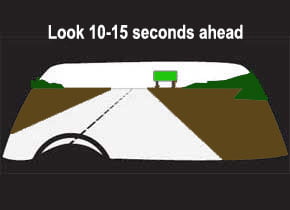
#1. By looking at least 10 seconds ahead on the roadway:
To avoid last-minute braking or the need to turn, you should look well down the road. By looking ahead and being ready to stop or change lanes if needed, you can drive more safely, save fuel, help keep traffic moving at a steady pace, and allow yourself time to better see around your vehicle and alongside the road. Looking well down the road will also help you to steer straighter with less weaving. Safer drivers tend to look at least 10 seconds ahead of their vehicle.

#2. In Montana, headlights are required:
In Montana, headlights must be used from one half hour after sunset until one half hour before sunrise, and at any other time when persons and vehicles are not clearly discernible at a distance of 500 feet.

#3. A flashing red traffic signal at an intersection has the same meaning as:
A flashing red signal means the same as a stop sign. Come to a complete stop. Look to the left, right, and ahead, yield to traffic and pedestrians and proceed when it is safe to do so.

#4. What do you use the three-second rule for?
There is an easy way to tell if you are following too closely. It is called the three-second rule, and it works at any speed. There are situations where you need more space in front of your vehicle. In the following situations, you may need a four-second following distance to be safe:
- On slippery roads.
- When the driver behind you wants to pass.
- When following motorcycles.
- When following drivers who cannot see you.
- When you have a heavy load or are pulling a trailer.
- When it is hard for you to see.
- When being followed closely.
- When following emergency vehicles.
- When approaching railroad crossings.
- When stopped on a hill or incline.

#5. When making a right turn, the following is unsafe and NOT recommended:
You should not drive close to the center divider line or left edge of the road.
When turning right, you must be in the extreme right-hand travel lane or a lane designated for right turns. Signal your turn at least 100 feet ahead.

#6. When you see a truck preparing for a right turn ahead, you should:
Watch for large trucks and buses making right turns. In order to make the turn they may need to swing left before turning right. Do not try to pass these large vehicles on the right.

#7. Which light indicates that you may make an unprotected turn (oncoming traffic has a green light)?
A flashing yellow arrow means left turns are allowed, but you must first yield to oncoming traffic and pedestrians. Oncoming traffic has a green light. You must determine if there is a safe gap before turning.

#8. When a school bus displays yellow flashing lights, it tells you:
A school bus displaying a yellow flashing light is about to stop and children may be in the road. Slow down and proceed carefully.
Upon meeting or passing from either direction any school bus stopped with its red lights flashing, you must stop at least 30 feet from the bus. You cannot proceed until the red lights are turned off.
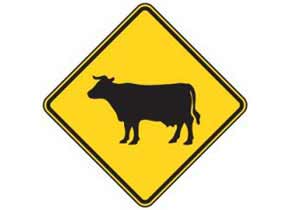
#9. What does this sign mean?
Cattle crossing.
A highway quite often splits a farm. This sign indicates a point where the stock is driven from one area to another.

#10. It is illegal to park a vehicle if a traffic signal is within:
Do not park within 30 feet of a traffic signal, stop sign, or yield sign.

#11. Which is true about seat belts?
If your vehicle is hit from the side, your body will be thrown toward the side that is hit. Side airbags will help in this situation, but you still need your lap and shoulder belts to help minimize your vulnerability to injury. Your lap and shoulder belts are needed to help keep you behind the wheel.

#12. When being stopped by a law enforcement officer:
If a law enforcement officer pulls you over:
- Acknowledge the officer’s presence by turning on your right turn signal.
- Move your vehicle onto the right shoulder of the road.
- Stop in well-lit areas when possible. Pull your vehicle as far off the road as possible.
- End your cell phone conversation and turn off your radio.
- Remain inside your vehicle unless otherwise directed by the officer.
- Place your hands in clear view (including all passengers’ hands)

#13. What should you do when you see this sign?
Keep right. A divided highway or traffic island where traffic must keep right is ahead. Stay on the right side of the divider.

#14. To avoid getting tired on a long trip, it is often a good idea to:
When you are tired, you could fall asleep behind the wheel and crash, injuring or killing yourself or others. Stop at least every two hours for a short break, open the window or cold air vent to allow fresh air to circulate throughout the vehicle, sing or play the radio.

#15. After an accident, the most important thing you can do to reduce the chances of secondary crashes is:
Stop your vehicle at or near the accident site. If your vehicle can move, get it off the road so that it does not block traffic.
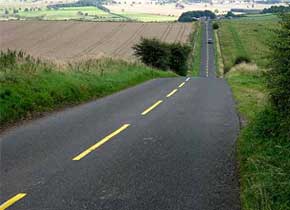
#16. To control speed and save brakes when going down a steep hill, you should:
When coming to a steep downhill, check your brakes and slow down. You may need to shift into a lower gear to control speed and save brakes. Never coast in neutral or with your foot on the clutch.

#17. On cold, wet days, which of the following roadways is most likely to hide spots of ice?
On cold, wet days shady spots can be icy. These areas freeze first and dry out last.
Overpasses and other types of bridges can have icy spots. The pavement on bridges can be icy even when other part of the road is not. This is because bridges do not have earth underneath them to help insulate them against the cold.

#18. Which pavement marking separates traffic traveling in opposite directions?
Yellow lines mark the center of a road used for two-way traffic. Broken yellow lines indicate that passing is permitted.

#19. You are driving on an interstate posted for 65 mph. Around you, traffic is traveling at 70 mph. What should your speed be?
Always obey the posted speed limit and take road conditions into consideration.

#20. When can you drive off the roadway to pass another vehicle?
You cannot pass on the right by driving off the pavement or main-traveled portion of the road, which means never passing on the shoulder (whether it is paved or not). It is against the law and other drivers will never expect you to be there and may pull off the road without looking.
Unless told to do so, never drive on the shoulder of any road.

#21. When driving on slick roads, you should:
As you cannot control a vehicle when it is skidding, it is best not to cause your vehicle to skid in the first place. Skids are caused by drivers traveling too fast for the conditions. Slow down as you approach curves and intersections. Avoid fast turns and quick stops. Try to avoid especially slippery areas, such as ice patches, wet leaves, oil, or deep puddles.
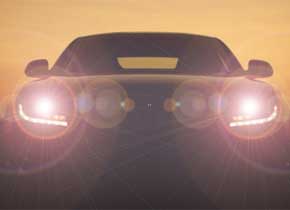
#22. Headlights should be capable of illuminating persons or vehicles for a distance of:
Headlights on upper beam (bright) shall reveal persons and vehicles for 350 feet, and when on lower beam (dim) for 100 feet.

#23. Anti-lock brakes reduce the chances of a skid occurring, particularly when:
One aspect of having Anti-Lock Brake Systems (ABS) is that you can turn your vehicle while braking without skidding. This is very helpful if you must turn and stop or slow down.
In general, if you need to stop quickly with ABS you must press on the brake pedal as hard as you can and keep pressing on it. You might feel the brake pedal pushing back when the ABS is working. Do not let up on the brake pedal. The ABS system will only work with the brake pedal pushed down.

#24. An HOV lane is reserved for:
HOV stands for High Occupancy Vehicles and indicates lanes reserved for vehicles with more than one person in them.

#25. Which is true about merging onto a high-speed roadway?
As you approach the highway:
- Check over your shoulder for a gap in the traffic on the highway.
- Adjust your speed to meet that gap and signal.
- DO NOT STOP unless there is no gap in traffic.
- As you merge, make sure you are driving about the same speed as other traffic.
- Do not forget that traffic on the highway has the right-of-way. You cannot always count on other drivers seeing you or moving over to give you room to enter.

#26. Unmarked crosswalks are crosswalks not marked by painted lines. They exist:
There is basically a crosswalk at every intersection, even if it is not marked by painted lines.
Remember, unmarked crosswalks are areas where a road intersects a sidewalk and there are no solid lines painted on the road.

#27. Fluorescent pink road signs show:
Fluorescent pink is used for emergency traffic incidents.

#28. It is legal to drive with an alcoholic beverage container that has been opened if the container is:
Open alcoholic beverage containers, including bottles, cans, jars, or other receptacles containing any amount of an alcoholic beverage must be kept:
- In a locked glove compartment or storage compartment.
- In a trunk, luggage compartment, truck bed or cargo compartment.
- Behind the last upright seat or within a closed container kept in an area not normally occupied by the driver or passenger of any motor vehicle that is not equipped with a trunk.

#29. This sign tells you:
This is a regulatory speed limit sign. It shows the maximum speed you are allowed to travel.
Remember, white is used as background color on regulatory signs.
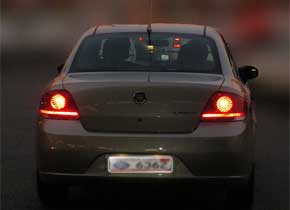
#30. Your brake lights tell other drivers that you:
Always signal to other drivers when you plan to turn left, right, slow down, or stop. Signals may be given by hand-and-arm positions or by using the vehicle’s signal lights.
Even though vehicles are equipped with turn and brake lights, you must know the basic hand signals as well. Use them when your signal lights are not working or hard to see for others.

#31. If red lights are flashing at a railroad crossing, you should:
By law, you must stop when:
- There is a stop sign.
- A warning signal tells you a train is approaching.
- A crossing gate is lowered.
- A flag person signals the approach of a train.
- A railroad train emits a signal, indicating that the train is an immediate hazard.
- An approaching railroad train is plainly visible and is in hazardous proximity to such crossing.

#32. What should you do when approaching a bicyclist from the rear on a two-lane road?
Perhaps the most hazardous situation is when a motorist approaches a cyclist from behind on a high-speed, two-lane roadway. In this case, the safest way to pass the cyclist is to view it as any other legitimate slow-moving vehicle, such as a farm tractor. With any slow-moving vehicle or bicycle, drivers should follow at a safe distance.
If approaching a bicyclist from behind, assume the bicyclist does not hear or see you. Proceed with extra caution.

#33. What should you do when you see this sign?
Cross Road. A four-way intersection is ahead. Be alert for cross traffic entering the roadway.
We have everything you need to pass your Montana Driver’s License or Learner’s Permit test.
| This Montana Written Sample Test | |
|---|---|
| Questions on each practice test: | 33 |
| Question pool: | 1,000+ |
| Test type: | Random multiple-choice |

Facts about Your Montana Written Test
| Montana Written Knowledge Test for a Permit or Driver’s License | |
|---|---|
| Number of questions on exam: | 33 questions |
| Passing score: | 82 percent |
| Correct answers to pass: | 27 |
| Allotted time to complete test: | No limit |
| Wait time before retest: | 1 day |
Montana Permit Practice Tests
Each practice test has 33 random questions based on the handbook and real MT MVD tests. After each question, you’ll get instant feedback. You’ll also see a short explanation if your answer needs to be corrected. Use it to look up more information in the Driver Manual.
Break up your test practice into many sessions for a week or more, resulting in more solid knowledge.
Take practice tests until you reach 100% without guessing.
Don’t just memorize questions and answers – it is really important that you understand the information and the rules since the wording may be slightly different on the real MVD knowledge test. You need to understand all the information to pass the knowledge exam.
Remember, the system draws questions from a large pool of questions. You can take as many tests as you need to feel comfortable with all questions and answers.
Best Study Tactics
1 Start by getting the latest version of the Montana Driver Manual .
2 Read the manual from first to last page. MVD also offers an easy-to-read adapted/illustrated version of the Montana Driver Manual.
3 Take a few practice tests to check how much you learned.
4 Follow up on questions or answers you don’t understand. Discuss driving rules with a friend, teacher, or parent.
5 Continue with practice tests until you feel confident with all answers.
Read our article about Risky Study Tactics that Could Cause You to Fail .

A Few Areas to Focus on for Your Montana Written Test
Montana MVD has issued the following quick reminder with statements that you should know and understand to pass the knowledge test and get your learner’s permit. Several of them appear on your test.
Solid yellow line means no passing
A yellow solid or unbroken line on the right-hand side of the center line means a no-passing zone. The right-hand side is your side of the center.
Parking on hills
When parking on a hill with a curb, you should turn your front wheels as follows:
– Downhill: toward the curb
– Uphill: away from the curb
Handle a skid
When your car starts to skid:
– Look where you want to go
– Ease off the gas pedal
– Don’t apply the brakes
– Steer where you want to go
Right of way at uncontrolled intersections
When two vehicles approach an intersection without traffic signals simultaneously, the driver on the left must yield the right of way to the driver on the right.
The driver on the right goes first.
Signaling before a turn
When preparing for a right turn, signal for at least 100 feet, check traffic to the rear, and drive in the right-hand lane.
Signal for at least 300 feet in rural areas.
Places where you CANNOT park
It is unlawful to park:
– On a sidewalk or bridge
– Closer than 20 feet to a crosswalk at an intersection
– Closer than 30 feet to a stop sign, traffic light, or flashing beacon
– Closer than 15 feet to a fire hydrant
– Closer than 20 feet to a fire station
– In front of the entrance to an alley or private driveway
– In any area reserved for disabled parking unless you are disabled.
Driving in school zones
In school zones, slow to 20 mph or other posted speed limit. Always watch for children.
Use of Headlights
You must turn on your headlights:
– From one-half hour after sunset to one-half hour before sunrise
– Anytime weather conditions make it hard to see
– When part of a funeral line
You should drive with headlights day and night so that other drivers can see your vehicle.
Yield to Emergency Vehicles
When you hear the siren of an emergency vehicle, you must pull over to the right and stop. Don’t stop within an intersection.
When you can pass on the right
Passing on the right is permitted only:
– When the roadway is wide enough for two cars to move legally in the same direction; and
– When the car ahead is making a left turn, providing you remain on the paved part of the highway.
What Happens if I Fail the Written Knowledge Test?
If you fail the test, you can retake it the next day. But it could be a good idea to wait at least three days, take several practice tests, and review the driver manual again.
You study the rules of the road not only because you want to pass the test but because you want to be a safe driver—knowledge matters.
Should you fail the test three times (or not pass within 12 months), you must submit a new application and pay the required fees again.
Who Must Take the Montana MVD Knowledge Test?
First-time applicants
When you apply for your first Montana Instruction Permit or Driver’s License, you must pass a vision screening and the written knowledge test.
For an unrestricted license, you must also pass the road skills test.
Drivers with a license expired more than three months
You can renew a Montana Driver’s License within three months after the expiration date without retesting. If you let your license expire for more than three months, you must reapply as a new driver and pass all necessary tests.
Drivers with a revoked Montana license
If the state revoked your license and the revocation period has ended, you may apply for a new driver’s license. Like a first-time applicant, you must retake and pass the knowledge, vision, and road skills tests.
Drivers with a license from another country
If you move to Montana, you must apply for a Montana driver’s license (or permit).
Suppose you already hold a license from the United States or Canada. In that case, you can exchange your valid driver’s license for a Montana license without a knowledge or road skills test.
You must pass all tests if you hold a license from other than the United States or Canada.
GDL: Graduated Driver Licensing in Montana
Montana has a Graduated Driver Licensing (GDL) Law like all other states. The law outlines a three-step program that reduces the risk while new drivers under 18 develop and improve their driving skills.
The steps include:
Step 1: Learner License
Step 2: Restricted License
Step 3: Full privilege Driver’s License
Teenagers typically start with the Learner License obtained in a driver education program. The minimum age is 14½ years.
To get a Learner License without completing a driver’s education program, you must be at least 16 years.
You hold your Learner License for at least six months and practice driving under supervision for at least 50 hours (10 hours must be at night) before you move on to step 2.
During step 2, you have a restricted license that allows you to drive without a supervising driver. Still, you cannot drive alone at night. There is a night curfew between 11:00 p.m. and 5:00 a.m. unless you must drive to or from work. There are a few other exceptions as well.
For the first six months with a restricted license, you can drive with only one non-family passenger under 18 years. During the next six months, you can drive with no more than three non-family passengers under 18 years.
The passenger restrictions don’t apply if a licensed parent or guardian or a licensed adult driver who the parent or guardian authorizes supervises your driving.
You must hold a restricted license for at least one year or until you are 18 years, whichever comes first.
After one year or when you are 18 years, you can get a full privilege Driver’s License.

