
New Hampshire DMV Test & Practice Questions – 2026


#1. When parking close to a traffic signal beside the road, you must keep this distance:
The distance you must keep from a traffic light is more than 30 feet.
Parking is not allowed within 30 feet of a stop sign, yield sign or traffic control signal.

#2. When you drive through a construction zone, you should:
When approaching a work zone watch for signs, cones, barrels, large vehicles, and workers. While driving in a work zone, drivers should reduce speed, increase the following distance, watch the traffic, and be prepared to stop.

#3. You must use your headlights:
New Hampshire law requires drivers to turn on their headlights during the period from half hour after sunset, to half hour before sunrise. For the safety reasons, drivers should use headlights to help other roadway users to see the vehicle when it is raining, snowing or foggy. Headlights must be on whenever rain, snow, or fog shall interfere with the proper view of the road so that persons and vehicles on the way are not clearly discernible at a distance of 1,000 feet ahead.

#4. Which background color is used for signs that give general warning of dangers ahead?
Yellow is used for general warning and advisory of what to expect ahead.
The shapes and colors of highway signs have special meanings. This helps you pick out signs quickly.

#5. What do the light gray areas in the picture mark?
Turn your head before changing lanes because your mirrors have blind spots. These blind spots can hide a motorcyclist or a bicyclist. Do not drive in another driver’s blind spot.

#6. A child must be properly fastened and secured in a child passenger restraint when:
A child less than 6 years of age and less than 55 inches in height shall be properly fastened and secured in a child passenger restraint which is in accordance with safety standards approved by the United States Department of Transportation.

#7. Driving under the influence of medication that impairs your ability to drive safely is:
Driving under the influence of any drug which impairs your ability to drive safely is illegal.

#8. A two-way left turn lane should be used for:
Two-way left turn lanes are shared center lanes marked on each side by a solid yellow and dashed yellow lines. Shared center lanes are for left turns only. They are not to be used for through traffic or passing other vehicles.

#9. If a motorcycle approaches from the left and signals a right turn into the road you are about to leave, you should:
Turn signals don’t automatically cancel out on most motorcycles. At times, the rider may forget to turn the signal off. Before you make a turn in front of a motorcyclist, be sure the rider is turning and not continuing straight ahead into your path with a forgotten turn signal still blinking.
#10. If the engine shuts off while you are driving, you should:
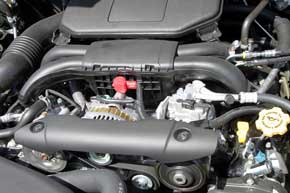
If the engine shuts off while you are driving:
- Keep a strong grip on the steering wheel. Be aware that the steering wheel may be difficult to turn, but it is still able to be turned.
- Look for an escape path. Do not brake hard. Instead, brake with steady pressure on the pedal, slow down, and then pull off the roadway.
- Stop and try to restart the engine. If unsuccessful, raise the hood and turn on the emergency flashers. Call for help.
#11. Compared to stopping on the pavement, what is true about the stopping distance on loose gravel?
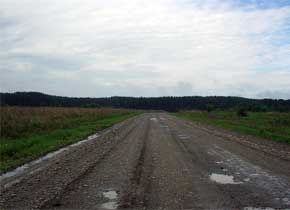
Traction can be reduced on gravel or dirt roads. Reduce your speed and increase the following distance. Also, realize you may skid when trying to stop the vehicle.

#12. Passing another vehicle on the right by driving onto a paved shoulder is:
Never pass on the shoulder, whether it is paved or not. The shoulder is a hard surface on the right side of the roadway that is to be used as an emergency stopping lane and not for through traffic.

#13. If you are about to turn right and a bicyclist is ahead of you:
When making a right turn, signal your turn, and check for bicyclists. You should slow down and let a cyclist clear the intersection before making your turn. Avoid turning sharply in front of a bicyclist and do not force a bicyclist off the road.

#14. What does this sign mean?
The chevron sign provides additional emphasis and guidance for the driver for a horizontal change in direction ahead. It marks a sharp change in direction. Slow down!

#15. When you arrive at a traffic signal showing a steady red light, you must:
A steady red signal means stop.
You may make a right turn on a red signal only if:
- there is no sign prohibiting a right turn on red and
- (if the intersection is equipped) a steady DON’T WALK signal is being displayed.
Remember, it is a violation of the law to make a right turn on red when a steady or flashing walk signal is being displayed even if there are no pedestrians in the crosswalk.

#16. When stopped by a law enforcement officer, you should:
If an approaching police vehicle with lights and/or sirens engaged pulls in behind a vehicle pulling off to the side of the road, a driver must:
- Come to a complete stop and place the vehicle in park.
- Remain in the vehicle unless requested to get out.
- Turn off the engine and turn on the hazard flashers and if at night, the interior lights to help the officer see that everything is in order inside the vehicle.
- Remain calm and keep the safety belt fastened. Ask any passenger(s) to do so as well. Place hands on the steering wheel and limit movements.
- When requested, locate and provide their driver license, and vehicle registration. If the officer asks the driver for these documents, tell the officer where they are located and reach for them slowly with one hand on the wheel. Answer the officer’s questions fully and clearly.

#17. Before exiting a highway, you signal for at least:
An appropriate signal gives other roadway users time to react to the driver’s vehicle movements. Drivers should signal at least 100 feet before a turn, and on the highway, drivers should signal at least 500 feet before changing lanes or exiting the roadway.
#18. Once you have entered a roundabout, you should:
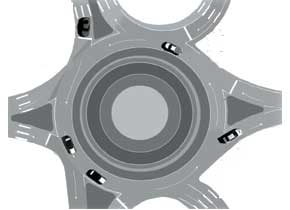
Once inside the roundabout, don’t stop. Follow directions on signs or pavement markings about which lane to use, then stay in your lane. Use your right turn signal when exiting.

#19. A broken yellow line alongside a solid yellow line means:
Yellow lines mean the lanes of traffic are moving in opposite directions. You may pass over any broken (dotted) lines when it is safe to do so. You must not pass if the line on your side is solid.

#20. A Crossbuck sign at a railroad crossing has the same meaning as:
The white, X-shaped sign with Railroad Crossing printed on it is located at all highway-railroad grade crossings. The crossbuck sign has the same meaning as a yield sign. It cautions the driver to slow down or stop, to look and listen for a train or railroad vehicle before proceeding.
| This New Hampshire DMV Practice Test | |
|---|---|
| Questions per test: | 20 |
| Question pool: | 500+ |
| Type of test: | Random multiple-choice |

| The Official New Hampshire Written DMV Test | |
|---|---|
| Questions on real exam: | 40 questions |
| Passing score: | 80% |
| Correct answers to pass: | 32 |
| Allotted time to complete test: | 40 minutes |
| Wait time before retest: | 10 days |
What is the Online NH Practice Test?
This DMV practice test for New Hampshire has 20 random questions to help you prepare for the written knowledge test. It is designed specifically for New Hampshire and is available without hidden costs or gimmicks. You have access to a pool of more than 500 DMV test questions with complete answers.
You can take the test as many times as you need or want. Each test will differ since we draw random questions from a larger pool.
After each question, you will get instant feedback. The feedback tells you if your answer is correct or not. Should you miss a question, you will also see a brief explanation to help you understand the right answer. When you don’t understand the answers, you should have the driver’s manual handy and look up more information.
You will find answers to all questions in the New Hampshire Driver’s Manual.
On the official examination, you can miss ten questions – when you use the practice tests at Driver’s Prep, you should aim for a 100% score. Understanding all questions and answers before taking on the real thing is a good idea.
The New Hampshire practice test has no time limit, whereas you must complete the official test within 40 minutes.
You should also know that practice tests differ from your actual DMV test. Every test has random questions. You never know which questions you will get.
How Should I Study for the NH DMV Test?
Before you start practicing you should get the latest version of the New Hampshire Driver’s Manual . Visit a local DMV office or download it online.

Everything you must learn for your examination is in this manual. Even if you find it boring to read the manual, you should know that it is easier to pass the test with a good understanding of the manual’s contents.
The practice tests on this website work best as a supplement to the manual rather than as a replacement. Using the manual and practice test in combination during each study session will give you a good chance of passing the test the first time.
Read more about our study tips: Best Way to Study
How Many Questions are on the NH DMV Test?
There are 40 exam questions on the New Hampshire knowledge test. The passing score is 80 percent, meaning you must correctly answer at least 32 of the 40 questions. If you miss eight questions, the system will terminate your test.
You must complete the DMV test within 40 minutes.
Who Must Take the Written Knowledge Test?
First-time applicants
Drivers with an expired license (one year)
Drivers with a foreign license (other than Canada and France)
When the license was revoked
When the license was suspended for three years or more
You must take the written, vision, and road tests for your first driver’s license.
If you want to upgrade your license to a different class, you must take the written test for that class of vehicle and a road test.
DMV will typically waive the written test when moving to New Hampshire and transferring a valid out-of-state driver’s license. Please note that DMV will not waive the knowledge if you hold a license from Puerto Rico.
DMV will not waive the knowledge test if your out-of-state license expired over a year ago.
When transferring an out-of-country license from a country other than Canada or France, you must take a written knowledge and road skills test.
A revocation of your license means that DMV will terminate your driving privilege. After the revocation period, you must submit to an investigation and apply for a new driver’s license.
If DMV suspends your license for three years or more, you must pass all tests.
Where Can I Take the Written Knowledge Test?
All license examinations are conducted at DMV service centers by their personnel.
New Hampshire does not offer third-party testing or online testing.
Is the Test Available in Spanish?
The test is available in several languages, including:
| Arabic |
| Chinese/Mandarin |
| English |
| Farsi |
| French |
| Portuguese |
| Spanish |
| American Sign Language (ASL) |
What to Expect at the Test Station
You take the test on a touchscreen monitor. You don’t need any special knowledge of computers. Each question has four possible answers, only one of which is correct. Identify your choice by touching the corresponding letter on the screen.

New Hampshire written tests have a time limit based on the number of questions. You generally have one minute per question (40 minutes for 40 questions). The allotted time is usually more than enough. Most test-takers finish in 15-20 minutes.
The test will automatically end if you exceed the time limit or have too many incorrect answers.
Should you fail your test, you must wait at least ten days before you can try again.
The test station has an optional audio feature accessible with headphones. Let the licensing representative know if you have trouble reading and want to use headphones.


I am 40 years old and just took the dmv written test in NH and passed after my license has been suspended for last 18 years I was wondering if I am allowed to drive with a licensed driver until I take my road test next week to get used to driving again to practice driving skills
Basically, yes. The suspension period should have ended a long time ago. Unlike other states, New Hampshire does not issue permits that allows you to practice driving. New drivers are allowed to drive when accompanied by a parent, legal guardian, or a licensed driver who is at least 25 years without any special permit. This, however, does not apply if your driving privileges have been suspended or revoked. With a current suspended or revoked license, you can have the license put in inactive status and practice driving only with a certified driving instructor. If your license was suspended 18 years ago, and not revoked, I suggest that you check DMV to make sure what applies in your case.