
North Dakota NDDOT License & Permit Practice Tests
Results
Good job! This is a passing score in North Dakota. Do you want to try another test?
This is not a passing score. Do you want to try again with different questions?


#1. When a police officer is directing you to drive against a red light, you should:
You must obey any traffic direction, order, or signal by a law enforcement officer.

#2. If you have a North Dakota driver's license, you must report the change of name within:
If you change your name or address, you must notify the Driver’s License Division within 10 days of the change.
A duplicate permit or license must be obtained in the event of a name change.
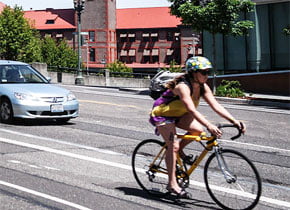
#3. When passing a bicyclist, you should:
When passing, maintain a safe operating distance between your car and a bicyclist. Move as far to the left as possible and safe. Pass a bicyclist only when road and traffic conditions dictate that it is safe to do so. Check over your shoulder after passing a bicyclist and before moving back to normal position.
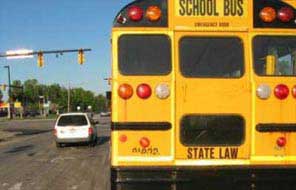
#4. When are you allowed to overtake a stopped school bus?
You may proceed if:
- the bus is moving, or
- the bus driver signals to let vehicles pass, or
- the red lights are no longer flashing.

#5. Which shape is used for stop signs?
Stop signs are always octagonal (eight-sided). A stop sign means that you must bring your vehicle to a complete halt.

#6. When backing up or reversing your car:
Place your right arm on the back of the seat and turn around so that you can look directly through the rear window. Do not depend on your rearview or side mirrors, as you cannot see directly behind your vehicle.

#7. When parking close to a fire hydrant, you must keep what distance?
Never park within 10 feet of a fire hydrant.

#8. This sign tells you that:
Hospital is a word message sign or an H symbol sign on a blue background.

#9. You may cross a double solid yellow line:
Broken yellow center lines are used on two-lane, two-way roads. You may cross them only to turn left or to pass another vehicle.
One solid line with one broken line means no passing when you are in the lane with the solid line. The solid line may be crossed only to turn left.
Two solid yellow lines on a two-lane road means no passing in either direction. Crossing the center line is permitted only as part of a left-turn maneuver.

#10. Why is it important to know what kind of braking system your vehicle has?
Conventional and anti-lock brakes (ABS) are used differently, so it is important to know what kind of braking system your vehicle has. Knowing how to apply your brakes in an emergency situation may save your life.

#11. To avoid glare from the high-beam headlights of an approaching car:
If you meet a vehicle that does not dim its lights, look to the right edge of the road to avoid being blinded. Remember, it takes time for your eyes to adjust after meeting a vehicle at night.
Do not try to get back at other driver by keeping your headlights turned to the high-beam setting. If you do, both of you may be blinded.

#12. What does this sign mean?
There is a four-way intersection (crossroad) ahead. Be aware of vehicles entering the flow of traffic.
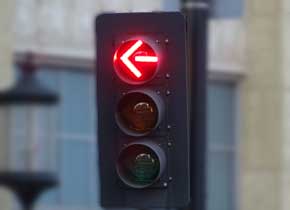
#13. A traffic light showing a red arrow means:
North Dakota does not allow turning against a red arrow.
Come to a complete stop before reaching the intersection, stop line or crosswalk for the direction indicated by the arrow. Remain stopped as long as the arrow signal is red.
39-10-05 Vehicular traffic facing a steady red arrow indication may not enter the intersection to make the movement indicated by the arrow.
Note: This turn may be allowed in other states.

#14. Which of the following is an acceptable reason for not wearing safety belts?
There is no good excuse for not wearing seat belts. Seat belts have been proven to be one of the most effective safety devices today. North Dakota’s seat belt law requires all front seat occupants to wear seat belts.
Occupants under the age of 18 must be buckled up in both the front- and rear-seating positions.

#15. A trucker's blind spot behind the truck may stretch up to:
Large vehicles have serious blind spots or no-zones into which a car can disappear from view. These zones exist up to 20 feet in front of the cab, on either side of, particularly alongside the cab, and up to 200 feet in the rear.

#16. Orange road signs are used:
Orange is used for construction and maintenance warning. The signs are usually diamond shaped. They notify drivers of unusual or potentially dangerous conditions near work areas.

#17. Car skids are mainly caused by
Most skids are the result of driving too fast for the road conditions on slippery roadways. The key to safe vehicle operation is slower speeds.

#18. Why should you increase your separation distance when following a large vehicle?
When following large trucks, your vision may be blocked. Your ability to see and to plan ahead will be improved if you fall back to increase your following distance.
If you are following too close, be aware that the truck driver may not be able to see you in the mirrors.
Falling back is a good idea to both see and be seen.

#19. What light beam should you use when driving at night in heavy fog?
Use the low beams in fog or when it is snowing or raining. Light from high beams will reflect back, causing glare and making it more difficult to see ahead.

#20. When are you allowed to drive around a lowered gate at a railroad crossing?
Never drive any vehicle through, around or under any gate or barrier. It is dangerous and against the law.
All crossings are required to have a sign posted with an emergency number to call and a crossing ID code. If the gate is malfunctioning, you must report it.

#21. If you drive slower than the flow of traffic on a multi-lane highway, you must:
You should use the left lane to drive faster, pass, or turn left. Keep to the right if you are traveling slowly.
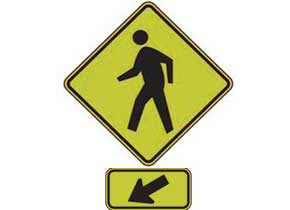
#22. What does this sign mean?
Pedestrian crossing.
Be alert for people crossing the street. Slow down, yield right of way to pedestrians, or stop if necessary

#23. One primary factor that affects the alcohol concentration in your blood is:
Three factors influence a person’s AC:
- The alcohol content. In the average drink the alcohol content is about the same whether it is a 12-ounce can of beer, a 4-ounce glass of wine, or a 1-ounce glass of scotch or whiskey. Remember that, in reality, mixed drinks at home or in a lounge vary a great degree. Drinks at a private party tend to be quite a bit stronger.
- The period of time over which the alcohol was consumed. The more alcohol you consume the longer it takes to sober up.
- The person’s lean body weight. Larger people have more blood and fluids which will dilute the alcohol consumed more than in a smaller person.
BAC does not depend on what kind of alcoholic beverage you drink, how physically fit you are, or how well you can hold your liquor. Food in the stomach causes alcohol to be absorbed more slowly, slowing down the rate and the amount of intoxication. The kind of food is not a primary factor.

#24. Which vehicle must yield when two vehicles arrive at the same time at an uncontrolled intersection?
When two vehicles approach an unsigned intersection at approximately the same time, the vehicle on the left side must yield to the vehicle on the right. When entering an intersection, it is recommended to look first to your left, then to your right and then left again. Be prepared to yield.

#25. What is the meaning of North Dakota basic speed rule?
Speed limits are maximum limits to be traveled only when driving conditions are ideal. Sometimes conditions may require you to drive slower than the posted speed limit allows. Never drive faster than the posted speed limit or conditions allow.
| This North Dakota Practice Test | |
|---|---|
| Questions on each practice test: | 25 |
| Question pool: | 500+ |
| Type of test: | Random multiple-choice test |

Facts about Your NDDOT Test
| North Dakota Written Knowledge Test for Permit and Driver’s License | |
|---|---|
| Number of questions on exam: | 25 questions |
| Passing score: | 80 percent |
| Correct answers to pass: | 20 |
| Allotted time to complete test: | 60 minutes *online |
| Wait time before retest: | 24 hours |
North Dakota Practice Tests
This practice test has 25 random multiple-choice questions based on the information in North Dakota Noncommercial Driver’s License Manual and real exam questions.
After each practice question, you will get immediate feedback on whether your answer is correct. If your answer is wrong, a short explanation also helps you understand the right answer.
NDDOT draws test questions from a large pool of questions, making each practice test unique. Use this in your favor and use our practice tests until you can easily reach a 100% score. That way, you will have seen hundreds of questions covering all possible items on the knowledge exam.
Practice questions cover all essential items that may appear on your exam. Still, they may not include all possible questions. Since tests are random, a practice test will never precisely match your final test.
You should also be aware that driversprep.com is not affiliated with any North Dakota or Government Entity. A test on this website is not official and will not generate a certificate of completion if you pass.
North Dakota Official Knowledge Test
The official knowledge test in North Dakota has 25 questions. The passing score is 80 percent, which means you can only miss 5 out of the 25 questions.
Questions are multiple-choice with a possibility of a few true-or-false questions.
There is no allotted time for the test, so you should have plenty of time to read all questions and answer alternatives. Take your time with the test. Test takers usually make more mistakes when they don’t take their time to read questions all the way through.
You will not be allowed to start the test one hour before closing for lunch or closing at the end of the day.
Should you fail the knowledge exam, there is no official wait time to retake the test. Still, examiners will usually not allow you to retake the test the same day.
You must pay a new testing fee each time you take the knowledge test.
The automated test is available in several languages, including:
Chinese
English
French
Russian
Serbo-Croatian
Somali
Swahili
Turkish
Vietnamese
Automated American Sign Language and Audio testing are available at the Fargo, Jamestown, Bismarck, Dickinson, Williston, Minot, Devils Lake, and Grand Forks driver’s license offices.
North Dakota Online Driver Exam
Most applicants over 18 years can complete their driver’s knowledge exam at home.
It is simple to register, and the online exam is available 24/7. You can use the knowledge test from anywhere with internet access. Still, you must have a laptop or a desktop computer. The test will not work on a mobile device.
The online test will let you choose between English and Spanish. Audio playback is also available.
You have 60 minutes to complete the online exam.
NDDOT allows you to take the online test up to five times within one year.

1 Start by Reading the Manual
Always get the latest North Dakota Noncommercial Driver’s License Manual. You can get it from your nearest Driver’s License Site or download it online .
Read it from the first page to the last. Using it as a reference when you take the practice tests is also a good idea.
Remember, everything in the manual is there for a reason. NDDOT draws questions to your final test from all parts of this manual. It isn’t easy to pass the knowledge test unless you have studied the manual.
2 Use Practice Tests Wisely
This practice test is a learning tool. It should be used together with the Driver’s License Manual, not instead of it.
A common mistake and poor strategy is to try to memorize all questions and answers. You’ll never know which questions and answers you will get on your test, and wordings may differ.
If you want to pass the exam and become a safe driver, your best strategy is to learn the essential rules of the road and common ND traffic laws.
Get some more study tips from Joni stark .

Who Must Take North Dakota Knowledge Test?
First-time Drivers
When you apply for your first original North Dakota driver’s license, you must always pass a vision screening and the written knowledge test.
Drivers who let their license expire more than one year
When you renew your driver’s license, NDDOT only requires a new knowledge test if you let it expire for over a year.
Drivers with a revoked license
If NDDOT has revoked your driving privileges, you must wait for the revocation period to end, meet all reinstatement requirements, and take the written and road tests before NDDOT issues a new license.
After a suspension, you will get driving privileges back after the suspension period has ended and you meet all reinstatement requirements. No tests are necessary.
Drivers with a foreign driver’s license
Suppose you move to North Dakota and hold a driver’s license issued by a country other than the United States or Canada. In that case, you must apply for an original North Dakota license and pass all tests.
Drivers Who Wish to Transfer an Out-of-State License
NDDOT usually waives the written knowledge test if you move to North Dakota and want to transfer your valid out-of-state license.
Should you let your out-of-state license expire for more than one year, you must apply for a new ND license and take all necessary tests as a first-time applicant.
Suppose your out-of-state license is in the process of being revoked, suspended, or canceled. In that case, you cannot transfer to a North Dakota license.
Your First Permit
If you are at least 14 years old, you can apply for an instruction Class D permit.
Before NDDOT issues the permit, you must pass a vision and written test. If you are under 18, your parent or legal guardian must sign and approve your application.
Until you are 16, you can only drive a vehicle owned by your parents, legal guardians, grandparents, siblings, aunts, or uncles.
If you are under 16 years, you must hold the instruction permit for 12 months or until you are 16 years, whichever comes first. A minimum holding period of six months always applies.
If you are 16 or 17 years, you must hold the instruction permit for six months or until you turn 18, whichever comes first.
Applicants who are under 16 years must complete at least 50 hours of supervised driving during the permit phase. Your parent/legal guardian must accompany you to the road skills test and sign
that you have completed this requirement.

