
2026 Utah Permit Practice & Driver’s License Tests


#1. When passing another vehicle, you should move completely into the left lane.
When passing, move completely into the left lane.

#2. When coming to a traffic signal with a flashing yellow light, you must:
When approaching a flashing yellow traffic signal light, you should exercise caution at the intersection and proceed through the intersection at a reduced speed.

#3. If you suddenly have a tire blowout while driving at high speed, you should immediately steer off the pavement.
Remember, do not overreact. The instinct may be to brake hard or immediately steer off the road. The steering wheel should be held tightly, and you should keep the vehicle going straight. Once the vehicle is under control, move slowly and safely off the road.

#4. Whenever you drive, you should adjust your speed based on:
Posted speed limits do not tell you at what speed to drive. They only tell you what the maximum legal speed is under ideal conditions. By law, you have to go slower if conditions make the posted speed limit unsafe.

#5. Tailgating a truck is especially dangerous because:
Tailgating a truck or car is dangerous because you take away your own cushion of safety if the vehicle in front of you stops short. If the vehicle you are following hits something on the road, you will have no time to react before it hits the front of your car.
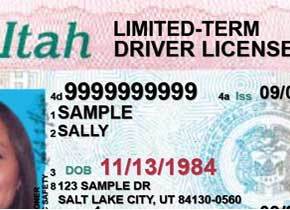
#6. Who may be issued a limited-term driver's license?
A limited-term license is the evidence of the privilege to drive a motor vehicle and was obtained by providing evidence of the lawful presence in the United States by an individual who is not a U.S. Citizen, a U.S. National, or a Legal Permanent Resident Alien.

#7. If you are following a car, you must dim your lights when you are within 300 feet of the vehicle ahead of you.
If you are following a car, dim your lights when you are within 300 feet of the vehicle ahead of you.

#8. Which is one factor that significantly affects your stopping distance?
The process of stopping your car has three main components: perception, reaction, and braking. This is usually referred to as stopping distance. The first two components can be affected by human factors such as tiredness, alcohol, fatigue, and concentration levels. The last component depends on factors such as: tires, brakes, road, and weather conditions. Always make sure to allow yourself enough stopping distance.

#9. When stopping at a railroad crossing, it is illegal to stop closer than:
When you stop at a crossing, you must be between 15 and 50 feet from the nearest rail.
Remember, this is stopping, not parking.

#10. What color are motorist service signs?
Motorist services signs are white on blue. They direct you to services, such as rest areas, tourist sites, hospitals, hotels, gas stations, eating places, campgrounds, or picnic areas. Blue is also used to identify parking spaces for disabled drivers.

#11. It is illegal to park a car if a sidewalk is within five inches.
Parking five inches from a sidewalk is allowed.

#12. What is the best advice for a driver who has been drinking alcohol?
If you have been drinking any alcoholic beverages, do not take a chance. Let someone who has not been drinking alcoholic beverages do the driving.
You can also use public transportation or a cab, if available.

#13. Which of the following must you obey over the other two?
Regardless of what traffic lights or signs may indicate, you must always obey the instructions of a police or peace officer.
Flaggers are often used to give specific directions in work zones. Follow all directions given by a flagger.
You must also follow directions given by school crossing guards.

#14. You are driving on a one-way street. You may turn left onto another one-way street only if:
You may turn left into a left-moving, one-way street if there is no sign to prohibit the turn.
Remember, do not turn against traffic.

#15. When must you stop at a railroad crossing?
You must always stop if there is any condition that makes it unsafe to proceed through the crossing.
Stop when a clearly visible electric or mechanical signal device gives warning of the immediate approach of a train. You must also stop when crossing gate is lowered, or when a human flagman signals you to stop.
Whenever an approaching train is plainly visible or emits a signal, and is in hazardous proximity to the crossing you are also required to stop.

#16. Proof of financial responsibility is needed:
All registered vehicles must have proof of insurance in the vehicle at all times.
It is acceptable for you to provide proof of insurance to a peace officer electronically using a mobile electronic device.

#17. A pedestrian has entered a crosswalk on your side of the roadway and should have the right-of-way:
If a pedestrian is crossing the street in a marked or unmarked crosswalk, you must yield the right-of-way to the pedestrian when the pedestrian is upon the half of the roadway upon which your vehicle is traveling. Drivers must also yield when a pedestrian approaching from the opposite side of the roadway is close to the center of the roadway.
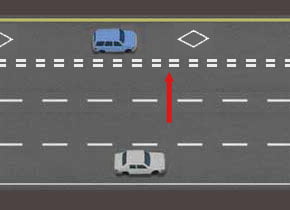
#18. Dashed white lines separating an HOV lane mean:
Dashed white lines mean you may enter. Double white lines mean no entry.
Because it is illegal to cross a double white line, permissive movements in and out of the carpool lane are not allowed except in specific locations (called access points) that will have white dotted striping rather than the solid lines. Access points are about 3,000 feet in length and are located at nearly every interchange along the length of the Express Lanes.

#19. Where are car/motorcycle collisions most likely to occur?
Intersections are the most likely place for motorcycle crashes to occur. For crashes involving a motorcycle and another vehicle, the other vehicle violates the motorcyclist’s right-of-way two-thirds of the time.

#20. What does this sign mean?
This five-sided sign means you are near a school. School signs are located near schools for a good reason. Children are often not careful around traffic and do not understand the dangers of moving vehicles. These signs can help you avoid a possible tragic situation.
#21. Four out of five crashes occur at speeds:
Four out of five crashes occur at speeds under 40 mph, with deaths occurring at speeds as low as 12 mph.
Remember, a safety belt should be worn at any speed, regardless of how slow you are moving.
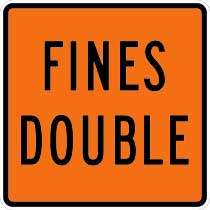
#22. In Utah, fines double for speeding in construction and maintenance zones:
The courts are required to fine a driver who speeds in highway construction or maintenance site where workers are present at least twice the amount of the regular fine for speeding.

#23. The two-second rule refers to how you should:
The two-second rule refers to a following distance. Always keep at least two seconds space cushion between you and the vehicle ahead.
Remember, you may need to give yourself a four-second-or-more cushion if you driveon slippery roads, following a motorcycle, pulling a trailer, or following large vehicles.

#24. If you see this sign in front of you, it tells you that:
Do not enter.
The sign marks a one-way roadway with traffic coming against you. You must not enter from the direction you are traveling.
Remember, this is a square sign with a white horizontal line inside a red ball. The sign is not circular.
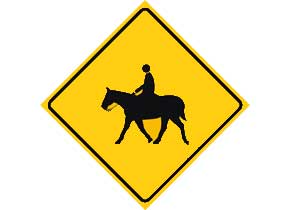
#25. This sign means that only horseback riders are permitted on this roadway.
Horseback riders in the area. They have the same right to the road as a motor vehicle.
| The Official Utah Written Knowledge Test | |
|---|---|
| Questions on real exam: | 50 questions |
| Passing score: | 80 percent |
| Correct answers to pass: | 40 |
| Allotted time to complete test: | No limit |
| Wait time before retest: | No (2 attempts per day) |

How Many Questions are on the FREE Utah Practice Tests?
Each practice test has 25 questions with answers found in the Utah Driver’s License Handbook. After every question, you will get instant feedback, so you’ll know if your answer is correct or not. If you miss a question, there is also a brief explanation to help you understand the right answer.
Even if the official passing score in Utah is 80%, you should aim for a 100% score on your practice tests. Take as many tests as you need until you get there! There is no limit. We want you to pass.
How Many Questions are on the Real Knowledge Test?
The real knowledge examination in Utah has 50 multiple-choice and True or False questions. You must correctly answer 40 of the 50 questions to pass the test.
Be careful with the True or False questions since they may seem simple but can be tricky.

What is the Best Way to Study?
The first step is to get the latest version of the Utah Driver Handbook. Then, make sure you read it!
Everything you need to learn for the knowledge examination is in the handbook.
The practice tests help you verify your knowledge and study for the exam. They are intended to be a learning tool – don’t use them instead of the handbook.
Trying to memorize questions and answers from the sample tests is a risky study tactic which can cause you to fail the exam.
Who Must Take the Utah Knowledge Test?
You must pass the knowledge test to get a learner’s permit.
If you are younger than 19 years old, you must complete an approved driver’s education course while holding the permit. Once completed, you must pay a non-refundable original license fee and pass a driving skills test.
Anyone less than 18 years old must hold a learner’s permit for six months before applying for a provisional license.
You must also pass the knowledge test if you have a Utah driver’s license and let it expire. In such a case, you must apply for a new license and complete all phases of the examination process (including the knowledge test).
If you are a new Utah resident and have a license from another State in the USA or another Country, Utah Driver’s License Division will ask you to pass a 25-question open-book test.
If you cannot show proof of an out-of-country or out-of-state driver’s license, you must pass a 50-question closed-book test.
When applying for a Utah driver’s license, your privilege to drive in another state cannot be suspended, revoked, disqualified, or denied.

Utah Written Knowledge Test
The written knowledge test has questions from the Utah Driver’s License Handbook. Questions relate to your specific written test or tests for the required license or endorsements.
You will generally see several common road signs and must explain their meaning. You will also get questions about rules and safe driving practices.
Utah allows you to take two written tests on the same day. After two failures, you must wait until the next day. After three failures, you must pay a new fee.
You have six months to complete all your tests from the day you pay your permit fee.
When taking the written knowledge test, please arrive early. You should also allow yourself at least one hour to complete the test, even if most test takers finish in less than 20 minutes.
You may take the test in your native language with an interpreter approved by the Department of Workforce Services.
Frequently Asked Questions
At what age can I get a Utah Learner Permit?
In Utah, a teenager may obtain a learner permit at the age of 15. Before Utah Driver License Division issues a Learner Permit you must pass the written knowledge test, an eye examination, and complete an online safety trends exam.
At what age can I get a Utah Driver License?
Utah Driver License Division may issue an unrestricted driver's license when you are 16 years and have held the permit for six months, passed an driver education course, the supervised driving requirements, and the driving skills test.
If you are 18 years, you must complete an approved driver education course.
If you are 19 years or older, you must hold a permit for 3 months OR complete an approved driver education course.
All first-time driver's license applicants must pass the online traffic safety and trends exam.
How many questions are on the Utah knowledge test?
The Utah knowledge test for a driver's license or learner's permit has 50 questions. To pass the test, you need 40 correct answers.
What questions are on the Utah knowledge test?
Utah Driver License Division draws questions from all parts of the Utah Driver Handbook. They focus on common road signs and traffic signals, safe driving practices, Utah traffic laws, and driver's license sanctions. Practice tests gives you a good idea of what to expect.
Is the Utah written knowledge test hard?
Utah Driver License Division do not publish the official failure rate. Estimates suggest that failure rate is less than 30%. By reading the handbook and taking advantage of online practice tests, most applicants pass their test the first time.
Do I need to schedule an appointment for the written test?
No. Utah DLD offers testing on a walk-in basis at any driver's license office. Scheduling your visit is, however, highly recommended to cut your waiting time. If you plan to walk-in for your visit you can complete the driver's license application in the office, or ahead of time online.
What is the Traffic Safety and Trends Exam?
Since 2016, you must pass a knowledge test before receiving a permanent Utah license. It is an online course with training videos covering driving safety topics and major causes of traffic related deaths, followed by exam questions. You must complete all sections with a score of 100%.
What restrictions come with the Utah Learner Permit?
Between 15 and 17 years, a permit holder must be accompanied by a parent, guardian, driving instructor, or responsible adult who signed for financial responsibility (the person must sit in the front seat). If younger than 17 years, the holder cannot drive between the hours of 12:00 am and 5:00 am. Unlike many other states, there is no passenger restrictions until tour license is issued.
How long must I hold my Utah Learner Permit?
If you are under 18 years, you must hold your permit for 6 months before applying for a class D license.
There is no holding period if you are 18 years, but you must complete an approved driver education course.
If you are 19 years or older, there is a 3-month holding period unless you choose to complete an approved driver education course.
What restrictions come with my first Utah Class D Driver License?
Nighttime restrictions (between the hours of 12:00 am and 5:00 am) apply when you are between 16 and 17 years. Passengers restrictions (only immediate family members in vehicle) apply until 6 months from the date your license was issued or until you are 18 years.


Question #20 is not worded correctly.
During this covid how can I get in to take a test for my learners permit. I am 20 yrs old and I am enrolled with a1 driving school. I’m not able to move forward without my learners permit
This is a very unique situation. Every state handles this pandemic differently. Please contact your local DMV or driving school for more information. If you can’t take your test right away, they should be able to schedule it or at least put you on a waiting list.
Good luck!