
Hawaii Permit Test Practice & License Sample Test Questions
Results
Great! This is a passing score. Do you want to try again?
This is not a passing score. Do you want to try again?


#1. Which is true about the use of brakes?
Careful use of the brakes can save considerable energy and money in replacing fuel, brakes, and tires. Avoid bursts of speed followed by heavy braking. A hard application of the brakes will cause one or more wheels to slide on the road. If the brake warning lamp on the instrument panel lights up when you apply the brakes, the brake system has partially failed, and immediate repair is required.

#2. There is an emergency vehicle with flashing lights directly behind you. If traffic is heavy and you cannot get out of the way, you should:
If the emergency vehicle is directly behind your vehicle when you are in heavy traffic, keep moving slowly until you can get out of the way.
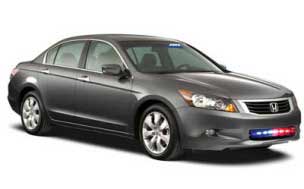
#3. When can you drive with a red light from the front of your motor vehicle?
The following motor vehicle equipment is prohibited:
- A red light showing from the front, or a blue light visible outside of the vehicle, except on authorized emergency vehicles.
- A bell, exhaust whistle or siren, except on authorized emergency vehicles.
- A muffler cut-out or by-pass, or a muffler that makes more noise than an original equipment manufacturer muffler.

#4. When riding in a vehicle, small children are safest:
Hawaii law requires children under the age of four to ride in a child safety seat and children ages of four through seven to ride in a child safety seat or a booster seat when traveling in a motor vehicle. The driver will be held responsible for compliance with the law.
No person is strong enough to hold onto even a small infant in accidents or sudden stops.

#5. Pavement markings show that a no-passing zone ends ahead. This means:
The end of a no-passing zone does not mean it is safe to pass. It means there is increased visibility ahead.
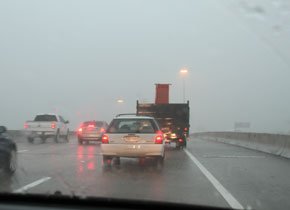
#6. On slippery roads, your following distance should be:
Extra care should be used when driving on wet, slippery, or gravel-covered road surfaces. Driving on a road covered with oil and water can be like driving on ice. You should reduce speed, use extra caution, and allow at least twice the normal following distance.
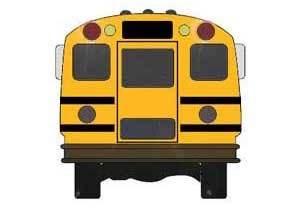
#7. When the red lights on a school bus stop flashing and the stop sign folds back, you should:
Remain stopped until the lights stop flashing or the stop sign folds back. Even after the warning signals have stopped, you should proceed with caution and be on the alert. There is a possibility of waiting children darting in front of traffic.

#8. Holders of provisional licenses must ensure that:
Holders of provisional licenses must ensure that all occupants of the vehicle use safety belts or child restraints.

#9. The use of a white cane identifies a person as:
A white cane is used by many people who are blind or visually impaired, both as a mobility tool and as a courtesy to others. Motor vehicles must always yield to pedestrians when the pedestrian is a blind person walking with a white cane or guide dog.

#10. When you approach a traffic signal displaying a steady yellow light, you should:
A yellow light means that the related green movement is being terminated OR that the red light is going to be shown immediately thereafter. You should avoid entering the intersection when the yellow light is shown. Stop, if you can do so safely.

#11. You are driving on a two-way road. Passing another vehicle to the right is only allowed if:
You may pass to the right of another vehicle:
- When the vehicle you are passing is about to make a left turn, but you may not drive your vehicle off the pavement or main traveled portion of the roadway to pass.
- On a paved street or highway with two or more lanes marked for traffic in each direction.
- On a one-way street with two or more lanes marked for traffic.

#12. If you have been drinking alcohol, what will help you to sober up?
Once the alcohol enters your blood there is nothing you can do to lessen the effect. Black coffee, food or a cold shower might wake you up, but they will not sober you up. Alcohol is burned up by your liver and eliminated from your body through your kidneys and lungs. This process takes time.
Only time will rid you of the effects of alcohol. Only time will sober you up.

#13. You want to turn left ahead. There is a shared left turn lane in the center of the road. What should you do?
Two-way left turn channelization markings are a combination of a yellow solid and dashed lines in the center of a roadway which mark a lane in the center of the roadway which may be used by vehicles traveling in either direction for left turn maneuvers only. The lane must never be used for passing.

#14. If you have a tire blowout while driving, you should:
If you experience a tire blowout on your vehicle:
- Do not apply the brakes.
- Grip the steering wheel firmly and steer to remain in your traffic lane.
- Reduce speed gradually without using the brakes until you are moving very slowly, then
- Apply the brakes lightly and pull off the road into a safe area.

#15. When you leave your vehicle unattended, you must:
Drivers are responsible for making sure that their vehicle is not a hazard when it is parked. When you leave your vehicle unattended, you must:
- Stop the engine
- Lock the ignition and remove the ignition key
- Set the parking brake
When the vehicle is on a grade, turn the wheels toward the curb (or when facing uphill and there is a curb, away from the curb).

#16. When driving in fog, you should:
Turn on low beam headlamps. Never use the high beam because the reflection, especially at night, will reduce your ability to see and the light will reduce the approaching driver’s ability to see.

#17. If you are driving next to a bicycle lane and want to turn right, you should:
When making a right turn at an intersection, do not drive in a bike lane.

#18. An inattentive driver is a driver who:
An inattentive driver can easily be identified. He is driving with one arm out the window and talking to a passenger, gesturing with his other hand, and paying little attention to the traffic flow. His passengers are often uncomfortable because of his lack of control of his vehicle. When he is alone, he daydreams or gazes at objects off of the roadway. His inattention forfeits his safety.

#19. When must you stop at a railroad crossing?
You must stop your vehicle not less than 15 feet from the nearest rail when:
- An installed electric or mechanical signal is giving warning of an approaching train.
- A crossing gate is lowered, or a flagman is signaling the approach of a train.
- A train approaching within 1,500 feet (460m) gives audible warning of its approach.
- When the approaching train is visible and so close as to constitute a hazard.

#20. One of the most frequent causes of collisions between motorcycles and other motor vehicles is:
Intersections are the most likely places for car/motorcycle collisions to occur. This usually is the result of a car driver not seeing the motorcycle and turning into the motorcycle’s path

#21. While driving, you should always try to:
One of the most common mistakes drivers make is looking in front of the car instead of up the road. Expert drivers try to keep looking 10 to 15 seconds in the city, 10 to 15 seconds is about one block.

#22. What is the background color of a warning sign like this?
Construction and maintenance signs are used to notify drivers of unusual or potentially dangerous conditions in or near work areas. Most signs in work areas are diamond shaped. A few signs are rectangular. All sings have an orange background.

#23. Even if you do not see other vehicles around, you should signal:
Always signal before every lane change and before pulling away from the curb, even when you do not see other vehicles around.
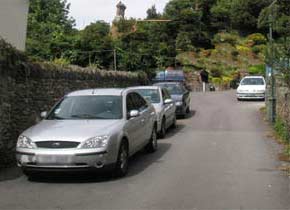
#24. You are going down a street with parked vehicles. Why is it essential to drive slowly and carefully?
Use care when passing cars parked by the roadside. These vehicles obstruct your view of possible conflict with other vehicles, bicycles, and pedestrians. Be alert to the possibility that a parked car may suddenly move into your traffic lane or that a door may be opened into the path of your vehicle.

#25. What does this sign mean?
Traffic signal ahead. Slow down and be prepared to stop, if necessary.

#26. This sign (yellow X) tells you that:
Sometimes it is desirable to have traffic in a lane in one direction at certain times and the opposite direction at other times. Lane control signals are used to control the direction of traffic movement in the lane. The signal is placed over the traffic lane it controls.
The yellow X means that you must move out of that lane of traffic because it is going to be used for traffic moving in the opposite direction. When the yellow X signal is flashing you may use that lane only when preparing to turn left.

#27. If your vehicle starts to skid, you should:
It is important to remember that when you encounter a skid or control problem, you should stop or reduce whatever it was that you were doing when the problem started.
- Ease off the accelerator. The skid may stop as soon as you do this.
- For cars without anti-lock brakes, avoid using the brakes.
- Turn the steering wheel in the direction of the skid.

#28. When can you legally drive faster than the maximum speed limit?
You must not drive at a speed that is greater than the posted maximum limit. It is illegal to exceed the posted speed limit.

#29. When you want to exit a freeway, you should:
When you want to get off a freeway, plan ahead and watch the exit signs so you can choose the proper exit.

#30. When you drive at night, you must:
You must use extra caution at night because it is harder to see things at night. No one can see as well at night as they can in the daylight. In addition, a driver’s exposure to alternate light and darkness prevents him from attaining his best seeing ability at night.
Hawaii Driver’s License Knowledge Test – Quick Facts
| What You Should Know | |
|---|---|
| Number of questions on exam: | 30 |
| Passing score: | 80 percent |
| Correct answers to pass: | 24 |
| Allotted time to complete test: | No limit |
| Wait time before retest: | 7 days |
| This Practice Test | |
|---|---|
| Number of questions on each practice test: | 30 |
| Question pool: | 1,000+ |
| Each test is random | |
The Hawaii Driver’s Practice Test for the Written Knowledge Examination
Driver’s Prep has designed these permit practice tests for use as a guide to help you become a safe driver and qualify for the Hawaii instruction permit or full driver’s license.
Each permit practice test has 30 random questions based on the Hawaii Driver’s Manual, the Complete Test Questions and Answers from Dept. Of Transportation, and real knowledge examination.
The test is easy to use. After each question, you will see the correct answer. If your answer isn’t correct, there is also a brief explanation.

By reading the official Hawaii Driver’s Manual and using these practice tests to check your progress, you increase your chances of passing the real written test the first time.
You can download a PDF-version online or buy a hard-copy from your local licensing office.
Acing the Hawaii Knowledge Test
The Hawaii passing score is 80 percent. To pass, you must answer at least 24 questions correctly.
Since this is only a practice test, don’t stop at this level.
You should answer at least 29-30 questions correctly on two or three practice tests before you are ready. A common mistake by first time applicants is to attempt the real knowledge test too soon.
Spreading your study sessions and practice tests over a longer period helps long-term memory. Instead of cramming for the DMV test just a few days before the real thing, start at least 4 weeks before your real exam. Study the manual and take a practice test or two each day.
Read more: How to Ace the DMV test .
Who Must Take the Hawaii Written Test?
First-time applicants
If you apply for an original Driver’s License and have not been licensed before, you must pass the written test consisting of recognition of traffic control devices and knowledge about rules of the road.
Holders of an expired driver’s license
When you renew a Hawaii driver’s license, you must do so within a year after the expiration date. If you let your license expire more than a year, you must follow the procedure for an original license and take all tests again.
Holders of a foreign driver’s license
When you have driver’s license from a foreign country other than Canada, you must pass all tests when transferring to a Hawaii license.
Who are Exempt from Taking the Hawaii Written Test?
Holders of a driver’s license issued by another state
Hawaii now waives the tests for holders of a valid U.S. or Territory driver’s license.

The Graduated Driver Licensing Program
Like all states, Hawaii has a graduated licensing law. The purpose of the law is to let new drivers under 18 years to gradually gain driving experience under adult supervision and with restrictions that limits high-risk driving situations.
The Hawaii graduated licensing program has three stages:
Phase I: Learner’s (Instructional) Permit
Phase II: Provisional License
Phase III: Full Driver’s License
Phase I: Learner’s (Instructional) Permit – Requirements
To apply for the Hawaii learner’s Permit, you must be at least 15 years and six months old.
To complete the application process you must show proof of:
Your full legal name
Date of birth (birth certificate is required if under 18 years)
Your social security number
Hawaii residency
Legal presence, if applicable
Parental approval if under 18 years (An Affidavit form must be submitted)
After paying the fees, and passing the vision test and the knowledge test, the department issues an instruction permit which is valid for one (1) year. If you wish to renew the permit you must do so no later than 90 days after the expiration date of the permit.
Phase I: Learner’s (Instructional) Permit – Restrictions
With the learner’s permit you can practice driving.
Whenever you drive you must be seated next to a person who is at least 21 years of age and licensed to operate the same type of motor vehicle. Under no circumstances can you drive alone.
You must have all occupants wear their seat belts and children under 4 years of age must be properly restrained within a safety seat.
There are no passenger restrictions and no night curfew. If you drive between the hours of 11:00 p.m. and 5:00 a.m., you must, however, be accompanied by a supervising parent or legal guardian.
When you practice driving you must always carry the permit with you.
Phase II: Provisional License – Requirements
To be eligible for the Hawaii provisional license, you must:
Be at least 16 years (and under 18 years)
Have held a learner’s permit for 180 days
Have completed a State certified driver’s education course
Pass a road skills test at a Driver Licensing Center
Pay the appropriate fees
Remember, you must schedule an appointment for the road-test exam.
Phase II: Provisional License – Restrictions
With the provisional license you can drive alone without a supervising driver, but the license comes with some restrictions:
No more than one passenger under 18 years.
Exceptions to this rule apply if (1) the passengers are household members or (2) you are being accompanied by a licensed parent or guardian.
No driving between 11:00 p.m. and 5:00 a.m.
You must not drive between the hours of 11:00 p.m. and 5:00 a.m.
There are however some exceptions to this rule:
- When driving to or from a place of employment
- When driving to or from a school-authorized activity
- If accompanied by a licensed a parent or legal guardian
If going to or from work, you must have a signed statement from the employer. When you drive to or from school activities a statement from a parent or guardian is necessary.
No driving without the license in your possession
All occupants wear seat belts or child restraints
The provisional license expires at your 19th birthday.
Phase II: Provisional License – Requirements
You are eligible for a full and unrestricted Hawaii driver’s license if you:
Is at least 17 years old
Have held the provisional license for at least six (6) months
Have no pending violation that might result in a suspension or revocation
Pass the vision exam (again)
Pay the appropriate fees
With a full and unrestricted Hawaii driver’s license all previous restrictions are lifted from your driving.
Frequently Asked Questions
How old must you be to get a Hawaii Learner's Permit?
To apply for the Hawaii learner's Permit, you must be at least 15 years and six months old.
What passenger restrictions are placed on a Hawaii Learner's Permit?
A holder of a Hawaii Learner's Permit must always be accompanied by a person who is at least 21 years of age and licensed to operate the same type of motor vehicle. If driving at night between the hours of 11:00 p.m. and 5:00 a.m, the supervising driver must be a licensed parent or legal guardian.
What are the passenger restrictions if you have a Hawaii Provisional License?
You can drive with NO more than one passenger under 18 years. Exceptions to this rule apply if (1) the passengers are household members or (2) you are being accompanied by a licensed parent or guardian.
What are the night time driving restrictions if you have a Hawaii Provisional License?
You must not drive between the hours of 11:00 p.m. and 5:00 a.m. Exceptions to this rule may apply if you drive to or from an employment, to or from a school-authorized activity, or if you are accompanied by a licensed a parent or legal guardian.
When are restrictions lifted from a Hawaii Provisional License?
A provisional licensee may be issued a full driver's license if the provisional licensee has satisfactorily held the provisional license for at least six (6) months and has no pending violation that might result in a suspension or revocation
How many questions are on the Hawaii permit test?
The Hawaii knowledge test has 30 questions. The passing score is 80 percent. To pass, you must answer at least 24 questions correctly.
What is the passing score on the Hawaii permit test?
The passing score on the Hawaii knowledge test is 80 percent. The test has 30 questions. To pass, you must answer at least 24 questions correctly.
If I fail the Hawaii permit test, how long must I wait before I can take test again?
You can retake the Hawaii knowledge test after waiting 7 days.

