
Idaho Driver’s Knowledge Tests & License Practice Tests
Results
Great! That is a passing score on the Idaho knowledge test. Try again?
Sorry, this is not a passing score on the Idaho knowledge test. Do you want to try again?


#1. When you park on a hill headed uphill, and there is a curb, you should turn your front wheels:
To keep your vehicle from rolling into traffic when parked on a hill, turn your front wheels sharply toward and against the curb or edge of the road if you are facing downhill, or if you are facing uphill, turn your wheels sharply away and against the curb (if there is no curb, turn the wheels sharply toward the edge of the road).
Study the illustrations in the driver’s manual.
#2. At intersections, crosswalks, and railroad crossings, you should always:
As you approach any place where other cars, people or animals may cross your path, look to both sides. Do not rely on traffic lights or stop signs. Always watch out for other drivers – they may run the light.

#3. Orange road signs are used for:
Orange is used as a background color for construction and maintenance warning signs.

#4. What does this sign mean?
The most common sign seen when approaching a roundabout is a warning sign with an arrow in a circle pattern. When an advisory speed panel is posted below the sign, slow down to the recommended speed.

#5. After stopping and yielding, you may turn right at a red light unless:
A steady red circular indication means stop. Come to a complete stop before you reach the stop line, crosswalk, or intersection. Remain stopped until the light changes and cross traffic clears the intersection.
You may turn right after stopping and yielding to cross traffic except where posted otherwise. You may turn left into a one-way street after stopping and yielding to cross traffic unless posted as no-left turns allowed.

#6. How do the following compare in alcohol content 12 ounces of beer, 1.5 ounces of 80-proof liquor, and five ounces of wine?
It is not what you drink, it is how much. A jigger (1.5 ounces) of 80-proof whiskey, five ounces of table wine, or 12 ounces of beer all contain approximately the same amount of alcohol – about an ounce each.
Note that it was 4 ounces of whisky in the question.

#7. Before exiting a freeway, you should signal for at least:
Proper signaling may prevent a rear-end collision. Always signal for at least five seconds before making a lane change or exiting a freeway.

#8. Who must yield when several vehicles approach an uncontrolled T-intersection?
If you are the driver on a road that ends at a T-intersection with no signs or signals, you must yield to any driver on the through road.

#9. If your vehicle starts to hydroplane, you should:
Do not slam on the brakes or turn suddenly. You may lose control and skid.
Slowly take your foot off the gas pedal.

#10. In Idaho, car tires must have a minimum tread depth of:
Each tire must have at least 1/32 of tread groove.
Most states require a minimum of 1/16 (2/32) inch tread depth.

#11. If you are involved in a crash, you must always:
Stop as near to the scene as possible without blocking traffic. You may move vehicles that pose a traffic hazard before the police arrive.
Do not try to move an injured person from a wrecked vehicle unless you have the necessary medical training or there is an immediate danger, such as fire.
You must report to the police any motor vehicle accident in which someone is injured, or property damage is more than $1,500.

#12. You are driving on a one-way street. You may turn left onto another one-way street only if:
Give your signal and approach the intersection in the lane closest to the left that is open to traffic going your direction. If you are on a two-lane road, you should move to the left side of your lane. Yield the right of way to pedestrians and oncoming vehicles. When safe, turn into the nearest lane in which traffic moves the direction you want to go.
Do not cut the corner

#13. What should you do when approaching a bicyclist from the rear on a two-lane road?
When you are following or passing a bicyclist, the best advice is: leave plenty of room.

#14. What does this sign mean?
Divided highway ends.
The divided road ends ahead. Two-way traffic will no longer be divided by a center island. You will be on an undivided roadway with two-way traffic. Watch out for oncoming cars.

#15. What does this sign mean?
Hospital is a word message sign or an H symbol sign. General service signs like this are accompanied with a directional message if used at intersections.

#16. Which of the following vehicles are required to stop at all railroad crossings?
Watch out for vehicles that must stop at crossings, be prepared to stop if you are following one.
All vehicles carrying hazardous materials must stop at all railroad crossings.
A school bus or transit bus must also come to a complete stop before crossing any railroad track.

#17. What does this sign mean?
All lanes will shift according to the sign. Stay in your lane as it shifts slightly to the right.

#18. What is true about fighting fatigue and highway hypnosis with stay-awake drugs or energy drinks?
Do not rely on stay awake drugs or energy drinks. They can make your driving even more dangerous.

#19. How do safety belts help you as a driver?
Safety belts help drivers maintain control of their car on winding or rough roads or when trying to avoid a collision.

#20. Which is true about driving 55 mph in a heavy rainstorm on a highway with a speed limit of 60 mph?
Idaho law has a basic rule requiring you to drive at a speed that is reasonable and prudent at all times. If you drive too fast for existing conditions – even if you driveunder the posted speed limit – you are violating the basic rule law.
This applies to all streets and highways where maximum speed limits are set by law or posted. Whenever you are driving, you need to think about how your speed affects other traffic (including pedestrians and bicycle riders). You also need to think about the road surface (the presence of ice, snow, rain, or rough pavement), hazards at intersections, visibility, oncoming traffic, curves, and any other conditions that may affect safety.

#21. The following are true about large trucks except:
It is not true that trucks need shorter stopping distance.
For example, it takes a loaded truck with properly adjusted brakes 450 feet to come to a complete stop when traveling 55 mph on a dry road.

#22. To drive across a median on a divided freeway:
Freeway median crossovers are for highway maintenance or emergency vehicle use only. It is illegal for any other vehicles to use them.

#23. If a yellow center line is solid on your side of the road, it means:
If the solid yellow line is on your side of the road, do not pass. Solid yellow lines indicate no passing.

#24. The best way to control your car on slippery roads is to:
On slippery roads, the keys to safety are slower speeds, gentler stops and turns, and longer following distances.
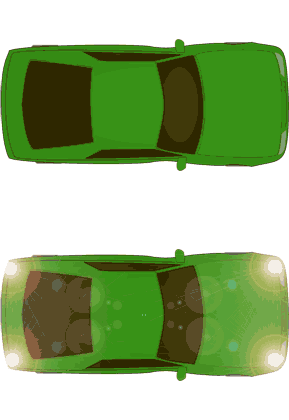
#25. You should use your four-way emergency flashers in the following situations except:
Also avoid using your four-way flashers while moving, other drivers may think you have stopped.
| This Practice Test | |
|---|---|
| Number of questions on each practice test: | 25 |
| Question pool: | 1,000+ |
| This is a randomized practice test | |
Facts about Your Idaho Driver’s Knowledge Tests
| DMV Knowledge Test for Learner’s Permit and Driver’s License | |
|---|---|
| Number of questions on exam: | 40 questions |
| Passing score: | 85 percent |
| Correct answers to pass: | 34 |
| Allotted time to complete test: | 25 minutes |
| Wait time before retest: | 3 days (There is a new fee for each test) |
This Idaho Practice Test
We have designed these practice tests to help you study for and pass the knowledge examination for a Class D (Non-Commercial) license or instruction permit in Idaho.
It has 25 questions drawn from a large bank of DMV questions and answers. Each one is specific to the traffic laws in the state of Idaho. It is, however, shorter than the actual knowledge test. We recommend taking at least a handful of tests to cover all items in the driver’s Handbook.
After each question, you will see the correct answer. If you answered a question incorrectly, there is a brief explanation for each question. Use the explanation to find more information in the Idaho Driver’s Handbook.
Remember, the actual examination and this Idaho practice test aim to check your knowledge of Idaho traffic laws, highway signs by shape and symbol, traffic signals, pavement markings, and equipment required on motor vehicles.
A practice test is not a cheat sheet and does not include all questions on the official knowledge test. Before taking the official test, you must study the Idaho Driver’s Manual.
The practice test, however, helps you prepare as much as possible and predict how likely you are to pass the Idaho knowledge examination.
1 Get the Driver’s Manual
Your first step is to get the latest version of the Driver’s Handbook from itd.idaho.gov. It would help if you only used the practice tests to verify your progress after studying the manual. Do not use the practice test as a replacement for the manual.
In the Driver’s Manual, you can find all the questions and answers you need to pass the written test for a class D license or instruction permit. It remains your best friend when studying for your first instruction permit.

Aim for a High Score on Each Practice Test
The number of questions on the real test in Idaho is 40, and the passing score is 85%, higher than in many other states. Only Maryland and Virginia have higher passing scores
You must correctly answer 34 out of the 40 questions, meaning you can only miss 6. With a poorly designed test and a high passing score, the Idaho knowledge test can be one of the hardest to pass, especially if you haven’t completed a classroom course.
It will help if you aim for the highest possible score on the practice tests. Take as many tests as you need, as often as you like.
On each test, you should make sure you truly understand why an answer is correct and why other options are incorrect.
Learn more about Risky Study Tactics .
Known Issues with the Idaho Knowledge Test
Idaho DMV tends to use four choices for each test question. On a lengthy test, it can be easy to skip reading all of the choices carefully enough.
Idaho DMV also has a disclaimer at the beginning of the test saying that there may be more than one correct answer and that you must select the best answer.
Idah still uses “All of the above” as one alternative, meaning all alternatives can be correct, a test practice no other states use today.
A nervous test taker may identify the first alternative as correct and read no further.
The same is true for: “Both of the above.”
Remember to read all choices carefully.
You may also see “None of the above” as the last choice. This alternative is also a poorly designed question since it doesn’t check if you know the correct answer.
Even if it is less common, you may see a negative question that contains the word not or never. In this case, you must look for an incorrect statement. It is easy to forget this and pick the correct statement instead.
You can overcome these flaws by not rushing through the test, being alert, and ensuring you read everything.
More about the Idaho Knowledge Test
The test is available in English, Arabic, Chinese, Farsi, French, Korean, Russian, Serbo-Croatian, Spanish, Vietnamese, and ASL (American Sign Language).
It is a closed-book test, meaning you cannot use any aid (written, audio, or electronic) while taking the exam.
If you fail the knowledge examination, you must wait at least three days before you can retake it. You must pay a new fee each time you take the test.
Who Must Take the Idaho Knowledge Test?
All new drivers applying for an original driver’s license must pass the knowledge exam.
If you are under 17 years old, you must complete a driver training program and comply with the Graduated Driver Licensing (GDL) Program requirements. After the supervised instruction period, you must take and pass the written knowledge test before receiving your driver’s license.
If you are 17 years or older, the GDL requirements don’t apply. You start the application process by taking the written knowledge test and a vision screening at a county sheriff’s office.
You must pass a Class D written knowledge test when transferring from another state, U.S. Territory, or the District of Columbia. Unlike many other states, DMV does not waive the written test for drivers with out-of-state driver’s licenses.
You must also pass all tests with a foreign driver’s license.
If you let your Idaho Driver’s license expire for 25 months or more, you must also retake the knowledge test.
Idaho Graduated Driver’s License (GDL) program
Anyone under 17 years who applies for their first driver’s license in Idaho must complete an approved driver’s training program and comply with the requirements of the GDL Program.
Unlike other states, Idaho does not require you to pass the written test before issuing a permit under this program (the test comes later).
The first permits are the Driver Training (DT) and the Supervised Instruction Permit (SIP). They allow anyone at least 14 1/2 years and under 17 to attend public school or a private driver’s training program. You must have your DT permit before taking any DT class.
The training program consists of a required 1,800 minutes (30 hours) of classroom instruction, 360 minutes (6 hours) of in-car observation in a DT car, and 360 minutes (6 hours) of behind-the-wheel driving with a DT instructor.
While enrolled in a training class, the DT permit allows you to drive while a training instructor supervises. When you have completed the program, the instructor will release the permit, and it becomes a Supervised Instruction Permit.
In this next phase, you can practice your driving skills when accompanied by any licensed driver at least 21 years old and occupying the front seat beside you (no other passengers are allowed in the front seat).
While You Hold an Idaho Supervised Instruction Permit
You cannot drive alone. You must always be supervised by an adult at least 21 years with a valid driver’s license.
All passengers must wear seat belts or child restraints. Only the supervising driver can sit beside you in the front seat.
You must observe all laws regarding alcohol and other intoxicating substances.
You must complete a minimum 6-month, violation-free supervised instruction period and log at least 50 hours of driving practice. 10 of these 50 hours must be at night.
If you violate any traffic laws while you practice driving under this program, DMV will cancel your SIP. After the cancellation, you must reapply for a new SIP, and the six months of supervised driving start over again.

Only after meeting these requirements under GDL will you be allowed to take the Idaho knowledge test.
You can schedule your road skills test if you pass the knowledge test.
After passing all tests, DMV will issue an Idaho Driver’s License.

