
Connecticut DMV Test & Permit Practice – All Tests are 100% Free
Results
Great job! This is a passing score. Do you want to try again?
This is not a passing score. Do you want to try again?


#1. Backing a vehicle in a travel lane:
Never back a vehicle in any travel lane, it is illegal and unsafe to do so, except to parallel park or to perform a three-point or K turn.

#2. This sign tells you:
Regulatory Speed Limit sign. With the word minimum, it shows the minimum speed you can travel.

#3. Which is the most crucial driving technique on icy or snowy roads?
The most important driving technique is to reduce speed and increase your following distance.
Remember, when the road is slippery, the vehicle’s tires do not grip as well as they do on a dry road.

#4. What is true about Anti-Lock Brakes (ABS)?
One important aspect of having ABS is that you can turn your vehicle while braking without skidding.
Press on the brake pedal as hard as you can and keep pressing on it. You might feel the brake pedal pushing back when the ABS is working. Do not let up on the brake pedal. The ABS system will only work with the brake pedal pushed down.

#5. Who vehicle must yield at an intersection without signs or signals?
At an intersection where there is no stop sign, yield sign or oncoming traffic signal, drivers must yield to vehicles coming from the right.

#6. When changing lanes, it is essential to:
When changing lanes, it is important to check your blind spot. Blind spots are the areas you cannot see through your mirrors. You must turn your head and look over your left shoulder to check your blind spots.

#7. A blue and white sign at a railroad crossing indicates:
A blue colored Emergency Notification System sign can be found at highway-rail grade crossings. They provide the public with a 24/7/365 telephone number to call to report problems or emergencies at these railroad locations.
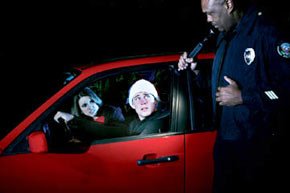
#8. If you are younger than 18 and found driving under the influence of alcohol with a BAC of .02 percent or higher, DMV will suspend your license for at least:
Any 16- or 17-year-old driver who fails the BAC test will have his or her driver’s license suspended for no less than one year, possibly more, depending on the number of DUI (Driving Under the Influence of alcohol) offenses on his or her driving record and the BAC level.

#9. What does this sign mean?
Sharp left turn. The road will make a sharp turn to the left.

#10. When approaching an intersection where the traffic light changes from green to yellow, you should:
A steady yellow traffic light means caution, the traffic light is about to change to red. You must stop if it is safe to do so. If you are in the intersection when the yellow light comes on, continue through the intersection.

#11. Know signs by their shapes. The circular shape is for:
A circular sign indicates that you are approaching a railroad crossing. Slow down, look, and listen for trains.

#12. What is the meaning of this sign?
Slippery when wet.
When pavement is wet, reduce your speed. Do not brake hard or change direction suddenly. Increase the distance between your car and the one ahead. These actions are needed on all wet roads and especially on roads where this sign is posted.

#13. The following are true about large trucks except:
It is not true that they need less room to maneuver.
The bigger trucks are, the more room they need to maneuver.

#14. All the following practices are dangerous while driving. Which is also illegal?
Hand-held cell phones or mobile electronic devices may not be used while operating a motor vehicle on any public highway. State law also prohibits using these devices when a vehicle is temporarily stopped because of traffic, road conditions or a traffic control sign or signal.

#15. If you are traveling in lane B (beneath a steady yellow X), you must:
Lane-use control signals are special signals posted by the side of the road or overhead. They indicate whether you should or should not drive in a specific lane. A green arrow means you can use the lane. A red X means you cannot.
A flashing yellow X means the lane is only for turning. A steady yellow X means that the use of the lane is changing, and you should move out of it as soon as it is safe to do so.

#16. Whenever you stop your car and go into a store to make a quick purchase, you:
Never leave your car until you have stopped the engine. Always set your parking brake. Leave the vehicle in gear if it has a manual transmission or in park if it has an automatic transmission. Never leave the ignition keys in a parked vehicle. It is a good habit to lock the doors whenever you leave your vehicle, remove the key, and set the parking brake.

#17. If you have an older vehicle and your brakes fail, you should try to get them working by:
Pump the brake pedal several times. This will often build up enough brake pressure to allow you to stop.

#18. Penalties for driving under the influence of drugs are:
The penalties are the same whether the driver was drinking alcohol or taking drugs (even prescription or over-the-counter drugs). In Connecticut, operating a motor vehicle while under the influence of alcohol and/or drugs is a criminal offense. This offense may be prosecuted with or without any direct evidence of a person’s BAC. The determining factor is whether a person’s ability to drive has been impaired.

#19. It is against the law to cross a double solid yellow center line:
Solid yellow lines indicate zones where passing is not allowed. Solid double yellow lines are used where there are four or more lanes with traffic moving in opposite directions. Two solid lines mark the center of the roadway. Solid yellow lines may be crossed to make a left turn to or from an alley, private road, driveway, or street.

#20. A posted speed limit like this is:
You must comply with speed limits. They are based on the design of the road and the types of vehicles that use them. They consider things you cannot see, such as side roads and driveways where people may pull out suddenly and the amount of traffic on that road.

#21. Which restraint system must you use for a child under two years?
State law requires children under 16 to be secured in proper child restraint and safety systems while riding in a vehicle. If under age 2, or less than 30 pounds, regardless of age, rear-facing child restraints must be used. If a child’s age and weight fall in two different categories (for example, a child is less than two years old but weighs more than 30 pounds) the more restrictive requirement (rear-facing car seat in this instance) applies.

#22. When should you give a sharp blast on your horn?
If there is danger, do not be afraid to sound a sharp blast on your horn. Do this:
- When a child or older person is about to walk, run, or ride into the street.
- When another vehicle is in danger of hitting you.
- When you have lost control of your vehicle and are moving toward someone.

#23. If you encounter an aggressive driver on the road:
Get out of the way and do not acknowledge the other driver. Avoid eye contact, ignore gestures and name calling, and refuse to return them. Do not use your vehicle as a weapon to retaliate.
If a motorist pursues you, do not go home. Instead, drive to a police station, convenience store, or other public and well-lit location where you can get help.

#24. Which of the following must you obey over the other two?
You must obey signals given by a law enforcement officer, even if the officer’s signals contradict the traffic signal. In work areas, a person with a sign or a flag may control traffic. You must obey these persons. In connection with fires and accidents, you must also obey instructions from firefighters. Near schools, obey signals from any crossing guards.

#25. Do not pass another vehicle:
Never pass a car that has stopped for pedestrians in a marked or unmarked crosswalk. Passing in this type of situation is a frequent cause of death to pedestrians, especially if the passing vehicle is traveling at a high rate of speed.
Quick Facts about the Connecticut DMV Permit Exam
| What You Should Know | |
|---|---|
| Number of questions on exam: | 25 |
| Passing score: | 80 percent |
| Correct answers to pass: | 20 |
| Allotted time to complete test: | Unlimited |
| Wait time before retest: | At least 7 days (new fee is required) |
| This Practice Test | |
|---|---|
| Number of questions on each practice test: | 25 |
| Question pool: | 1,000+ |
| Each test is random | |
Connecticut License & Permit Practice Tests
Each of these practice test at Driver’s Prep has 25 random questions based on the Connecticut Driver’s Manual and real DMV tests. After each question, you’ll see the correct answer. If your answer is wrong, you’ll also see an explanation based on the information in the manual.
Before you start practicing, it is a good idea to familiarize yourself with the content of the Driver’s Manual. Make sure you get the latest version from the Connecticut Department of Motor Vehicles (DMV) . Read the manual at least once.

The passing score on the knowledge test in Connecticut is 80 percent. This means you must answer at least 20 questions correctly to pass the exam.
It’s a good idea to aim higher on the practice tests. We recommend that you keep practicing until you can reach a score of 100 percent on each test. You should also make sure you understand questions and the correct answers, don’t just memorize them.
Who Must Take the Connecticut Knowledge Test?
In general, you need to take the written DMV test:
» When you are a first time Connecticut applicant:
…and have never been licensed.
» When you have been licensed in this or another state:
…but your driver’s license has expired for more than two years.
» When you are 16 or 17 years old with a valid license from another state:
…DMV waives the written knowledge test, but you must complete the 8-hour Safe Driving Practices class and the 2-hour parent/legal guardian training.
» When you are a new U.S. resident with an out-of-country license:
…and wish to convert to a Connecticut driver’s license. The test is normally waived if you have a valid license from Canada, Germany, or France.
» When you are a foreign traveler on a visitor’s visa and with an out-of-country license:
…and have stayed in this state for one year. The test is normally waived if you have a valid license from Canada, Germany, or France.

What is on the Connecticut Written Test?
The written test measures your knowledge of common road signs, traffic signals, Connecticut driving laws, and safe driving techniques.
Connecticut has specific laws, such as speeding, driving too fast for conditions, reckless driving, driving under the influence, and others that aim to protect all people on the road whether vehicle drivers, passengers, or pedestrians. Many questions on the permit test address these laws. Make sure you know and fully understand them.
Remember, all questions are based on the information in Connecticut Driver’s Manual. You must read the manual to be able to pass the test. Don’t rely solely on practice tests. The practice tests should be used as a supplement to the manual, not instead of it.
Read more: Risky study tactics .

Other Things You Should Know about the Test
Knowledge tests are offered on an appointment basis only. We recommend that you schedule your knowledge test online .
Double check that you have all necessary documents. Log at least 5 practice tests with a 100% score before you attempt the real exam.
If you fail, you will be required to reschedule online and must repay the exam fee. You can make your new appointment immediately but must wait at least 7 days before you can take the test again.
After you successfully pass the knowledge test, you will be able to schedule an appointment for the road test, but you must always hold your permit for a specified period. The time you must hold the learner’s permit depends on your age.
Languages
Knowledge tests for a learner’s permit are given in the following languages: Albanian, Arabic, Bosnian, Cambodian, Chinese, English, Farsi, French, German, Greek, Hebrew, Italian, Korean, Lithuanian, Polish, Portuguese, Russian, Somalian, Spanish, Turkish and Vietnamese.
Please note that not all DMV offices offer testing in all languages. Only English and Spanish are offered at all locations.
You should also know that DMV requires two intervals of knowledge testing. One prior to issuing a learner’s permit and one prior to issuing the driver’s license. On the first, you can expect questions about permit restrictions.
Read more: About the Test
Master the Test with More Knowledge


Understand Connecticut Graduated Driver Licensing (GDL) Law
All teenagers under 18 years must follow a step-by-step program to get their first Connecticut Driver’s License.
The steps include:
Your first Connecticut learner’s permit
A restricted license for all 16- and 17-year old drivers
An unrestricted Connecticut driver’s license
The purpose of the Connecticut GDL program is to let young drivers gain driving experience in a safe environment before being eligible for full driving privileges.
The Connecticut Learner’s Permit
All new drivers must start with a Connecticut learner’s permit. To get the permit all applicants must pass a vision test and the 25-question knowledge exam.
The learner’s permit allows you to practice driving together with a supervising driver. The supervising driver must be a licensed driving instructor, licensed parent, or another licensed driver who is at least 20 years old and has had license for 4 years and no license suspension in last 4 years.
When you practice driving you must always carry the permit with you.
You must not have any other passengers than a supervising driver. This restriction does, however, not apply when you are supervised by licensed driver instructor from a commercial driving school or driver education program. Parents or legal guardians can also accompany any instructor.
You must hold your permit at least 120 days, if enrolled in a driving school, or 180 days, if home taught. If you are 18 years or older, you must hold the permit for at least 90 days prior to taking a road test.
During the permit phase you must complete a classroom instruction course, including a 2-hour course for a parent/legal guardian, and 40 hours of on-the-road training.
Acceptable Driver Education Courses and Driving Practice
| Commercial Driving School |
|---|
| 30 hours classroom training, which includes the Safe Driving Practices course and 2 hours of parent training |
| 40 hours practice driving* |
| High School (Secondary) Driver Education |
|---|
| 30 hours classroom training, which includes the Safe Driving Practices course and 2 hours of parent training |
| 40 hours practice driving* |
| Home Training |
|---|
| 22 hours classroom type training, and an 8-hour Safe Driving Practices course at commercial/secondary school which includes 2 hours parent/legal guardian training |
| 40 hours practice driving* |
- 40-hour practice driving (behind-the-wheel) may be given by any combination of commercial/secondary/parent instruction.
Read more about Driver Training Requirements

Driving Restrictions for All 16- and 17-Year-Olds
No driving from 11 pm to 5am, unless for school, job, religious, or medical necessity, or Safe Ride Program.
No cell phone use, no hands-free cell phone use, no texting, no mobile electronic device use allowed.
No passengers in the first six months of licensure, exceptions are the same as for the learner’s permit period (see above).
No passengers in the second six months of licensure, except for members of driver’s immediate family.
All passengers must wear seat belts regardless of age and seating position, or be in an appropriate child passenger restraint (car seat).


Tôi có thể nhận tài liệu học lái xe bằng tiếng VIET NAMESE tại nha lộ vận?
moro no Brasil mas tenho documento Americano preciso do livro para estudar para tirar carteira no estado CT
Go here: https://portal.ct.gov/DMV/Drivers-Manuals/Manuals/Drivers-Manuals
In which city are you located? the test is done in Albanian
Schedule your appointment online, it will tell you where to go. Verify that your location offers the test in Albanian.
Hi can i get the Arabic book for practice my permit test pls
Connecticut DMV has the handbook in Spanish and English.
Hi ,how can i get a arabic hand book test.thanks
DMV gives you the knowledge test in Arabic when you ask for it. Call ahead and make sure your office has it (they usually do).
Driver’s Prep don’t have any practice tests in Arabic.
Hi, sorry how I can get a Russian hand book test?
Our tests are only in English.
Hi , sorry how can I get a Italian hand book test ?
Eu não encontro um teste em português do Brasi
Nossos testes são apenas em inglês
Hi , Is there have a specific time on permit test ?
How long the maximum time on permit test .?
No, it is not timed in Connecticut. So, don’t rush through the test. Read everything carefully. You will typically finish within 20 minutes or less.