
Pennsylvania Driver’s License Tests & Permit Practice
Results
Well done! This is a good score. Do you want to try again?
Or check your knowledge of Pennsylvania road signs!
Do you want to try again?
Or check your knowledge of Pennsylvania road signs!


#1. You approach an intersection with a stop sign and a stop line painted across the pavement. You must:
You must always stop before crossing a marked stop line or crosswalk. If you do not see any lines, you must stop before entering the intersection.

#2. This sign tells you that:
The dirt on the side of the pavement is soft and can be dangerous. Use extreme caution and stay on the pavement.

#3. When you are in a line of traffic at a railroad crossing that has no signals or gates:
Never try to pass someone as you approach or enter a railroad crossing. Always make sure you have enough room to get all the way across before you drive onto the tracks.

#4. When is it important to allow a longer following distance than usual?
Allow a longer following distance than usual when you are following a driver who is carrying a heavy load or pulling a trailer. The extra weight will make it more difficult to stop.

#5. The posted speed limit on a road is 55 mph. When this road is wet:
Reduce your speed by 5 to 10 mph on wet roads and increase your following distance to five (5) or six (6) seconds.
On ice- or snow-covered roads you need to slow down even more. On packed snow, decrease your speed by half. On ice, slow to a crawl. Leave about 10 times more space than normal between you and the vehicle ahead.
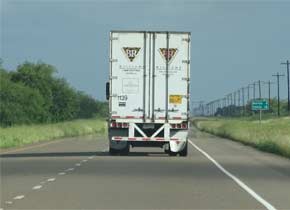
#6. The danger areas around trucks and buses where crashes are more likely to occur are called:
No-zones are danger areas around large vehicles where crashes are more likely to occur. No-zones on the side, front and rear also include blind spots where your car disappears from the driver’s view. Learning the No-zones can save your life!

#7. What should you do when you see this sign?
Move or merge right. Large electronic flashing arrow panels (move/merge right or left) placed in the roadway or mounted on vehicles advise approaching motorists of lane closures. Begin your merge well in advance of the sign.

#8. When driving past this sign:
The Do Not Enter and Wrong Way signs work as a team. The Do Not Enter sign is put at the beginning of one-way streets and ramps. When you see this sign, do not drive onto that street. Wrong Way signs are placed farther down the ramp or one-way street. If you pass this sign, you are driving the wrong way on a one-way street.

#9. If you hold a regular driver's license and your driving record reaches six or more points for a second time:
When a driving record reaches six or more points for the first time, the driver will receive a written notice to take a written special point examination. When the driving record is reduced below six points and reaches six or more points for a second time, the driver will have to attend a Departmental hearing. Further accumulations of six or more points will result in additional Departmental hearings and/or suspensions of your driving privilege.

#10. You should not use your horn:
Never honk your horn to encourage someone to drive faster or get out of the way.
Remember, you should use your horn when it is reasonably necessary to ensure safe operation. A light tap on the horn can be necessary when coming to a place where another driver or pedestrian might not see you, like a steep hill, a sharp curve, or exiting a narrow alley.
If there is a real danger, do not be afraid to honk your horn. For example, use your horn when a child is about to run into the street, when another vehicle is in danger of hitting you or if you have lost control of your vehicle.
There are several situations when you should not use your horn. They include:
- Encouraging someone to drive faster or get out of the way.
- Letting other drivers know they made a mistake.
- Greeting a friend.
- Around blind pedestrians.
- Passing bicyclists.
- When approaching horses.

#11. Always look carefully for motorcycles before you turn at an intersection because:
Motorcycles are small and, therefore, more difficult to see. The smaller profile can make it more difficult to judge the speed and distance as they approach. Before turning left, be alert for motorcycles by looking carefully to the front and sides of your vehicle. Their size also allows them to duck easily into your blind spot. Always make a visual check for motorcycles by checking mirrors and blind spots by turning your head and looking before entering or leaving a lane of traffic and at intersections.

#12. What is true about driving on a wet roadway?
At excessive speeds, your vehicle can begin to hydroplane on a wet roadway. Hydroplaning happens when your tires lose their grip on the road and ride like skis on a film of water. The faster you drive on a wet roadway, the less effective your tires become at wiping the water from the road. You can hydroplane at speeds as low as 35 mph, when water is only 1/10 of an inch deep. Worn tires make this problem worse. Hydroplaning can be reduced by driving slower.

#13. This sign means you:
This sign indicates a left turn is permitted, but you must yield to oncoming traffic. It is commonly placed at intersections, near the left-turn traffic signal, to remind drivers left turns are not protected when the circular green signal comes on.

#14. Does a posted speed limit of 65 mph mean you may always drive 65 mph on that highway?
Speed limits are maximum limits to be traveled only when driving conditions are ideal. When the road is wet or slippery, when you cannot see well or when anything else makes conditions less than perfect, drive below the posted speed limit. Even if you drivewithin the posted speed limit, you can still be ticketed for driving too fast for conditions.
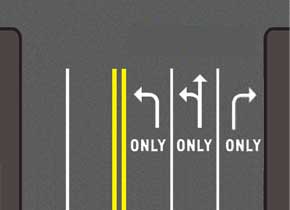
#15. These pavement markings tell you that at the intersection ahead
When a lane is marked with both a curved and straight arrow, turning or proceeding straight ahead is allowed. When a lane is marked with a curved arrow and the word ONLY, you must turn in the direction of the arrow.
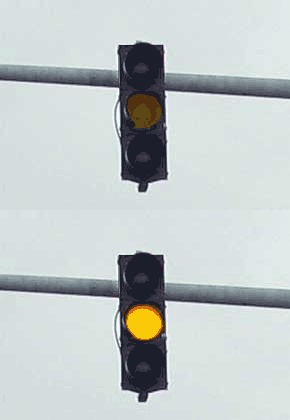
#16. You are coming to an intersection with a yellow flashing light. You should:
A flashing yellow light means caution. Slow down, look and proceed with care. You don’t need to stop for a flashing yellow light, but you must slow down and be especially alert before entering the intersection.

#17. The primary purpose of red road signs is to:
All red signs are regulatory signs and must be obeyed. They indicate stop or prohibition and include signs like: stop, yield, do not enter and wrong way. If you see red on a traffic device, STOP.
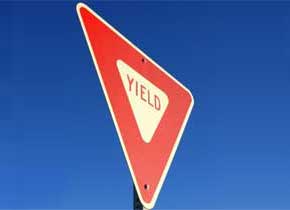
#18. It is illegal to park a vehicle if a yield sign is within:
Never stop, stand or park your vehicle within 30 feet of any flashing signal, stop sign, yield sign, or traffic control device located at the side of a roadway.
| This Pennsylvania Written Practice Test | |
|---|---|
| Number of questions on each test: | 18 |
| Question pool: | 500+ |
| Type of test: | Random multiple-choice |

| Pennsylvania Written Knowledge Test | |
|---|---|
| Number of questions on exam: | 18 questions |
| Passing score: | 84 percent |
| Correct answers to pass: | 15 |
| Allotted time to complete test: | No limit |
| Wait time before retest: | 1 day |
Pennsylvania (PennDot) Practice Tests
This permit practice test has 18 random study questions with answers found in the Pennsylvania Driver’s Manual. All questions are for the state of Pennsylvania. You are likely to find some on your real PA PennDot knowledge exam.
After each question, you will get instant feedback to help you learn faster. If you miss a question, a brief explanation enables you to understand the correct answer.
Using this practice test a few times is the easiest way to make sure you will pass the Pennsylvania knowledge test the first time.

How Should I Study?
Start by getting the latest version of the Pennsylvania Driver’s Manual. You can get it from a PennDOT location near you or download it online .
Read the manual to get an overview of what you must learn.
The next step is to use the practice tests to verify your progress and level of readiness. The manual is handy for quick reference whenever you miss a question. Try to understand each question and answer.
If you focus only on memorizing answers, you are much more likely to fail the exam.
Remember, you can take this test repeatedly until you have covered all critical items. Each set of questions is random, meaning you will see new questions each time you take the test.
How to Ace the driver’s license test .
What is the Passing Score on the PA Knowledge Test?
The passing score in Pennsylvania is 84 percent, which means you must answer at least 15 of 18 questions correctly.
It helps to always aim for a 100% score on the practice tests. Since the real exam only has 18 questions, you have little room for errors.
Who Must Take the Pennsylvania Knowledge Exam?
You must pass a knowledge exam if this is the first time you have had a license.
If you have a driver’s license from another state but let your license expire for more than six months, you must also take the test.
PennDot will waive the test if your out-of-state driver’s license is valid or has expired six months or less.
With an out-of-country license, you must pass the knowledge test unless you are a citizen of France, Germany, or Canada and hold a valid license from your home country.

More about the Pennsylvania Written Test
The PennDot knowledge exam aims to verify your knowledge of traffic signs, Pennsylvania’s driving laws, and safe driving practices.
You take the test on computer-based stations. The test is available in Arabic, Chinese (Mandarin), English, French, Hindi, Korean, Russian, Spanish, Ukrainian, and Vietnamese languages at all locations. Upon request, you can also take a voice (oral) test.
For individuals who are hard of hearing and communicate by sign language, the Bureau of Driver Licensing will provide an interpreter. Make sure you call the local office ahead of your test.
If you fail the knowledge exam, you must wait one business day before you can retake the test.
Pennsylvania Knowledge Test FAQ
How many questions are on the Pennsylvania knowledge test?
The Pennsylvania knowledge test for a learner's permit or driver's license has 18 questions. You need 15 correct answers to pass the test.
Is the Pennsylvania knowledge test hard?
The Pennsylvania knowledge test for a learner's permit or driver's license is considered fairly easy. It has basic questions about Pennsylvania driving rules. You can miss 3 of the 18 questions on the test and still pass.
Do I need an appointment for the knowledge test?
Under normal circumstances, you don't need to make an appointment. Look up your nearest service center, bring your completed Non-Commercial Learner's Permit Application (PDF), your completed Parent and Guardian Consent form (PDF) and required proof of identity and residency, and appropriate fee.
What happens if I fail the Pennsylvania knowledge test?
If you fail the knowledge test, you can take it again the next business day. Your fee is valid for three attempts. If you fail three times, you must pay the fee again.

What You Need to Know about the Pennsylvania Learner’s Permit
Holding a learner’s permit means you can begin your behind-the-wheel practice.
PennDOT issues the permit after you have completed a physical examination, vision screening, and knowledge test.
With your learner’s permit, you must practice driving for at least six months before PennDOT allows you to take the road test for a junior license. The permit is valid for one year.
The permit comes with some important rules:
You cannot drive alone.
The supervising driver must be 21 years or older.
An experienced, licensed driver 21 years or older must always accompany you. The supervising driver must sit beside you in the front seat.
Night-time driving is restricted.
You can only drive between 11 p.m. and 5 a.m. – if for employment or volunteer or charitable service.
Passengers restrictions apply.
You can have only one non-family member under 18 in the vehicle unless a parent or legal guardian is in the car.
Avoid Driver Points.
PennDot will suspend your permit for 90 days if you accumulate six points or have a high-speed violation (driving 26 miles per hour or more over the posted speed limit).
Practice driving for at least 65 hours
Before taking your skills test, a parent or guardian must certify that your behind-the-wheel practice included at least 65 hours of practical, adult-supervised driving experience before moving on to the next step.
Your driving practice must include 10 hours of night driving and five hours in poor weather conditions.
What You Need to Know about the Pennsylvania Junior License
After passing your road test, you are eligible for the Pennsylvania Junior License.
The following restrictions apply when driving with a Junior License:
Night-time restrictions.
You cannot drive between the hours of 11 p.m. and 5 a.m. Exceptions for employment and volunteer or charitable service will apply, but young drivers must carry proper documentation regarding their need to travel.
Passenger restrictions.
You can have only one non-family member under 18 in the vehicle. After six months, the restriction is at most three passengers under 18.
The law excludes immediate family members from the restriction.
The restriction also does not apply if you have a parent or legal guardian in the vehicle.
Pennsylvania Learner’s Permit FAQ
Can I drive at night with a Pennsylvania Learner's Permit?
With a learner's permit you cannot drive between the hours of 11 p.m. and 5 a.m. if you are under 18 years. You may, however, drive during these hours if it is for employment and for volunteer or charitable service. Under no circumstances are you allowed to drive without a supervising licensed driver who is 21 years or older.
There is no nighttime restriction if you are 18 years or older.
Can I drive with passengers if I have a Pennsylvania Learner's Permit?
If you are under 18 years and hold a Pennsylvania Learner's Permit you can drive with only one non-family member under 18 in the vehicle. You may drive with family members and also friends that are 18 years or older. An experienced, licensed driver 21 years or older must always accompany you.
There is no passenger restriction if you are 18 years or older.
Can I drive to work or school if I hold a Pennsylvania Learner's Permit?
Yes, you may drive to work or school if an experienced, licensed driver 21 years or older is sitting beside you. Under no circumstances may you drive unsupervised.
How long must I hold a Pennsylvania Learner's Permit?
If you are under 18 years there is a six-month waiting period before PennDOT lets you take the driving test. You must have completed at least 65 hours of driving practice, including 10 hours of night driving and five hours of driving in poor weather conditions.
How many hours of behind-the-wheel practice do I need before I can take the Pennsylvania road test?
The graduated licensing law in Pennsylvania requires that you practice driving for at least 65 hours. These hours must include 10 hours of driving at night and five hours of driving in poor weather conditions.
What You Need to Know about the Pennsylvania Learner’s Permit
Holding a learner’s permit means you can begin your behind-the-wheel practice.
PennDOT issues the permit after you have completed a physical examination, vision screening, and knowledge test.
With your learner’s permit, you must practice driving for at least six months before PennDOT allows you to take the road test for a junior license. The permit is valid for one year.
The permit comes with some important rules:
You cannot drive alone.
The supervising driver must be 21 years or older.
An experienced, licensed driver 21 years or older must always accompany you. The supervising driver must sit beside you in the front seat.
Night-time driving is restricted.
You may drive between 11 p.m. and 5 a.m. only if it is for employment, volunteer, or charitable service.
Passenger restrictions apply.
You may have only one non-family passenger under 18 in the vehicle unless a parent or legal guardian is present
Avoid Driver Points.
PennDot will suspend your permit for 90 days if you accumulate six points or have a high-speed violation (driving 26 miles per hour or more over the posted speed limit).
Practice driving for at least 65 hours
Before taking your skills test, a parent or guardian must certify that your behind-the-wheel practice included at least 65 hours of adult-supervised driving before moving on to the next step.
Your driving practice must include 10 hours of night driving and five hours in poor weather conditions.
What You Need to Know about the Pennsylvania Junior License
After passing your road test, you become eligible for the Pennsylvania Junior License.
The following restrictions apply when driving with a Junior License:
Night-time restrictions.
You cannot drive between the hours of 11 p.m. and 5 a.m. Exceptions for employment and volunteer or charitable service will apply, but young drivers must carry proper documentation regarding their need to travel.
Passenger restrictions.
You can have only one non-family member under 18 in the vehicle. After six months, the restriction increases to a maximum of three passengers under 18.
The law excludes immediate family members from the restriction.
The restriction also does not apply if you have a parent or legal guardian in the vehicle.
Pennsylvania Learner’s Permit FAQ
Can I drive at night with a Pennsylvania Learner's Permit?
With a learner's permit you cannot drive between the hours of 11 p.m. and 5 a.m. if you are under 18 years. You may, however, drive during these hours if it is for employment and for volunteer or charitable service. Under no circumstances are you allowed to drive without a supervising licensed driver who is 21 years or older.
There is no nighttime restriction if you are 18 years or older.
Can I drive with passengers if I have a Pennsylvania Learner's Permit?
If you are under 18 years and hold a Pennsylvania Learner's Permit you can drive with only one non-family member under 18 in the vehicle. You may drive with family members and also friends that are 18 years or older. An experienced, licensed driver 21 years or older must always accompany you.
There is no passenger restriction if you are 18 years or older.
Can I drive to work or school if I hold a Pennsylvania Learner's Permit?
Yes, you may drive to work or school if an experienced, licensed driver 21 years or older is sitting beside you. Under no circumstances may you drive unsupervised.
How long must I hold a Pennsylvania Learner's Permit?
If you are under 18 years there is a six-month waiting period before PennDOT lets you take the driving test. You must have completed at least 65 hours of driving practice, including 10 hours of night driving and five hours of driving in poor weather conditions.
How many hours of behind-the-wheel practice do I need before I can take the Pennsylvania road test?
The graduated licensing law in Pennsylvania requires that you practice driving for at least 65 hours. These hours must include 10 hours of driving at night and five hours of driving in poor weather conditions.
Pennsylvania Knowledge Test on Video
Video: Pennsylvania Driver’s License Test – 18 Questions
Video 2: Pennsylvania License Exam Questions and Answers
Pennsylvania Road Sign Test – 15 Road Signs
This road sign practice test offers a unique way of studying some common road signs that may appear on your official driver’s license test in Pennsylvania. It has 15 road sign questions. You can find a description of all signs in the Pennsylvania Driver’s Manual.


