
Free Oklahoma Driver’s License Tests & Permit Practice – Get it Here
Results
Good job! This is a passing score. Do you want to try again?
Unfortunately, this is not a passing score. Do you want to try again?


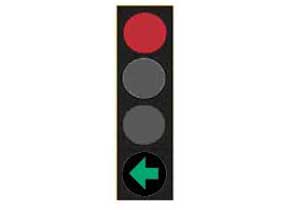
#1. At this red traffic light with a green arrow, you may proceed in the direction of the arrow:
When the green arrow is lit, you may go in the direction of the arrow, even when the red light is still on. If you are in a turning-only lane, you must wait for the arrow. You can only make the turn indicated by the arrow unless there are signs with other information. If there are turning lanes, you must be in the proper lane to make the turn.
Enter the intersection cautiously. You must yield to pedestrians in the crosswalk and to other vehicles legally in the intersection.

#2. If your vehicle breaks down on a highway:
If you have a breakdown, an emergency, or have to stop for some reason, signal, and then pull off to the extreme right shoulder away from moving traffic where it is safe. Turn on your emergency flashers.
If you need help, raise your hood and tie a white cloth to the hood or radio antenna.
When you are out of your car, never walk near the roadway. Keep children away from the traffic.
Remember, if your car is blocking the flow of traffic, you must move it off the roadway.

#3. When being passed by another car, you should:
Do not increase your speed. If a car approaches from the other direction while you are being passed, slow down and let the passing driver pull in front of you.

#4. What does this sign mean?
This is a regulatory No Pedestrian sign. It means that no pedestrians are allowed on the road.

#5. To avoid glare from the high-beam headlights of an approaching car:
Avoid glare from oncoming lights by looking down to the right hand edge.
Do not wear sunglasses or colored glasses when driving at night or on dark days. Glare from oncoming headlights, billboard and advertising lights, and in some conditions, from streetlights, can interfere with your night driving vision because your eyes take longer to adjust. Colored lenses cause your eyes to adjust even more slowly and can reduce your vision.

#6. A sign with this shape means:
Four-sided diamond-shaped signs warn you of existing or possible hazards on roadways or adjacent areas.

#7. Which of the following vehicles must always stop before crossing railroad tracks?
Some vehicles must stop before crossing train tracks. These vehicles include buses, church buses, school buses, and trucks transporting hazardous loads.

#8. A good rule of thumb for calculating the safe distance between you and the car ahead is:
Stay 3 seconds behind the vehicle in front of you. Allow 4 seconds or more in bad weather. With a safe following distance you give yourself time and distance to respond to problems.

#9. When driving at night in a city, you should normally use:
Use low beams when following other vehicles, when meeting oncoming vehicles, and when driving in the city where there are streetlights. Use high beams only when driving in the open country without other cars near. Parking lights are not for highway driving.
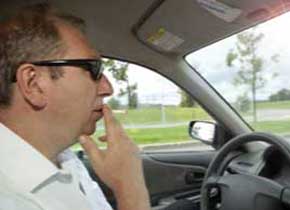
#10. A drug conviction while using a motor vehicle will result in:
State law requires that the driving privilege be revoked for any drug conviction (misdemeanor or felony – does not have to involve a motor vehicle).

#11. In general, you will find the most alcohol in:
Remember this sobering fact about alcohol: it is not what you drink, it is how much. A 12 oz. can of beer, a 5-ounce glass of wine, and a cocktail with 1.5 ounces of 80 proof distilled spirits all contain the same amount of alcohol.
Note that it was 4 ounces of whisky in the question.

#12. On which side should you pass a vertical panel like this?
Stripes on barricades and panel devices slope downward in the direction traffic must travel.
Stripes sloping downward to the left mean the driver should bear to the left. Stripes sloping downward to the right mean the driver should bear to the right.

#13. What does this sign mean?
Stop sign ahead. When you come to this sign, slow down to be ready to stop at the stop sign.

#14. This hand position on the steering wheel is:
Use a solid, strong grip on the steering wheel. You should have at least 1/3 of the wheel between your hands to have a strong turning force with either hand. Think of the steering wheel as a clock. Generally, your left hand should be between 9:00 and 10:30 and your right hand between 2:00 and 4:00.
To help avoid injury if your vehicle’s airbag goes off, experts say it is best to hold the steering wheel with your right hand at 3:00 and your left hand at 9:00.

#15. Defensive driving means that you should:
Defensive driving means you should do everything you can to avoid getting into trouble in traffic and on the road. Obey all traffic rules and be prepared to adjust for driving errors of others. Have a plan of action in case another driver does something stupid.
Remember, drivers should protect each other from their own mistakes.
Study the list of defensive driving tips in your driver’s manual.

#16. When you park and leave your car, you must:
Remember, when you leave your car:
- Set the parking brake.
- Put the gear in low, reverse, or park.
- Turn off the motor.
- Lock the ignition and remove the key.
It is always a good practice to lock your car, even in your own driveway.

#17. The easiest way to avoid lingering in a truck's blind spots is to:
The easiest way to avoid lingering in a blind spot is to look for the truck driver’s reflection in the side mirror. If you cannot see the driver’s reflection, or cannot see the side mirrors at all, you are in the truck driver’s blind spot.

#18. When two vehicles from different directions arrive at the same time at a four-way stop, which one must yield?
At four-way-stop intersections and at intersections without stop signs or signals, the car or truck that entered the intersection first has the right-of-way. When two vehicles approach at the same time, the driver on the left yields to the driver on the right.
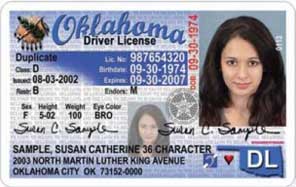
#19. An Oklahoma driver's license generally is valid for:
Your license is issued for four years from the month in which you paid your fee and received your license. It expires the last day of the month.

#20. Before turning, signal continuously for at least:
Signal at least 100 feet before you change lanes, turn right or left, merge into traffic, or park.

#21. To make a safe left turn, you should do all the following except:
You should not keep close to the right edge pavement marking. Well ahead of the turn, you should move over close to the center line.
(Remember to read all questions carefully, this one asked what you should not do).

#22. If you encounter an aggressive driver on the road, it is wrong to:
Avoid eye contact with an aggressive driver. Just get out of the way.
This question asked what you should not do.

#23. You want to turn left ahead. There is a two-way left-turn lane in the center of the road. What should you do?
Enter the lane while preparing for the turn. Do not use any other lane for the turn.

#24. You approach this road sign. What does it tell you?
Two roadways come together ahead with a new lane added. You do not have to merge (form one line), but watch for traffic in the new lane.

#25. What should you expect ahead when you see this sign?
Divided highway begins ahead. Two-lane highway ends. The highway ahead is divided into two one-way roadways with a center strip (median).
| This Oklahoma DPS Sample Test | |
|---|---|
| Questions on each practice test: | 25 |
| Question pool: | 500+ |
| Type of test: | Random multiple-choice test |
Facts about Your Oklahoma Knowledge Test
| Oklahoma Written Knowledge Test for Permit or Driver’s License | |
|---|---|
| Number of questions on exam: | 50 questions |
| Passing score: | 80% |
| Correct answers to pass: | 40 |
| Allotted time to complete test: | No limit |
| Wait time before retest: | 1 day (first three tests) |
Oklahoma Practice Tests – 25 Questions
This free permit practice test at Driver’s Prep has 25 random test questions. Each set of questions will help you prepare for the real Oklahoma exam and speed up your learning.
All questions are the same or similar to real Oklahoma written knowledge test questions, and all answers are in the latest Oklahoma Driver’s Manual.
After each practice question, you will get instant feedback and the correct answer. It helps you learn faster.
If you miss a question, a brief comment will help you understand why your answer was wrong.
Oklahoma Real Knowledge Tests – 50 Questions
Please note that the official knowledge test in Oklahoma has 50 random questions about road signs, traffic signals, safe driving techniques, and Oklahoma traffic laws. The real test will take slightly longer to complete.
Questions on the actual exam are from the latest version of the Oklahoma Driver’s Manual. Therefore, you should always get the newest version of the Oklahoma Driver’s Manual.
You can get the manual for a small fee at Motor License agents (Tag Agents ).
You can also download a free PDF version from oklahoma.gov .
After reading the manual and learning the basic driving rules, you should familiarize yourself with the practice tests.

The passing score in Oklahoma is 80 percent, which means you must answer at least 40 of the 50 questions correctly.
Getting 80 percent on the practice test is also good. But aiming for a full score on each practice test is better. Ensure you fully understand why an answer is correct (or incorrect); it will help on the exam.
Remember, all our tests are 100% free. So, take enough tests to feel comfortable with all answers.
The examination format has (in general) stayed consistent over the last decade. It helps you understand what kind of knowledge the DPS checks for., which can be just as important as learning the content.
Read more about: How to Ace the DMV test .


Who Must Take the Oklahoma Knowledge Test?
All persons applying for an original first-time Oklahoma license must pass the knowledge test.
If you want to renew a license that expired more than three years, you must retake all tests, including the written knowledge exam.
When you want to transfer a valid (not expired) out-of-state license to an Oklahoma driver’s license, DPS will waive written and driving tests if the license meets department standards.
If you have an out-of-country license, you must generally take all tests. Exemptions exist for drivers with a driver’s license from Canada or Germany who must pass only the vision screening.
You cannot get a driver’s license or permit if your driving privilege has been canceled, suspended, or revoked in Oklahoma or any other state.

The Official Exam
As we already said, you can find all answers to the questions on the Class D license exam in the official Driver’s Manual. That is why you should make sure you read it.
The test has questions about Oklahoma traffic laws, safe driving practices, traffic signs and signals, and drug and alcohol laws/effects.
If you need an oral test instead of a computerized one, call ahead and make an appointment.
Unlike many other states, the test is only available in English and Spanish. You can bring an interpreter if needed. Oklahoma DPS will not pay for the interpreter.
Appointments
Avoid the inconvenience of standing in line at the DPS. The new scheduling service offers the opportunity to make appointments from your mobile device or computer.
Unfortunately, there is a small fee for using the online scheduling system.
Oklahoma Sample Test Video – When You Are on the Go
This video shows 40 questions about highway signs, traffic signals, and road markings. The essential things you must know for your Oklahoma driver’s exam.
Watch it and see if you really know all answers!


