
Indiana BMV License Tests & Permit Practice
Results
Great job. This is a passing score. Do you want to try again?
This is not a passing score. Do you want to try again?


#1. If you have a probationary driver's license, you may use a cell phone while driving:
Indiana law prohibits probationary license holders from operating a motor vehicle while using any form of telecommunications device, such as a wireless phone, personal digital assistant, pager or text messaging device unless the device is being used to make a 911 emergency call.

#2. Following another vehicle too closely will result in the following points on your driving record:
Following another vehicle too closely will result in six points.

#3. The first rule for a safe and legal turn is to:
The first rule for a safe and legal turn is to move into the proper lane well before the turn. To turn left, be in the far-left lane for your direction of travel. To turn right, be in the far right lane for your direction of travel.
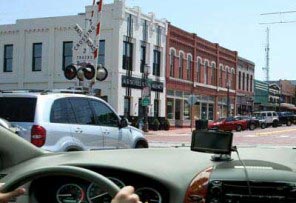
#4. A driver should never begin to cross railroad tracks unless:
A driver should never begin to cross railroad tracks unless the tracks can be cleared without stopping.

#5. If a fog becomes so thick that you can barely see the road ahead, you should:
If fog closes in completely, and visibility is reduced to near zero, carefully pull off the road as far as possible and stop. Keep flashing emergency signals turned on.
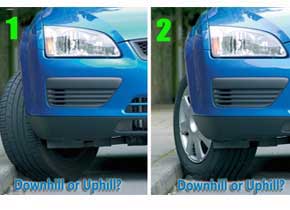
#6. Which photo shows proper parking on a sloping street when the vehicle is facing downhill?
When you park facing downhill, turn your vehicle’s wheels toward the curb. When you park facing uphill, turn your vehicle’s wheels away from the curb. If there is no curb, turn your vehicle’s wheels away from the street.

#7. What is the best way to reduce the chance of injury or death in a crash?
Wearing a seat belt is the best way to reduce the chance of injury or death in a crash – and it is the law.

#8. Worn tires can cause:
Worn or bald tires can increase your stopping distance and make turning more difficult when the road is wet. Worn tires also increase the effect of hydroplaning and increase the chance of having a flat tire.

#9. What is true about a designated center lane for left turns?
Busy roads on which there are many places a vehicle may make a left turn often have a center lane designated solely for the left-turning vehicles. Always be aware that vehicles traveling in the opposite direction may be entering the center lane to turn left in front of your vehicle. Never use this type of center lane for passing other vehicles.
Designated center lanes for left turns can usually be identified by a sign with alternate directional arrows that states CENTER LANE ONLY or with pavement arrows, although some center lanes do not have signs or pavement arrows.

#10. When entering an interstate highway, you must:
Drivers already on the interstate should make allowances for those entering. However, drivers entering an interstate must yield the right of way to vehicles on the interstate.

#11. In Indiana, it is a criminal offense to drive with a blood alcohol concentration (BAC) above the legal limit. The legal limit is:
Operating a vehicle while intoxicated or with a blood alcohol concentration (BAC) in excess of the legal limit (.08) is a criminal offense and has an immediate effect on your privilege to operate a vehicle.

#12. You approach a school bus from behind. It displays amber flashing lights at the top. You must:
School buses are equipped with both amber and red flashing lights. When the school bus driver activates the amber lights, they is warning other drivers that the bus is slowing and is going to load or unload children. Once the bus stops, the red lights and stop arm will be activated.

#13. The risk of hydroplaning increases:
Chances of hydroplaning increases with speed and, at any point your tires may be in contact only with the oil, dirt and water. If this happens, there is no friction to brake, speed up, or turn, and a gust of wind, a change of road level, or a slight turn can cause you to lose control of your vehicle.
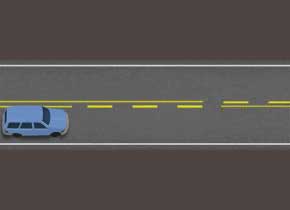
#14. When can you cross the yellow center lines to pass another vehicle?
Yellow lane markings separate multiple lanes of traffic going in opposite directions. You may cross a broken yellow line to pass another vehicle when it is safe, but you must not cross a solid yellow line except to turn.
Remember, it is dangerous and illegal to try to pass other vehicles when a solid yellow line is marked on the driver’s side of the center line of the road.

#15. If it appears that your car will hit something, there are three things you can do:
Despite safe driving, emergencies do arise. If it appears that a car will hit something, there are three things you can do, depending on the situation:
- Stop quickly
- Turn quickly. If you feel you cannot stop in time, turn your vehicle away from the potential collision
- Speed up. Accelerating may be the best or only way to avoid a collision.

#16. The blind spot behind a tractor-trailer may stretch up to:
Blind spots for the tractor-trailer driver will be up to 20 feet in front of the cab, on either side of the trailer, alongside the cab and up to 200 feet behind the vehicle.

#17. When driving on a slippery surface, you should:
When you are driving on a slippery surface, your tires may lose contact with the road. There may be no friction to brake, speed up, or turn. A gust of wind, a change of road level, or a slight turn can cause you to lose control of your vehicle.

#18. What is the best thing you can do if your wheels run off the pavement?
If your wheels drift onto the shoulder of the road, do not try to turn back onto the pavement right away. This action might throw your vehicle off balance. Instead, drive along the shoulder and ease up on the gas pedal. After slowing down, turn back onto the road gradually.

#19. Why is it important not to drive with a defective muffler or exhaust system?
Carbon monoxide gas from a vehicle engine can harm or kill you or your passengers. Carbon monoxide is most likely to leak into a vehicle when its heater is running, when the exhaust system is not working properly, or in heavy traffic where exhaust fumes are breathed from other vehicles.
How to avoid carbon monoxide poisoning:
- Have your vehicle’s exhaust system checked regularly.
- Be alert for any unusual roar from under the car.
- Never let your vehicle’s engine run in a closed garage.
- In congested traffic, close the fresh-air vent.
- On highways in cold weather, open the fresh-air vent.

#20. You approach this traffic signal. What is true about making a right turn at this intersection?
Left turns and thru traffic and, if not otherwise prohibited, right turns may proceed, when safe.

#21. What is the first thing you should do if you have a traffic accident and someone is injured?
If the accident results in the injury or death of another person, you must give reasonable assistance to each person injured in or entrapped by the accident. You must get help by making sure local police, county sheriff, or a 911 telephone operator is notified.
Do not move an injured person unless it is absolutely necessary. Never give injured persons anything to drink, not even water.
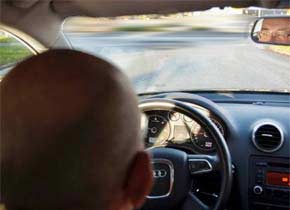
#22. Which of the following conflicts with other traffic and is more hazardous?
A U-turn is a maneuver in which a driver changes direction by making a 180-degree turn. It is potentially dangerous and should only be undertaken when not prohibited by law.

#23. Whenever traveling in a work zone, you should:
- Stay alert. Look for reduced speed limits, narrow driving lanes and highway workers.
- Pay attention. Work zone signs will state exactly what to expect ahead.
- Merge early. If merging at first sight of signs, traffic will flow more smoothly.
- Slow down. If you are speeding when you approach a work zone you will encounter slowed or stopped traffic within seconds.
- Don’t tailgate. Maintain a safe distance on all sides of your vehicle.
- Minimize distractions.
- Plan ahead and expect delays.

#24. Which is one factor that significantly affects your stopping distance?
Many factors affect a vehicle’s ability to stop. Some of the most important are:
- Weight of vehicle.
- Type and condition of brakes.
- Type and condition of tires.
- Physical condition of pavement.
- Slickness of pavement.
- Grade of road.

#25. Driving around traffic barricades or past road closed signs is allowed:
Do not drive around traffic barricades or past road closed signs.
It is not legal to enter a road that is officially closed due to hazardous conditions.

#26. The two-to-three-second rule refers to how you should:
A good rule for drivers to follow is to stay at least two to three seconds behind the vehicle ahead. When following a vehicle, watch for the vehicle ahead to pass a fixed object and estimate how much time elapses before you pass the same object.
The two-to-three-second rule is a minimum safe distance when road conditions are clear and dry.
Allow at least three or four seconds when following a motorcycle so the motorcyclist has enough time to maneuver or stop in an emergency.
When following behind a tractor-trailer, if you cannot see the tractor-trailer driver’s rear-view mirrors, the tractor-trailer driver cannot see you. Tailgating a tractor-trailer is dangerous.

#27. Unless otherwise posted, the maximum speed limit in an alley is:
In alleys, vehicles may not exceed 15 miles per hour or the posted speed limit.

#28. A good defensive driver:
Defensive driving means that you should look out for the actions of other drivers and anticipate dangerous situations.

#29. You must yield to a pedestrian using a white cane or guide dog:
Drivers must always yield the right of way to persons who are blind.
Traveling aids for a person who is blind are often a white cane or a trained guide dog. Independent travel for people with visual disabilities involves some risk that can be greatly reduced when drivers are aware of the use and meaning of a white cane or guide dog.

#30. When approaching a stationary emergency vehicle with flashing lights on a multi-lane highway, you must:
When you see a stationary emergency vehicle with flashing lights, you must slow down and move into a lane that is not adjacent to the emergency vehicle, if it is possible to do so safely. If it is not possible to do so safely, you must slow down and proceed with caution.

#31. If you have already entered an intersection to make a turn when the traffic signal changes from yellow to red, you should:
If you are facing a steady yellow light, your right-of-way is ending. Remember, you should stop for a yellow signal, unless you are too close to the intersection to stop safely. If you cannot stop safely, drive cautiously through the intersection after yielding the right of way.
Never speed up to beat the red signal.

#32. After passing another vehicle and before returning to the proper lane, it is best to:
Continue to move forward until you can see the vehicle that you are passing in your rear-view mirror. Before returning to the lane in which you were originally driving, use the appropriate turn signal.

#33. This hand signal means:
Slowing or stop – left arm extended downward, with the palm to the rear.

#34. True or false? Before entering a roundabout, you must always stop.
A roundabout allows you to continue through without stopping at a stop sign or a traffic signal. The roundabout is typically controlled with yield signs.
| This Practice Test | |
|---|---|
| Number of questions on each practice test: | Indiana Road Rules: 34 |
| Question pool: | 500+ |
| The test is randomized and not an official test | |
Facts about the Indiana BMV Knowledge Examination
The Two-Part BMV Permit Practice
The driver’s exam in Indiana has a two-part written test with 16 sign questions and 34 multiple-choice questions about road rules.
This Indiana sample test focuses on the road rules part, with 34 questions randomly picked from an extensive database.
After each test question, you will see the correct answer. If you miss a question, there is also a short explanation. At the end of the test, you will see your score.
You can find the answers to all test questions in the latest version of the Indiana Driver’s Manual.
Indiana’s total passing score is 84 percent (slightly higher on the road signs sequence and lower on the road rules sequence).
When studying for your actual examination, you should score close to 100% on each sample test, which will give you a safe margin when you attempt the real thing.

Your Way to Success
Visit your nearest Indiana BMV office or go online to get the latest version of the Driver’s Manual.
You need to review and understand the contents of this booklet, including road signs, signals, safe driving, and Indiana traffic rules and laws.
When you take a practice test, have the manual handy. Look up information in the manual to speed up your learning. Discuss tricky questions with a friend or a parent. Putting words to things you don’t understand will also help your learning process.
Read more: How to Ace the Test.
Who Must Take the Indiana Knowledge Exam?
You must pass Indiana’s written knowledge test when you:
- Apply for a learner’s permit
- Become a new Indiana resident and hold an out-of-country driver’s license
- Let your driver’s license expire for more than 180 days
- Have six or more active points on your driving record and want to renew your driver’s license
Note that holders of a valid out-of-state driver’s license are no longer required to pass the knowledge test. Like many other states, BMV waives the tests if you hold a valid license from another state.
What You Must Know about the Indiana Knowledge Test
BMV bases the Official written knowledge test on information in the driver’s manual. The purpose of the test is to make sure you have read the manual and have a good understanding of traffic laws and safe driving practices.
Read more: Are the DMV Practice Tests Enough?
It is best to arrive at a licensing branch one hour before closing. Otherwise, you will not be allowed to take the test.
If you fail the test, you must wait until the next business day before you can retake it.

Indiana Knowledge Test – FAQ
How many Questions are on the Indiana BMV Test?
There are 50 multiple choice questions on the Indiana knowledge test. 16 questions are about common road signs and the other 34 questions deal with safe driving techniques. You need 14 correct answers on the road sign part and 28 correct answers on the second part.
Is the Indiana BMV test difficult?
The Indiana BMV test is generally considered medium hard. Failure rate is estimated to 30%.
Do I have to make an appointment for the Indiana BMV knowledge test?
The Indiana knowledge test is offered on a walk-in basis. No appointment is needed unless you need assistance when taking the test. Appointments for applicants who are deaf or hard of hearing can be made by a branch manager or by calling the BMV’s Contact Center.
Is there a time limit on the Indiana BMV knowledge test?
You are expected to finish your test within 45 minutes, but there is no official time limit.
What happens if I fail the Indiana knowledge test?
If you fail the knowledge exam you must wait until the next business day before taking the test again.
Is the Indiana knowledge test available in other languages?
The Indiana knowledge test is available in: Arabic. Burmese, Chinese, French, German, Japanese, Korean, Polish, Punjabi, Russian, Simplified Chinese, Spanish, and Vietnamese.
How long must you study for the Indiana knowledge test?
By preparing 3 or 4 weeks ahead of the real test, you have a better chance of passing the first time. Read the manual at least twice. Take many practice tests and discuss traffic rules with friends and family.


Apply for a Permit – Get Your Documents Ready
Remember, when you apply for a learner’s permit or driver’s license, you must prepare your documents. BMV will ask for the following:
Proof of your identity
The most common documents you can use to prove your identity include an original U.S. birth certificate, unexpired United States passport, and foreign passport with a visa and I-94 form (checkout this list with approved documents).
Social Security Number
It is best to bring your Social Security card. However, you can also show a W-2 form or a pay stub with your name and Social Security number.
Legal Presence
Your legal status is usually shown on your U.S. birth certificate or unexpired passport. Still, if you were born abroad or hold a foreign passport, you must show proof of legal presence, like an unexpired visa.
Two Docs Proving Indiana Residency
The easiest way to prove residency is to get a statement from your bank/credit card company and a utility bill with your name and address. Pay stubs are also a common way of proving your Indiana residency. Documents must not be older than 60 days when you visit a BMV branch.
If you cannot provide two original documents proving your Indiana residency, you may submit an Indiana Residency Affidavit instead. The affidavit must be signed by an individual at least 18 years of age and with whom you reside. The individual signing an Indiana Residency Affidavit must present their unexpired Indiana driver’s license or identification card, one document proving identity, and two documents proving their Indiana residency.
What is a Learner’s Permit?
The Learner’s Permit allows you to practice driving before you get a full driver’s license.
BMV may issue a learner’s permit if you are at least 15 and enrolled in an approved behind-the-wheel training course.
To get a learner’s permit without enrolling in or completing a driver’s education course, you must be 16 or older.
With a learner’s permit, you must always drive under the supervision of a licensed driver. The supervising driver must meet certain requirements. For details, please visit the BMV website.

