
2026 Iowa MVD Test & Permit Practice – 100% Free
Results
Congratulations, this is a passing score on the Iowa knowledge test. Do you want to try again?
Sorry, this is not a passing score on the Iowa knowledge test. Do you want to try again?


#1. If an intersection is blocked and you cannot drive through without having to stop in the intersection:
Do not enter an intersection until it is clear. Do not interfere with other traffic or block the intersection.

#2. You need to drive more slowly at night because:
You should drive a little slower at night because it is easy to over drive your headlights. That means the distance you can see is shorter than the distance in which you can stop.

#3. You must always keep proof of your liability insurance:
Drivers of vehicles registered in Iowa must carry with them an insurance card verifying liability coverage is currently in force. Failure to do so could result in fines and possible impoundment of the vehicle.

#4. Which shape is used for stop signs?
Stop signs are always octagonal (eight-sided). A stop sign means that you must bring your vehicle to a complete halt.
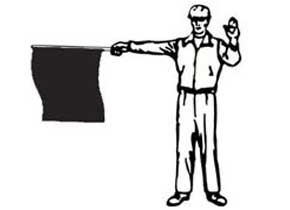
#5. What color do flag persons in construction zones generally wear on vests, shirts, or jackets?
They should be wearing lime green or orange vests, shirts, or jackets.

#6. Left turns on a red light are:
Traffic facing a steady circular red signal must come to a complete stop at the stop line or before entering the intersection.
The driver must remain stopped until allowed to proceed by another indication. The only exception is to make a permitted turn on red.
A driver may turn right on red at the intersection of two-way streets or may turn left on red from a one-way street to another one-way street. These turns may be made after yielding to all other traffic and pedestrians, and if no signs are posted to prohibit them.

#7. If you have a tire blowout while driving, you should:
If a tire suddenly goes flat, hold the steering wheel tightly and keep the vehicle going straight. Slow down gradually. Take your foot off the gas pedal and use the brakes lightly. Gradually move to the right shoulder of the roadway when safe.
A front tire blowout will jerk the car violently towards the side of the car with the flat. Be careful not to overcorrect when steering after a front tire blowout.
Remember, it is dangerous to brake or steer off the road before your vehicle is under control.

#8. You must turn on your headlights:
Iowa law requires you to use your headlights from sunset to sunrise or whenever visibility is 500 feet or less.
It is a good idea to turn on headlights whenever the windshield wipers are in use.

#9. A three-point turn should only be used:
This is the most difficult and dangerous way to turn around. Use it only when the road or street is too narrow to make a U-turn and you cannot go around the block.
#10. Visitors at least 16 years with a driver's license from a foreign country may drive in Iowa, as long as:
You do not need an Iowa driver’s license if you are a student or visitor and have a current license from your home state or country.

#11. To avoid panic stops, you should:
Try to avoid panic stops by watching for things well ahead of you. By slowing down or changing lanes, you may not have to stop at all. If you do have to stop, it can be a more gradual and safer stop.

#12. A five-sided sign means:
The pentagon (five-sided) shape warns you of school zones and marks school crossings.

#13. You approach this road sign. It means:
Keep Right. The road ahead is divided. Stay on the right side of the island or barrier.
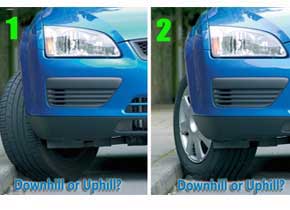
#14. Which photo shows proper parking on a sloping street when the vehicle is facing downhill?
This how you park on hills:
- If you park facing uphill where there is a curb, you should set the parking brake and turn the wheels away from the curb.
- In any other situation turn the wheels toward the curb or edge of the road.

#15. Why should you always look carefully for motorcycles before changing lanes?
When changing lanes, you must check for other road users. Remember there are other road users such as motorcycles, bicycles, and pedestrians that are harder to see than cars and trucks.

#16. What does this sign mean?
Deer crossing. There may be deer trying to cross the roadway in the area. Slow down and watch carefully.

#17. You approach a stopped emergency vehicle with flashing lights. If it is unsafe to move over or change lanes, you should:
If a lane change is not possible, prohibited by law, or unsafe, you must slow down to a reasonable and proper speed for the existing conditions and be prepared to stop.

#18. Always signal to other drivers when you:
Turn signals give other drivers time to react to your moves. You should use your turn signals before you change lanes, turn right or left, merge into traffic, or park. Signaling your turns is always something you should do for safety reasons.

#19. Why should you be prepared to stop when approaching a railroad crossing and there is a truck with a hazardous load ahead?
Watch for vehicles that must stop at railroad crossings. All school buses and vehicles carrying passengers for hire, and all vehicles required to be placarded for hazardous materials, must stop within 15 to 50 feet of railroad tracks before crossing.
Remember, if you are following this type of vehicle you should slow down and be prepared to stop. It is against the law to pass any vehicle within 100 feet of a railroad crossing.

#20. When driving inside a roundabout, do not:
Do not drive beside trucks or buses. They may straddle lanes or may not see you.
This question asked what you should not do.

#21. When overtaking another vehicle on a two-lane road, you must:
Signal properly to show you intend to change lanes. Signal early enough to allow other drivers to know your intentions.
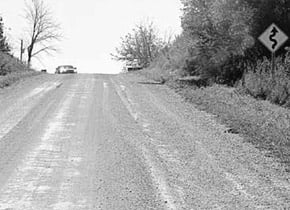
#22. As you approach the crest of a hill, you should:
Hills and curves on rural roads are often steeper and sharper than on highways. Before reaching the crest of a hill or before entering a curve, slow down, move to the right side of the road and watch for oncoming vehicles.

#23. The most considerable risk with airbags is:
The biggest risk is being too close to the airbag. In an airbag-equipped vehicle, there should be a 12-inch clearance between you and the steering wheel hub.

#24. Which of the following does alcohol affect?
In your brain, alcohol affects those areas of your brain that control judgment and skill. Alcohol slows your reflexes and reaction time, reduces your ability to see clearly, and makes you less alert. You will have trouble judging distances, speeds, and the movement of other vehicles. Alcohol also reduces your coordination and relaxes your eye muscles, causing your vision to lose its sharpness.

#25. Stop lines, crosswalks, and parking spaces are marked with:
Stop lines, crosswalks, and parking spaces are marked with white lines.

#26. This sign tells you that there is:
Railroad Crossing.
This sign alerts motorists that a railroad crossing is ahead.
| This Iowa Practice Test | Number of questions on each practice test: | 25 |
|---|---|
| Question pool: | 750+ |
| The Iowa practice test is random | |
Facts about the Iowa MVD Knowledge Examination
| MVD Knowledge Test for Permit and Driver’s License | |
|---|---|
| Number of questions on the permit exam: | 35 |
| Passing score: | 80 percent |
| Correct answers to pass: | 28 |
| Allotted time to complete test: | No limit (but must start 30 minutes before closing) |
| Wait time before retest: | 1 day [761-604.20] |
Practice Tests for Your Iowa Instruction Permit and Driver’s License
Studying for your driver’s license or instruction permit just became much easier with more sample questions and answers based on the official driver’s manual and actual examinations from the Iowa Motor Vehicle Division (MVD). You can pass the Iowa knowledge exam the first time with these practice tests.
Each practice test has 25 random questions from a large bank of verified questions and answers. After each test question, you will get instant feedback, including a short explanation if your answer is incorrect, which will help you learn the Iowa rules of the road a lot faster.
Remember, don’t try to simply memorize questions and answers. You will be much better off if you also understand why an answer is correct. Check the information in the driver’s manual when you need clarification.
Read more: Risky Study Tactics .

1 Start by Getting the Driver’s Manual
You will only pass the test with a good overview of the contents in the official Driver’s Manual.
Start by getting the latest version of the manual. You can get it online or from any MVD service center.
Read it several times over a few days or 1 – 2 weeks, depending on how much you already know.
2 Use Practice Tests Wisely
When you’ve read the manual, you should use these practice tests to check your progress and see if you are ready for the real examination or not.
But use the practice tests wisely.
Besides giving you an idea of the questions asked on the examination, they are a learning tool. Questions will challenge your understanding of Iowa traffic laws and the highway signs that regulate, warn, and direct traffic.
On the real knowledge exam, you must pass 80%, but on practice tests, you should always aim for 100%. You may miss questions about details that seem unimportant for safe driving or miss questions because you didn’t read them carefully enough. Those are common mistakes on the actual examination as well.
Remember, everything in the manual is there for a reason. Iowa Motor Vehicle Division draws questions from all parts of the manual.
3 Active Learning
Active learning can take many forms but centers around writing, talking, problem-solving, or reflecting.
Studies show that the more you engage in an active learning process, the faster you learn, and the better your new knowledge will stick.
Think beyond the knowledge test and focus on understanding how you can be a safe driver. Discuss traffic rules with friends and family, make your own quizzes, etc. Give yourself plenty of time to learn. It will pay off.
3 Testing Strategy
Your best strategy for taking the examination is to rest the day before the test. Don’t try to cram the night before the test.
If you take your test at an MVD location, arrive there in good time for your scheduled appointment.
If you take the test at home, steer away from all distractions. Turn off your phone and ensure you have plenty of time to finish the test without rushing through questions.
After reading a question, try to answer it on your own before you look at the choices. Then read the possible choices and look for the correct one.
Always make sure that your answer choice makes sense.

Who Must Pass the Iowa Written Knowledge Test?
You must take the MVD knowledge test:
As a first-time applicant
You must pass all tests if you apply for your first learner’s permit or full driver’s license.
Applicants under 18 years will follow Iowa’s graduated driver’s license (GDL) program. The program includes three steps allowing increased driving privileges as the driver accumulates skill and demonstrates responsible driving practices.
If you hold a foreign driver’s license
If you move to Iowa and hold a foreign license, you must transfer to an Iowa license. You must pass all tests if you hold a license from a country other than Germany or Canada.
If you hold an out-of-state driver’s license that has expired
Holders of an out-out-state license are usually exempt from taking the knowledge test. If the license is invalid or expired for over a year, you must pass the entire examination as a first-time applicant.
If you want to replace a revoke license
If the state revokes your license, you must apply for a new one and pass all tests again.
The same applies if another state revoked your license.
You must wait until the revocation period has passed to apply for a new Iowa license.
Moving to Iowa
Remember, when you move to Iowa and wish to drive, you must apply for an Iowa license.
MVD usually waives the knowledge and driving tests if you have an out-of-state license valid for the same driving privilege you are applying for in Iowa.
You are considered an Iowa resident for purposes of driver licensing if you have any of the following:
- Registered to vote in this state.
- Enrolled your children in public school.
- Accepted a permanent job in the state.
- Lived in Iowa continuously for 30 days.
You do not need an Iowa driver’s license if you are:
- Driving a military motor vehicle while on duty with the U.S. Armed Forces.
- Driving farm equipment between the home farm and any nearby (not more than two miles) farmland or farm operation.
- A student or visitor with a current license from your home state or country.
The Purpose of the Written Test
The official knowledge exam will determine how well you know and understand highway signs and Iowa traffic laws.
Iowa DOT offers computer-based tests for both permits and driver’s licenses. A traditional written test on paper may still be available in some locations.
While the number of questions on Iowa tests may vary, the test for a new learner’s permit has 35 questions. Twenty questions address traffic laws and safe driving techniques. The remaining 15 questions are about signs, signals, and markings.
Our practice tests mix questions corresponding to a 25-question test. There may be fewer questions about road signs than on the official permit exam – but we cover all road signs from the driver’s manual in our tests.
Practice tests at driversprep.com are similar to the practice test you will find on MVD’s website, but with more questions.

Take the Written Knowledge Test at Home
Minors up to 18 years may take the knowledge test for an Iowa learner permit in their home.
This is what you need:
You need to be at least 14 years old and under 18 years.
An internet connection and a computer (not a phone or tablet).
An application submitted by a parent.
A parent must complete and submit the Application to Proctor Knowledge Exam form. The parent must also administer the test and ensure you follow the rules.
Once the application is approved, MVD will email instructions for taking and administering the test. It takes about 7-14 days before you get the email.
MVD will also email the test results and further instructions after you have completed the test.
The option to take the knowledge test at home is not available if you are 18 or older.
Knowledge Test at MVD
If you are 18 or older, you must make an appointment and take the test at a service center. Make an appointment .
Remember that you can do business at any available location, not just the one nearest you.
Iowa First-Time Instruction Permit Requirements
The following is a summary of the requirements for the first step in the Iowa GDL program:
You must be at least 14 years old to apply for an Instruction Permit.
The permit requires the written approval of parent/legal guardian.
You must pass vision screening and a knowledge test.
Iowa First-Time Instruction Permit Restrictions
The following is a summary of the permit restrictions and the requirements for the next step in the Iowa GDL program:
You must hold the permit for a minimum of 12 months.
All driving must be supervised.
Number of passengers limited to the number of seat belts in the vehicle. All passengers must buckle up.
You must log 20 hours of supervised driving, of which two hours must be between sunset and sunrise.
You must complete an approved driver education course. The course must include thirty hours of classroom training and six hours of laboratory.
You must drive accident- and violation-free for six consecutive months immediately before applying for an intermediate license.
Remember, under no circumstances can you practice driving alone. A supervising driver must always accompany you. The driver must sit in the front seat beside you.
You can drive with a parent or legal guardian, any family member over 21 years, a licensed driver education teacher, or any licensed driver who is at least 25 years old and has written permission from your parent or legal guardian.
When you practice driving, you must always have your instruction permit.
Frequently Asked Questions
What is the passing score on the Iowa permit test?
You must correctly answer at least 28 of 35 questions (80%) to pass the Iowa MVD permit examination.
At what age can I take the Iowa permit test?
The Iowa instruction permit is available when you are 14 years old.
What happens if I fail the Iowa permit test?
If you fail the Iowa permit knowledge test, you must wait at least one day before you can take the test again.
Can I take the Iowa permit test from home?
Iowa MVD has a online testing program you can take from home if you are under 18 years. If you are 18 years or older, you must visit a MVD office to take your knowledge test.
Is the Iowa knowledge test hard?
The difficulty level on Iowa knowledge test for a permit is rated moderate. It is estimated that one-third of all first-time test takers fail the exam.
If I have an Iowa permit, can I practice driving with a licensed driver who is 21 years old?
If you don't practice driving with a parent or legal guardian, a family member over 21 years, or a licensed driver education teacher, the supervising driver must be at least 25 years old. The driver must be licensed and have a written permission from a parent/legal guardian to supervise you.
How many hours must I practice driving before I can get an Iowa Intermediate License?
Under the Iowa Graduated Driver Licensing (GDL) program, you must log at least 20 hours of supervised driving while you hold the instruction permit. A minimum of two hours must be between sunset and sunrise.


