
Maine BMV Driver’s License & Permit Practice Tests
Results
Great job! This is a passing score. Do you want to try again?
Unfortunately, this is not a passing score. Do you want to try again?


#1. The driver ahead signals:
Slowing or stop – left arm extended downward, with the palm to the rear.
#2. A third conviction of using false or fraudulent credentials to obtain liquor or gain entrance into a drinking establishment by a minor will result in a license suspension for:
The law requires a court to suspend the driver’s license of a person, under 21 years of age, who is adjudicated of the offense of using false or fraudulent credentials to obtain liquor or gain entrance into a drinking establishment. The court is given discretionary authority to suspend the license for 30 days for a first offense and is required to suspend the license for 90 days for a second offense and one year for any subsequent offense. The Secretary of State is obligated to impose the suspension for second and subsequent offenses. The offense will carry six demerit points.

#3. If a yellow center line is solid on your side of the road, it means:
If the solid yellow line is on your side of the road, do not pass. Pass only if there is a dashed (broken) line on your side.

#4. A right turn against a traffic light showing a red arrow:
A steady red arrow means traffic making the turn indicated by the arrow must stop until the arrow changes to green.

#5. If someone offers you alcohol to drink, and you know you must drive a few hours later, you should:
The best thing is to avoid drinking.
Alcohol is a drug. It is the most used and abused drug in America today. Alcohol can and has ruined the lives of untold millions. If you have been drinking do not drive. If you are driving do not drink!

#6. When children are nearby, what should you do before you back out of a driveway or parking lot?
Check behind the car before you get in. Children or small objects are hard to see from the driver’s seat. Turn your shoulders and head to the right so that you can look directly through the rear window. Do not depend solely on your mirrors. Back slowly. Your car is much harder to control and to stop while you are backing. Back no faster than a slow walk.
Remember, it is always safest to look behind the vehicle before getting in and not become overly reliant on backup cameras and sensors.

#7. Which is true about the combined effect of alcohol together with other drugs?
Many times worse than alcohol or drugs used alone is the use of alcohol and drugs at the same time. The combined influence of these two substances can produce dangerous effects on the mind and body, often resulting in death.

#8. Infants in rear facing child safety seats should NEVER:
Never put an infant less than one year old in the front seat of a car with a passenger side airbag.
A child in a rear-facing child-restraint system may only be placed in the front seat if the front passenger airbag is deactivated.

#9. When another vehicle is in danger of hitting you, you should:
People cannot see you unless they are looking your way. The horn can get their attention. Use it whenever it will help prevent an accident. If danger is near, do not be afraid to sound a sharp blast.
Horns can be wrongly used. You should NOT use them without cause or to make an unreasonably loud noise.
Tap the horn lightly, well in advance, to warn others you are there. Try to avoid using the horn around bicycles or horses because the riders may lose control if startled.

#10. When you park and leave your car, you must:
Whenever you park and leave your vehicle, you must make sure your car cannot move. Set your parking brake and shift gears to park (first or reverse in a manual shift car). Turn off the engine and remove the key when you leave a car. If the car will be out of your sight, lock it.

#11. When are you most at risk of drowsy driving?
Traveling for long distances on straight roads may make you drowsy or unaware of what is happening around you. This is an hazardous situation. Concentration is vitally important whenever you are behind the wheel.
Schedule a break every two hours or 100 miles. And, of course, stop sooner if you are experiencing any of the danger signs and take a short 15-to-20-minute nap.

#12. You should check your rear-view mirrors:
Check your mirror often for traffic behind you – every 6 to 8 seconds. This way you will find out if someone is following too closely or coming up too fast, and you will still have time to do something about it. Additionally, you will know how much space you have behind the car.
You need to look behind you whenever you slow down quickly, back up, or drive down a long or steep hill.
Remember to avoid a fixed, straight-ahead stare.

#13. How does alcohol affect your vision and perception?
Good driving skills require good perception. Drinking severely diminishes good perception.
Good perception is the ability to see clearly and be visually aware of what is going on around you while driving. The ability to see well becomes even more important at night since normal vision is reduced by 50% because there is not enough light for your eyes to function properly.

#14. To avoid a collision, a driver has three actions they can take:
In avoiding a collision, a driver basically has three options: (1) stop quickly, (2) turn quickly, and (3) speed up quickly.

#15. What is the first thing you should do if your gas pedal sticks?
If your gas pedal becomes stuck or jammed:
- Keep your eyes on the road.
- Shift to neutral.
- Put on the brakes.
- Find a safe place to pull off the road.
- As you bring your car to a stop, turn off the engine.
- If you cannot free the pedal so that it does not get stuck again, call for assistance and do not try to drive the car.

#16. When coming out of driveway or alley:
Cars coming out of driveway or alley must stop before the crosswalk, and wait for pedestrians and traffic.
#17. A driver's license is:
Having a driver’s license and driving a motor vehicle on public highways in Maine is a privilege and a serious responsibility.
It is important for Maine drivers to remember that a driver’s license is not a basic right guaranteed under our Constitution. It is a privilege that is issued and may be withdrawn at the discretion of the State.

#18. Unless otherwise posted, at what speed should you travel when driving through a business district?
Unless otherwise posted, the legal speed limit is 25 mph in a business, or residential district, or built-up area of the state.

#19. The Wrong Way sign means:
You may find red with white signs at exit ramps and the beginning of one-way streets. The Wrong Way sign tells you that you are going in the wrong direction. It supplements the Do Not Enter sign. It is placed along the exit ramp or the one-way roadway farther from the crossroad.

#20. Which of the following vehicles are required to stop at all railroad crossings?
Be alert for buses, school buses, tank trucks, etc. that must stop at all railroad crossings.
Buses transporting passengers, including school buses, and tank trucks carrying flammable liquids must always stop at railroad crossings. So expect the stops and slow down early to allow plenty of room.

#21. You should always look carefully for bicyclists before you change lanes because:
Remember that bicycles are less visible and quieter. They have smaller profiles and sometimes are not noticed in traffic.
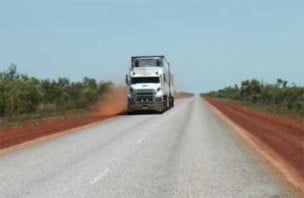
#22. When you meet a truck coming from the opposite direction on an undivided road, you should:
Because of the size of large vehicles, at highway speed the vehicle will push a cushion of air to the side and rear. When a large vehicle is passing or approaching you from the opposite direction, stay as far to the right of your lane as possible until the vehicle is clear. You will avoid being sideswiped or shaken by air turbulence.

#23. Right-of-way is something:
Remember, the law only says who must yield the right-of-way. Even though right-of-way rules have the force of law, a good driver never depends exclusively on them for safety. A driver who should have the right-of-way should use it sensibly, never insist on it.
You must exercise special care to avoid colliding with pedestrians or bicyclists.

#24. You are crossing an intersection. An emergency vehicle with activated lights and sirens approaches from behind. What should you do?
Never stop in the middle of an intersection. If you are at an intersection, get out of it before you pull over.

#25. What color is used for general warnings of special situations or hazards ahead?
Most warning signs are black on yellow and most are diamond-shaped. They warn you to slow down and be prepared to stop if necessary. A special situation or hazard is ahead.

#26. What does this sign mean?
School Zone.
A five-sided sign means you are in a school zone. Be alert for school crossings in the country as well as in town. You must stop when the school crossing guard directs you, and remember to always yield the right-of-way to any schoolchildren crossing the street.

#27. You approach this road sign. What must you do ahead?
Pedestrian crossing.
Crosswalks are special areas set aside for people to cross the street. They are often marked with yellow or white lines. Slow down and watch for people crossing the street on foot. Pedestrians in crosswalks must be given the right-of-way at all times.

#28. Which is true about signaling before making a sudden stop?
You may not stop or suddenly decrease a vehicle’s speed without first giving an appropriate signal to the operator of a vehicle immediately to the rear.
Your brake lights let people know that you are slowing down. If you are going to stop or slow down at a place where another driver does not expect it, tap your brake pedal three or four times quickly.
Use hand signals if the signal lights are not working or are hard to see.

#29. Can you drive faster than the speed limit when overtaking another vehicle?
You may NOT exceed the speed limit when passing.

#30. Who is exempt from the seat belt law?
Certain people are exempt from the seat belt law. They include a rural mail carrier of the United States Postal Service. He or she is not required to be secured in a seat belt while engaged in the delivery of mail.
| This Maine Permit Sample Test | |
|---|---|
| Number of questions on each practice test: | 30 |
| Question pool: | 1,000+ |
| Type of test: | Random |

Facts about Your Maine Driver’s License Test
| Maine Knowledge Test for Learner’s Permit and Driver’s License | |
|---|---|
| Number of questions on exam: | 30 questions |
| Passing score: | 80 percent |
| Correct answers to pass: | 24 |
| Allotted time to complete test: | n/a |
| Wait time before retest: | No official wait time |
Maine Practice Tests for Permit and Full License
Each preparation test on this website has 30 questions based on the Motorist Handbook & Study Guide and real BMV tests.
You will get instant feedback after each question. If your answer is wrong, you will also see a brief explanation. If you keep the Motorist Handbook handy throughout your studies, you can compare answers with the information in the Handbook.
Make sure you get the latest version of the Study Guide from your BMV office or download it online .
The passing score in Maine is 80 percent, which means must answer at least 24 questions correctly. All questions are from the Motorist Handbook & Study Guide.
It is a good idea to aim higher on a practice test. At a minimum, you should aim for 92 percent. But it is, of course, best to aim for the perfect score of 100%.
Read more about study tactics .

What You Should Know about the Knowledge Examination in Maine
The knowledge test will check your knowledge of common road signs, rules of the road, Maine’s DUI laws, the dangers associated with distracted driving, and Maine traffic laws.
Traditionally the test had 10 separate questions about road signs and 20 questions about road rules and traffic laws. Expect the same numbers on the new test.
The test should take about 15 minutes to complete.
If you are enrolled in a driver education, you typically take the test as part of your education class at a driving school. You don’t have to take another written test.
Maine does not offer online testing from home.
If you transfer a license from another country or are required to pass the exam for other reasons, you must take the test at a BMV location.
If you fail the test, you may be able to take it again the same day at the discretion of the examiner. There is no official wait time to retake the knowledge test.
The knowledge test is a closed book test, and you cannot used books, manuals, notes, or digital devices in the testing area.
The test is available in several languages, but Maine BMV has made no effort to publish them. Any applicant who requires accommodations for the written or road test should contact the Exams Division of the BMV by phone, inquire in person at any BMV branch, email the Exams unit at license.bmv@maine.gov or mail Bureau of Motor Vehicles, State House Station 29, Augusta, Maine 04333.
Who Must Pass the BMV Test?
First-time applicants who have not been licensed before.
You must take all tests, including vision screening, knowledge test, and driving test, when you never had a license or permit before.
Drivers who let their license expire more than 5 years.
If you had a driver’s license issued in Maine or another state and let that license expire for more than 5 years, you must apply for a new driver’s license and take all tests again.
Drivers who hold a foreign driver’s license.
New residents with an out-of-country license from a foreign country other than Canada must take all tests to convert their license to a Maine driver’s license. They must show proof of address in Maine and documents that show their legal presence.
Drivers with a suspended / revoked license.
When your license is suspended for certain violations, BMV may require a new knowledge test and driving test before your license is reinstated.
When is the BMV Knowledge Test Waived?
If you apply for a driver’s license in Maine and hold a license from another state, US territory, or Canada, the knowledge test and road skills test are usually waived.
Is the BMV Knowledge Test Hard?
The failure rate on the BMV knowledge test is about 30 percent, which means that one out of three fails the test the first time they take it. The difficulty level is graded moderate to hard, so it is a good idea to prepare well.
Don’t Forget Your Documents
Before you can pass the vision screening and the knowledge test, you must have all your paperwork in order. It is common that applicants are sent back home from the BMV service center because they didn’t have all the necessary documents .
You must show:
2 different proof of identity – at least one must indicate your date of birth and the other must have your written signature.
Proof that you are a Maine resident.
Proof that you are a U.S. citizen or are in the country lawfully (legal presence).
Maine Graduated Driver Licensing (GDL) Laws
1 Learner’s Permit
| Minimum Age (Years) | Minimum Duration (Months) | Required Supervised Driving Hours (Night Hours) |
|---|---|---|
| 15 | 6 | 70 (10) |
2 Intermediate License
| Minimum Age (Years) | Nighttime Driving Restriction | Passenger Restriction (except family, unless noted) |
|---|---|---|
| 16 | Midnight – 5 a.m. | First 9 months: no passengers |
3 Full License
| Minimum Age (Years, Months) |
|---|
| 16 years, 9 months |
Videos Maine Driver’s License Test Questions & Answers


