
Maryland MVA License Test & Permit Practice
Results
Congratulations! This is a passing score. Do you want to try again?
This is not a passing score. Please try again.


#1. A truck's blind spots:
No-zones are blind spots to the front, sides, and rear of the vehicle. Some truck drivers may not be able to see up to 20 feet in front of the cab, on either side of the trailer, and up to 200 feet to the rear.

#2. During an enforcement stop by a police officer, you should:
If you are stopped by a police officer:
- Signal your intentions of moving over.
- Pull off to the side of the roadway as far away from traffic as possible.
- Turn on your flashers.
- Turn off your engine and radio, and roll down your window so you can communicate with the officer.
- Stay in your vehicle and keep your seatbelt fastened.
- Keep your hands in plain view, preferably on the steering wheel.
- Do not make any movement that will make the officer think you are hiding or reaching for something.
- If the officer issues you a citation, do not argue with the officer about the citation.

#3. Which of the following is an acceptable reason for not wearing seat belts?
Whatever your reason for not wearing seat belts, it is usually not reasonable and may violate the law.
Maryland Motor Vehicle Law requires that the driver and all passengers must wear seat belts. In addition, any individual under the age of 16 must wear a seat belt or be restrained in a child safety seat if applicable.

#4. When sharing the road with a motorcyclist, it is dangerous to:
Do not share a lane with a motorcycle. Motorcyclists are entitled to use the entire lane. Remember, motorcyclists often adjust their position in the traffic lane to avoid road hazards like potholes or oil spills, because of wind, and to be seen by other road users.

#5. What does this sign mean?
This sign indicates that there is a work zone ahead. Pay close attention. Obey work zone signs and watch for workers and slow-moving equipment.

#6. Traffic signs that warn a driver of temporary traffic conditions due to road works are:
Orange is used for construction and maintenance warning. The signs are usually diamond shaped. They notify drivers of unusual or potentially dangerous conditions near work areas.

#7. It is a good idea to use your high-beam headlights in the following situations except:
Use high beams on open roads, which are not lighted by streetlights.
You should not use your high-beam headlights in fog.

#8. Always signal to other drivers when you plan to:
You should always let other drivers know your intentions by using signal lights. If any other vehicle might be affected, the law requires that you use turn signals. You must also signal when you stop or suddenly decrease the speed. Stop signals are given by your brake lights and/or hand signals.

#9. If you can't stop yawning or have trouble keeping your head up while driving, it is best to:
It is important to be aware of the signs of drowsy driving and to take the necessary action to ensure that you do not put yourself and others in a situation that could result in a crash. If you become tired or sleepy while driving, it is best to rest, or change drivers. Being tired dulls your mind and slows down your reactions, making driving hazardous.

#10. What can you do to reduce road rage?
A good general rule is to treat other drivers and road users like you would like to be treated. Some tips to reduce the possibility of becoming involved in an aggressive driving incident are:
- allow extra time to travel
- be patient
- be courteous
- concentrate on your driving behavior
- always signal your intentions
- obey all traffic laws, signs, signals, and pavement markings
- yield the right of way
- avoid competing with other drivers

#11. Which of the following may use a lane marked with this sign?
High Occupancy Vehicles. An HOV lane is a special lane used only for carpools, buses, motorcycles, or decaled low-emission vehicles. You may use a carpool/HOV lane or on-ramp if your vehicle carries the posted minimum number of people required for the carpool lane (three in this case), or you drive a low-emission vehicle displaying a special DMV issued decal.

#12. When driving at night you should:
Increase your following distance when driving at night. This will help prevent a collision in the event the vehicle in front of you needs to stop quickly.

#13. This road sign means:
Reduction in Lanes (Lane Ends). This sign is used on multi-lane highways to warn you of a reduction in the number of traffic lanes in the direction you are traveling. Be prepared to change lanes or to allow other vehicles to merge into your lane.

#14. You are approaching a pedestrian standing by the roadway. The pedestrian is carrying a white cane and using a guide dog. You should:
You must always yield the right-of-way to a blind or partially blind pedestrian carrying a clearly visible white cane or accompanied by a guide dog.

#15. In Maryland, it is against the law to:
It is against the law to drive without vehicle insurance! If you do not maintain your vehicle insurance on all vehicles, you will be fined up to $2500 per vehicle each year.

#16. When it starts to rain or snow:
Wet road surfaces can become slippery, reducing traction, and increasing the chances of a crash. It is important to take proactive steps. Slow down and keep a safe distance. The space needed between you and the car in front of you is much greater on wet roads than it is in dry conditions. Avoid slamming on the brakes. Avoid sharp steering or changing speed quickly.

#17. If your car starts to skid, you should do the following except:
Do not overreact or slam on the brakes.
Instead, take your foot off the accelerator and brakes. Slow down gradually.

#18. When a traffic signal is showing a flashing yellow light, you must:
A flashing round yellow signal means slow down and proceed with caution.

#19. You approach this vehicle from behind. It keeps a low speed. What should you do?
A broken yellow line indicates that passing on the left is permitted when the way ahead is clear. Overtaking and passing should be done with care because of oncoming traffic.

#20. When a law enforcement officer is directing you to do a U-turn against existing signs, you should:
The only exceptions to obeying all traffic control devices are emergency situations when directions from police officer or other emergency personnel take priority. Uniformed school crossing guards also have the authority to direct traffic at locations near schools. You must also respect and obey a flagger in a work zone.

#21. Which of the following is illegal when driving on a limited-access highway?
Stopping on the traveled portion of a highway is prohibited. Stopping on the shoulder is permitted only when your vehicle is disabled or in other emergencies. If you must stop on the shoulder of the interstate or highway, turn on your emergency flashers to warn other drivers and stay inside your vehicle if you can.

#22. You may be arrested for driving under the influence of:
Illegal drugs, (marijuana, heroin, etc.), prescription medications (i.e. codeine), and chemical inhalants can severely impact a person’s ability to safely operate a motor vehicle. Drugs have serious harmful effects on the skills required to drive safely, like alertness, concentration, coordination, and reaction time. All drugs can make it difficult to judge distances and react to signals and sounds on the road.
Remember, using prescription drugs can also impair your ability to drive.
It is important to pay close attention to both prescription and over the counter drug label warnings, which instruct individuals to avoid using certain drugs when operating a motor vehicle or heavy machinery. Disregarding this recommendation can lead to criminal penalties should your ability to safely operate a vehicle be impaired.

#23. If you cannot get in the clear on the other side of a railroad crossing, you should:
Never start to cross the tracks unless you can clear the tracks completely. Make sure there is room for your vehicle on the other side of the tracks before proceeding.

#24. Which is one factor that significantly affects your stopping distance?
Your actual stopping distance will depend upon many factors, including:
- The length of time it takes a driver to see and recognize that there is a dangerous situation.
- The type and condition of the roadway.
- The condition of the tire treads.
- The condition of the brakes.
- Vehicle weight and speed.
A posted speed limit does not affect the stopping distance, only your actual speed does. Speed limits do not tell you at what speed you should drive. They only say you cannot go faster than the speed shown.

#25. After passing this sign, you reach an intersection without signs or signals. You must:
T Intersection Ahead. The road you are traveling does not continue. You must turn either right or left.
| This Practice Test | |
|---|---|
| Number of questions on each practice test: | 25 |
| Question pool: | 500+ |
| This practice test is NOT timed. | |
Facts about Your Maryland MVA Knowledge Examination
| Maryland MVA Knowledge Test for Learner’s Permit and Driver’s License – Class C | |
|---|---|
| Number of questions on exam: | 25 |
| Passing score: | 88 percent |
| Correct answers to pass: | 22 |
| Allotted time to complete test: | 20 minutes |
| Wait time before retest: | 1 day (1st failure) Seven days (after two or more failures) |
Free Permit Practice Tests for a Maryland Driver’s License
Each permit practice test has twenty-five questions based on the Driver’s Manual and actual MVA tests.
After answering a question, you will get instant feedback and a brief explanation if your answer is wrong.
Whenever you miss a question on the practice test, note it and look up the information in the driver’s manual. Ensure you fully understand the correct answer and why you got it wrong.
Test Preparations Step by Step
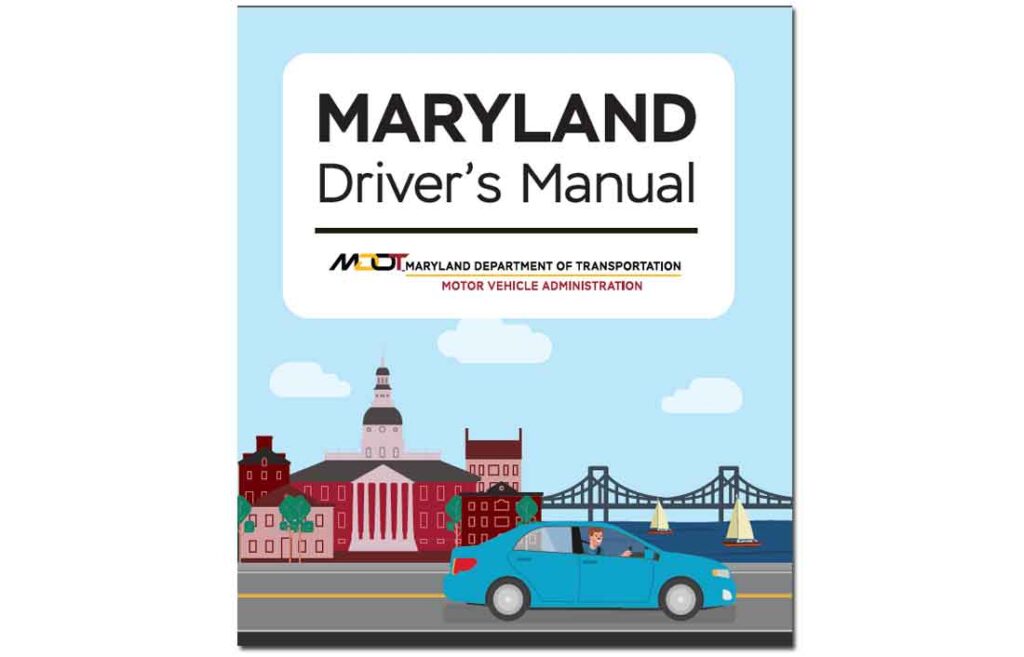
1 Get the Driver’s Manual.
When you prepare for your first learner’s permit or full driver’s license, always start by reading the driver’s manual. You can get a copy from your local MVA office or download it online.
Don’t get a copy from a friend or parent. Always ensure you have the latest version—rules and information in the manual change over time.
2 Take the practice tests.
After reading the manual, you should understand Maryland’s rules of the road, common road signs and signals, and how alcohol and drugs affect your driving.
Use the practice tests to verify your knowledge and whether you are ready for the actual exam. With a bank of more than 500 questions, you will get plenty of practice and cover all aspects of the exam.
You should not attempt the real test too soon. Getting all questions right when you use the practice tests is a good idea. If you do, you are more likely to pass the actual exam.
Read more about risky study tactics .
3 Interact with others.

Discussing road rules and safe driving with a parent, teacher, driving instructor, or friend also helps you prepare. Be bold and ask questions, even when they sound silly.
Who Must Take the Maryland Knowledge Test?

All first-time applicants
All new drivers applying for their first Maryland learner’s permit or driver’s license must take and pass the written knowledge exam.
A driver who had their license revoked
A license revocation means that MVA removes your driving privilege, and they will not automatically reinstate it. There is always a minimum waiting period before you can re-apply for a license, and to get a new license, you must pass all tests.
A driver who let their license expire
When you wish to renew your driver’s license, you must take the written test if you let your license expire for more than one year.
New tests are not required if your license expired less than a year ago.
Applicants with an out-of-country license
Drivers with an out-of-country license must generally pass all examinations, including the knowledge test.
There are exceptions for drivers with a driver’s license from France, the Republic of Korea, Germany, Taiwan (Republic of China), and Japan.
The license should be valid, but MVA accepts if you have a license from France or Japan that expired less than a year ago .
All drivers must, however, pass the vision test.
The Maryland Knowledge Test is Waived
MVA typically waives the knowledge and practical driving tests if you hold a driver’s license from another state, Territories of the United States, or Canada.
What You Need to Know about the Knowledge Testing
The Maryland knowledge test for a noncommercial Class C driver’s license has 25 questions. You need to answer 22 questions correctly. That is a passing score of 88%, which is higher than in other states . Make sure you prepare well.
The knowledge test for noncommercial Class A and Class B has 20 questions.
The Maryland MVA test has a time limit. You have 20 minutes to complete the knowledge test. Twenty minutes may not seem much, but it is usually more than enough. You will have time to read questions and answer choices carefully.
Take your time answering questions. Don’t be lured into answering questions too quickly. Remember to read everything before you pick your answer.
Knowledge tests are administered on a computer and are available in English and the following languages:
French
Nepali
Vietnamese
You can use foreign language interpreters for other languages, but MVA does not pay the interpreter fee.
If you are uncomfortable with computers, MVA can offer a paper test. Make sure you ask for it in advance.
If you need an oral test, always make an appointment and tell MVA your unique needs.
Don’t try to cheat on the test. You must turn off all electronic devices and put them away during the test, including cell phones, tablets, and MP3 players. Keep papers, notes, or books out of the testing area.
Should you fail the test the first time, you can retake it the next business day if the branch office has a test appointment available.
If you fail the test a second time, you must wait at least seven days before retaking it.
What is the Maryland Graduated Driver Licensing System?
The Maryland Graduated Driver Licensing (GDL) system is a three-step program to let new drivers gradually gain experience while limiting risks contributing to crashes. In this program, a teen driver progress through three levels of licensing:
Step one: the learner’s permit
Step two: the provisional license
Step three: the full, unrestricted driver’s license
MVA often refers to this program as the Rookie Driver Program.
Step One: The Learner’s Permit

The purpose of the learner’s permit is to allow new drivers to practice driving under the supervision of a licensed driver and gradually develop driving skills and gain experience.
All new drivers must start with a learner’s permit before getting a provisional license in Maryland. The period they must hold the permit varies by age, from 45 days (25 years and older) to 9 months (under 18 years).
Requirements:
Minimum age 15 years and 9 months.
MVA can only issue a learner’s permit after you turn 15 years and nine months.
School Attendance Certificate if under 16 years.
If you are under 16 years, you must provide a completed Learner’s Permit School Attendance Certification form (DL-300 ).
Parental approval if under 18 years.
If you are under 18 years, a parent or legal guardian must co-sign your application.
Pass vision screening and knowledge test.
Before MVA issues the learner’s permit, you must pass a vision screening and the written knowledge test.
Restrictions on the learner’s permit:
Supervised driving only.
A learner’s permit does not allow you to drive alone.
Whenever you practice driving, you must drive under the supervision of an experienced, licensed driver who is 21 years or older and has held a driver’s license for at least three years.
The supervising driver must sit beside you in the front seat. No one else can sit in the front seat.
There are no other passenger restrictions and no night curfew.
No use of cell phones.
Learner’s permit holders under 18 years cannot use a cell phone or Bluetooth/hands-free devices while operating a motor vehicle except to make an emergency 911 call.
Permit is valid for 2 years.
Learners’ permits are valid for two years from the date they are issued. You must always have the permit in your possession when you drive.
Step Two: The Provisional License

You are now ready to drive on your own without a supervising driver.
Requirements:
Minimum age 16 years and 6 months
A minor under 19 years must generally hold the learner’s permit for at least nine months and, consequently, be at least 16 years and six months before MVA issues a provisional license.
Had a permit for a violation-free minimum period
For a minor, the usual holding period is nine months. If you are 18 years old with a High School Diploma or equivalent, you must hold the permit for only three (3) months.
A three-month holding period applies if you are between 19 and 24 years old.
If you are 25 years or older, the holding period is 45 days.
The holding period is always nine months if you have been convicted of or granted probation before judgment for a moving violation.
Completed at least 60 hours of driving experience.
You also got a practice skills log form when you got your learner’s permit. Your supervising driver (parent, guardian, or mentor) must complete the practice skills log, and you must provide the certification page when you apply for the provisional license. The record must show at least 60 hours of driving practice, of which ten must be at night. If you are 25 years or older, the log must show 14 hours of training with an experienced driver, of which three hours must be at night.
Completed driver education course.
You must also have completed a driver education course, including 30 hours of in-class and six hours of behind-the-wheel instruction. You can enroll in this course already at age 15.
The MVA only sometimes accepts out-of-state education certificates. An exception exists for Delaware driver education courses.
Pass the driving skills (road) test.
You must fulfill all requirements mentioned above before you take the road test.
Restrictions on the Maryland provisional license:
If you are under 18 years, the MD provisional license carries four restrictions .
1. Night curfew between midnight and 5 a.m.
If you hold a provisional license and are under 18 years, you cannot drive between midnight and 5 a.m. unless you are:
accompanied and supervised by a licensed driver who is at least 21 years old,
driving to or from work, or driving in the course of employment,
driving to or from a school class or official school activity,
driving to or from an organized volunteer program, or
driving to or from an opportunity to participate in an athletic event or related training session.
The curfew restriction is lifted when you turn eighteen.
2. Passenger restrictions
You are not allowed to have passengers under 18 years during the provisional period’s first five months (151 days). This restriction does not apply if passengers are immediate family members or relatives living at the same address or a qualified supervising driver accompanies you.
The passenger restriction is lifted after 151 days or when you turn eighteen.
3. Seat belt requirement
A seat belt or child safety seat must properly restrain the driver and all passengers. This restriction applies to all license holders in Maryland, regardless of age.
4. Wireless Device Restriction
All provisional license holders under 18 years are prohibited from using a wireless communication device except for making an emergency 911 call.
The restriction includes both handheld and hands-free devices.
If you are 18 years or older, you are prohibited from using handheld cell phones, including texting, while driving. Although hands-free devices are permitted, you should use your cell phone only in emergencies.
Step Three: The Full Driver’s License

Requirements:
Minimum age 18 years.
MVA can only convert the provisional license to a full driver’s license once you are 18 years.
Held the Provisional License for at least 18 months.
No moving violations during the previous 18 months.
You must not have any moving violation convictions or have been granted probation before judgment for any moving violations within the previous 18 months.
If you are 18 years and meet all requirements:
Once you are at least 18 years and meet the other requirements, MVA automatically converts the provisional license to a full driver’s license.
You don’t have to get a new license. Instead, you will get an attachment card showing the new status. When your provisional license expires, and you apply for a renewal, you will automatically get a full license, and the attachment card is no longer needed.
Prepare by Watching the Video

Video: Maryland MVA Exam – Questions and Answers
Current Operations
All MDOT MVA branches are open by appointment. Take advantage of the many services and transactions that can be completed online.
Transactions that are available for scheduling include:
First Learner’s Permit Law Test
First Learner’s Permit Law Test
Non-Commercial Driver’s Skills Test
Commercial Driver’s Skills Test
Hazardous Material (Hazmat) Endorsement
You can complete many other transactions from the comfort of your home. Visit the Online Services page to see what MDOT MVA business you can complete from your computer, tablet, or phone.


This side is good and am preparing to go and take the learner’s permit test next month plse I need ur help and guidance
I NEED TO PRACTICE ON THE PHONE, WHAT IS THE PH. NUMBER?
These are online tests only. No access by voice/phone.
How can I get the online test
If you mean a state-administered knowledge test online, MVA does not have one.