New Mexico MVD License Tests & Permit Practice
Results
Great! This is a passing score. Do you want to try again?
This is not a passing score. Do you want to try again?


#1. A lane with this pavement marking may be used by:
Sharrows are shared lane pavement markings. They are painted on the pavement when a road is too narrow for side-by-side road sharing with slower vehicles. They indicate that bicyclists are encouraged to take the whole travel lane and that motorists shall yield to the bicyclist as needed.

#2. When parking parallel to a curb, you must not park:
Do not park more than 18 inches from the curb.

#3. This sign warns you of:
Two-way Traffic.
Warning that you are leaving a separated one-way highway and will soon be driving on a two-way highway. The sign is also used to remind drivers they are on a two-way road.
Remember, you should drive in the right-hand lane and expect oncoming traffic in the left-hand lane.

#4. Night driving is more dangerous than daytime driving because:
It is much harder to see at night. Night driving is more difficult than day driving, and it is more dangerous.

#5. When you see a wild animal standing near the roadway:
Scan the road as you drive. Watch the edges of the highway for wildlife that are about to cross. Watch for animal crossing signs. These signs warn you that vehicles have hit wildlife in this area before. And if you see animals that have been hit or animals standing beside the road, slow down.

#6. What is most important when you adjust to a safe speed?
Posted speed limits do not tell you at what speed to drive. They only tell you what the maximum legal speed is under ideal conditions. You must reduce your speed when conditions require it. For example, you should reduce your speed when the roadway is slippery, during rain, snow, icy conditions, or when it is foggy and difficult to see clearly down the road.

#7. Which is one factor that significantly affects your stopping distance?
Your actual stopping distance will depend upon many factors, including:
- Your perception and reaction time.
- Type and condition of the pavement.
- Kind and condition of tires.
- Vehicle design and weight.
- Type and condition of brakes.
- Weather conditions, including wind and visibility.

#8. When driving at night on well-lighted streets, you should use:
Use low beams:
- Within about a one-block distance of an oncoming vehicle.
- Within 200 feet when following another vehicle.
- When in heavy traffic.
- On well-lighted streets.
- In fog.
- When it is snowing or raining hard.

#9. If your car breaks down, you should do all the following except:
Never stand in the roadway.
A raised hood or a white cloth on the antenna, side mirror or door handle signals an emergency.
This question asked what you should NOT do.

#10. If you see a pedestrian with a white cane at a crosswalk, you must:
Pedestrians using a guide dog or carrying a white cane should always be given the right-of-way. Stop, and do not use your horn as it could confuse or frighten a blind pedestrian.

#11. When you see a truck preparing for a right turn ahead, you should:
Big trucks and RVs need more room to make turns. They often swing wide to make a right turn. When you follow a big rig, look at its turn signals before you start to pass. If you think the truck is turning left, wait a second and check the turn signals again. The driver may really be turning right.
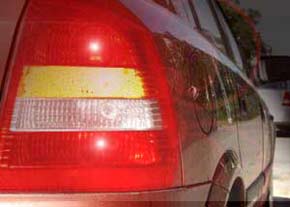
#12. Signaling when suddenly slowing down or stopping is:
Signaling is required by law.
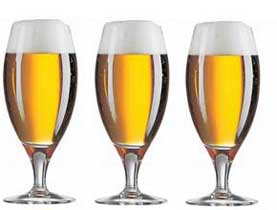
#13. If you drink three alcoholic drinks, approximately how long will it take for all the alcohol to leave your bloodstream?
Your body gets rid of one alcoholic drink per hour.
Remember, time is the only thing that will sober you up.

#14. The program that gradually phases in driving privileges for new drivers is known as:
If you are applying for your first New Mexico driver’s license and are under age 18, you must go through the New Mexico Graduated Licensing System to get your license.
Graduated driver licensing eases beginning drivers into traffic by limiting their exposure to driving situations proven to be particularly dangerous.

#15. What does this sign mean?
This is a yield sign.
It means you must slow down and yield the right-of-way to traffic in the intersection you are crossing or roadway you are entering.

#16. If you see this sign beside the road, you should:
Traffic signals are ahead. Slow down and be ready to stop.

#17. A flashing red traffic signal at an intersection has the same meaning as:
A flashing red traffic light means the same as a stop sign. You must come to a full stop and then may proceed when it is safe to do so.
The signal does not change color, it stays red.

#18. The three-second rule refers to how you should:
The three-second rule refers to a following distance.
Watch when the rear of the vehicle ahead passes a sign, pole, or any other stationary point. Count the seconds it takes you to reach the same spot. You are following too closely if you pass the mark before you reach three seconds.

#19. To avoid last-minute moves, you should:
To be a good driver, you must know what is happening around your vehicle. You must look ahead to the sides and behind the vehicle. Scanning helps you to see problems.

#20. At a railroad crossing, you must give trains the right-of-way:
A white X-shaped sign or crossbuck is located at a railroad crossing. This sign has the same meaning as a yield sign.
Remember, you are legally required to yield the right of way to crossing trains. Never try to beat a train across the tracks.

#21. When approaching a stopped school bus with flashing red lights at a four-way intersection, you must stop when approaching from:
You must stop for a school bus that is stopped with its red lights flashing whether it is on your side of the road, the opposite side of the road or at an intersection you are approaching.

#22. If an oncoming vehicle is drifting head-on into your lane:
If your vehicle is about to be hit from the front it is important to try and have a glancing blow rather than being struck head on. This means that if a collision is going to happen, you should try to turn the vehicle.
Avoid swerving to the left, into the oncoming lane or traffic. The other driver may wake up, realize the mistake, and turn back into their proper lane.
Pull to the right, brake, sound your horn and flash your headlights.

#23. When it is safe to do so, you may cross a broken yellow center line:
Passing with caution is permitted next to a broken line, but passing is forbidden next to a solid line.
#24. What should you do if you are involved in a traffic crash, and someone is injured with severe bleeding?
If there is bleeding, supply direct pressure to the wound. Even severe bleeding can almost always be stopped or slowed by using direct pressure to a wound.

#25. In this situation (approaching the bicyclist from behind), you should:
If possible, you should avoid passing other vehicles, including motorcycles and bicycles, on two-lane roads.
| This New Mexico MVD Sample Test | |
|---|---|
| Questions on each practice test: | 25 |
| Question pool: | 500+ |
| Type of test: | Randomized multiple-choice |
Facts about Your New Mexico MVD Knowledge Test
| New Mexico Written Knowledge Test for a Permit or Driver’s License | |
|---|---|
| Number of questions on exam: | 50 questions |
| Passing score: | 70 percent |
| Correct answers to pass: | 35 |
| Allotted time to complete test: | No limit |
| Wait time before retest: | 2nd test same day, but no more than two tests in same week |
The New Mexico Practice Test
This NM practice test for a driver’s license or learner’s permit has 25 random multiple-choice questions from an extensive database (the real exam has 50 questions).
After each question, the instant feedback tells you whether your answer is correct. When you miss a question, there is also a short explanation that can help you understand the correct answer. You will see your final score at the end of the test.
The test is a learning tool that only includes some questions that can appear on your official MVD exam. However, with the extensive database, the test will cover all essential items on the test and will match the contents of the New Mexico Driver Manual.
Before practicing, you should get the latest New Mexico Driver Manual version. You can get it from your driver education course provider, a local MVD office, or download it online from http://mvd.newmexico.gov.
NM MVD updates the manual sparingly, but you should ensure you have the latest version.
With a passing score of a mere 70% on the actual exam, it is tempting to stop practicing when you reach the passing score. We recommend that you aim higher than 70% on the practice test. The failure rate on the knowledge test in New Mexico is still high.
You can take this random practice test repeatedly; there is no limit. Take as many tests as you need to feel confident with all questions and answers.
The article about risky study tactics can help you avoid some less successful study habits.

Who Must Take the Knowledge Exam?
New drivers.
All persons applying for a first-time New Mexico driver’s license must pass the knowledge test.
Drivers with a license expired 5 years or more.
If you let a New Mexico or out-of-state Driver’s License expire for five years or more, you must apply for a new license and retake all tests.
Drivers with a foreign license.
All applicants that hold a license from a country other than the United States and Canada must pass the written knowledge test and a road skills test before MVD issues a New Mexico Driver’s License.
Drivers with a revoked license.
If you had your driver’s license revoked or suspended for more than five years, you must take the written knowledge test again. It includes a revocation due to a DWI conviction unless you maintain the driving privilege with an ignition interlock license during the revocation period. If a license revocation due to a DWI conviction is less than one year, MVD will not require a new test.
Who are Exempt from Taking the Knowledge Exam?
MVD will not ask you to take the written test if you move to New Mexico and have a valid out-of-state or valid license from Canada. Out-of-state licenses include the District of Columbia and all U.S. territories.
The Official New Mexico Written Test
The official New Mexico knowledge test now has 50 questions, and you must correctly answer 35 questions (70%).
Test questions are from the New Mexico Driver Manual and administered on computer-based kiosk machines. You have two hours to complete your test. Note: you are typically not allowed to start the test after 3 p.m. It is to make sure you have enough time to complete the test.
The test is available in the following languages:
English
French
Italian
Spanish
Vietnamese
You can take the test at an MVD location or as part of your driver education course.
Some driver education schools are licensed and contracted with MVD to issue learner permits.
If you visit an MVD office for your permit or license, you should schedule an appointment here
The knowledge test is closed-book; you cannot bring your manual or any notes or use electronic devices during the exam.
What Happens if You Fail the First Time?
If you fail the test, you can retake it the same day, but not more than twice during the week. You can, for example, take it twice on a Friday and then again on a Monday.
But if you fail your New Mexico knowledge exam three times, you must wait six months (from the date of the first test attempt) before you can take a new test.
What Happens after You have Passed the Test?
If you are at least 15 years old and under 18 years old, you must participate in a 3-step Graduated Driver’s License (GDL) program until you meet the requirements for an unrestricted license. A driver education course approved by the Traffic Safety Bureau is mandatory if you are under 18. Such a course includes DWI education and practice driving. When you apply for a license, you must also have a consent form signed by your parent or guardian.
After passing the vision screening and the knowledge test, MVD will issue your first learner’s permit, also known as an instructional permit.
A permit allows you to practice driving while supervised by another driver at least 21 years old and licensed to drive that vehicle. The supervising driver must always sit in the front seat beside you when you drive.
You must hold your instructional permit for at least six months.
Step 2: Provisional License
The minimum age to receive a provisional license is 15 years and six months if you have held an instructional permit for six months.
MVD will check that you have completed at least 50 hours of driving, of which 10 hours must be nighttime.
You cannot have been convicted of a traffic violation in the 90 days before applying for a provisional license.
With a provisional license, you can drive without a supervising driver, but not at night. With a few exceptions, there is a night curfew between midnight and 5:00 a.m.
Step 3: Unrestricted License
To be eligible for the full and unrestricted license under the GDL program, you must:
- Have held a provisional license for 12 months immediately before applying.
- Not have been convicted of a traffic violation 90 days immediately before applying.
- Have no traffic violations pending.
- Not have been adjudicated guilty or have an offense pending involving the use of alcohol or drugs during the provisional period.
If You are 18 Years or Older
If you are 18 years old, the GDL program does not apply. After receiving a permit, you can schedule the road skills test. There is no specific wait time.
A permit is unnecessary if you hold a valid license from another country.
All applicants between 18 and 24 years must enroll in and complete a DWl Awareness Program before MVD issues a license.