
New Jersey MVC Driver’s License & Permit Practice – 2026
Results
Perfect! You reached the passing score. Do you want to try again?
This is not a passing score. Do you want to try again?


#1. It can be dangerous to leave a motor running in a garage because of:
Avoid idling a vehicle in a garage. Certain conditions can cause dangerous levels of carbon monoxide to accumulate in or around a vehicle

#2. Why should you avoid passing or stopping close to a truck that is preparing to or is backing up?
Stay far behind a truck that is preparing to back up or is backing up. Never pass close behind a truck that is preparing to back up or is in the process of backing up. Because of their width, the trailers completely hide objects that suddenly come between them and a loading area. The area behind the truck is a no-zone (blind spot), not only for the truck driver but for other motorists as well.

#3. When traveling at a speed of 20 mph, your foot brake must be able to stop your car within:
The foot brake must be strong enough to stop a vehicle traveling at a speed of 20 mph within 25 feet.

#4. To avoid being blinded by the high-beam headlights of an approaching car:
If a vehicle is approaching with high beams, you should look to the right of the road until the vehicle passes. Never flash high beams at an approaching motorist.
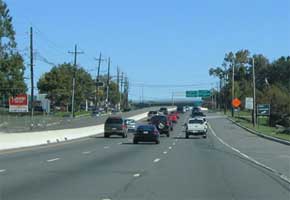
#5. The New Jersey the Safe Corridors Program means:
In an effort to improve highway safety, New Jersey initiated the Safe Corridors Program, which was signed into law in July 2003. The Safe Corridors law doubles fines on various state highways for a variety of driving offenses, including speeding and aggressive driving.
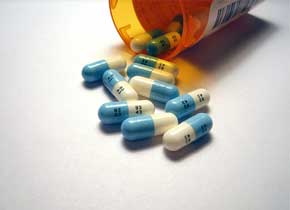
#6. Motorists using prescription drugs must:
If asked, motorists using prescription drugs must show proof of the prescription to law enforcement. If a motorist does not have a prescription for the drug, and a prescription is necessary in order to obtain the drug, the drug will be considered illegal.

#7. Which traffic light has the same meaning as a stop sign?
A flashing red traffic signal light means stop. You must yield to traffic and pedestrians. Go only when safe.

#8. What is the meaning of this sign?
Traffic signal ahead. This sign warns of traffic signals at the intersection ahead. Slow down. Poor visibility is likely.
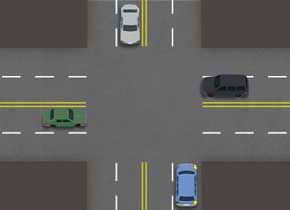
#9. When making a safe right turn, you should do the following EXCEPT:
Do not swing outward or into another lane while making the right turn.

#10. When parking uphill on a two-way street with no curbs, your front wheels should be:
Headed either uphill or downhill and there is no curb, turn the wheels to the right so the car will roll away from the center of the road if the brakes fail.
Remember, when you park on a hill, the general rule is to turn your wheels sharply toward the side of the road or curb. This way, if your vehicle starts to roll downhill, it will roll away from traffic. However, when headed uphill at a curb, you should turn the front wheels in the opposite direction, away from the curb and towards the road. Then, let your vehicle roll backwards until the back of your front wheel touches the curb. The curb will stop your car from rolling into traffic.

#11. Rear-facing infant seats should:
The safest place for a child to sit is in the back seat. The rear middle seat is best. Infant seats must face the back of the vehicle.
Never put a back-facing child safety seat in the front passenger seat if your vehicle has an airbag for that seat.
#12. Why can it be dangerous to start your vehicle or warm up the engine in a closed garage?
Avoid idling a vehicle in a garage. Certain conditions can cause dangerous levels of carbon monoxide to accumulate in or around a vehicle

#13. You want to overtake the vehicle ahead of you. Which pavement marking tells you that you are allowed to pass?
Dashed lines on a motorist’s side of the center line of the road mean that passing is permitted when safe.
Remember, dashed lines are permissive in character. Solid lines are restrictive in character.

#14. A regulation sign usually is:
Vertical signs, including square signs, are generally used for regulatory signs. They give instructions or tell you the rules of the road. Some warning signs may also have this shape.
In the horizontal position, the signs generally give directions or information.

#15. When you approach a school bus displaying yellow flashing lights, you must:
Yellow lights will begin to flash to warn drivers that a bus is approaching a stop. This is your signal to slow down and prepare to stop.

#16. When driving on slick roads, you should:
To prevent skidding on slippery surfaces you should adjust your speed, avoid fast turns and quick stops.

#17. When you plan to exit a highway, parkway, or turnpike, you should:
A motorist should always watch for signs that direct where to exit the roadway. When the exit is located on the left of a roadway, look for signs that will direct traffic to the proper lane for exiting. Start slowing down when entering a deceleration lane. Obey the posted advisory speed limit of the deceleration lane.

#18. What does this sign mean?
School signs tell you are near a school or school crossing.
Motorists should watch for signs that mark special hazard areas, such as school zones, bus stops, playgrounds, parks, and schools, where children are most likely to play or cross the streets. Children chasing a ball, for instance, give no thought to traffic. Small children are hard to see. Always watch for movement around parked vehicles.

#19. At this intersection, you may:
Side road. Another road enters the highway from the direction shown. Watch for traffic from that direction

#20. When traveling at 50 mph under ideal conditions, one rule of thumb for safe following distances is to keep back:
Although there is no perfect rule for following distance, the rule of thumb most often used is to keep one car length back (about 20 feet) for each 10 miles per hour of speed. At high speeds or in bad weather, following distances should be increased.

#21. You approach an intersection with a stop sign and a stop line painted across the pavement. You must:
When a stop sign, traffic light, flashing light or other traffic-control device requires a vehicle to stop at an intersection, the driver must stop at the appropriately marked stop line. If there is no stop line or marked crosswalk, the driver must stop before entering the intersection where he/she has a view of the intersecting street.

#22. Which of the following could be signs of aggressive driving?
Aggressive driving is a progression of unlawful driving actions including, but not limited to, unexpectedly altering the speed of a vehicle, making improper or erratic traffic lane changes, disregarding traffic control devices, failing to yield the right of way and following another vehicle too closely.
New Jersey is waging a campaign against road rage. The state has specially trained enforcement patrols to help stop aggressive motorists. To report an aggressive motorist call (888) SAF-ROAD or cell phone #77.

#23. You want to turn right at an intersection when you see this sign at the corner. What should you do?
No right turn. You cannot make a right turn at this intersection.
Remember, regulatory signs with a red circle with a red slash over a symbol prohibit certain actions.

#24. You must obey directions, signals, and instructions from:
You must obey the orders of a police officer, firefighter or uniformed adult school crossing guard who is directing traffic or performing official duties.
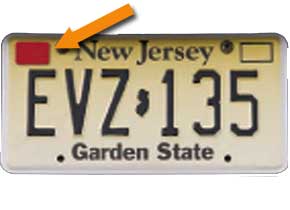
#25. A red reflective decal in the left corner of a license plate means:
All GDL drivers under age 21, who possess a permit or probationary license, are required to display two visible, red reflective decals, distributed through the MVC, on any vehicle that they operate. One decal is to be displayed on the top left corner of the rear license plate and the other on the top left corner of the front license plate.

#26. When should you use your low-beam headlights?
The dim (low) beams are used for city driving and driving in traffic on roadways. Always turn on your low beam lights when you encounter fog, dust, heavy rain, or snow. Bright beams will be reflected back into your eyes. You must also dim your lights when traveling behind other vehicles or when another vehicle is approaching.

#27. When driving on a multi-lane highway, you should do the following except:
On a multi-lane roadway, motorists must drive in the lane nearest to the right-hand edge or curb of the roadway when the lane is available for travel, except when overtaking another vehicle or in preparation for a left turn. (That you should use the middle or left-hand lane is not true).
Facts about Your New Jersey Driver’s License Test
| New Jersey Written Knowledge Test for a Permit or Driver’s License | |
|---|---|
| Number of questions on exam: | 50 questions |
| Passing score: | 80 percent |
| Correct answers to pass: | 40 |
| Allotted time to complete test: | No limit |
| Wait time before retest: | No official wait time |

| This New Jersey MVC Sample Test | |
|---|---|
| Questions on each practice test: | 25 |
| Question pool: | 1,000+ |
| Type of test: | Random multiple-choice |
New Jersey Permit Practice Tests at Driver’s Prep
Each practice test has 25 sample questions based on the handbook and NJ MVC tests. After each question, you will get instant feedback on whether your answer is correct. Should you get it wrong, a short explanation can help you understand the correct answer. You can also use this to look up the facts in the New Jersey Driver Manual.
Keeping the manual handy when you take the practice tests is a good idea. This way, you will learn everything faster.
Typically, you can get the latest version of the New Jersey Driver Manual from your nearest MVC office or download it online .
Do not use practice tests instead of the manual. Practice tests are a supplement to the manual, not a replacement.

The Real New Jersey Knowledge Test
On the actual examination, you will get 50 questions. The passing score is 80 percent, meaning you can only miss up to 10 out of the 50 exam questions. On practice tests, aim for perfection and try to answer all 50 questions correctly.
Read every question and all choices carefully. Make sure you fully understand everything before answering. A single word can make a choice wrong, even if it looks like it could be the correct answer. Look out for words like unless, not, and only.
You should also be careful with questions that have “All of the above” or “None of the above” as an option. These alternatives are not considered best testing practices today, but New Jersey still uses them (you will also see them on this practice test).
All questions on the knowledge test are from the New Jersey Driver Manual. Expect questions about road signs and signals, traffic laws, and specific New Jersey rules and regulations.
Questions on the test are random multiple-choice questions, where only one answer is acceptable.
You take the test on a computer-based system with touch screens. Paper tests are no longer available.
Read more about acing the MVC test .
Is the New Jersey Knowledge Test Hard?
About 30% of all first-time applicants fail the New Jersey knowledge examination for a permit or driver’s license. With a high demand for testing appointments, you should pass the test the first time to avoid unnecessary waiting times.
Who Must Take the Knowledge Examination?
First-time applicant
All first-time applicants must pass all three tests: the written knowledge test, the vision test, and the road test.
They must also complete the NJ MVC’s Graduated Driver’s License (GDL) program.
The program has different requirements depending on the applicant’s age.
Expired license (more than three years)
You must apply for a new license if you let your New Jersey Driver’s License expire after a three-year grace period. Like any new applicant, you must pass all tests, including the knowledge and skills tests.
Licensed drivers from another country
All out-of-country applicants, including U.S. possessions and territories, must pass the knowledge and vision tests.
In some situations, MVC can also ask a driver with an out-of-country license to complete the road test.
Exception: Out-of-State Licenses
MVC typically waives the knowledge and skills tests if you move to New Jersey and have a valid out-of-state non-provisional driver’s license issued by any 50 states or the District of Columbia.
Exception: Suspensions
After a license suspension in New Jersey, MVC does not require new tests, unless they question your ability to drive.
Unlike states with revocation policies, you don’t have to apply for a new license when MVC has terminated your New Jersey license.

More about the New Jersey Knowledge Test
Besides English, MVC also offers the New Jersey written knowledge test in the following languages: Arabic, Chinese, French, Japanese, Korean, Polish, Portuguese, Russian and Spanish. There is also a test using sign language visuals available.
For other languages, you may use an approved interpreter. The interpreter can be a full-time faculty member of a state-accredited college or university with proper identification, a priest, minister, rabbi, or other religious leader of a recognized organization with appropriate credentials, or an approved Department of State interpreter. Interpreters can be scheduled and paid for by MVC.
If you have trouble reading, you can ask for headphones. All tests have audio support.
If you are hard of hearing, you can take the knowledge test with an MVC-approved Department of State interpreter. The interpreter must be certified by the National Registry of Interpreters for the Deaf and listed with the New Jersey Division of the Deaf or evaluated by the Division of the Deaf and on the approved list of that division’s interpreters. MVC pays the interpreter’s fee for such applicants.
What Happens if I Fail the New Jersey Knowledge Test?
New Jersey has no specific rules about retesting, but you may not be able to retest on the same day due to service limitations. So, it is essential that you prepare well and don’t waste time on retesting.

New Jersey Graduated Driver’s License Law
All New Jersey residents who have never had a driver’s license must follow New Jersey’s Graduated Driver’s License program to get their first unrestricted basic driver’s license.
16 years old follow The Early Bird Road
17-21 years old follow The Young Adult Road
21 years and older follow The Adult Road
The law is designed to give new drivers increased, step-by-step instruction and driving experience on the road.
You must pass the knowledge and vision test before practicing driving, regardless of age. After passing the tests, MVC issues a permit that lets you get behind the wheel with a supervising driver who is at least 21 years old and has been licensed to drive for at least three years. The supervising driver must sit beside you in the front seat.
The Early Bird Road (16 Years Old)
To get the Special Learner Permit for young drivers, you must be at least 16 years old.
You must also:
Have a signed parent or guardian consent
Be enrolled in approved behind-the-wheel driver training course
Have an approved instructor purchase the permit
Pass the MVC’s knowledge and vision tests
Pay required fee
Your Learner Permit has the following restrictions:
You cannot drive alone
No driving between 11:01 p.m. and 5:00 a.m.
No more than 1 passenger
Must have red GDL decals attached to vehicle when driving
No use of cell phones (handheld or hands-free), iPods etc.
Seat belts are required
The night curfew has an exemption when driving to and from work or a religious event. To qualify for the work or religious exemption, drivers must carry legible documentation on letterhead signed by the employer, organization, or religious institution stating the reasons for the exemption from the curfew restriction. The letter must include the designated official’s signature, title, address, and telephone number.
There is also an exemption from the passenger restriction when a parent or legal guardian accompanies a teen or the passengers are the driver’s dependents (children).
Note: You cannot get behind the wheel and start driving until you have completed the behind-the-wheel driver training course and got the permit validated at an MVC Driver Testing Center.
After practicing driving skills, MVC can issue a Probationary License after you have completed at least six months of supervised training and turned 17.
You must pass the road test to be eligible for the Probationary License.
With the Probationary License, you can continue to practice driving without a supervising driver.
Your Probationary License has the same restrictions as the permit, except that you can now drive alone.
You must hold your Probationary License for one year and be 18 years old before MVC issues a basic and unrestricted Driver’s License.
The Young Adult Road (17-21 Years Old)
You can apply for the Examination Permit if you are between 17 and 21 years old.
You must be at least 17, pass the knowledge and vision tests, and pay the required fee.
If you are under 18 years old, you must also obtain parent or guardian consent.
With the Examination Permit, completing a behind-the-wheel driver training course is unnecessary.
Restrictions are the same as on the N.J. Learner Permit.
You cannot drive alone
No driving between 11:01 p.m. and 5:00 a.m.
No more than 1 passenger
Must have red GDL decals attached to vehicle when driving
No use of cell phones (handheld or hands-free), iPods etc.
Seat belts are required
MVC may issue the Probationary License after you have completed at least six months of supervised driving.
You must hold your Probationary License for one year and be 18 years old before MVC issues a basic and unrestricted Driver’s License.
The Adult Road (21 Years Old)
As an adult, MVC issues the Examination Permit after you have passed the knowledge and vision tests and paid the required fee.
You must practice driving with a supervising driver who is at least 21 years old and has been licensed to drive for at least three years. You must practice for at least three months.
There are no passenger restrictions or night curfew when you are 21.
However, electronic devices are still prohibited and you must have red GDL decals and must use seat belts.
After three months of training and passing the road skills test, MVC issues a Probationary License. With the Probationary License, you can drive alone.
You must hold the Probationary License for at least one year before applying for the basic license.

