
South Dakota DPS Knowledge Test & Permit Practice – 2026
Results
Good job! This is a passing score. Do you want to try again?
Unfortunately, this is not a passing score. Do you want to try again?


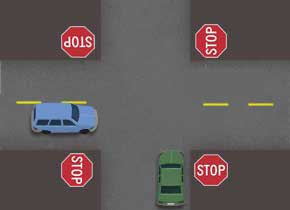
#1. If you arrive at a four-way intersection controlled by stop signs at the same time as another driver, you should:
At a four-way intersection controlled by stop signs, you must yield the right-of-way to the driver on your right if both of you arrive at the intersection at the same time (Same Time Rule).

#2. What does this sign mean?
Slippery when wet. The road on which you are traveling can be slippery when wet and you should reduce speed.

#3. South Dakota's zero tolerance law:
All states have zero tolerance laws (no alcohol in the circulatory system) or similar laws for drivers under the age of 21.

#4. You should stop before railroad tracks and not cross them if:
Do not move forward across tracks until you can do so safely. In heavy traffic make sure there is room for your vehicle on the other side before starting to cross.

#5. Keeping a safe following distance using a four-second rule means:
Following the vehicle in front of you closely limits your vision of the road and does not allow enough time to react to avoid a crash. Always try to keep a minimum following distance of 4 seconds between your car and the vehicle in front.
Remember, there are certain situations when you need more space in front of your vehicle.

#6. If an intersection is blocked and you cannot drive through the intersection without having to stop in the intersection:
If you are stopped and then the light turns green, you must allow crossing traffic to clear the intersection before you proceed.
Even if you have a green light, do not start across an intersection if it causes your vehicle to stop in the intersection and block other traffic or a pedestrian crosswalk.

#7. You should stop at the scene of an accident ONLY if:
Do not stop at an accident unless you are involved or if emergency help has not yet arrived. Keep your attention on your driving and keep moving, watching for people who might be in or near the road.

#8. When driving at night in heavy traffic, you should use the following:
Use high beams only when there are no oncoming vehicles. Whenever it is necessary to drive with the lights on, use the headlights – not parking lights. Parking lights are for parked vehicles only.

#9. To back your vehicle safely:
Follow these steps to back a vehicle up safely:
- Check behind the vehicle before you get in it. Children and small objects cannot be seen from the driver’s seat.
- Place your foot on the brake and shift to reverse.
- Grasp the steering wheel at the 12 o’clock position with your left hand.
- Place your right arm on the back of the passenger seat to the right and look directly through the rear window.
- Occasionally check your mirrors when backing up but keep in mind that these mirrors do not show the area immediately behind your vehicle. If your vehicle is equipped with a rearview camera, occasionally check it while backing up.
- Accelerate gently and smoothly, keeping your speed slow. Your vehicle is much harder to steer while you are backing up.
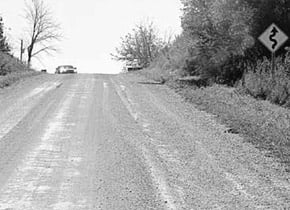
#10. If vision is reduced as you approach the crest of a hill, you should:
Hills and curves can limit how far you can see. In this type of area always reduce your speed and be prepared to stop.

#11. You approach this road sign. It tells you to be particularly alert and watch for:
Deer crossing.
Deer often cross the road in this area. Slow down if you see deer or other wildlife.

#12. To avoid getting tired on a long trip, you should:
When you are tired, you could fall asleep behind the wheel and crash, injuring or killing yourself or others. Stop every hour or so or when you need to. Walk around, get some fresh air, and have some coffee, soda, or juice. The few minutes spent on a rest break can save your life.

#13. Which months have the highest number of car/deer crashes?
Be especially alert for deer in October and November, the months with the highest number of car/deer crashes.

#14. A warning sign with these symbols has this shape:
A circular sign is used to warn that there is a railroad crossing ahead.

#15. The most effective device for reducing the chance of injury in a crash is:
Studies have shown that if you are in a collision while using safety belts, your chances of injury or death are greatly reduced. Safety belts keep you from being thrown from the vehicle and helps the driver keep control of the vehicle.

#16. After moving to South Dakota, new residents must register their vehicles within:
You have 90 days to register a vehicle brought in from another state. The registration certificate must be carried in the vehicle at all times.

#17. On a road with lanes separated by white lines:
White lines mark traffic lanes going in the one (same) direction.

#18. At this intersection, cars in the left lane must:
Lane use control signs tell you where you can go or where you can turn and often use an arrow symbol. Cars in left lane may turn left or go straight. Cars in center lane must go straight. Cars in right lane must turn right.

#19. If you run off the pavement, you should:
Avoid panic steering which means when someone tries to return to the pavement as soon as the vehicle wheels leave the pavement. If your vehicle leaves the paved road surface due to an uneven surface drop-off, slow down gradually when safe to do so, and steer gently back onto the pavement. The key to safely driving off the road and safely returning involves gradually moving off and back on the road. The turning of the steering wheel should be slight. This reduces the chance of erratic vehicle behavior when your tires encounter an uneven or unpaved shoulder.

#20. A three-point turn on a narrow road should only be used:
Use this type of turnabout only when the road or street is too narrow to make a U-turn and you cannot go around the block. This type of turn should only be used on a two-lane roadway that is not busy. It is better to circle an entire city block if the street is busy.

#21. When you approach a stopped emergency vehicle with flashing warning lights on an interstate, you must:
If you are on a road with two or more lanes of traffic going the same direction and you approach an emergency vehicle, tow truck or roadside assistance vehicle that is stopped with lights flashing, you must change lanes, so you do not drive next to the stopped vehicle.
If making a lane change is unsafe or you are on a road with one lane in each direction, you must reduce your speed by at least 5 miles per hour under the posted speed limit and give the emergency vehicle as much room as safely possible.

#22. This sign means:
The stop sign is the only eight sided (octagonal) sign you will see. When you come to a stop sign, you must make a complete stop.

#23. The blind spot behind a large truck can stretch up to:
Blind spots for large vehicles can extend up to 200 feet directly behind the vehicle. In this area, the driver cannot see your car and you cannot see traffic directly in front of you.

#24. When driving at night, you should:
Driving at night is more difficult and hazardous than daytime driving. The distance you can see in front is limited by light provided by your headlights.

#25. When can a motorcycle operator use a complete traffic lane?
Allow a motorcyclist a full lane width. Never try to share a lane with a motorcycle. The motorcycle needs space for the motorcyclist to react to other traffic.
| This South Dakota DMV Practice Test | |
|---|---|
| Number of questions on each test: | 25 |
| Question pool: | 500+ |
| Type of test: | Random multiple-choice |

| South Dakota DMV Written Knowledge Test | |
|---|---|
| Number of questions on exam: | 25 questions |
| Passing score: | 80 percent |
| Correct answers to pass: | 20 |
| Allotted time to complete test: | No limit |
| Wait time before retest: | 1 day |
South Dakota Practice Tests
This South Dakota knowledge test has 25 random questions, just like the actual SD knowledge examination. You must correctly answer 20 questions to pass the test, meaning you must reach a passing score of 80 percent.
After each question, there is instant feedback to let you know whether your answer is correct. When you miss a question, there is also a brief explanation based on the information in your Driver’s License Manual.
You will find answers to all exam questions in the South Dakota Driver’s License Manual, so make sure you read it.
You can get a hard copy from any DPS location or download a PDF version online .
Each practice test has random questions (just like the real knowledge test). It pulls questions from an extensive database with several hundred questions, making every test slightly different. You will see new questions every time you start over.
You can repeat the practice test until you feel ready for the real South Dakota DPS test.
Please note that this is a practice test, not an actual examination that qualifies for a test certificate. South Dakota does not offer knowledge testing from the comfort of your home.
You should also know that Driversprep.com is not affiliated with South Dakota DPS or any Government Entity.

After reading the Driver’s License Manual, you should take practice tests to verify how much you’ve learned. Most likely, you will miss some questions when you start practicing. Read the short comment and look up information in the manual. If you need more clarification on the answers and why they are correct, find someone to discuss rules and safe driving techniques with. It will help you learn much faster.
An essential key to success is to read all questions and choices carefully. Try not to add your information or read anything into a question that isn’t there.
Another common mistake is to try to memorize questions and answers. It is a risky study tactic and no guarantee of passing the real exam.
You must truly know and understand the information in the Driver’s License Manual to pass the real permit examination.
What You Must Know About the Real South Dakota Knowledge Test
Your first step towards a South Dakota driver’s license contains two tests:
A vision screening
A written knowledge test (on a computer)
If you need glasses/lenses for your vision screening, remember to bring them. If you fail the vision screening, you will not be allowed to take any other tests.
The passing score on the South Dakota permit test is 80%. You need 20 correct answers to pass. If you fail the written test, you must wait at least one day before you can try again. There is no new fee the second time your try, but after three attempts, you must pay a new fee.
A parent or legal guardian must accompany minors when they visit a Driver Licensing office.
Languages
The written test is available in English only.
Driver Education Course
If you have passed an approved South Dakota driver education course with at least an 80% score, you don’t have to take an additional knowledge test at a driver exam office.
Remember to bring the driver’s education certificate to the driver exam station and pass the vision screening.
Is the South Dakota Permit Test Difficult?
South Dakota does not publish failure rates, but experts estimate that about one out of three fail their first attempt on the test.
Who Must Take the South Dakota Test?
All new drivers
If you are a first-time applicant, you must always pass all tests.
If you are under 18 years, you must follow the three-step program under the Graduated Driver Licensing (GDL) law, which includes the first Instruction Permit, the Restricted Minor’s Permit, and the full unrestricted South Dakota Driver’s License.
Drivers with an expired license
If you let your South Dakota Driver’s License expire more than 30 days, the examiner will ask you to retake the knowledge test.
Drivers with a revoked license
If the department has revoked your driving privilege, you must pass all applicable tests, including a new application fee and a reinstatement fee.
Suppose the department has suspended your driving privilege. In that case, you don’t have to take any new tests for the department to reinstate your privilege – unless the license expires for more than 30 days during the suspension period.
Drivers with a license from another country
A foreign driver’s license holder who moves to South Dakota must pass the same tests as first-time applicants. Exemptions exist for holders of a valid license from Canada or Germany.
When you hold a valid driver’s license in another state or territory and move to South Dakota, no testing (except vision screening) is necessary to get a South Dakota driver’s license.
What is on the Official South Dakota Written Test?
The DPS designs written tests to test your:
“…ability to read and understand highway signs regulating, warning, and directing traffic, the knowledge of the traffic laws of this state.”
You should expect a few questions about the road signs described in the South Dakota Driver’s License Manual. Remember to learn how colors and shapes convey information.
You will also see questions about traffic signals and pavement markings. Know when you can cross yellow center lines and when you cannot.
There is also a clear focus on how to safely share our highways with pedestrians, bicyclists, motorcyclists, and commercial vehicles such as tractor-trailers and large trucks.
Specific South Dakota traffic laws include the consequences of impaired driving and the purpose of the South Dakota point system.
Many questions in the question pool also deal with everyday driving situations, such as right-of-way rules at intersections and what to do in case of accidents and vehicle failure.
Remember, you will find everything you need to know for your test in the Driver’s License Manual.

South Dakota Permit and License FAQ
What documents do I need to apply for a South Dakota permit or driver license?
If you are a US citizen, you should bring an original or certified birth certificate, social security card, and two documents proving your South Dakota address. If you are a minor, proof of address can be provided by the parent who comes to the driver's license exam station with you.
If you are a non-citizen, you need an unexpired permanent resident card or unexpired U.S. Visa with an unexpired I-94, social security card, and two documents proving your South Dakota address.
Do I need my parents approval when I apply for an instruction permit?
If you are under 18 years, you must have approval of a parent/legal guardian, and the parent/legal guardian must accompany you when apply for the permit.
A parent or guardian who signed for you to get your permit can at any time request to have your permit or license canceled.
Can I practice driving with any adult driver?
When you hold an instruction permit and practice driving, you must be supervised by a licensed driver who is at least 18 years old and have at least one year driving experience. The supervising driver must always sit in a front seat beside you.
Can I practice driving at night when I have an instruction permit?
The Instruction Permit allows you to practice from 6 a.m. to 10 p.m. if you you are supervised by a driver who is not a licensed parent or guardian.
From 10 p.m. to 6 a.m., you must have a parent or legal guardian seated beside you.
When can I change my Instruction Permit to a Restricted Minor’s Permit?
The holding period for the Instruction permit is 180 days if you have satisfactorily completed a state-approved driver education program. This means that you must 14 years and 180 days old before you can apply for the Restricted Minor's Permit.
If you haven't completed a driver education course, this holding period is extended to 275 days and the minimum age for applying becomes 14 years and 275 days.
During these periods you must have a minimum of 50 hours of parent/guardian supervised driving (10 hours at nightand 10 hours in inclement weather) to upgrade to a Restricted Permit.
You cannot have had any traffic convictions within the last six months when you apply.
Can I drive alone with a South Dakota Minor's Permit?
Yes, the minor's permit allows you, with your parent's or guardian's permission, to drive unsupervised during daytime (between 6 a.m. and 10 p.m.
If you want to drive at night, a parent or legal guardian must occupy a seat beside you.
When you are 16 years old, you can apply for a full operator's license with full driving privileges and no restrictions.
What if I get a traffic ticket when I have an Instruction Permit?
Your Instruction Permit or Restricted Minor’s Permit will be suspended for 30 days if you are under 16 years old and are convicted of a traffic violation or of violating the restrictions of your permit.
If you are convicted a second time, the suspension period is 90 days or until you turn 16, whichever is longer.
When can I get a full and unrestricted driver's license?
You must be at least 16 years of age and have met the requirements of an Instruction Permit (see above) to get your full SD Driver's License.
You must have held a Restricted Permit for a minimum of six months.
If you have achieved at least an 80% grade in a state-approved driver education course within the last year, no road skills test is necessary.
Final Note
We have designed all tests to challenge your knowledge of the rules of the road and safe driving practices. When you use our practice tests as a study guide, you can prepare for and pass the South Dakota DPS knowledge test without problems.


