
5 Tips and Test Answers about Trucks for Your Permit Exam

Why You Will Get Truck Questions on Your Test
According to NHTSA, 5,788 people were killed in traffic crashes involving large trucks in 2021. It was a 17-percent increase from 4,945 in the year before.
The majority of people killed (72%) are occupants of passenger cars, not the occupants of the truck.
Over half of all traffic crashes involving large trucks or buses and passenger cars are the car driver’s fault.
Trucks transport 12 billion tons of goods annually. We see more and more trucks driving on the roads and must be constantly aware of the dangers when sharing the road with large vehicles.
That is why you can expect questions about sharing the road with trucks on your DMV test.
Here are five things about trucks and large vehicles to remember for your safety on the road and your driver’s license or DMV permit test.
The facts are directly related to areas covered in your driver’s manual and are likely to appear in sample tests and written knowledge exams.
1. Blind Spots
One-third of all car-truck crashes are related to large vehicle’s blind spots. An excellent rule of thumb for drivers sharing the road with large vehicles is, ” If you cannot see a truck driver in their side mirror, they cannot see you.” .
For your test, you should also remember that the truck has larger blind spots than a standard car.
You can read more about truck’s blind spots here: The No-Zones
2. Trucks Swing Wide
When any vehicle makes a turn, the rear wheels follow a shorter path than the front wheels. The longer the vehicle, the greater the difference. It means a large vehicle may move to the left before turning right to get enough room for maneuvering. Stay back and pay close attention to the vehicle’s turn signals.
Never try to pass on the right-hand side at intersections. The truck might not know you are there, and if the truck turns, you might get squeezed between the truck and the curb.
Read more here: Squeeze Play Crashes
3. Trucks Have Longer Stopping Distances
The exact stopping distances in feet are of little importance. You must, however, understand that larger vehicles take longer to stop than cars traveling at the same speed.
Cutting into the open space in front of a truck may put you at risk if you suddenly must slow down or stop. The truck driver cannot stop as quickly as you.
Never cut off a truck in traffic just because you must reach an exit or change lanes. You take away the truck driver’s safety cushion.
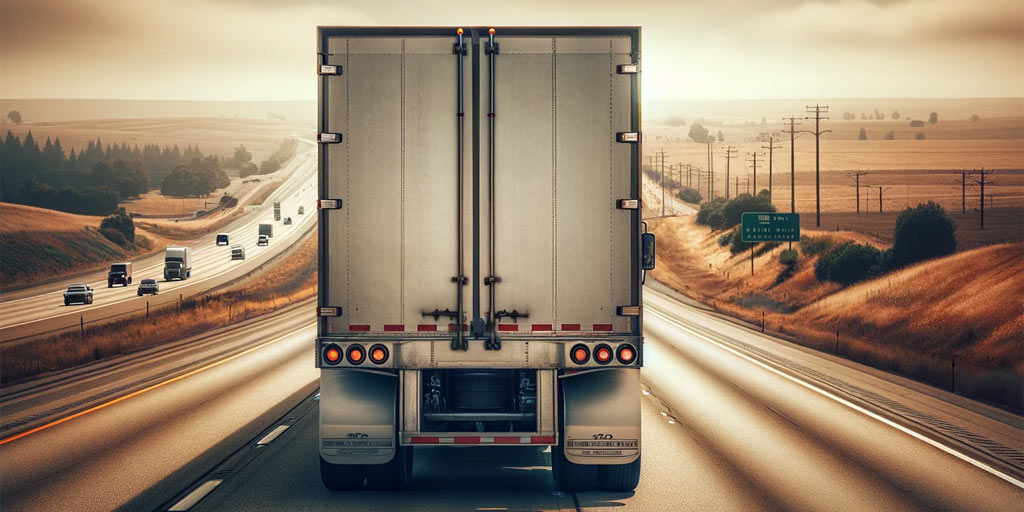
4. Never Tailgate
Tailgating is always dangerous and especially hazardous when following large vehicles.
If you follow a large vehicle too closely, it will block your view ahead. You will not see what the trucker sees and may not have enough time to react if the truck suddenly swerves or brakes to avoid a hazard.
There is also a significant risk that the truck driver doesn’t know you are there.
5. Do Not Underestimate the Speed of a Truck
Due to its size, a truck or tractor-trailer often appears to be traveling slower than it is. Many car-truck collisions occur at intersections because the car’s driver misjudges how close or quickly the truck is approaching.
Check What You Have Learned
Take the following quiz with nine questions to check what you have learned about sharing the road with trucks and other large vehicles.
Results
Well done!
Read the text again?


#1. Why should you not suddenly slow down or stop in front of a large vehicle?
Do not move in front of a large vehicle and suddenly slow down or stop. The large vehicle will not be able to stop fast enough to avoid crashing into you.

#2. What can you do to ensure you are not driving in a truck's blind spot?
If you cannot see the truck’s side mirrors, the truck driver cannot see you.

#3. Why do large vehicles often swing wide when turning right?
When a vehicle turns, the rear wheels follow a shorter path than the front wheels. The longer the vehicle, the greater the difference in the length of the turning path. This is why large vehicles and truck drivers must often swing wide to complete a turn.

#4. The heavier a truck is and the faster it is moving:
The heavier the vehicle and the faster it moves, the longer it takes to stop safely, meaning a loaded truck will take longer than an empty truck.

#5. Which is true about large trucks?
Trucks are not as maneuverable as passenger vehicles. Large trucks have longer stopping and starting distances. They take more space for turns, and they weigh more. They also have bigger blind spots than most passenger vehicles. When a vehicle makes a turn, the rear wheels follow a shorter path than the front wheels. The longer the vehicle, the greater the difference in the turning path. This is why big rig drivers must often swing wide to complete a right turn.

#6. When a vehicle turns, the rear wheels take:
When a vehicle turns, the rear wheels follow a shorter path than the front wheels. The longer the vehicle, the greater the difference in the length of the turning path. This is why large vehicles and truck drivers must often swing wide to complete a turn.

#7. Cutting into the open space directly in front of a large truck:
When driving near large vehicles and trucks, do not change lanes directly in front of them to reach an exit or turn.

#8. Following a large truck too closely is unwise because:
If you follow a large vehicle too closely, it will block your view ahead.

#9. On which side should you typically pass a large vehicle?
Always pass a large vehicle on the left side to provide more visibility to the truck driver.


| Alabama |
| Alaska |
| Arizona |
| Arkansas |
| California |
| Colorado |
| Connecticut |
| Delaware |
| District of Columbia |
| Florida |
| Georgia |
| Hawaii |
| Idaho |
| Illinois |
| Indiana |
| Iowa |
| Kansas |

