
Work Zone Answers You Must Know for Your DMV Test

Work Zone Questions
Who is at most risk in a road work zone? A driver or a road worker?
You may be surprised to learn that, on average, 85 percent of all deaths in work zones are drivers and passengers in cars. You should also know that, during daytime, half of all crashes in active work zones are rear-end crashes. (More Facts and Statistics.)
That is why you are likely to see a chapter about work zones in your driver handbook. That is also why questions about work zones may appear on your written DMV test. Work zone safety cannot be emphasized enough.
Always Obey Signs and Signals
The presence of a construction and maintenance zone on the road can be annoying and delay your trip. But it is essential to take extra care and obey all signs and signals.
You must obey signs and signals even if you do not see any workers on the road or don’t believe there is ongoing work.
There are several common signs in work zones that you must be able to identify and obey. Do you know all the signs below?

You probably already know that road signs in a temporary work zone are orange. It is something you should remember for your DMV test.
Flashing arrow boards may indicate reduced lanes, a detour, or a crossover. Lane markings on the road, traffic cones, barrels, or barricades will outline your path.
You should also know the meaning of this arrow board.

It is a warning signal that tells you to use caution. Such a warning may also consist of an alternating diamond pattern.
Merge well before you reach any lane closure. It helps if you don’t zoom right up to the lane closure and try to force your way in. It may trigger aggressive driving by others.
Be Alert and Pay Attention
At first sight of orange signs or devices on the road, avoid distractions. Be fully alert and concentrated on your driving. Traffic will likely slow down or even stop further down the road. Look well ahead of your vehicle and pay attention to signs.
If your cell phone rings, ignore it. There is a better time for a phone call or text message, regardless of what the law in your state says and even if you use hands-free devices.
Slow Down
Most work zones have reduced speed. Start slowing down when warning signs alert you of a reduced speed. Remember, speeding in work zones may carry increased fines and contribute to many accidents.
Highway patrols or local police often provide active work zone enforcement support. They identify and pursue traffic law violators in or around the work zone. They are less likely to be lenient with work zone offenders.
Know the consequences of speeding in a work zone in your state. Be prepared to answer a question like this:
Question: If convicted of speeding through a road work zone:
A. Fines may be doubled
B. Your license may be suspended
C. Both A. and B. are correct
If there is a reduced speed limit through a work zone, wait to resume normal speed until you see a roadway sign indicating the end of the work zone or the standard black-and-white speed limit sign indicating a higher speed.
Fines for speeding in work zones may be double. Additional signs indicate such zones. These signs may also come with a plaque saying, “When Workers are Present.”
With the additional plaque, you receive a double fine when workers are present, but you must still obey the speed limit regardless of whether there is ongoing work.
Remember, speed limits can be set for different reasons, not only because workers may be present. Even if you don’t see workers in a work zone, you must always obey signs and signals.
Avoid Tailgating
As you remember from the beginning of this article, rear-end crashes are the most common type of collision in work zones. Be sure to keep enough distance from any vehicles ahead. Tailgating in work zones is hazardous. The car ahead of you may slow down or stop suddenly because of an obstacle, workers working close to travel lanes, irregular pavement surfaces, lane shifts, pavement edge drop-offs, or narrow lanes.
Watch traffic around you, be prepared to react, and be especially aware of brake lights.
If someone tailgates you, your best action is not to speed up but to slow down!
It is also a good idea not to use cruise control when driving through a work zone.
Use Your Headlights
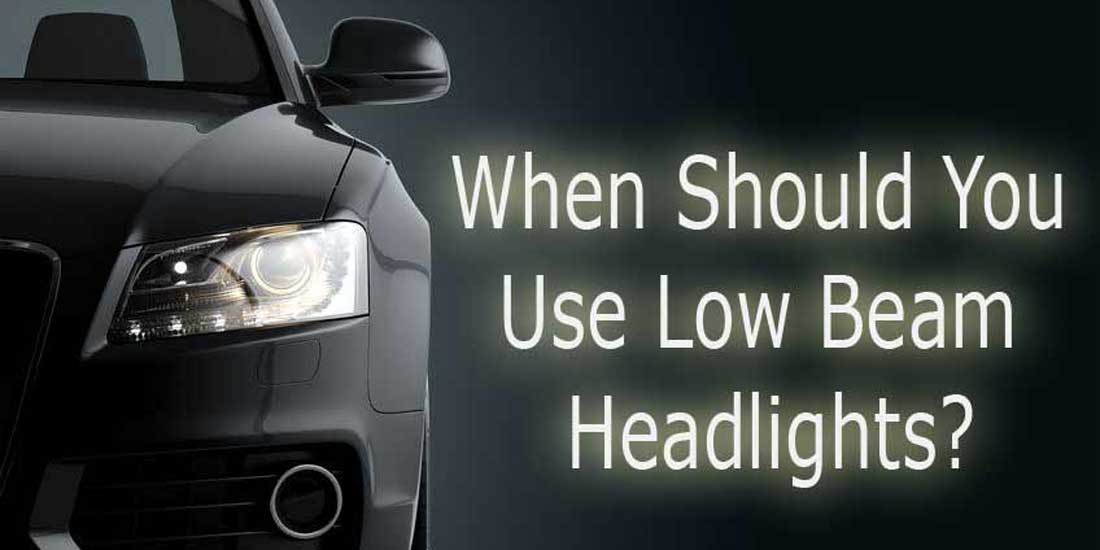
Low-beam headlights make it easier for others to see you. Turn them on. In some states, the law requires headlight use in work zones, but you should use it even if it isn’t the law in your state.
At night, use high-beam headlights whenever necessary. High beams help you see further down the road. But be careful not to blind others with your high beams.
Avoid Unnecessary Lane Changes
Stay in your lane. Change lanes only where pavement markings indicate it is allowed and only when traffic conditions permit. Solid white lines mark stretches where changing lanes is discouraged or prohibited.
Flaggers Must Be Obeyed
In some construction areas, flaggers may control traffic flow. When stopping traffic, the flagger extends a fluorescent orange or red flag in a horizontal position into the line of traffic. They may also use a signal paddle with a stop sign. You may proceed only when directed by the flagger to do so. Proceed slowly and with caution.
Learn what all the flagger signals mean, even if they won’t appear on your final test. Can you identify all three?
Remember, if your state’s handbook doesn’t describe flagger signals, they are not on the test. But it is still helpful for your everyday driving if you know them.

Understand the Stripes on Barricades and Panels
It is usually easy to follow the instructions given by signs and markings in a work zone. After all, authorities design them to help you navigate a work zone as smoothly as possible.
Even if you intuitively know how to pass panels and barricades in a work zone, some basics can be good to know.
The orange diagonal stripes on a panel or barricade have a specific meaning. They always guide you and tell you on which side you must pass.
Stripes sloping downward to the right mean you must pass on the right side of the panel or barricade. If they angle down to the left, you must pass on the left side.
Sometimes, you may see two barricades together, one with stripes angled down to the right and one with stripes down to the left. In this situation, you may pass on either side of the barricades.
If two barricades have stripes slanting down to the center, the roadway is closed to traffic! An additional sign, “Road Closed,” is usually posted on the barricade or nearby. Do not drive past the barricades.
 Pass on the left.
 Pass on either side
 Roadway closed
Sloping Stripes on Barricades and Panels
Check Your Knowledge

A. Slow down
B. Use Caution
C. Merge right
D. Merge left or right
A. Avoid tailgating
B. Watch for workers and work equipment
C. Both A and B are correct

A. Proceed
B. Slow
C. Stop
D. Pull over
A. Red
B. White
C. Orange
D. Pink

A. Flagger ahead
B. Stop ahead
C. Detour ahead
D. Closed roadway

A. Only when workers are present
B. Always
C. Unless it is safe to go faster
D. Only during the daytime
A. A yellow warning sign ahead of the work zone
B. Red pavement markings in the center of the highway
C. Black and white signs guiding the motorists through the work zone
D. Orange cones, barrels, and signs where road construction is taking place
A. Rear-end crash
B. Single vehicle crash
C. Head-on crash
D. Worker-vehicle crash
A. Do Not Enter, No Parking, and One way
B. Wrong Way, Yield, and Hospital
C. No Right Turn, Pass with Care, and Speed Limit
D. Detour, Road Construction Ahead, and Flagger Ahead

A. On the left side
B. On the right side
C. On either side
D. On no side (you must turn around)
Answers
Question 1: The correct answer is merge left or right.
Question 2: Both A and B are correct.
Question 3: The correct answer is slow.
Question 4: The correct answer is orange.
Question 5: The correct answer is Flagger ahead.
Question 6: The correct answer is Always.
Question 7: The correct answer is Orange cones, barrels, and signs where road construction occurs .
Question 8: The correct answer is Rear-end crash.
Question 9: The correct answer is Detour, Road Construction Ahead, and Flagger Ahead.
Question 10: The correct answer is On the right side.
Get more DMV Questions:
| Alabama |
| Alaska |
| Arizona |
| Arkansas |
| California |
| Colorado |
| Connecticut |
| Delaware |
| District of Columbia |
| Florida |
| Georgia |
| Hawaii |
| Idaho |
| Illinois |
| Indiana |
| Iowa |
| Kansas |

