
Virginia Driver’s License & Permit Practice Tests
Results
Good job! This is a passing score. Do you want to try another test?


#1. Signing a citation after being pulled over by a police officer:
If an officer issues you a citation, you will be asked to sign the citation. This is not an admission of guilt. Refusal to sign the citation may result in your arrest. Or you may be required to go to the police station.

#2. You are driving on a highway posted for 60 mph. Traffic around you is traveling at 70 mph. You may legally drive:
A speed limit is the maximum legal speed you can travel on a road under ideal conditions. You may drive slower than the posted speed, but it is illegal to drive any faster. By law, you must drive slower if conditions such as road construction or bad weather make the posted speed unsafe.

#3. When indicated by a sign or signal, which is the legal speed limit in a school zone?
Legal speed limit in school zones, business or residential districts is 25 mph. You are required to travel 25 mph in a school zone only when indicated by a sign or signal. Otherwise, maintain the posted speed.

#4. When turning in the direction of a green arrow, you must:
A green arrow means go. You must turn in the direction the arrow is pointing after you yield to any vehicle, bicyclist, or pedestrian still in the intersection. The green arrow allows you to make a protected turn. This means oncoming vehicles, bicyclists, and pedestrians are stopped by a red light as long as the green arrow is lighted.

#5. When sharing the road with a motorcyclist, you should refrain from:
Respect the vehicle space of a motorcycle and its position in traffic. Never drive beside a motorcycle in the same lane. Although a motorcycle is not as wide as the lane, the rider will use the entire lane as traffic situations and road conditions change. A slight change or debris on the road surface can be a major obstacle for a motorcyclist. Expect the motorcycle to make sudden moves within the lane.

#6. What is true about bicyclists?
Bicycles are considered vehicles and have the same right-of-way as motor vehicles. Bicyclists are allowed to ride in the center of the lane, when necessary, such as when they are about to turn left or when the lane is too narrow to share side-by-side with a car.

#7. Unmarked crosswalks are crosswalks not marked by painted lines. They exist:
There is a crosswalk at every intersection even it is not painted as such. This is known as an unmarked crosswalk.
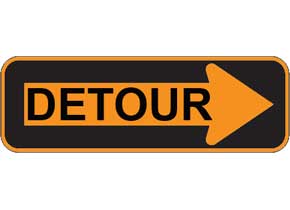
#8. This sign alerts you to:
This sign indicate a change in the route ahead.
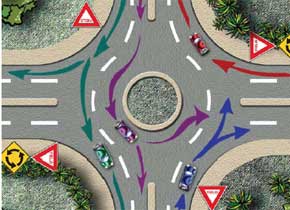
#9. When you are inside a roundabout, you should:
While inside the roundabout, stay in your lane until you are ready to exit. Use your vehicle’s right turn signal to let drivers around you know what you want to do.

#10. You have stopped your car. Before opening your door, you should always:
Be aware of other traffic when exiting your vehicle. Look for other cars, bicyclists, and pedestrians before opening the door.

#11. Unless there are two or more lanes moving in the same direction, passing another vehicle is not allowed:
Passing is unlawful and unsafe on hills, curves, at intersections and railroad crossings, except on roads with two or more lanes of traffic moving in the same direction.

#12. It is illegal to park a vehicle if an intersection is within:
Never park within 20 feet of an intersection.

#13. An adult car passenger must always wear a safety belt:
Under Virginia law, the driver and all front seat passengers must wear safety belts. A passenger younger than age 18 must be properly secured in a safety belt, booster seat or child safety seat no matter where the child is seated in the vehicle.

#14. What is the best thing to do if you experience sleepiness behind the wheel?
Constant yawning, head nodding, heavy eyelids, blurred vision and weaving while driving are some of the warning signs that you may be on the verge of falling asleep at the wheel.
Stop at a safe place and take a nap. Wait at least 10 minutes after waking up to see how alert you are. If you don’t feel any more alert, don’t drive. Find a place to sleep for an hour or for the night.

#15. The best way to increase visibility when backing up is to:
The most common mistake that drivers make when backing up is failing to look both ways behind them. Mirrors do not give you a full view. To see as much as possible, turn your body and head to the right and look out through the rear window. Back up slowly and check for pedestrians and approaching traffic by glancing quickly to either side.

#16. To see vehicles in your blind spots, you must look:
You must glance over your shoulder to be sure no one is in the blind spot.

#17. What is the best advice for a driver who has been drinking alcohol?
A person that had too much to drink must not drive. If possible, they should arrange for a designated driver, use public transportation, or call a cab.
Remember, alcohol-related crashes are not accidents. They can be prevented. The only way to avoid the risks of drinking and driving is to decide before you start drinking that you are not going to drive.
#18. Roads freeze more quickly when they are:
Watch for ice on bridges and in shady areas. Bridges freeze before other road surfaces.
Always approach bridges, shaded spots, overpasses and turns slowly.

#19. When approaching another vehicle from behind at night, at what distance should you dim your headlights?
Bright lights must be dimmed 500 feet before meeting an oncoming vehicle or 200 feet before passing a vehicle.

#20. If you meet an aggressive driver on the road:
If you see an aggressive driver, stay out of the way. Do not challenge the aggressive driver by speeding up or trying to out-maneuver him. Avoid eye contact and ignore his gestures and shouting.
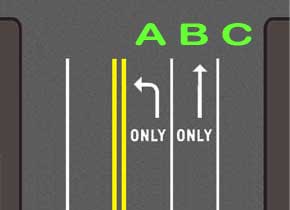
#21. You approach this intersection. Which lane must you use for a left turn?
Arrows are often used with the white lines to show which turn may be made from the lane.
If you are traveling in a lane marked with a curved arrow and the word ONLY, you must turn in the direction of the arrow. If your lane is marked with both a curved and a straight arrow, you may turn in the direction of the arrow or you may go straight.

#22. The driver is responsible for making sure that children are properly secured:
The driver is responsible for making sure that children are properly secured. If you are convicted of violating the child restraint law, you will be fined $50. A second or subsequent offense could mean a $500 penalty. All children under age 8 must be properly secured in a child safety seat or booster seat when riding in vehicles manufactured after January 1, 1968.

#23. If someone follows you too closely (tailgates you), you should:
Most rear end collisions are caused by the vehicle in back following too closely. If you find yourself in this situation, do not brake suddenly. If possible, move over to another lane, or gently tap your brakes to flash your brake lights and slow down. This should encourage the tailgater to pass you or slow down.

#24. When merging onto an interstate or a high-speed divided roadway, you should:
Use your mirrors and turn signals. Turn your head to look quickly to the side before changing lanes.

#25. When approaching a stopped school bus with flashing red lights at a four-way intersection, you must stop:
You must stop for stopped school buses with flashing red lights and an extended stop sign when you approach from any direction on a highway, private road, or school driveway.
| This Virginia Permit Practice Test | |
|---|---|
| Questions per test: | 25 |
| Question pool: | 500+ |
| Type of test: | Random multiple-choice / True or False |

| The Official Virginia Written Knowledge Test | |
|---|---|
| Questions on real exam: | Part I: 10 Part II: 25 |
| Passing score: | Part I: 100% Part II: 80% |
| Correct answers to pass: | Part I: 10 Part II: 20 |
| Allotted time to complete test: | No limit |
| Wait time before retest: | 1-15 days |
This Virginia (VA) Permit Practice Test
This practice test helps you prepare for the second part of your knowledge examination. It has 25 questions about Virginia traffic laws, standard road rules, and safe driving practices.
After each question, you can see whether your answer is correct. If your answer needs to be corrected, there is also a short explanation to help you understand the facts behind the question.
Keep the latest version of the Virginia Driver’s Manual handy and compare comments with the information in the manual. By reading up on your weaknesses, you will learn faster. If you don’t have the manual yet, you can quickly get the latest PDF version online .
Remember, we have designed the practice tests to help you study. Use them as a supplement to the Driver’s Manual – not instead of it.

Two-part Knowledge Examination
To get your learner’s permit or driver’s license in Virginia, you must pass a two-part knowledge examination:
A road sign identification test
A general knowledge test
The first test addresses ten road signs described in the driver’s manual. You must correctly identify all ten signs by shape, color, symbols, and messages. You can check your knowledge of the road signs here: Virginia road sign Recognition test .
It is imperative to know and understand all the road signs.
The second part will verify your general knowledge of laws, rules, and standard driving practices. On this part, the passing score is 80 percent. Out of 25 questions, you need to get at least 20 questions right to pass.
If you combine these two parts, the passing score is 86%, which is higher than in many other states .
On the practice tests, you should aim for a perfect score of 100%.
Who Must Pass the Virginia Knowledge Exam?
First-time applicants.
First-time applicants must always pass all tests, including the written knowledge exam.
Drivers who had their license revoked.
After a license revocation, DMV will restore your driving privilege only if you re-apply for a new driver’s license and pass all applicable tests again, including the written knowledge exam.
Drivers who let their license expire for more than a year.
Be sure to renew your driver’s license in time. If you let your license expire for more than one year, DMV may ask for a re-test.
Drivers with a foreign driver’s license.
DMV will typically waive the knowledge exam if you apply for a Virginia license and hold a valid driver’s license from another U.S. state. The same applies if you are 19 or older and have a valid license from Canada, Germany, France, or the Republic of Korea.
Applicants with a license from a country other than Canada, Germany, France, or the Republic of Korea who are at least 19 years old may convert their foreign license to a Virginia license only after successfully passing all tests.
Failing the Knowledge Exam
You can only take the written exam once per day.
If you fail the test and you are less than 18 years, you must wait 15 days before you can retake it. If you are 18 years or older, you can retake it the next business day – but must pay an additional testing fee.
If you fail the knowledge exam three times, you must complete a driver education course before you can take the test a fourth time. The course must be part of driver education at a driver training school approved by the DMV or the Department of Education. Note that driver improvement courses don’t meet this requirement!
Learn how to ace the DMV test !
Languages
The knowledge test is available in English and Spanish. But several other languages are also supported. For a complete list, check out dmv.virginia.gov .
Audio versions of the exam are available. Ask for a headset and audio support before you start the test.
Applicants with other needs or special help should inform a DMV staff member before the examination. We recommend that you call ahead and explain your situation. Such accommodations may not be available at driving schools.

Cheating
Remember, you can’t:
- Get help from others when taking the test.
- Help another person during the test.
- Try to get test questions or answers before the test.
- Give another person exam questions or answers.
- Use a cell phone or other electronic devices during the exam.


Test permit MA