
Virginia Driver’s License & Permit Practice Tests
Results
Good job! This is a passing score. Do you want to try another test?


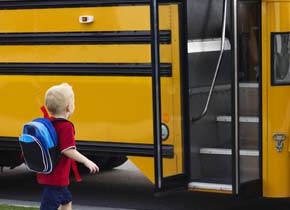
#1. While driving, you approach a school bus from behind. The bus has stopped to pick up children, but no red lights are flashing. You should:
You must stop for stopped school buses with flashing red lights and an extended stop sign when you approach from any direction on a highway, private road, or school driveway. Stop and remain stopped until all persons are clear, and the bus moves again.
You must also stop if the bus is loading or unloading passengers and the signals are not on.
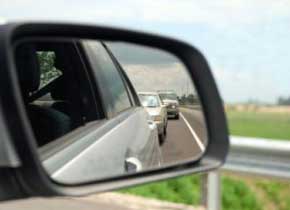
#2. As a safe driving practice, you should check your rear-view mirrors every:
Do not develop a fixed stare. Use your rear-view mirror to frequently (about every 10 seconds) check the traffic behind you. This will alert you if someone is moving up too quickly or tailgating you. Check the traffic behind you when changing lanes, backing up, slowing down quickly, or driving down a long, steep hill.
#3. When moving to Virginia, how soon are you required to title and register your vehicle?
You must title and register your vehicle and obtain Virginia license plates within 30 days of moving to Virginia.
You got 60 days to obtain a Virginia driver’s license.

#4. When you are carrying a passenger younger than age 18 you must make sure that the passenger:
The driver is responsible for making sure that children are properly secured. If you are convicted of violating the child restraint law, you will be fined $50. A second or subsequent offense could mean a $500 penalty. All children under age 8 must be properly secured in a child safety seat or booster seat when riding in vehicles manufactured after January 1, 1968.

#5. When merging onto an interstate or a high-speed divided roadway, you should:
Use your mirrors and turn signals. Turn your head to look quickly to the side before changing lanes.

#6. If you are under age 18, it is legal to use a cell phone while driving:
When on the road, drivers should not use cell phones, computers, or other distracting devices except to report a crash or emergency. There is, however, no general prohibition on cell phone use while driving in Virginia.
Virginia law prohibits drivers under age 18 from using cell phones or any other wireless communication device while driving except in a driver emergency and the vehicle is lawfully parked or stopped.
Text messaging or reading of text messages while driving is illegal for all drivers

#7. What parts of a road might hold frost and ice while the rest is dry?
Watch for ice on bridges and in shady areas. Bridges freeze before other road surfaces.
Always approach bridges, shaded spots, overpasses and turns slowly.

#8. Which is one factor that significantly affects your stopping distance?
The process of stopping your car has three main components: perception, reaction, and braking. This is usually referred to as stopping distance. The first two components can be affected by human factors such as tiredness, alcohol, fatigue, and concentration levels. The last component depends on factors such as: tires, brakes, road, and weather conditions.

#9. Consuming caffeine, energy drinks or other stimulants are reliable methods for staying awake and prevent drowsy driving.
Consuming caffeine, energy drinks or other stimulants do not prevent drowsy driving and are not reliable methods for staying awake.

#10. When are you allowed to park your vehicle on a crosswalk?
You may not park on a crosswalk.

#11. A bicyclist is in front of you on a two-lane highway, and a car approaches from the other direction. What is the best thing to do?
Pass only when safe. Instead of driving between the car and the child, take one danger at a time. First, slow down and let the car pass. Then, move to the left to allow plenty of room (at least three feet) before you pass the child.
Remember, slow down when you approach bicyclists. State law requires motorists to pass cyclists with at least three feet of clearance. Give them plenty of room when passing and be prepared to stop suddenly. Look for bicycles on all public roads.

#12. If you are in an intersection, when an emergency vehicle with flashing lights approaches from behind, you should:
If you are in an intersection, continue through the intersection and then drive to the right as soon as you can and stop. Never stop in an intersection.

#13. When indicated by a sign or signal, which is the legal speed limit in a school zone?
Legal speed limit in school zones, business or residential districts is 25 mph. You are required to travel 25 mph in a school zone only when indicated by a sign or signal. Otherwise, maintain the posted speed.

#14. If a traffic signal light is not working, you must:
If a traffic signal light is not working, proceed as if the intersection is controlled by a stop sign in all directions. Meaning, you must stop, and may only proceed when you can do so safely.

#15. You may continue carefully against a yellow light if:
Yellow circular lights or arrows are caution warnings. The light is about to change. If you have not entered the intersection, stop if you can do so safely. If you are already in the intersection, go through it. Do not speed up to beat the light.

#16. You are following a school bus, and there is a railroad crossing ahead. You must slow down and prepare to stop because the bus:
Some vehicles, such as school buses or vehicles carrying hazardous materials, must always stop at railroad crossings. When driving behind one of these vehicles, a motorist must be prepared to stop, even if signals do not indicate a train is coming.

#17. What can help prevent serious injuries in a crash?
Wearing seat belts, also called safety belts, can double your chances of surviving a crash and more than double your chances of avoiding serious injury. Never wear your shoulder belt behind your back or under your arm.

#18. When you encounter fog, dust, heavy rain, or snow, you should turn on high beam headlights.
Fog reflects light and can reflect your own headlights back into your eyes. Use your low-beam lights when you encounter fog, dust, heavy rain, or snow.

#19. To reduce your risk of hitting a wild animal you should be extra alert:
Thousands of deer-vehicle crashes take place in Virginia each year, resulting in fatalities, injuries, and costly vehicle damage. To avoid hitting a deer, you should be alert at dusk and dawn, especially in the fall. Deer are most active in the dusk and dawn hours.

#20. When entering or crossing a road from a driveway:
When entering a roadway from a private road or driveway, you must stop and yield to all traffic and pedestrians. Stop at the sidewalk, or if there is no sidewalk, at a point prior to entering the roadway.

#21. You are driving on a freeway posted for 65 mph. Around you, traffic is traveling at 70 mph. What should your speed be?
A speed limit is the maximum legal speed you can travel on a road under ideal conditions. You may drive slower than the posted speed, but it is illegal to drive any faster. By law, you must drive slower if conditions such as road construction or bad weather make the posted speed unsafe.

#22. What is the only thing that will reduce the alcohol concentration in your blood?
Only time can decrease intoxication. Things like coffee, cold showers, vitamins, or exercise will not sober you up.

#23. When are broken white lines used as pavement marking between lanes?
Broken white lines separate lanes of traffic going in the same direction. You may change lanes with caution.

#24. If you accidently run off the pavement, you should:
If you run off the road, do not panic. Stay on the shoulder and gradually reduce your speed. Ease up on the gas pedal and use your brakes carefully. Regain control, look in the direction you want to go, then turn slowly back onto the road.
Too often motorists panic, over-correcting, and steer abruptly to return to the road.

#25. When a lane is too narrow for cars and bikes to drive side-by-side:
Bicycles are considered vehicles and have the same right-of-way as motor vehicles. Bicyclists are allowed to ride in the center of the lane, when necessary, such as when they are about to turn left or when the lane is too narrow to share side-by-side with a car.
| This Virginia Permit Practice Test | |
|---|---|
| Questions per test: | 25 |
| Question pool: | 500+ |
| Type of test: | Random multiple-choice / True or False |

| The Official Virginia Written Knowledge Test | |
|---|---|
| Questions on real exam: | Part I: 10 Part II: 25 |
| Passing score: | Part I: 100% Part II: 80% |
| Correct answers to pass: | Part I: 10 Part II: 20 |
| Allotted time to complete test: | No limit |
| Wait time before retest: | 1-15 days |
This Virginia (VA) Permit Practice Test
This practice test helps you prepare for the second part of your knowledge examination. It has 25 questions about Virginia traffic laws, standard road rules, and safe driving practices.
After each question, you can see whether your answer is correct. If your answer needs to be corrected, there is also a short explanation to help you understand the facts behind the question.
Keep the latest version of the Virginia Driver’s Manual handy and compare comments with the information in the manual. By reading up on your weaknesses, you will learn faster. If you don’t have the manual yet, you can quickly get the latest PDF version online .
Remember, we have designed the practice tests to help you study. Use them as a supplement to the Driver’s Manual – not instead of it.

Two-part Knowledge Examination
To get your learner’s permit or driver’s license in Virginia, you must pass a two-part knowledge examination:
A road sign identification test
A general knowledge test
The first test addresses ten road signs described in the driver’s manual. You must correctly identify all ten signs by shape, color, symbols, and messages. You can check your knowledge of the road signs here: Virginia road sign Recognition test .
It is imperative to know and understand all the road signs.
The second part will verify your general knowledge of laws, rules, and standard driving practices. On this part, the passing score is 80 percent. Out of 25 questions, you need to get at least 20 questions right to pass.
If you combine these two parts, the passing score is 86%, which is higher than in many other states .
On the practice tests, you should aim for a perfect score of 100%.
Who Must Pass the Virginia Knowledge Exam?
First-time applicants.
First-time applicants must always pass all tests, including the written knowledge exam.
Drivers who had their license revoked.
After a license revocation, DMV will restore your driving privilege only if you re-apply for a new driver’s license and pass all applicable tests again, including the written knowledge exam.
Drivers who let their license expire for more than a year.
Be sure to renew your driver’s license in time. If you let your license expire for more than one year, DMV may ask for a re-test.
Drivers with a foreign driver’s license.
DMV will typically waive the knowledge exam if you apply for a Virginia license and hold a valid driver’s license from another U.S. state. The same applies if you are 19 or older and have a valid license from Canada, Germany, France, or the Republic of Korea.
Applicants with a license from a country other than Canada, Germany, France, or the Republic of Korea who are at least 19 years old may convert their foreign license to a Virginia license only after successfully passing all tests.
Failing the Knowledge Exam
You can only take the written exam once per day.
If you fail the test and you are less than 18 years, you must wait 15 days before you can retake it. If you are 18 years or older, you can retake it the next business day – but must pay an additional testing fee.
If you fail the knowledge exam three times, you must complete a driver education course before you can take the test a fourth time. The course must be part of driver education at a driver training school approved by the DMV or the Department of Education. Note that driver improvement courses don’t meet this requirement!
Learn how to ace the DMV test !
Languages
The knowledge test is available in English and Spanish. But several other languages are also supported. For a complete list, check out dmv.virginia.gov .
Audio versions of the exam are available. Ask for a headset and audio support before you start the test.
Applicants with other needs or special help should inform a DMV staff member before the examination. We recommend that you call ahead and explain your situation. Such accommodations may not be available at driving schools.

Cheating
Remember, you can’t:
- Get help from others when taking the test.
- Help another person during the test.
- Try to get test questions or answers before the test.
- Give another person exam questions or answers.
- Use a cell phone or other electronic devices during the exam.


Test permit MA