
Michigan Driver’s License & Permit Practice Tests 2026
Results
Great! This is the passing score you need on the real exam. Do you want to try again?
This is not a passing score. Do you want to try again?


#1. A sign with this shape means:
Octagon (Stop): This eight-sided shape always means stop. You must come to a complete stop at the sign, stop line, pedestrian crosswalk, or curb. Wait for any vehicle or pedestrian to clear the way.
The color and shape of a traffic sign communicates important information about the sign’s message. In poor visibility conditions, such as heavy fog, you may be able to make out only the shape of a sign. As you approach a sign and while still distant, you may see the color long before you can read the message or see the symbol, giving you some advance information.

#2. What is a passive railroad crossing?
Passive railroad crossings do not have flashing lights or gates to warn of approaching trains. Slow down or stop as necessary and yield to any rail traffic.

#3. What should you do when approaching a bicyclist from the rear on a two-lane road?
Leave plenty of extra space between your vehicle and a bicyclist ahead. They can usually stop in shorter distances than a car and may have to swerve suddenly to avoid obstacles.

#4. You approach this road sign. What must you do ahead?
This sign tells you that you are near an area where a large number of pedestrians cross the street. Slow down and watch for people crossing the street on foot. Pedestrians in crosswalks must be given the right of way at all times.

#5. If you miss your exit when leaving a freeway, you should:
If you miss your exit ramp, never back up, turn around, or use a median crossover. Instead, drive to the next exit.

#6. If the rear of your vehicle starts to skid left, you should:
If the vehicle begins to skid, remain calm and do the following:
- Take your foot off the accelerator and let the vehicle slow down gradually.
- Turn the front wheels only enough to keep them pointed in the direction you want to go and no farther.
- Be prepared for a secondary skid in the opposite direction.
- Again, turn the wheels in the direction you want to go. Then straighten the wheels to bring the vehicle under control.
Don’t use the brake unless absolutely necessary. Slow the car gradually until it is under control.

#7. When may you drive at the maximum speed indicated by a speed limit sign?
Michigan’s basic speed law means you must drive at a careful and prudent speed in all driving conditions. You must drive at a speed that always allows you to stop within the clear distance ahead. This speed is never faster than the posted speed limit. Depending on conditions, it may be slower than the posted speed limit.

#8. A conviction for a fatality or for drunken or drugged driving remains on your driving record:
A conviction for a fatality or for drunken or drugged driving remains on your driving record permanently.

#9. If you are being followed closely or tailgated, it can be dangerous to:
If other drivers tailgate you, pull over and let them pass. It is better to have these unsafe drivers in front where you can see them rather than having them driving on your rear bumper.

#10. Where are you more likely to get in a crash?
Most crashes occur at intersections.

#11. Daily deer activity is highest:
Deer are most active in the dusk to dawn hours, so you should be especially alert while driving during those times.
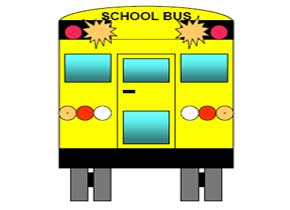
#12. You are following a school bus. It turns on its amber overhead lights. You should:
Flashing yellow lights are a warning signal. It means that the bus is about to stop. You should slow down and be prepared to stop.

#13. Changing lanes is prohibited when the line dividing two lanes is:
A double solid white line is used to show a travel path where driving in the same direction is permitted on both sides of the line, but crossing the line is prohibited.

#14. When you see a large truck preparing for a right turn ahead, you should:
Stay behind trucks making right turns. Commercial vehicles need room to make right turns. They may swing wide to the left to safely negotiate a right turn. When you see a commercial vehicle with its right turn signal on at an intersection, know that the truck is going to make a wide right turn. Do not try to pass on the right-hand side or you might get squeezed between the truck and the curb.

#15. You may always continue carefully against a steady yellow arrow when:
A solid yellow arrow warns you that the left turn signal is about to change to red. If you are approaching the intersection, you must stop. However, if you are already within the intersection and there is no conflicting traffic present, you may complete your left turn.

#16. This white sign means you must not pass:
The white Do Not Pass sign will be posted on the right side. A yellow pennant sign may be posted on the left side of the road. The signs mean do not pass other vehicles.

#17. What is true about riding with a child in your lap?
Until children are 8 years old or 4 feet, 9 inches tall, they must be in either a properly fitting child safety seat or booster seat.
Never hold a child on your lap or buckle a child with another passenger into one seat belt. Always insist children buckle their seat belts before starting the engine.

#18. When driving on wet winter roads, you should:
Reduce your speed. Allow extra space between your car and the car ahead. Do not brake or turn suddenly. Use a low gear when going down steep hills. Be careful on bridges and overpasses. These areas freeze first and dry out last.

#19. In which of the following places can you park your car?
Never park your car in front of a public or private driveway, within 15 feet of a fire hydrant, or in a tunnel. You may park at a traffic light if the distance is more than 30 feet.

#20. Driving in reverse on an expressway:
Driving in reverse on an expressway is prohibited.
| This Michigan Practice Test | |
|---|---|
| Number of questions on each practice test: | 20 |
| Question pool: | 750+ |
| This is a randomized practice test. | |

Facts about Your Michigan Permit Test
| MI SOS Knowledge Test for Learner’s Permit and Driver’s License | |
|---|---|
| Number of questions on exam: | 80 questions |
| Passing score: | 70 percent |
| Correct answers to pass: | 56 |
| Allotted time to complete test: | n/a |
| Wait time before retest: | 1 day (three attempts, a new fee is required each time) |
What You Should Know about this Michigan Practice Test
This Michigan permit practice has 20 random questions in each set.
You can find the answers to all questions in the MI driver’s handbook “What Every Driver Must Know” published by Michigan Secretary of State (SOS).
When you study for your permit or full (adult) driver’s license, you should get the latest version of the Michigan handbook. You can get it online or a copy at any Secretary of State branch office. Remember to read this manual all the way through.
After building up some basic knowledge from the guide, use the practice tests to check your progress and whether you are ready for the permit exam. Remember, focus on understanding questions and answers, not just memorizing them. You should use a practice test as a supplement to the manual, not as a replacement.
After each practice question, you will get instant feedback that tells you whether your answer is correct. If you make a mistake, there is a short comment explaining the correct answer. Reading the corresponding chapter in “What Every Driver Must Know” is a good idea.
You can take as many sample tests as you need. There is a new set of questions each time.
Practice questions that are the same or similar to the real test , but the tests are not real knowledge exams. They will only help you prepare for the real thing and help you study. You should know that driversprep.com is privately owned and not affiliated with the Michigan Secretary of State or any other State Entity.
Why is There Only 20 Questions on the Michigan Practice Test?
The actual examination (segment 1 test for teenagers) has 80 questions. It is a lengthy test, and staying concentrated through 80 questions is hard, especially when you are only practicing.
A shorter practice test helps you stay focused all the way through. It also gives you more time to compare answers with the facts in the manual.
Aim for a 100% score on each sample test. That way, you will know that you can pass the real examination.

Why Should I Take the Michigan Practice Tests?
How do practice tests help?
Online practice tests have two purposes.
- They help you recap important areas of “What Every Driver Must Know.”
- They help you verify that you have learned important rules and road signs and tell you whether you are ready for the real test.
Driving is a complex task. It helps if you are well-prepared every time you get behind the wheel. Knowledge, training, experience, and attitude are all important to be safe on the road.
With knowledge and a good understanding of road rules, safe driving techniques, road signs, and traffic signals, you can reduce the risk of getting into accidents.
That is why it is crucial to learn the facts in the Michigan manual and verify your knowledge.
Studying for both the test and your future safety on the road is in your best interest.
Is the Michigan Permit Test Hard?
The passing score in Michigan is 70 percent. It is the lowest passing score in United States .
| State | Passing Score |
|---|---|
| Michigan | 70% |
| New Mexico | 70% |
| New York | 70% |
| Texas | 70% |
| Massachusetts | 72% |
With 80 questions, more than any other state, the test also has much room for mistakes and is therefore considered one of the easiest in the country.
Where Can I Take the Test?
If under 18 years, you take your knowledge tests as part of your driver education.
All applicants under 18 must pass the Graduated Driver Licensing (GDL) program, which includes two segments of driver education. Each segment has a knowledge test at the end of the course. These tests are known as the Segment 1 and Segment 2 exams.
At the end of the segment 1 class, you must pass a written test with 80 questions about road rules, traffic laws, safe driving, and road signs. You must correctly answer 56 of the 80 questions.
To pass the Segment 2 class, you must correctly answer 14 out of 20 questions about distracted, impaired, fatigued, and emotional driving dangers. There are also questions about general strategies for safety on the road.
If you are 18 years or older, you apply for your temporary instruction permit at a Secretary of State office. You also take your knowledge test at the office. This test corresponds to the Segment 1 exam. There is no additional test if you are 18 years or older.
Michigan state does currently not allow online testing from home.
Do You Feel that 80 Questions is Overwhelming?
Eighty questions may sound like an overwhelming test, but you only need 56 correct answers to pass. If you take many practice tests on this website, your chances of passing are good.
When studying for 10 hours or more, more than 96% of our users pass the Michigan exam on their first attempt.
We rarely get reports about users who failed the test. If you do, we would like to know why you think you failed it.
Read more: Top 5 Mistakes Test Takers Make .

Who Must Take the Michigan Knowledge Test?
New first-time applicants
If this is the first time you apply for a license, you must always pass all the tests before you can get a Michigan Driver’s License.
If you are under 18, you must follow the GDL program rules, which have two knowledge tests.
There is just one knowledge test if you are 18 years or older.
New residents with a permit from another state
Suppose you have a permit issued by another state. In that case, you must prove that the driver education in the other state meets Michigan’s minimum standards of 30 hours of classroom and six hours of behind-the-wheel training. Otherwise, you must pass Michigan’s state exams.
New residents with a foreign license
Suppose you move to Michigan from a country other than the United States, Canada, Germany, and the Republic of Korea (South Korea). In that case, you must pass the same tests as new drivers.
Drivers with a license expired more than 4 years
If your Michigan license expired more than four years ago, you must apply for a new license and retake all tests.
Drivers with revoked license
A driving privilege will remain revoked until you attend a Driver Assessment re-examination. Depending on the reason for your revocation, the Department may require that you pass the written, vision, and on-road performance test again.
Drivers involved in crashes or with a bad driving record
Michigan Department of State can ask for a re-examination if you have the following:
- A physical or mental condition that impairs your ability to drive safely.
- Been involved in three or more negligent crashes resulting in injury or property damage during the last two years.
- Been involved in a fatal crash.
- 12 or more points on your driving record within two years.
- Been convicted of violating your driver’s license’s terms, restrictions, or conditions.

When is the Michigan Knowledge Test Waived?
Suppose you move to Michigan with a valid license from another state, the District of Columbia, or a U.S. territory. The Secretary of State will usually waive the knowledge test in that case.
Good to Know
The computerized test is available in English.
If you need help speaking or reading English, ask for a list of available foreign language interpreters. Paper versions of the official written test are also available in some other languages. Check with your driver instructor or local State office. If you are hard of hearing, you can request a sign language interpreter in advance or use a personal interpreter.
The permit test has no time limit, but you must arrive at least one hour before closing to allow enough time to complete the test. The test usually takes about 25-30 minutes to complete.
Should you fail the test, SOS allows you to retake it the next day, but you may choose to wait a bit longer. If you missed 24 questions, you missed many vital facts.
You must pay a new fee each time you take the test, and you are only allowed three attempts before a longer waiting time kicks in.
Have Your Documents Ready

Ensure you have the correct documents before visiting a Secretary of State office. The clerk will only accept your application for a permit or driver’s license if all necessary documents are present.
You need:
Proof of Social Security Number (1).
Proof of legal presence (1), if applicable.
Proof of identity (1).
Proof of Michigan residency (2 documents).
A parent or guardian signature/approval if under 18 years.
For minors, residency can be confirmed through documents in the parent’s name if other proof can establish the family relationship.
If you have any questions about what documents you need, visit SOS FAQ or call the Information Center at 888-SOS-MICH (767-6424).
What to expect from the Segment 1 Driver Education
To start, you must be at least 14 years and eight months, have approval from a parent or legal guardian, and have your application confirmed by SOS.
The classroom phase of the education must include:
A minimum of 24 hours of instruction.
A maximum of 2 hours of instruction per day.
No more than 36 students per class (no exception).
The state-approved written test for consideration of a certificate of completion.
Home study time is not considered time earned toward the 24-hour classroom requirement.
The driver education provider may have additional classroom requirements such as attendance, homework, and additional testing requirements.
The driving instruction phase of education must include the following:
A minimum of 6 hours of on-the-road driving instruction.
No more than 1 hour of driving instruction per day.
At least 4 hours of observation time in the training vehicle.
The maximum number of students in a driver education vehicle is 4. At most, two people can occupy the front seat. A student can only have driving instruction individually if there is written consent from a parent.

What to expect from Segment 2 Driver Education
To move on to the segment 2, you must have:
Held a valid Level 1 license for a minimum of 3 consecutive months.
Completed a minimum of 30 hours of driving time, of which 2 hours must be at night.
Classroom Requirements during this segment:
A minimum of 6 hours of instruction.
No more than 2 hours of instruction per day.
A maximum of 36 students per class.
Home study time does not count toward the 6-hour classroom requirement.
Recent Changes
The state has simplified the graduated driver licensing process to reduce customer visits to branch offices. They will issue a photo license hard card for a GDL Level 1 license instead of a paper license. You don’t need to return to the branch office for your Level 2 or Level 3 licenses.
The full unrestricted license will be mailed to you when you turn 18.


