
Wyoming Driver’s License Tests & Permit Practice Questions – 2026
Results
This is a passing score. Do you want to try again?
This is not a passing score. Do you want to try again?


#1. If you are sitting in a large truck, is your view of the road better or worse than in a car?
Many drivers falsely assume that a trucker can see the road better because they sit twice as high as the driver of a car. The truck driver has a better view over the top of any cars ahead of him, but heavy vehicles also have sizeable blind spots that passenger vehicles do not have.

#2. When you approach a roundabout, you must:
Slow down as you approach a roundabout and yield to pedestrians and traffic already in the roundabout.
Traffic in the roundabout must be given the right-of-way.

#3. Proof of insurance is needed:
You must maintain liability insurance and carry proof of insurance whenever you drive.

#4. Orange road signs give:
Orange is used for construction and maintenance warning. The signs are usually diamond shaped. They notify drivers of unusual or potentially dangerous conditions near work areas.

#5. The following are dangerous while driving. Which is also illegal?
Wyoming law prohibits reading or sending a text message from a cell phone or other device while operating a vehicle.

#6. You are entering a work zone. There is a temporary speed limit displayed. You must
Watch for and obey slower speeds limits.

#7. When you see a sign with this shape and color, you must:
A stop sign means you must come to a complete stop. Give the right-of-way to pedestrians and to all cross traffic before moving again.

#8. If your gas pedal sticks, it is hazardous to:
If your gas pedal sticks:
- Concentrate on steering (Keep your eyes on the road.)
- Try to free the pedal with your foot (If this does not work, push in the clutch or shift to neutral.)
- Use your brakes, stop at the nearest safe place and turn off the ignition.
- Find out what caused the problem and have it repaired.

#9. Which light indicates that you must always come to a complete stop at an intersection?
At a steady red signal, you must stop behind the crosswalks or stop line. You can turn right unless there is a sign that prohibits the turn. You may turn right only after stopping and yielding to persons and other vehicles. You may also, after stopping and yielding, turn left from a one-way street onto a one-way street.

#10. In general, parking is legal:
You must not park in front of a driveway or on a bridge. Parking on a hill is allowed if you are far enough from any travel lane to avoid interfering with traffic and visible to vehicles approaching from either direction.

#11. When you are fatigued, you:
If you are tired, have been drinking, or simply are not paying attention, you may not identify the danger at all. You won’t be able to predict what may happen until it is too late to decide what you should do. Finally, you may not be able to execute your decision soon enough because your reaction time may also be slower.

#12. Which of these statements about drugs and driving is true?
Most of the common drugs affect at least one of the major skills you need as a driver. Drivers need to know how drugs affect their ability to Identify, Predict, Decide and Execute.
Be cautious of new medicines. Do not drive until you are certain that they will not impair your driving.

#13. If you are being followed closely or tailgated, you should:
- Provide more time and space ahead to react to emergencies (increase the following distance between you and the vehicle in front of you.)
- Move to the right lane of a multi-lane highway.
- Reduce your speed to encourage the driver behind to pass. Never slow down quickly to discourage a tailgater, all that does is increase your risk of being hit from behind.

#14. This red and white sign means:
This sign prohibits the driver from entering a restricted road section.
When you see this sign, do not drive onto that street or ramp from your direction.
The sign is square, not round.

#15. When driving on wet winter roads, you should:
Watch for ice on bridges, overpasses, and shaded areas, where it can remain, even after the sun comes out. These areas also tend to freeze before the rest of the road does.

#16. If you find yourself on a roadway marked with a yellow line on the right edge and a white line to your left:
If you ever find yourself with yellow to your right and white to your left, you are going the wrong way.
Remember, solid yellow lines are used on the left of the roadway edge of divided streets or roadways. When driving, a yellow line should always be to your left.
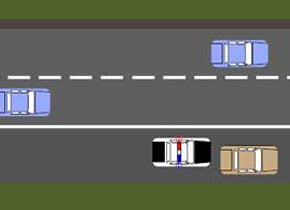
#17. When approaching a stationary emergency vehicle with flashing lights on an interstate, you must:
When you are driving on a highway with two or more lanes, upon approaching an authorized emergency vehicle parked with lights flashing, you must merge your vehicle into the lane farthest from the emergency vehicle. On roads with only one lane in each direction, you must reduce your speed to at least 20 mph below the speed limit when approaching a parked emergency vehicle.

#18. Merging onto a road is safest if you:
While moving along the entrance ramp check over your shoulder for a gap in the traffic on the interstate. Adjust your speed to meet that gap and turn on the turn signal to indicate your need to enter the traffic lane. Do not try to merge into a gap that is too small. A small gap can quickly become even smaller. Do not forget that traffic on the interstate has the right of way.

#19. What should you do if you are involved in a traffic crash, and someone is injured?
Give aid to any injured persons and send for an ambulance. Do not move an injured person unless there is danger of another crash.
Remember to contact the police if there is an injury, death or property damage amounting to $1,000 or more. The law requires you to give the police information on the crash at the time of the crash.

#20. You are in the right-hand lane and approach this sign. What should you do?
Reduction of lanes. Right lane ends. Merge left.
Two lanes of traffic will soon become one lane of traffic. Right-lane traffic must yield when merging.

#21. When should you drive with your parking lights turned on?
Never use parking lights while driving. They cannot be seen until after your vehicle is clearly visible. It is not legal to drive with only parking lights when headlights are required.

#22. Which is true about signaling when you do not see anyone else around?
Get into the habit of signaling every time you change direction or lanes. Signal even when you do not see anyone else around. It is easy to miss someone who needs to know what you are doing.

#23. From which lane should you turn when turning left from a one-way street.
Turn from the lane closest to the lane you want to enter. For a left turn from a one-way street, turn from the left-hand lane.

#24. To obtain an instruction permit an applicant must be:
An instruction permit may be obtained at 15.

#25. If gates rise at a railroad crossing and the red lights still flash, you should:
When gates are down, realize the road is closed. Stop and wait until the gates go up and the red lights stop flashing before proceeding. NEVER drive around gates.
| Wyoming Permit Practice Test | |
|---|---|
| Questions per test: | 25 |
| Question pool: | 500+ |
| Type of test: | Random multiple-choice |

| The Official Driver’s License Test in Wyoming | |
|---|---|
| Questions: | 25 |
| Passing score: | 76 percent |
| Correct answers to pass: | 19 |
| Allotted time to complete test: | – |
| Wait time before retest: | None (twice per day) |
What You Should Know about the Wyoming Practice Test
This permit practice test has 25 random questions from the Wyoming Driver’s License Manual and actual WY DMV examinations. After each question, you will get instant feedback that tells you whether your answer is correct.
Should you miss a question, there is a brief note to help you understand the correct answer. You can also use the information to look up the topic in the Driver’s License Manual and expand your knowledge.
You can take this license practice test as many times as you need. The system creates a new set of questions every time you restart the test.

Get the Wyoming Driver’s License Manual
Start studying by getting the Driver’s License Manual. It is a must-read. You can find answers to all your exam questions in this manual.
You can get a copy from your local DMV office or download a PDF version online .
The information in the manual help you pass the examination. It also helps you to be a safe driver once you get your license.
Taking Practice Tests
The passing score in Wyoming is only 76 percent, which means you must answer at least 19 of 25 questions correctly.
You should, however, aim higher on the practice tests. Try to reach a 100% score on a handful of tests.
Instead of memorizing questions and answers, it is best to fully understand why one answer is correct, and another isn’t. It will make it easier to pass the exam. You will also retain the knowledge longer.

Who Must Take the Wyoming Knowledge Test?
When you apply for your first driver’s license, you must pass a written knowledge test.
You must also pass the knowledge test again if you let your license expire and have not driven for two years or more.
DMV can also ask you to retake all tests after a license revocation.
Based upon personal observation, medical or vision information, and other factors, a DMV representative always has the discretion to ask for a knowledge test.
Official Wyoming Knowledge Test
The knowledge test has questions related to the class of license you are applying for. You can find all answers to the exam questions in the applicable driver’s manual.
On the test, you must identify traffic signs by shape, color, or symbol and identify signals and pavement markings. The test also has questions about seat belt usage, traffic laws, safety rules, crash prevention, and vehicle equipment.
You take your test on a computerized system. Applicants with reading difficulties can ask for a headset and hear the questions through a phone system. If you prefer to use the audio system, you must ask the examiner to connect you to the system before you begin your written test.
If you fail your first attempt, again the same day. You can take the test twice daily.
This does not apply if you miss 13 or more questions. In such a case, you must wait at least three days to retake the test.
Languages
Wyoming tests are only in English. You may use an interpreter for the written tests if you cannot speak English.

Photo credits:
- Struggling woman – CollegeDegrees360
- Young man with Help sign – Marcos Calvo Mesa
- Cover of Wyoming Driver’s License Manual – Photo by Rick Carpenter, Public Affairs Office


