
New Hampshire DMV Test & Practice Questions – 2026


#1. What is most important when you adjust to a safe speed?
Posted speed limits do not tell you at what speed to drive. They only tell you what the maximum legal speed is under ideal conditions. By law, you have to go slower if conditions make the posted speed limit unsafe. This is known as the general or basic speed law. Whenever you drive, you must consider road conditions, visibility conditions and the flow of other traffic in choosing a safe speed to drive.

#2. Tractor-trailers and large trucks:
Larger vehicles are less maneuverable than a car. These vehicles have much larger blind spots than cars. They have longer stopping and accelerating distances. and need more room to turn.

#3. What does the four-second rule mean?
Drivers need time and space to adjust and react to other road users. The more space drivers allow between their vehicle and other roadway users, the more time the driver has time to react. Traffic, speed, along with light, weather and road conditions will impact the space needed between the vehicle being driven and potential hazards. In order to reduce the risk of a collision, drivers should maintain enough following distance space to allow time to safely stop or change the path of travel to avoid a collision.
Drivers should always try to keep a minimum following distance of at least four seconds between their car and the vehicle in front. Drivers should increase the following distance:
- On slippery roads.
- When following large vehicles like trucks, buses, recreational vehicles, and vehicles pulling a trailer.
- At night, in fog, or in bad weather.
- When following vehicles required to stop at railroad crossings, like transit buses, school buses or vehicles carrying hazardous materials.

#4. This sign tells you:
This is a regulatory Speed Limit sign. It shows the minimum speed you are allowed to travel.

#5. When are broken white lines used as pavement marking between lanes?
White lines mean these lanes of traffic are moving in the same direction.
You may pass over any broken (dotted) lines when it is safe to do so.
You must not change lanes or pass to the left of an unbroken painted line.
A single white line also marks the edge of the road.

#6. You approach a motorcycle in the same lane. When passing, you must:
Drivers should never attempt to share a lane with a motorcycle. Motorcycles are entitled to the same full lane width as all other vehicles. Never move into the same lane alongside a motorcycle, even if the lane is wide and the cyclist is riding far to one side. Do not try to crowd cyclists in any way or force them to the edge of the road. It is not only illegal, but also extremely hazardous.

#7. This road sign means:
Y Intersection. You must bear either right or left ahead.

#8. A flashing yellow light means:
A flashing yellow signal light warns you to be careful. You do not need to stop for a flashing yellow light, but you must slow down and be especially alert before entering the intersection.

#9. After passing a car and before returning to your lane, you should:
Continue to pass until the complete front of the passed vehicle is visible in your rear-view mirror.

#10. Pedestrians crossing at street corners should have the right-of-way:
Pedestrians are difficult to see, and it is difficult to determine their intentions. As a driver:
- Always be prepared to yield to pedestrians even if they are not in a crosswalk.
- You must yield when a pedestrian is in a crosswalk, even if it is unmarked, including mid-block crosswalks marked by warning signs and pavement markings.
- You must yield the right-of-way to all pedestrians in the intersection even if the traffic light is green.

#11. You should look carefully for bicyclists, especially when:
Check mirrors and do head checks before opening a vehicle door, backing out of a driveway or into a roadway as bicyclists could be approaching.

#12. Emotions affect your driving. If you feel angry or excited, you should:
There are ways of dealing with emotions:
- A driver should take time to calm down before getting behind the wheel. Taking a short walk or nap prior to getting behind the wheel may help.
- Allow extra time for traffic or weather conditions.
- Have someone else drive.

#13. When making a left turn on a two-way street with multiple lanes, you should complete the turn in:
Before turning, drivers should:
- Search all corners for traffic controls, pedestrians, other vehicles, etc. and signal intentions.
- Enter and maintain proper position in the lane that is closest to the direction they want to go.
- Look through the turn to the farthest point possible along the intended path.
- Accelerate smoothly to appropriate speed, make sure turn signal is canceled and check traffic to the rear.
When making a left turn yield to oncoming traffic. Always turn left from the left-most portion of the lane.
Drivers should signal at least 100 feet before a turn.

#14. Which road signs have an eight-sided shape?
Octagon (8 sides) shape means stop.
The shapes and colors of highway signs have special meanings. This helps you pick out signs quickly.

#15. If an emergency vehicle with flashing lights has stopped on the shoulder of a four-lane roadway, you should:
The Move Over law requires drivers to provide a wide space or change into a lane not adjacent to an emergency vehicle if traffic conditions allow to do so safely. You must:
- Maintain a reduced speed.
- Obey the directions of any authorized person directing traffic and of all applicable emergency signals and traffic control devices.
- Vacate any lane wholly or partially blocked, as soon as possible.
- Give a wide berth, without endangering oncoming traffic, to public safety personnel, any persons in the roadway, and stationary vehicles displaying blue, red, or amber emergency or warning lights.

#16. When driving at night, you should:
To drive safely at night, slow down and drive within the range of the vehicle’s headlights. Allow for more safety margins than you would during daylight. Keep the interior light off, and adjust your instrument lights as low as you can to still be able to read the gauges.

#17. Before entering an intersection, it is recommended that drivers:
Before moving after stopping at an intersection, drivers should take the extra time to check for crossing traffic and bicyclists. It is recommended that drivers look left, then right and left again before entering the intersection.

#18. NH law prohibits the use of a hand-held cell phone:
Pursuant to NH law, no person, while driving a moving motor vehicle upon a way or temporarily halted in traffic for a traffic control device, or other momentary delay, shall use any hand-held mobile electronic device capable of providing voice or data communication. Drivers may make use of a cellular telephone or other electronic device capable of voice communication to report an emergency to the enhanced 911 system or directly to a law enforcement agency, fire department, or emergency medical provider.

#19. What is the first thing you should do if your gas pedal sticks?
If the accelerator becomes stuck, drivers should:
- Keep their eyes on the road.
- Shift the vehicle into the neutral gear.
- Brake firmly to counteract the effects of the acceleration.
- When safe to do so, pull the vehicle off the road.
- Bring the vehicle to a stop and turn off the engine.
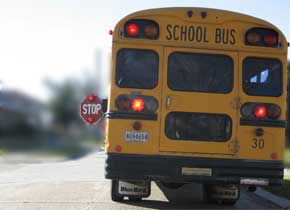
#20. When stopping behind a school bus with flashing red lights, you must stop:
Drivers must stop at least 25-feet in any direction for a school bus that is stopped with its red lights flashing and/or the stop arm extended at all times unless the roadway is separated by a physical barrier. Drivers shall remain stopped until the school bus resumes motion or until the flashing red lights cease to operate. Proceed slowly while always watching for children.
| This New Hampshire DMV Practice Test | |
|---|---|
| Questions per test: | 20 |
| Question pool: | 500+ |
| Type of test: | Random multiple-choice |

| The Official New Hampshire Written DMV Test | |
|---|---|
| Questions on real exam: | 40 questions |
| Passing score: | 80% |
| Correct answers to pass: | 32 |
| Allotted time to complete test: | 40 minutes |
| Wait time before retest: | 10 days |
What is the Online NH Practice Test?
This DMV practice test for New Hampshire has 20 random questions to help you prepare for the written knowledge test. It is designed specifically for New Hampshire and is available without hidden costs or gimmicks. You have access to a pool of more than 500 DMV test questions with complete answers.
You can take the test as many times as you need or want. Each test will differ since we draw random questions from a larger pool.
After each question, you will get instant feedback. The feedback tells you if your answer is correct or not. Should you miss a question, you will also see a brief explanation to help you understand the right answer. When you don’t understand the answers, you should have the driver’s manual handy and look up more information.
You will find answers to all questions in the New Hampshire Driver’s Manual.
On the official examination, you can miss ten questions – when you use the practice tests at Driver’s Prep, you should aim for a 100% score. Understanding all questions and answers before taking on the real thing is a good idea.
The New Hampshire practice test has no time limit, whereas you must complete the official test within 40 minutes.
You should also know that practice tests differ from your actual DMV test. Every test has random questions. You never know which questions you will get.
How Should I Study for the NH DMV Test?
Before you start practicing you should get the latest version of the New Hampshire Driver’s Manual . Visit a local DMV office or download it online.

Everything you must learn for your examination is in this manual. Even if you find it boring to read the manual, you should know that it is easier to pass the test with a good understanding of the manual’s contents.
The practice tests on this website work best as a supplement to the manual rather than as a replacement. Using the manual and practice test in combination during each study session will give you a good chance of passing the test the first time.
Read more about our study tips: Best Way to Study
How Many Questions are on the NH DMV Test?
There are 40 exam questions on the New Hampshire knowledge test. The passing score is 80 percent, meaning you must correctly answer at least 32 of the 40 questions. If you miss eight questions, the system will terminate your test.
You must complete the DMV test within 40 minutes.
Who Must Take the Written Knowledge Test?
First-time applicants
Drivers with an expired license (one year)
Drivers with a foreign license (other than Canada and France)
When the license was revoked
When the license was suspended for three years or more
You must take the written, vision, and road tests for your first driver’s license.
If you want to upgrade your license to a different class, you must take the written test for that class of vehicle and a road test.
DMV will typically waive the written test when moving to New Hampshire and transferring a valid out-of-state driver’s license. Please note that DMV will not waive the knowledge if you hold a license from Puerto Rico.
DMV will not waive the knowledge test if your out-of-state license expired over a year ago.
When transferring an out-of-country license from a country other than Canada or France, you must take a written knowledge and road skills test.
A revocation of your license means that DMV will terminate your driving privilege. After the revocation period, you must submit to an investigation and apply for a new driver’s license.
If DMV suspends your license for three years or more, you must pass all tests.
Where Can I Take the Written Knowledge Test?
All license examinations are conducted at DMV service centers by their personnel.
New Hampshire does not offer third-party testing or online testing.
Is the Test Available in Spanish?
The test is available in several languages, including:
| Arabic |
| Chinese/Mandarin |
| English |
| Farsi |
| French |
| Portuguese |
| Spanish |
| American Sign Language (ASL) |
What to Expect at the Test Station
You take the test on a touchscreen monitor. You don’t need any special knowledge of computers. Each question has four possible answers, only one of which is correct. Identify your choice by touching the corresponding letter on the screen.

New Hampshire written tests have a time limit based on the number of questions. You generally have one minute per question (40 minutes for 40 questions). The allotted time is usually more than enough. Most test-takers finish in 15-20 minutes.
The test will automatically end if you exceed the time limit or have too many incorrect answers.
Should you fail your test, you must wait at least ten days before you can try again.
The test station has an optional audio feature accessible with headphones. Let the licensing representative know if you have trouble reading and want to use headphones.


I am 40 years old and just took the dmv written test in NH and passed after my license has been suspended for last 18 years I was wondering if I am allowed to drive with a licensed driver until I take my road test next week to get used to driving again to practice driving skills
Basically, yes. The suspension period should have ended a long time ago. Unlike other states, New Hampshire does not issue permits that allows you to practice driving. New drivers are allowed to drive when accompanied by a parent, legal guardian, or a licensed driver who is at least 25 years without any special permit. This, however, does not apply if your driving privileges have been suspended or revoked. With a current suspended or revoked license, you can have the license put in inactive status and practice driving only with a certified driving instructor. If your license was suspended 18 years ago, and not revoked, I suggest that you check DMV to make sure what applies in your case.