
Nebraska Knowledge Exam – Driver’s License Written Test – 2026
Results
Great job. This is a passing score. Do you want to try again?
This is not a passing score. Do you want to try again?


#1. What does overdrive your headlights mean?
A common term associated with light conditions that cause crashes is over driving your headlights. Overdriving your headlights means driving too fast to stop safely within the distance clearly lit by your headlights.

#2. Road signs with a yellow background indicate:
Yellow is used for general warning and advisory of unexpected roadway conditions.

#3. If you encounter a flooded roadway, you should:
Do not drive through flooded areas. If you see a flooded roadway ahead, turn around and find another route to get to your destination.

#4. This sign means:
T-Intersection. Your roadway ends ahead. You must signal before turning right or left.

#5. Why should you not use your high-beam headlights when driving in fog?
Light from high beams will reflect back, causing glare and making it more difficult to see ahead.

#6. What does the basic speed rule mean?
Nebraska’s speed law requires driving at a speed that is reasonable and safe under existing conditions.

#7. When a large tractor-trailer is signaling for a right turn ahead, you can expect the driver to:
Because of the size, trucks sometimes need to swing wide to manage their turns.
When they do, truck drivers cannot see cars directly behind or beside them. Give them plenty of room and never try to squeeze around them.
When following a tractor-trailer, observe its turn signals before trying to pass. If it appears to be starting a left turn, wait a moment to check and see which way the driver is going to turn before passing on the right.

#8. Parking 21 feet from the nearest rail of a railroad crossing:
Parking is not allowed within 50 feet of the nearest rail of a railroad crossing.

#9. Which of the following is an acceptable reason for not wearing safety belts?
Whatever your reason for not wearing safety belts, it is usually not reasonable and may violate the law. The Occupant Protection Law applies at all times for drivers and front-seat passengers – with few exceptions (Nebraska Revised Statute 60-6,270). The Child Passenger Restraint Law applies to children up to age 18, regardless of seating position.

#10. Moving into the same lane alongside a motorcycle:
Allow the motorcyclist a full lane width. Although it may seem as though there is enough room in the traffic lane for an automobile and a motorcycle, remember the motorcycle needs the room to maneuver safely. Do not share the lane. It is illegal and unsafe.
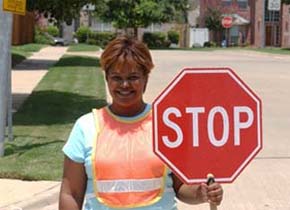
#11. You must obey signals and directions from school crossing guards:
You must obey their directions at all times.

#12. If you refuse to take a test to determine your blood alcohol level, the administrative sanction for refusal is a license revocation for a period of:
The administrative sanction for refusal is one year of license revocation.
Criminal penalties for refusal are the same as criminal penalties for a DUI BAC .15 or over conviction. A convicted person’s license may be revoked from two to fifteen years (depending on the number of prior convictions) in addition to fines and jail time.

#13. What does this sign mean?
Road curves gradually to the left. Be prepared for the change in direction. Check your speed.

#14. If you see flashing red lights at a railroad crossing, you must:
When required to stop, stop at the stop line. If none, a stop must be made within 50 feet but not less than 15 feet from nearest rail. You may not proceed until you can do so safely.

#15. This sign tells you:
Regulatory speed limit sign. With the word minimum, it shows the minimum speed you are allowed to travel.

#16. A pedestrian has entered a crosswalk where there are no signs or signals. Who has the right of way?
Yield to all pedestrians within crosswalks. Slow down and be ready to stop if needed. Always yield to pedestrians before making a turn.

#17. What do the light gray areas in the picture mark?
Your blind spot is the area to the side of a vehicle which cannot be seen in mirrors. A blind spot exist on both sides of your vehicle. When changing lanes or making a turn, glance over your shoulder to be sure no one is in the blind spot.

#18. When can you overtake a stopped school bus?
Remember, under special circumstances, an officer may be directing the flow of traffic. If so, obey the officer’s signals instead of the normal traffic signals or signs.

#19. The best way to increase visibility when backing up is to:
Always turn your head and look to the rear while backing. Do not depend on your mirror. Back slowly, your vehicle is much harder to steer while you are backing.

#20. When a traffic signal is showing a steady yellow light:
A steady yellow light means caution. It is a warning that the light is about to change. If you have not entered the intersection, you must stop if you can do so safely. If in the intersection, continue moving and clear it safely. Speeding up to beat the light is unlawful.
#21. You are convicted of willful reckless driving (deliberate and intentional). How many points will be added to your driving record?
Six points are assessed if you are convicted of willful reckless driving (deliberate and intentional).

#22. What does this sign mean?
The sign marks a shared two-way left turn lane. Motorists entering this lane should use caution and may only turn left. Using this lane to pass is prohibited.
Note: curved arrows pointing in different directions do NOT indicate that the lane should be used for right turns, they indicate left turns from opposite directions.

#23. Car tires must have a minimum tread depth of:
Tread depth must be at least 2/32 of an inch.

#24. When driving on the interstate, you should use the left lane:
On multi-lane roads, the left-most lane is intended to be used for passing slower vehicles. Stay in the right lane unless overtaking and passing another vehicle.

#25. When you approach this sign, you must:
This sign provides advance notice to upcoming speed limit change. Be prepared to slow down.
| This Nebraska License Sample Test | |
|---|---|
| Questions on each practice test: | 25 |
| Question pool: | 750+ |
| Random questions | |
Facts about Your Nebraska DMV Written Test
| Nebraska Written Knowledge Test for a Permit or Driver’s License | |
|---|---|
| Number of questions on exam: | 25 questions |
| Passing score: | 80 percent |
| Correct answers to pass: | 20 |
| Allotted time to complete test: | No limit |
| Wait time before retest: | 1 day |
The Purpose of the Online Nebraska Practice Test
We have designed these practice tests to help you study and ultimately pass the written knowledge exam for a Nebraska permit or driver’s license.
Each test is random. Our system draws questions from a larger pool, similar to how DMV creates the official written test. Each test is slightly different from the previous one.
You can take the Nebraska practice tests as often as you like. The tests will help you to get comfortable with everything you need to learn for the written examination.
The practice tests are a learning tool. Use them after reading and studying the Nebraska Driver’s Manual, not as an alternative to studying the manual. You need both.

Nebraska Driver’s Manual
Make sure you get the latest version of the official Nebraska Driver’s Manual. Your driving school typically provides the manual as part of your driver’s education. You can also get a copy from any DMV office or download a copy online from dmv.nebraska.gov.
Nebraska DMV draws all questions on your written exam from this manual’s information. Please read it carefully. Understanding Nebraska traffic laws, rules of the road, and other information in the manual is an essential first step toward successfully passing the exam.
How to Use the Nebraska Practice Test
After reading the manual, take a few practice tests to check how much you have learned.
You will get instant feedback after each practice question. Should you make a mistake, there is also a brief explanation to help you understand the correct answer. Use the manual for more information if you need clarification on the right answers. Being active during a study session is a proven way of learning faster.
At the end of the practice test, you will see your score. Your score is a rough indication of your level of readiness.
You need 20 correct answers to pass your official written test. When practicing for the exam, practice you should only be satisfied once you reach a score of 100%.
Reading questions and choices twice is a good idea, even if it is just a practice test. The most common mistake on the exam is rushing through the test without carefully reading questions and answers.
You are not in a hurry!
Using the Nebraska practice tests to learn how to pace yourself during a test is a good idea. You have plenty of time to complete your written DMV exam.

It also helps to discuss standard rules and safe driving practices with a friend, teacher, parent, or licensed driver. Being active improves learning. The more you know, the easier it will be to pass the examination.
Is the Written Nebraska Examination Hard?
The Nebraska written test is known to be complicated. More than 32 percent of all first-time applicants fail the Nebraska written test. So, you should prepare well.
The true-and-false questions in the manual are not a good representation of the actual exam.
Read more about How to Ace the DMV Test.
Who Must Take the Written Test?
There is a separate written test for each class of license. You can find more information about different tests in the driver’s manual.
First-time applicant
As a first-time applicant, you must always take and pass a written knowledge test.
- Learner’s Permit – Type LPE: must pass vision and written tests.
- Learner’s Permit – Type LPD: must pass vision and written tests. DMV will waive the written test if a school learner’s permit (LPE), school permit (SCP), or learner’s permit (LPD) is valid or has not expired for more than one year.
- School Permit – Type SCP: waived if the applicant has completed a DMV-approved driver safety course.
- Provisional Operator’s Permit – POP: DMV waives the test if the applicant has completed a DMV-approved driver safety course.
- Operator’s License (Class O): waived if the applicant held a POP.
Drivers with an expired out-of-state license
If you have an expired out-of-state driver’s license, you must also take the test before you can get a Nebraska license.
Drivers with a Nebraska license expired more than one year
DMV will waive the written test when you renew a valid Nebraska operator’s license. If you let your license expire for over 12 months, you must take the written test again.
Drivers with a revoked license
After a revocation, you must apply for a new license and retake all tests.
Drivers with a foreign driver’s license
Drivers who move to Nebraska and hold a license from a foreign country other than Canada, Germany, or Mexico must pass all tests before DMV issues a Nebraska driver’s license.

What You Must Know about the Exam
The official test has 25 multiple-choice and true-or-false questions. The passing score is 80%. You must be aware that there can be questions with more than one correct answer, which is the case when you see “All of the above” as the last choice. Ensure you read everything before answering.
The Nebraska written test is a closed-book test. You cannot use your driver’s manual or other books during the examination. Any electronic device, such as your cell phone, is also banned.
If you cheat on the examination, the examiner will end and postpone your exam.
The Nebraska written test has no time limit. You can take as much time as you need to complete the test. Typically, you will finish in less than 15 minutes.
Should you fail your exam, you must retake it on a different day.
You typically take the test as part of your driver’s education, but you can also take the test at a DMV office.
Nebraska DMV does not offer online testing from home.
Nebraska Graduated Licensing Laws

If you are between 14 and 16 years, you can apply for a School Learner’s Permit (LPE). This permit allows a student to legally practice driving for a School Permit (SCP). The School Permit can be issued if you live outside a city of 5,000 or more or attend a school outside a town of 5,000 or more. With a school permit, you can drive unsupervised to and from your school.
The other route to your full driver’s license starts with a standard Learner’s Permit (Type LPD). You must be at least 15 years to apply for the LPD.
The Learner’s Permit allows you to practice driving for a Provisional Operator’s Permit (POP), Operator’s (Class O), or Motorcycle (Class M) License.
A Provisional Operator’s Permit (POP) is the intermediate step between your first learner’s permit and a full unrestricted driver’s license. You must be at least 16 years before DMV issues the provisional permit, and you must have held an LPE, LPD, or SCP for at least six months.


