
Wyoming Driver’s License Tests & Permit Practice Questions – 2026
Results
This is a passing score. Do you want to try again?
This is not a passing score. Do you want to try again?


#1. The two-second rule refers to how you should:
The two-second rule refers to a following distance. If you are driving a car, stay at least two seconds back from the vehicle ahead. The two-second following distance rule is simple to use and works at all speeds.

#2. A road sign with a round shape means:
A circular sign is used to warn that there is a railroad crossing ahead.

#3. When entering an interstate:
While moving along the entrance ramp check over your shoulder for a gap in the traffic on the interstate. Adjust your speed to meet that gap and turn on the turn signal to indicate your need to enter the traffic lane.

#4. After a conviction of not having liability insurance, you will be required to provide proof of liability insurance for how long?
An SR-22 is an insurance certificate that your insurance company files with the department. Proof of financial responsibility must be maintained for three years from the date it is required.

#5. If you are younger than 21 years of age and convicted of DWUI, your license will be suspended for:
If you are younger than 21 years of age and are in actual physical control of a vehicle with an alcohol concentration of two one-hundredths of one percent (0.02 percent) or more, you will be suspended for DWUI. For a first offense the length of the suspension is 90 days.

#6. Anti-lock brakes are most effective when you:
One aspect of having Anti-Lock Brake Systems (ABS) is that you can turn your vehicle while braking without skidding. In an emergency situation, ABS pumps the brakes for the driver – much faster than the driver can. All drivers need to do is press down hard on the brake pedal, hold it and steer out of danger. Drivers should be aware that removing steady pressure from the brake pedal or pumping the brakes will disengage or turn off the ABS system. Make sure you are aware of the type of braking system your vehicle has.

#7. When parking uphill on a two-way street with no curbs, your front wheels should be:
If you park facing uphill where there is a curb, you should set the parking brake and turn the wheels away from the curb. In any other situation, turn the wheels towards the curb or edge of the road.
Turn off the engine, take the keys and lock the car.

#8. This sign tells you that:
This is a regulatory No U-turn sign. It means that you are not allowed to make a U-turn.

#9. When driving at night, you must:
Never drive so fast that you cannot stop within the distance you can see ahead with your headlights. Your lights will only let you see clearly about 250 feet. If you then drive faster than 55 mph on a dark road, you are really driving blind because you won’t be able to stop within the 250 feet ahead of you that is lit well enough to see.

#10. Which is true about signaling?
Always signal to other drivers when you plan to turn left, right, slow down, or stop. Signals may be given by hand-and-arm positions or by using the vehicle’s signal lights / brake lights.

#11. What does this sign mean?
The Flagger ahead sign warns drivers that there is a flagger ahead, and to be especially alert in the work zone.

#12. If you see a pedestrian with a white cane attempting to cross the street, you must:
Wyoming Statutes require a driver to give the right of way or yield when a blind pedestrian is carrying a clearly visible white cane or is accompanied by a guide dog.
Do not use your horn at blind pedestrians.

#13. What can you do to avoid carbon monoxide poisoning?
Carbon monoxide is a colorless, odorless, and poisonous gas. Signs of carbon monoxide poisoning are weariness, yawning, dizziness, nausea, headache, and ringing in the ears. If you feel any of these symptoms, stop your engine and open the windows to get fresh air.
Have the exhaust system checked regularly to be sure it does not leak. Avoid parking for long periods of time with the engine running. Do not start your vehicle, or warm up the engine, in a closed garage.

#14. What is true about driving on a wet roadway?
The only contact your car has with the road is through its tires, and each only has an area of rubber about the size of a person’s hand on the surface of the road. If the road is wet, the grip your tires have is reduced. Therefore, drive slower than you would on a dry road.
As you go faster, your tires may lose contact and start to ride on a thin film of water instead of the road.

#15. If there is a double solid yellow line in the center of a roadway, crossing the solid yellow line is:
Solid yellow lines indicate no passing or lane changing – unless making a left turn into or from an alley, private road, or driveway.

#16. The blind spots where a truck driver will not be able to see you include:
Large vehicles have serious blind spots or no-zones into which a car can disappear from view. The blind spots exist on both sides, particularly alongside the cab. They also have deep blind spots directly behind them and a blind spot in front of the cab.
Study the illustration in Rules of the Road.

#17. Deer are usually most active and seen along the roadside:
Stay particularly alert at dusk and dawn, times when animals venture out to feed and also when your visibility is limited.

#18. You are in the right-hand lane and approach this sign. What should you do?
Reduction of lanes. Right lane ends. Merge left.
Two lanes of traffic will soon become one lane of traffic. Right-lane traffic must yield when merging.
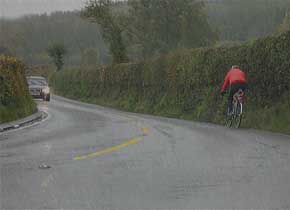
#19. Why should you leave plenty of room when overtaking a bicyclist on a wet road?
A bicyclist might turn sharply to avoid a sewer grate, something in the road, or a door being opened from a parked car. On a wet road, always give bicyclists extra room.

#20. Backing a vehicle on controlled-access highways:
Backing up on any controlled-access highway is dangerous and illegal.
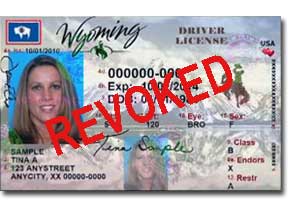
#21. Revocation of a driving privilege is the same as:
A revocation is a termination of a person’s privilege to drive for an indefinite period of time.

#22. When may you legally drive around a lowered gate at a railroad crossing?
When gates are down, realize the road is closed. Stop and wait until the gates go up and the red lights stop flashing before proceeding. NEVER drive around gates.

#23. The legal drinking age for alcohol is:
You are not allowed to buy or consume alcohol unless you are 21 years of age or older.
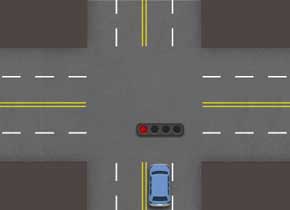
#24. Left turn against a traffic light showing a red arrow:
A red arrow prohibits turning in the direction of the arrow. It is used to remind drivers that they must turn in the direction the arrow is pointing when the light turns green.

#25. Can you drive with just your parking lights on when headlights are required?
Never use parking lights while driving. They cannot be seen until after your vehicle is clearly visible. It is not legal to drive with only parking lights when headlights are required.
| Wyoming Permit Practice Test | |
|---|---|
| Questions per test: | 25 |
| Question pool: | 500+ |
| Type of test: | Random multiple-choice |

| The Official Driver’s License Test in Wyoming | |
|---|---|
| Questions: | 25 |
| Passing score: | 76 percent |
| Correct answers to pass: | 19 |
| Allotted time to complete test: | – |
| Wait time before retest: | None (twice per day) |
What You Should Know about the Wyoming Practice Test
This permit practice test has 25 random questions from the Wyoming Driver’s License Manual and actual WY DMV examinations. After each question, you will get instant feedback that tells you whether your answer is correct.
Should you miss a question, there is a brief note to help you understand the correct answer. You can also use the information to look up the topic in the Driver’s License Manual and expand your knowledge.
You can take this license practice test as many times as you need. The system creates a new set of questions every time you restart the test.

Get the Wyoming Driver’s License Manual
Start studying by getting the Driver’s License Manual. It is a must-read. You can find answers to all your exam questions in this manual.
You can get a copy from your local DMV office or download a PDF version online .
The information in the manual help you pass the examination. It also helps you to be a safe driver once you get your license.
Taking Practice Tests
The passing score in Wyoming is only 76 percent, which means you must answer at least 19 of 25 questions correctly.
You should, however, aim higher on the practice tests. Try to reach a 100% score on a handful of tests.
Instead of memorizing questions and answers, it is best to fully understand why one answer is correct, and another isn’t. It will make it easier to pass the exam. You will also retain the knowledge longer.

Who Must Take the Wyoming Knowledge Test?
When you apply for your first driver’s license, you must pass a written knowledge test.
You must also pass the knowledge test again if you let your license expire and have not driven for two years or more.
DMV can also ask you to retake all tests after a license revocation.
Based upon personal observation, medical or vision information, and other factors, a DMV representative always has the discretion to ask for a knowledge test.
Official Wyoming Knowledge Test
The knowledge test has questions related to the class of license you are applying for. You can find all answers to the exam questions in the applicable driver’s manual.
On the test, you must identify traffic signs by shape, color, or symbol and identify signals and pavement markings. The test also has questions about seat belt usage, traffic laws, safety rules, crash prevention, and vehicle equipment.
You take your test on a computerized system. Applicants with reading difficulties can ask for a headset and hear the questions through a phone system. If you prefer to use the audio system, you must ask the examiner to connect you to the system before you begin your written test.
If you fail your first attempt, again the same day. You can take the test twice daily.
This does not apply if you miss 13 or more questions. In such a case, you must wait at least three days to retake the test.
Languages
Wyoming tests are only in English. You may use an interpreter for the written tests if you cannot speak English.

Photo credits:
- Struggling woman – CollegeDegrees360
- Young man with Help sign – Marcos Calvo Mesa
- Cover of Wyoming Driver’s License Manual – Photo by Rick Carpenter, Public Affairs Office


