
Maine BMV Driver’s License & Permit Practice Tests
Results
Great job! This is a passing score. Do you want to try again?
Unfortunately, this is not a passing score. Do you want to try again?



#1. A driver who has been drinking is more likely to:
Alcohol interferes with the brain’s ability to react and to concentrate. A person who has been drinking is more likely to:

#2. Failure to yield the right-of-way to a visually impaired pedestrian, may result in:
An operator who fails to yield the right-of-way to a visually impaired pedestrian is liable for a traffic infraction with a minimum $50 and maximum $1,000 fine. (Failure to yield to a pedestrian will result in four points on your record.)

#3. When passing a bicyclist, you should pass:
Leave at least three feet of passing space between the right side of your vehicle and a bicyclist.

#4. You are driving the children of a good friend. The children are 12 years old. Who is responsible for ensuring they wear seat belts?
It is you, the operator, who must ensure that anyone who is less than 18 years is properly secured.

#5. If you have an engine fire, you should pull off the road quickly and:
If you have a fire, pull off the road quickly, shut off the ignition to cut electrical power, and get all passengers away from the car immediately. Call the fire department. Do not open the hood as you may be severely burned.
#6. Operating a motor vehicle in this State means you consent to take a test for the alcohol content of your blood or breath:
When you operate a motor vehicle in Maine you automatically consent to a test at any time the authorities wish to administer it. You will not be forced to take such a test, but your driver’s license will be immediately suspended if you refuse. The suspension will be for a period of up to six years by the Secretary of State. It is administrative. That means no court action is necessary.
The law states: If there is probable cause to believe a person has operated a motor vehicle while under the influence of intoxicants, that person shall submit to and complete a test to determine an alcohol level and the presence of a drug or drug metabolite by analysis of blood, breath, or urine.

#7. Who should have the right-of-way at a traffic circle or roundabout?
All vehicles approaching traffic circles or roundabouts must yield the right-of-way to vehicles already in the circle or roundabout unless otherwise directed by a police officer or by traffic control devices. You must also yield to pedestrians and bicyclists who are legally crossing the road.

#8. In which situation are you allowed to pass a school bus?
It is illegal to pass a stopped school bus with red lights flashing on school property, on any undivided highway or parking area in Maine.
If you are approaching a stopped school bus from either direction, with its red lights flashing, you must bring your vehicle to a complete stop in front or rear of the school bus and wait while children are getting on or off the bus. You must not proceed until the bus resumes motion or until signaled by the school bus driver to do so. Violations carry severe penalties.

#9. This sign (red X) over a lane means:
Special overhead lights are sometimes used to indicate which lanes of a highway may be used at certain times:
- Steady Red X: Do not drive in this lane.
- Steady Yellow X: Clear this lane, signal is about to change to red.
- Flashing Yellow X: This lane may only be used for a left turn.
- Green Arrow: You may use this lane.

#10. You approach this road sign. What does it mean?
Divided highway ends.
The divided road ends ahead. Two-way traffic will no longer be divided by a center island. You will be on an undivided roadway with two-way traffic. Watch out for oncoming cars.

#11. You should always allow extra room in front of your vehicle when following:
You can tell if you are following too closely by using the two-second rule. In some situations, you should allow an extra cushion. A three to four-second (or more) following distance may be needed when following trucks, tractor-trailers, and buses. Never follow so closely that their drivers cannot see you in their rear-view mirrors or your view of the road ahead is blocked.
Keep a safe following distance to see and be seen!

#12. True or false? In general, it takes less gas to restart a car than it does to let it idle.
If you are waiting for someone, turn off the engine. It takes less gas to restart the car than it does to let it idle. The average car uses a cup of gas every six minutes when idling.

#13. This sign means:
Road turns right. Road ahead makes a sharp turn in the direction of the arrow (right). Slow down, keep right, and do not pass.
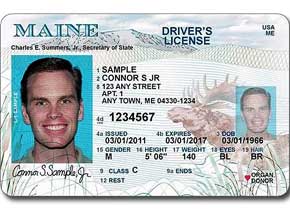
#14. To obtain a Maine driver's license, an applicant who has NOT completed an approved driver education course must be at least:
You must be at least 18 years of age if you have not completed an approved driver education course.
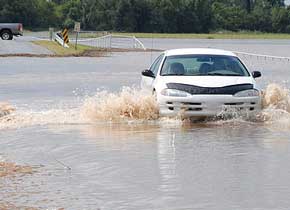
#15. If you drive through deep water, what is the first thing you should do afterward?
Always test the brakes after driving through deep water. The brakes may pull you to one side, or they may not work at all. Dry the brakes by driving slowly and putting your brakes on lightly for a short distance.

#16. You are driving on a rural road with no streetlights on a clear night. If you cannot see well with your low-beam headlights, which of these actions would help?
Use the high beams whenever there are no oncoming vehicles nor vehicle close ahead. High beams let you see twice as far as low beams.
Use low beams in fog, snow, or heavy rain. Light from high beams reflects back from such precipitation and causes glare.

#17. A red line through a red circle on a road sign means:
A red line through a red circle means that you cannot do something.

#18. If your power steering fails:
If your power steering fails:
- If going straight, grip the wheel with both hands to keep control. If turning, pull hard with both hands to make it around the corner.
- Stop the car. You may have to push hard if your car has power brakes.
- Restart the engine.

#19. If your vehicle breaks down on a highway and you cannot move it off the road:
If you cannot get completely off the roadway, try to stop where people have a clear view of you.
Try not to stop just over a hill or around a curve.
Give other drivers plenty of warning. Use flares or stand by the side of the road, and wave traffic around.

#20. To be convicted of Operating Under the Influence (OUI) if you are 21 or older, your BrAC level:
If you are the operator of a motor vehicle and are driving with an alcohol level of 0.08 grams per 100 milliliters of blood or 210 liters of breath, you are guilty of a criminal offense of operating under the influence.
However, any amount of alcohol is likely to impair your driving ability. A testimony of the arresting police officer regarding your driving performance can result in an OUI conviction even without the alcohol test results to back it up. This means that your alcohol level can be less than .08 and you can still be convicted.

#21. Penalties for driving under the influence of drugs are:
It is hazardous to drive under the influence of any drug, legal or otherwise. If you are convicted of driving in this condition you will be subject to the same punishments as those for driving under the influence of alcohol.

#22. You approach a traffic congestion at a traffic light. A parking area offers an opportunity to avoid the traffic light. What should you do?
You may not drive a motor vehicle through a parking area to avoid obeying the requirements of a traffic control device.

#23. Which of the following vehicles are required to stop at all railroad crossings?
Be alert for buses, school buses, tank trucks, etc. that must stop at all railroad crossings.
Buses transporting passengers, including school buses, and tank trucks carrying flammable liquids must always stop at railroad crossings. So expect the stops and slow down early to allow plenty of room.

#24. What should you do when you see this sign?
Move or merge right. Large flashing or sequencing arrow panels may be used in work zones to guide drivers into certain traffic lanes and to inform them that part of the road or street ahead is closed.

#25. When passing a truck, it is dangerous to:
Stopping distances are much greater for heavier vehicles than for automobiles. If you suddenly pull in the lane in front of a truck, you have compromised the driver’s braking ability and could cause an accident.
Never pass or pull in front of a large vehicle that is already slowing or stopping. The driver has based their braking ability on the space ahead.

#26. Some municipal ordinances do not allow you to park:
Some municipal ordinances do not allow you to park within 10 feet of a fire hydrant.

#27. If you are involved in a traffic accident where someone is injured, one of your main priorities should be:
Check to see if the victim is breathing, if not, begin cardiopulmonary resuscitation (CPR), if you have been trained to do it, or mouth to mouth breathing.
You can help stop bleeding by putting pressure directly on the wound with your hand or a clean cloth, if available. Maintain pressure until help arrives.
Cover the victim with a blanket or a coat to maintain body temperature and help prevent shock.

#28. Which is true about changing lanes when you turn left at an intersection?
Turn into the lane that is closest to the lane from which you came. If you need to move into another lane, move only after you have finished your turn and when traffic is clear.

#29. When driving on a slippery surface such as snow or ice, you should:
You will need more distance for stopping, and you may skid on quick turns. Drop your speed and increase your following distance. Begin braking well ahead of a stop.

#30. You are allowed to exceed the speed limit to pass on a two-lane road:
It is illegal to exceed the posted speed limit.
| This Maine Permit Sample Test | |
|---|---|
| Number of questions on each practice test: | 30 |
| Question pool: | 1,000+ |
| Type of test: | Random |

Facts about Your Maine Driver’s License Test
| Maine Knowledge Test for Learner’s Permit and Driver’s License | |
|---|---|
| Number of questions on exam: | 30 questions |
| Passing score: | 80 percent |
| Correct answers to pass: | 24 |
| Allotted time to complete test: | n/a |
| Wait time before retest: | No official wait time |
Maine Practice Tests for Permit and Full License
Each preparation test on this website has 30 questions based on the Motorist Handbook & Study Guide and real BMV tests.
You will get instant feedback after each question. If your answer is wrong, you will also see a brief explanation. If you keep the Motorist Handbook handy throughout your studies, you can compare answers with the information in the Handbook.
Make sure you get the latest version of the Study Guide from your BMV office or download it online .
The passing score in Maine is 80 percent, which means must answer at least 24 questions correctly. All questions are from the Motorist Handbook & Study Guide.
It is a good idea to aim higher on a practice test. At a minimum, you should aim for 92 percent. But it is, of course, best to aim for the perfect score of 100%.
Read more about study tactics .

What You Should Know about the Knowledge Examination in Maine
The knowledge test will check your knowledge of common road signs, rules of the road, Maine’s DUI laws, the dangers associated with distracted driving, and Maine traffic laws.
Traditionally the test had 10 separate questions about road signs and 20 questions about road rules and traffic laws. Expect the same numbers on the new test.
The test should take about 15 minutes to complete.
If you are enrolled in a driver education, you typically take the test as part of your education class at a driving school. You don’t have to take another written test.
Maine does not offer online testing from home.
If you transfer a license from another country or are required to pass the exam for other reasons, you must take the test at a BMV location.
If you fail the test, you may be able to take it again the same day at the discretion of the examiner. There is no official wait time to retake the knowledge test.
The knowledge test is a closed book test, and you cannot used books, manuals, notes, or digital devices in the testing area.
The test is available in several languages, but Maine BMV has made no effort to publish them. Any applicant who requires accommodations for the written or road test should contact the Exams Division of the BMV by phone, inquire in person at any BMV branch, email the Exams unit at license.bmv@maine.gov or mail Bureau of Motor Vehicles, State House Station 29, Augusta, Maine 04333.
Who Must Pass the BMV Test?
First-time applicants who have not been licensed before.
You must take all tests, including vision screening, knowledge test, and driving test, when you never had a license or permit before.
Drivers who let their license expire more than 5 years.
If you had a driver’s license issued in Maine or another state and let that license expire for more than 5 years, you must apply for a new driver’s license and take all tests again.
Drivers who hold a foreign driver’s license.
New residents with an out-of-country license from a foreign country other than Canada must take all tests to convert their license to a Maine driver’s license. They must show proof of address in Maine and documents that show their legal presence.
Drivers with a suspended / revoked license.
When your license is suspended for certain violations, BMV may require a new knowledge test and driving test before your license is reinstated.
When is the BMV Knowledge Test Waived?
If you apply for a driver’s license in Maine and hold a license from another state, US territory, or Canada, the knowledge test and road skills test are usually waived.
Is the BMV Knowledge Test Hard?
The failure rate on the BMV knowledge test is about 30 percent, which means that one out of three fails the test the first time they take it. The difficulty level is graded moderate to hard, so it is a good idea to prepare well.
Don’t Forget Your Documents
Before you can pass the vision screening and the knowledge test, you must have all your paperwork in order. It is common that applicants are sent back home from the BMV service center because they didn’t have all the necessary documents .
You must show:
2 different proof of identity – at least one must indicate your date of birth and the other must have your written signature.
Proof that you are a Maine resident.
Proof that you are a U.S. citizen or are in the country lawfully (legal presence).
Maine Graduated Driver Licensing (GDL) Laws
1 Learner’s Permit
| Minimum Age (Years) | Minimum Duration (Months) | Required Supervised Driving Hours (Night Hours) |
|---|---|---|
| 15 | 6 | 70 (10) |
2 Intermediate License
| Minimum Age (Years) | Nighttime Driving Restriction | Passenger Restriction (except family, unless noted) |
|---|---|---|
| 16 | Midnight – 5 a.m. | First 9 months: no passengers |
3 Full License
| Minimum Age (Years, Months) |
|---|
| 16 years, 9 months |
Videos Maine Driver’s License Test Questions & Answers


