
2026 New York DMV Tests & Permit Practice – 100% Trust Score


#1. How would you signal a slowdown and stop if you use arm signals?
Slowing or stop – left arm extended downward, with the palm to the rear.

#2. This sign means:
School crossing: This sign warns that children must cross the street on their way to and from school. The sign is sometimes located several blocks from the school. Signs may be fluorescent yellow-green or standard yellow in color.

#3. To keep track of what is happening around your vehicle, you should always:
Keep your eyes moving. Look ahead so you can prevent, or decrease, possible problems. Notice what is happening at the sides of the road, and check behind you through your mirrors every few seconds.

#4. What does this road sign tell you?
Right lane ends, merge left. There will be fewer lanes ahead. These signs are used on multi-lane highways to warn you of a reduction in the number of traffic lanes in the direction you are traveling. Be prepared to change lanes or to allow other vehicles to merge into your lane. Drivers of all vehicles may need to adjust their speed and position to avoid a collision with another vehicle.

#5. If red lights are flashing and gates are closing at a railroad crossing, you should:
If red lights are flashing at a railroad crossing, you must always stop. Remain stopped until the train passes by and the lights stop flashing.

#6. What do the markings in the center lane (B) mean?
Arrows show which lanes you must use. When a lane is marked with both a curved and straight arrow, turning or proceeding straight ahead is allowed.
When a lane is marked with a curved arrow, you must turn in the direction of the arrow.

#7. Car tires are worn-out and unsafe if the remaining tread depth is:
The law requires that your vehicle’s tires have at least 2/32nds of an inch of tread. Most tires for passenger cars and light trucks have wear bars that show across the tire grooves when the minimum tread depth is reached. It is also illegal to drive with tires that have cuts down to the cords, knots bumps or bulges.
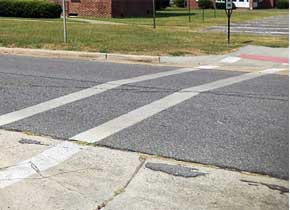
#8. True or false? You may park on a crosswalk if you are more than 20 feet from an intersection.
Parking on a crosswalk is not allowed.

#9. Which is true about large trucks?
Large trucks, recreational vehicles and buses are not big cars. The bigger they are:
- The bigger their blind spots.
- The longer it takes them to stop.
- The more room they need to maneuver.
- The longer it takes a car to pass them.
- The longer it takes them to accelerate.
- The wider they turn.

#10. Which of the following is true about roadways on bridges and overpasses when sleet, freezing rain or snow begin to fall?
When sleet, freezing rain or snow begin to fall, remember that bridges, ramps, and overpasses will freeze first. They will also dry out last.
Also know that slippery spots may remain after road workers have removed the snow.

#11. When you are facing a green light, and vehicles are in the intersection:
A driver who approaches an intersection must yield the right-of-way to traffic that is in the intersection. You cannot enter an intersection if traffic is backed up on the other side and you cannot get completely through the intersection. Wait until traffic ahead clears, so you do not block the intersection.

#12. When approaching another vehicle from behind at night, at what distance should you dim your headlights?
Your headlights must be on low beam when you are within 500 feet (150 m) of an oncoming vehicle or within 200 feet (60 m) of a vehicle ahead of you, even if the vehicle ahead is in a different lane.

#13. A fire police is directing you to do a turn against a no-turn sign. What should you do?
Directions given by traffic officers take precedence over signs, signals, or pavement markings.
If a traffic officer signals you to stop at a green light, for example, you must stop. If an officer signals you to drive through a red light or stop sign, you must do so. Among those authorized to direct traffic are police officers, peace officers such as on-duty auxiliary or fire police, highway work area flag persons, and school crossing guards.

#14. This sign means:
Eight-sided red stop signs mean you must make a full stop. Stop before entering a crosswalk or at a white limit line. If a crosswalk or limit line is not painted on the street, stop at the corner without entering the intersection.

#15. This road sign means:
This is a regulatory No U-turn sign. It means that you are not allowed to make a U-turn to go back.

#16. When a stopped school bus flashes its red lights, traffic that approaches from either direction must stop:
When a stopped school bus flashes its red lights, traffic approaching from either direction, even in front of the school and in school parking lots, must stop before reaching the bus.
This law applies on all roadways in New York State. You must stop for a school bus even if it is on the opposite side of a divided highway.

#17. Taking a cold shower after drinking alcohol:
The only way to effectively reduce your BAC is to spend time without drinking. Coffee, fresh air, vitamins, exercise, and cold showers cannot reduce your BAC and the effects of alcohol.

#18. To avoid getting tired on a long trip, you should:
Schedule regular stops for every 100 miles or 2 hours.

#19. You cannot pass a vehicle on the left:
You cannot pass a vehicle on the left if you are within 100 feet (30 m) of a railroad crossing on a two-way roadway.

#20. Can you make a U-turn across a solid double yellow line?
You can go across the lines to do a U-turn, unless prohibited by signs. Note: all U-turns are illegal in business districts of New York City.
| This New York DMV Permit Test | |
|---|---|
| Questions on each practice test: | 20 |
| Question pool: | 500+ |
| Type of test: | Random multiple-choice test |

Facts about Your New York DMV Test
| New York Written Knowledge Test for Learner’s Permit or Driver’s License | |
|---|---|
| Number of questions on exam: | 20 questions |
| Passing score: | 70 percent |
| Correct answers to pass: | 14 |
| Allotted time to complete test: | No limit |
| Wait time before retest: | No wait time |
The NYS Permit Practice Test
This permit practice test has 20 random questions from the information in the New York Driver’s Manual and actual DMV tests. After each question, you will get instant feedback showing if your answer is correct.
Should you make a mistake and miss a question, there is also a short explanation to help you understand the correct answer. If you need more information about a subject, keep the Driver’s Manual handy and look for the answer in the manual. This way, you will learn faster.
With that being said, you should always make sure you have the latest version of the New York Driver’s Manual and that you have read it.
You can take this practice test as often as you like until you feel comfortable with all the questions and answers.
But try not just to memorize answers and hope you will get the same question on the exam. It is a risky study tactic .
The Official DMV Permit Test in New York State
There are 20 questions on the official DMV permit test in New York, of which four address some of the road signs described in the Driver’s Manual. The road sign recognition part is not a separate test in the state of New York, but you can find a separate practice test here: New York DMV Road Signs Quiz
The passing score in New York is 70 percent, meaning you must correctly answer at least 14 of the 20 questions. You can, in other words, miss 6 of the 14 questions. But be aware that the test also counts how many correct answers you have on the road signs. You must correctly identify three road signs to succeed in the test, even if all other answers are correct.
The New York state exam is known to be the most straightforward DMV test in the United States. It has a failure rate below 10%. But should you fail your knowledge exam, you can retake it the same day at the examiner’s discretion. There is no limit on how many times you can retake the test.
You can easily beat the statistics by studying a little more and taking several permit practice tests here at driversprep.com. Our latest survey showed that 100% of our users in New York passed their examination the first time.
If you take the written test through your high school’s DMV Online Knowledge Test Application (OKTA) program, the test is available in English and Spanish. At any DMV office, the test is available in several languages, including:
Arabic
Bengali
Bosnian
Chinese
Greek
Hebrew
Italian
Japanese
Nepali
Polish
Russian
Spanish
New York DMV does not offer online home testing.

Who Must Pass the New York Knowledge Exam?
First-time applicants
The first time you apply for a driver’s license or permit in New York or any other state, you must pass all three tests: the written knowledge test, the vision test, and the road skills test.
In New York, most drivers must also complete an approved 5-hour classroom training course.
Drivers with a revoked license
A revoked driver’s license means the DMV has canceled your license =and you must apply for a new one when the revocation period ends. Usually, the DMV will ask you to retake the written and driving tests and pay a license reapplication fee.
Drivers who let their New York license expire more than two years.
If you let your license expire for two years or more, you must apply for a new original license and take and successfully pass the vision screening, the written test, and the road test. You must also complete the pre-licensing course again!
Drivers with a foreign license.
If you are a new resident with a valid license from a country other than the United States or Canada, you must apply for an original N.Y. driver’s license and pass all required tests.
Drivers with an out-of-state license expired more than one year.
If you hold a license from another U.S. state, territory or possession, or a Canadian province or territory, the DMV usually waives the knowledge test, safe driving course, and road test. You must, however, always pass the vision screening.
It only applies-of-state license has been valid for less than six months or expired over a year ago. Then, you must take both the written knowledge test and the road test.
You must also complete the safe driving course.
How to Get Your Driver’s License When You Move to the State of New York

More to Learn for Your NY Knowledge Test
What is the New York Move Over Law?
New York’s Zero Tolerance Law
New York DMV Road Signs Quiz – Signs you Must Know


I need help with my permit please
I need help with my learners permit