
Washington DMV Tests & Practice Permit Tests
Results


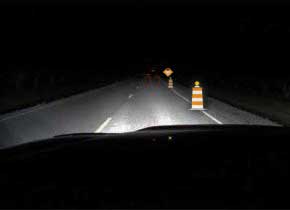
#1. If you are driving through a construction area on a clear night, you should turn on:
It is important to use high beams on unfamiliar roads, in construction areas, or where there may be people along the side of the road.

#2. Whenever it is practical, children should be secured in a back seat until they are:
Children under 13 years old are to be transported in the back seat where it is practical to do so. Children in the front seat, whether in safety seats or seat belts, can be injured or killed when the airbag deploys.

#3. A traffic signal with a flashing yellow arrow means:
A flashing yellow arrow means left turns are allowed, but you must yield to oncoming traffic and pedestrians. This is known as an unprotected turn.

#4. If you are in an intersection when an emergency vehicle with flashing lights approaches from behind, you should:
If you are in an intersection, drive through the intersection and then drive to the right as soon as you can and stop. Never stop in an intersection.
#5. If your vehicle is equipped with air-bags:
Air bags are designed to work with seat belts, not replace them. People who are unrestrained when an airbag deploys risk serious injury or death because they will not be properly positioned to benefit from the cushioning that airbags provide.

#6. Three vehicles approach an uncontrolled intersection. Car A is on the right of Car B. Car C is on the left of Car B. In which order should they proceed through the intersection?
Car A goes first.
Car B must yield to car A.
Car C must yield to both car A and B.
At an intersection where there is no stop sign, yield sign, or traffic signal, drivers must yield to vehicles in the intersection and to those coming from the right. Drivers turning left must yield to oncoming vehicles and pedestrians and bicyclists.

#7. If the engine dies while you are driving:
If the engine stalls while you are driving:
- Keep a strong grip on the steering wheel. Be aware that the steering wheel may be difficult to turn, but you can turn it with more effort.
- Pull off the roadway. The brakes will still work but you may have to push very hard on the brake pedal.

#8. A solid yellow line next to a dashed yellow line means that vehicles:
Broken lines indicate passing or lane changing is permitted if the way is clear.

#9. Even if you do not see a train coming at a railroad crossing:
Even if you do not see a train coming, never drive around a lowered gate or ignore the flashing lights.
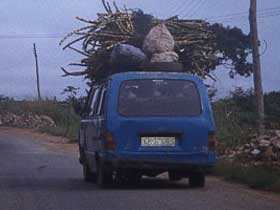
#10. If you see a vehicle driving with an unsecured load, you should:
If you see a vehicle driving with an unsecured load, you should stay as far away as possible and call 911 when it is safe for you to do so.

#11. Traffic signs that warn a driver of sharp curves, special situations, speed zones, or hazards ahead are usually:
The shape and color of road signs show the type of information they provide. Warning signs are usually yellow with black lettering or symbols. These signs warn you to slow down and be prepared to stop if necessary. They warn you of sharp curves, special situations, speed zones, or hazards ahead.

#12. You see this sign ahead. What should you do?
Winding Road. There are several curves ahead. Slow down and drive carefully.

#13. This red and white sign means:
This sign supplements the Do Not Enter sign. It tells you that you have already entered a one-way road and are driving in the wrong direction.

#14. When approaching a sharp curve where you cannot see what is ahead and there is no immediate danger, you should:
If there is no immediate danger, a light tap on the horn should be all you need. Give your horn a light tap:
- when a person on foot or on a bike appears to be moving into your lane of travel.
- when you are passing a driver who starts to turn into your lane.
- when a driver is not paying attention or may have trouble seeing you.
- when coming to a place where you cannot see what is ahead, like a steep hill, a sharp curve, or exiting a narrow alley.

#15. In this situation (approaching the bicyclist from behind), you should:
When passing a bicyclist, be patient. Do not squeeze the bicyclist off the road. Do not use your horn.
On this road, passing on the other half of the roadway is not allowed (see pavement markings).

#16. What does this sign mean?
Yield ahead. This sign warns of a yield sign ahead. Slow down and be prepared to yield other traffic.

#17. If your car starts to skid on a wet road, you should:
If your vehicle begins to skid:
- Take your foot off the accelerator.
- Stay off the brake. Until the vehicle slows, your brakes will not work and could cause you to skid more.
- Steer – Turn the steering wheel in the direction you want the vehicle to go. When the vehicle begins to straighten out, turn the steering wheel back the other way.
- Continue to steer – Continue to correct your steering, left and right, until the vehicle is again moving down the road under your control.

#18. To reduce the risk of hand, wrist, or arm injury if the airbag is deployed, it is a good idea to grip the steering wheel by:
Your grip on the steering wheel is important. Your hands should be placed on opposite sides of the steering wheel (left hand between 8 and 9 o’clock and right hand between 3 and 4 o’clock). This position is comfortable and on high-speed roads it allows you to make turns without taking your hands off the wheel. It also positions your hands out of the way of the airbag.

#19. You should leave more space on slippery roads in front of your vehicle.This extra space is needed:
Because you need more distance to stop your vehicle on slippery roads, you must leave more space in front of you. If the vehicle ahead suddenly stops, you will need the extra distance to stop safely.

#20. Compared to cars, what is generally true about large trucks?
Safely sharing the road with large trucks and buses requires knowledge of their special limitations. Generally speaking, the bigger they are the longer it takes them to stop.
| This Washington Permit Practice Test | |
|---|---|
| Questions per test: | 20 |
| Question pool: | 800+ |
| Type of test: | Random multiple-choice |

| The Official Washington Written Knowledge Test | |
|---|---|
| Questions on real exam: | 40 questions |
| Passing score: | 80% |
| Correct answers to pass: | 32 |
| Allotted time to complete test: | 45 minutes |
| Wait time before retest: | Varies |
Washington State (WA) – Practice Permit Test
You can double your chances of passing the official WA DOL permit test with this practice test from Driver’s Prep.
Each set of practice questions is easy to use. Every time you start a new practice test, you will get 20 random questions from a database with more than 800 questions. The large pool of possible questions gives you plenty of practice for the official knowledge exam.
After each question, you will get instant feedback on whether your answer is correct. Should you make a mistake, there is also an explanation to help you understand the right answer. Use this explanation to learn more and, when needed, read about the topic in the Driver Guide.
Start by Getting the Washington State Driver Guide

When you prepare for the real knowledge test, you should always start by getting the latest version of the Washington State Driver Guide . The Department of Licensing updates the guide regularly, so make sure you have the latest version.
The Driver Guide helps you clearly understand what you must learn for the examination.
After studying the guide, use these practice tests to check your progress and whether you are ready for the actual driver’s exam.
The passing score in Washington is 80 percent. On the examination, you must answer 32 out of 40 questions correctly.
Each practice test on driversprep.com is limited to 20 questions to speed up the process, but when you have taken 10-15 practice tests, you have also covered all the critical items and the most likely questions on the exam.
Aiming for a 100% score on the practice tests is best. It gives you a good margin on the DOL exam.
Remember, every practice question counts. The more comfortable you are with questions and answers, the more likely you will pass the examination.
Focus on authentic learning instead of simply memorizing answers because investing in knowledge always pays off.
The more you know, the stronger you stand. Invest in your future today, and you won’t regret it.

Read more: How to Ace the DMV Test
When Must I Pass a Knowledge Exam?
If you haven’t been licensed before
All first-time applicants must pass all tests, including the Washington written knowledge test.
If you let your WA license expire for more than six years.
If your Washington license expired more than six years ago, you must apply for a new license and pass all tests.
If you hold an expired license from another state.
If you have an expired out-of-state license, the typical test waiver does not apply, and you must pass the knowledge test before you can get a Washington license.
If you hold a license from a foreign country
If you hold an out-of-country license, the DOL will ask you to take all tests. However, the DOL will waive the knowledge and drive test if you have a valid driver’s license from British Columbia, Germany, South Korea, or Taiwan.
Test Waivers
When moving to Washington, DOL will waive the knowledge test if you hold a valid out-of-state license. If you are under 18, you must prove you completed a driver-training course meeting Washington standards.
When renewing your license, DOL waives the knowledge and driving tests unless the Department determines that you are not qualified to hold a driver’s license.
The Department of Licensing can ask you to retake the knowledge and driving test if necessary—chances of a necessary re-test increase with poor driving records or age.
What You Need to Know about the Washington Written Test
The knowledge exam is sometimes called the written test. It is the same test.
The test aims to verify that you understand road signs, traffic signals, pavement markings, Washington traffic laws, and common safe-driving practices.
DOL draws all questions from the information in the Washington Driver Guide. So, ensure you read the guide. Relying solely on taking practice tests is not a good idea.
Read more: Are Taking Practice Tests Enough?

You can take the test at all driver licensing offices. Unless you have notified DOL about support needs, the office will offer the test on a computerized test station.
The knowledge exam is a multiple-choice test with 40 questions. If you miss more than eight questions on the exam, you may have to wait before you can re-test.
Remember, before you can take the exam, you must apply online or at a WA driver’s license office.
You can also take the test at authorized driving schools and participating high schools.
Should you fail the knowledge examination, there is no official wait time before you can make another attempt. Examiners at a driver licensing office are less likely to let you have another go at the test the same day. Expect a waiting time of at least two to three days, depending on location and how many questions you missed.
With third-party test providers, like a driving school, you can take the test twice in one day, even if they recommend waiting at least 24 hours.
Each attempt to pass the test usually comes with a new fee of $35 (some third-party testers may waive the re-test fee).
The Department of Licensing does not offer the test from the comfort of your home, regardless of age.
Languages
The computerized knowledge test in Washington state is available in these languages:
English
Japanese
Russian
Vietnamese
What is on the Washington Permit Test
The Department expanded the test from 25 to 40 questions a few years back. The new 40-question test focuses more on distracted driving and the distraction of cell phones. Texting and using a handheld phone while driving is against the law in Washington State.
You should know that drivers with an intermediate license or instruction permit cannot use any wireless device, not even a hands-free phone while driving.
On the test, you should also expect questions about impaired driving, including how the use of marijuana affects your ability to drive safely.
Is the Washington Permit Test Hard?
Washington State does not release failures on the knowledge test, but experts generally consider it to be one of the toughest in the United States.
Failing the test can be expensive since you must pay the testing fee again.


Photo credits:
Struggling woman – CollegeDegrees360
Young man with Help sign – Marcos Calvo Mesa

