
Vermont Driver’s License & Permit Practice Tests


#1. Which is the general meaning of a sign with a circular shape?
You can tell what road signs mean by the shape and color as well as the wording. If the sign is covered by dirt, snow, or anything else, you should know the general meaning (regulatory, warning, information) of the sign by its shape. Circular signs with a large X and the letters RR indicate there is a railroad crossing ahead.

#2. After stopping and yielding, you may turn right at a red light unless:
A steady red traffic light means stop. Right turns at circular red lights are usually allowed, but only after the driver has stopped and yielded the right of way to pedestrians and other vehicles. Some intersections have signs or symbols that indicate you cannot turn right on red.

#3. Which is true about an antilock braking system (ABS)?
If your vehicle is equipped with anti-lock brakes use steady brake pressure, do not pump the brakes! Follow the instructions in your owner’s manual.

#4. If your lane ends ahead and there is a large truck in the lane beside you, you should:
Slow down and merge behind the truck. Cutting into the open space in front of a truck is dangerous. Trying to beat a truck through a single-lane construction zone, for example, removes the truck driver’s cushion of safety and places you in danger.

#5. If you are involved in a minor highway accident without injuries, you should always:
If possible, move the involved vehicles out of the traveled lanes and onto the shoulder. This will reduce the chance of someone else crashing into the involved vehicles, causing additional damage and injury.

#6. Signaling before turning is:
The law states that a driver must use a turn signal not less than 100 feet before making a turn or changing lanes. Signaling three to five seconds before any of these actions covers this requirement. Applying your brakes will signal vehicles behind you that you are planning to slow down or stop. If your vehicle’s directional lights or brake lights are not working, you must use hand signals to let other drivers know you are planning to stop or turn. Directional lights or brake lights which do not work must be fixed immediately.

#7. An infant under one year or under 20 lbs. must always be secured in:
For the best possible protection keep infants in the back seat, in rear-facing child safety seats, as long as possible up to the height or weight limit of the particular seat. At a minimum, state law requires keeping infants rear-facing until age 1 and at least 20 pounds.

#8. If a yellow center line is solid on your side of the road, it means:
If the solid yellow line is on your side of the road, do not pass. Pass only if there is a dashed (broken) line on your side.

#9. If you miss your exit when leaving an expressway, you should:
If you miss your exit, take the next one.

#10. If you see flashing red lights at a railroad crossing, you must stop and keep this distance from the light post or gate:
You must stop at least 15 feet before the crossing.

#11. What do the light gray areas in this picture show?
Turn your head before changing lanes because your mirrors have blind spots. These blind spots can hide a motorcyclist or a bicyclist. Do not drive in another driver’s blind spot.
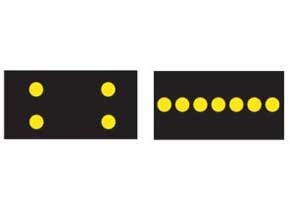
#12. An arrow panel displaying either of the following messages means:
Flashing arrow panels may be used to guide drivers into the correct lane. When the arrows are not in use, the panels are put in caution mode, with a straight line of blinking lights, or blinking lights on the 4 corners of the sign. Drivers should slow down when they see the panels in caution mode.

#13. If you are in an intersection when an emergency vehicle with flashing red lights approaches from behind, you should:
If you are in a roundabout or intersection, pull over when you have safely exited the roundabout or intersection.

#14. When two vehicles from different directions arrive at the same time at a four-way stop, which one must yield?
At a four-way intersection controlled by stop signs, you must yield the right-of-way to the driver on your right if both of you arrive at the intersection at the same time (Same Time Rule).

#15. When you park on the right side of a street with a curb:
A vehicle parked on a two-lane road must have the right wheels within 12 inches of the right side of the road or curb. On a one-way road the vehicle must be positioned within 12 inches of the side of the road. Your vehicle must be parked in the same direction as traffic flow.

#16. The legal blood alcohol level for any person under 21 years is:
Vermont law states that when a person’s blood alcohol concentration (BAC) is .08 or above, that person is under the influence or impaired. People under the age of 21 who operate a vehicle with an alcohol concentration of .02 or more can receive a civil traffic violation. The driver’s license will be suspended, and the driver must complete an alcohol and driving education program at his/her own expense.

#17. You must turn on your headlights when you cannot see persons or vehicles at a distance of::
If you cannot clearly see persons or vehicles 500 feet ahead, Vermont law requires drivers to have headlights turned on.

#18. If a school bus with flashing red lights has stopped on the other side of a four-lane roadway with a median barrier, you should:
Once the red warning lights have been activated you must stop your vehicle. Even in a schoolyard, you must not pass a stopped school bus with its alternately flashing red warning lights activated. There are a few exceptions where a stop is not necessary. You do not have to stop on a divided highway if the school bus is traveling in the opposite direction. A concrete barrier may be used to separate traffic from the bus, and you are not required to stop.

#19. Why should you use care when driving in rural areas in late evening, nighttime, and early morning hours?
The presence of moose and deer on highways is most likely to occur during late evening, nighttime, and early morning hours. Use caution when driving during those hours when deer and moose tend to roam or feed.

#20. What does this sign mean?
Divided highway ahead. The highway ahead is divided into two one-way roadways. Opposing flows of traffic are separated by a median or other physical barrier.
| This Vermont Permit Practice Test | |
|---|---|
| Questions per test: | 20 |
| Question pool: | 500+ |
| Type of test: | Random multiple-choice |
| The Official Vermont Written Knowledge Test | |
|---|---|
| Questions on real exam: | 20 questions |
| Passing score: | 80 percent |
| Correct answers to pass: | 16 |
| Allotted time to complete test: | No limit |
| Wait time before retest: | 1 day |
Vermont Practice Tests
This practice tests for a Vermont Driver’s License or Learner’s Permit has 20 random questions based on the handbook and real exam questions. After each question, you will get instant feedback. You can immediately see if your answer is correct or not. When you miss a question, there is also a brief explanation to help you learn faster.
Since the test is randomly created, there are unlimited sets of questions available. You can take as many as you need, as many times as you want.
Get the Latest Vermont Driver’s Manual
Your first step is to get the latest version of the Vermont Driver’s Manual. You can get a copy from a local branch office, your high school, driving school, or download it online .

When you’ve studied the manual, use this practice test to check your progress and see if you are ready for the real examination or not.
Don’t use the tests as a replacement for studying the manual. Practice tests are only a supplement to help you learn faster and verify your progress.
Make sure you fully understand all answers. Just memorizing questions and answers is a risky study tactic .

Passing Score in Vermont is 80 Percent
The passing score in Vermont is 80 percent, which means you must answer at least 16 of 20 questions correctly to pass the examination.
Since there are only 20 questions it is easy to make four or more mistakes and not pass. This is why you should aim for a 100% score on the practice tests. It gives you a better margin for errors when attempting the real exam.
Who Must Pass the Vermont Knowledge Test?
To get an original Vermont Driver’s License all first-time applicants must pass the knowledge test.
When you apply for your first Learner Permit or Junior Operator License you are subject to the rules in the Vermont Graduated Driver’s License law.
When you move to Vermont with a valid out-of-state license or an out-of-state license that has been expired for one year or less, DMV will normally waive the knowledge and road tests. Should you let your out-of-state license expire for more than one year, you must take the same tests as a first-time applicant.
If another state has suspended, revoked, denied, or canceled your driver’s license, you cannot get a Vermont license.
With an out-of-state junior operator’s license, you must successfully pass the required examinations, show proof of successful completion of a driver education program, and have completed 40 hours of driving. You are subject to all provisions in the Vermont Graduated License law, unless you have held the Junior Operator’s License in the other state for a period of at least six months.
With an out-of-country license you must always pass the knowledge test before DMV will issue a Vermont license.

Vermont Written Permit Test
The purpose of the Vermont written test is to verify your understanding of common road signs, traffic laws and safe driving practices.
It is a multiple-choice test with four available answers to choose from (this practice test has only three choices).
Only one alternative is correct and there are no trick questions.
The knowledge and road tests are usually done on separate days. You cannot make an appointment for the road test until you have passed the written test.
If you fail the written test, you must wait at least one business day before taking a new one.
Remember, all exams now require an appointment. Taking the knowledge test on a walk-in basis is not an option. You can schedule your written exam online via the Vermont DMV Portal or by phone at 888-970-0357.
Oral Tests
The computerized test has audio support so that you can listen to all questions.
If you have trouble reading or any another disability that requires a person-to-person oral test, you should inform DMV when making an appointment. DMV will provide you with assistance and schedule an oral test. At an oral test, the examiner will give you a road sign identification test and then read the rest of the written test to you.
Problems hearing?
If you are hard of hearing and want an interpreter, you must ask for one when you schedule your appointment.
Languages
If you speak another language and have difficulty reading English, you may use a dictionary and also ask the examiner to assist you.
Should you wish to have an interpreter other than an ASL interpreter, you must provide the interpreter yourself and that person must have a valid driver’s license from a U.S. State or territory.
Practice Test You Can Take as Many Times as You Need
No fees, no gimmicks. Always 100 Free.


Photo credits:
Vermont city street – Copyright: Xzelenz Media / Driversprep.com
Struggling woman – CollegeDegrees360
Young man with Help sign – Copyright: Marcos Calvo Mesa

