
Mississippi Permit Test Practice & Driver’s License Tests – 2026
Results
80% is the passing score in Mississippi. Do you want to try a new test?
80% is the passing score in Mississippi. Do you want to try a new test?


#1. You approach this road sign. What should you expect ahead?
Divided highway ahead (divided highway begins). Two-way traffic will be divided by a center strip ahead. Each roadway is one-way. Stay to the right.
#2. Penalties for a first conviction of drunk driving for a minor under the Zero Tolerance Law include a license suspension for a period of:
Penalties for a first offense under the Zero Tolerance Law include a 90 day suspension.

#3. When can you legally park your car in front of a private driveway?
Parking is not allowed in front of a public or private driveway.

#4. When must you turn on your headlights?
You must use your lights between sunset and sunrise and at any other time when you cannot see clearly ahead for a distance of 500 feet.
You should use headlights to see and be seen. Use them in rain, snow, fog and when it is dark.

#5. When a school bus with flashing red lights stops on the other side of a road with four lanes and a shared center turn lane, you should:
You must stop for a school bus, regardless of your direction, whenever the bus is stopped and receiving or discharging children. You must not proceed until the children have crossed the street or highway and the school bus has resumed motion or the flashing red lights are no longer actuated and the hand-operated stop sign is retracted.
You are not required to stop when the highway that has four lanes or more, and the school bus is on a different roadway.
You may also pass when on a controlled-access highway where the school bus is stopped in a loading zone that is a part of or adjacent to the highway and where pedestrians are not permitted to cross the roadway.

#6. The following are true about large trucks except:
It is not true that they need less room to maneuver.
Large vehicles are more difficult to maneuver, are longer, heavier, and require much more room to turn.

#7. When you approach a traffic signal displaying a steady yellow light, you must:
A solid yellow light means the light will soon turn red. Vehicular traffic facing the signal shall stop before entering the nearest crosswalk at the intersection, but if such stop cannot be made in safety a vehicle may be driven cautiously through the intersection.

#8. When entering an interstate highway from the acceleration lane, how fast should you go?
As you reach the end of the ramp, increase your speed in the acceleration lane until you reach cruising speed. Keeping the same speed as highway traffic allows you to merge smoothly. Stay within posted speed limits.

#9. A blue and white sign at a railroad crossing indicates:
The blue Emergency Notification System (ENS) sign is at every highway-rail grade crossing. The sign is located on the black and white cross buck or on the metal box near the crossing. The toll-free number is answered by railroad dispatchers, who can attempt to stop all train traffic at the crossing during an emergency. The sign also includes an identification number for your exact location. By following the information on the sign, you can report unsafe conditions such as:
- malfunctions of warning signals, crossing gates and other safety devices at the crossings
- disabled cars, trucks or other vehicles blocking the railroad tracks at the crossings
- the presence of trespassers on the tracks or along the right of way at the crossing
- any other information relating to an unsafe condition at the crossing.
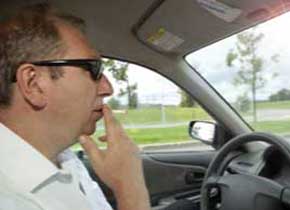
#10. People who use marijuana often:
Marijuana, like alcohol, only slows down your reflexes, impairs your judgment, and makes you very dangerous when you drive.
Studies have shown that people who use marijuana make more mistakes, have more trouble adjusting to glare, and get arrested for traffic violations more than other drivers.
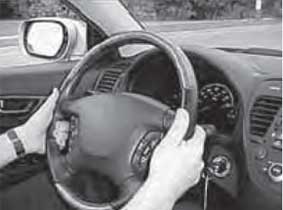
#11. When you drive a vehicle with airbags, this hand position on the steering wheel is:
While you drive, keep both hands on the steering wheel. At least one third of the wheel should separate the hands. To reduce the risk of hand, wrist or arm injury if the airbag is deployed the left hand should be on the wheel at 9:00, as on the face of the clock, with the right hand at 3:00, or slightly lower. Never drive with your elbow resting in the window.

#12. To check your blind spot when changing lanes to the left, you should glance:
Look over your shoulder in the direction you want to move. Be sure no one is near the left or right rear corners of your vehicle. These areas are blind spots. To see the blind spots, you have to turn your head and look.

#13. The minimum amount your liability insurance must cover against injury or death of two or more individuals is:
On January 1, 2006, the minimum liability requirements increased to the following: $25,000 per person (limited to a single accident), $50,000 per accident for bodily injury, and $25,000 per accident for property damage.

#14. If you are in an intersection when an emergency vehicle with flashing lights approaches from behind, you should:
Any emergency vehicle flashing red or blue lights or signaling with a bell or siren must be given the right-of-way on any street in any traffic situation. Pull over to the extreme right-hand side of the road until the emergency vehicle has passed.
If you are at an intersection, proceed through, and then pull over to the extreme right.

#15. A regulation sign telling you to keep right usually has what shape?
Vertical rectangle is usually used for regulatory signs (such as speed limits).
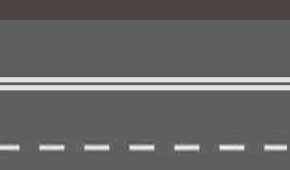
#16. When is a double white line used as pavement marking between lanes?
A double, solid white line means travel in the same direction is permitted on both sides of the line. Crossing a double white line is prohibited.

#17. If you see this sign in front of you, it tells you that:
The Do Not Enter sign might include the words ‘do not enter’ or it might only include the white bar across the red circle background. Either way, it means you may not enter this lane of travel.

#18. What is the meaning of this sign?
Winding road. The road ahead is winding with a series of curves or turns. Adjust your speed.

#19. Which car or cars have the position for a left turn on this one-way street?
A good rule to remember when traveling on a one-way street is to always turn from the lane nearest the curb. (However, pavement markings or signage may permit turning from additional lanes.)

#20. When being passed by another vehicle, you must:
When being passed on a two or three lane highway, you are required to keep to the right, and you should not increase your speed until the other car has completely passed you.

#21. A pedestrian has entered a crosswalk where there are no signs or signals. Who should be given the right of way?
Respect the right-of-way of pedestrians. Always stop for any pedestrian crossing at corners or other crosswalks, even if the crosswalk is in the middle of the block, at corners with or without traffic lights, whether or not the crosswalks are marked by painted lines.

#22. If you have a tire blowout while driving, you should:
If you develop a flat tire or have a blowout, do not apply your brakes suddenly. Hold the steering wheel firmly. Take your foot off the accelerator, and then apply the brakes slowly and cautiously. If you have plenty of stopping distance, let the vehicle stop by itself. Remember, keep the vehicle going straight until you have full control.

#23. When driving on slick roads, your vehicle will:
Charts in the manual show the shortest total stopping distances under ideal conditions. If the weather is bad or the road is slick, then the distances will be drastically different

#24. Which of the following is the best method to improve safety when driving at night?
At night, visibility is greatly reduced. This makes it necessary to reduce your speed and to exercise caution. You can only see as far as your headlights can reach. Therefore, be careful not to overdrive your headlights – that is, do not so fast that you cannot stop within the distance you can see.

#25. This sign is normally seen together with:
This sign often accompanies a stop sign at an intersection. It tells you that although you must stop for your stop sign, this is nota four-way stop.
| Mississippi Permit Test Practice | |
|---|---|
| Questions per test: | 25 |
| Question pool: | 500+ |
| Type of test: | Random multiple-choice |

| The Official Mississippi Permit & Driver Exam | |
|---|---|
| Exam Questions: | 30 |
| Passing score: | 80% |
| Correct answers to pass: | 24 |
| Allotted time to complete test: | – |
| Wait time before retest: | 1 day |
Mississippi Practice Tests
You can now prepare for your Mississippi Driver’s License or Learner’s Permit with practice tests from Driversprep.com.
Each test has 25 random questions based on the Driver’s Manual and the real exam questions from Mississippi Driver Services Bureau.
After each question, you will get instant feedback that tells you whether your answer is correct. When you make a mistake, there is also a short explanation to help you learn faster. Remember, if you need more clarification on questions and answers, study the relevant chapter in the Driver’s Manual.
You can take the test as many times as you want or need. The system generates a new set of questions each time.
Do I Need to Study the Driver’s Manual
Everything you must learn for your knowledge examination is in the Driver’s Manual, so you must study it well. Practice tests supplement the manual and should not be used instead of reading the manual.
You should have the latest version of the manual. We strongly recommend getting a hard copy from a Driver Services office, but please note that there is a small fee for the printed copy.
You can also download a copy of the manual from their website, for which the Driver Service Bureau charges a fee. Mississippi is currently the ONLY state in the United States that charges you a fee for an online version.
Unfortunately, we have several reports of a malfunctioning download service and zero support. So, go for a printed copy and don’t waste your money on the PDF version.
How Should I Study for the Exam?
After reading the manual, you can use the practice tests to check your progress and see which facts you might have missed.
Don’t try to memorize questions and answers. They can be worded differently on the actual exam. Proper understanding will make the test more straightforward and make you a better driver.

Read more about Risky Study Tactics .
Can I Take the Test online?
Mississippi Driver Service Bureau does not offer online testing from the comfort of your home. You must take the test at a service location or as part of your driver education course.
How Many Questions are on the Mississippi DPS Written Test?
Questions on the test will cover Mississippi traffic laws and safe driving rules.
There are 30 questions on the exam, and you must correctly answer at least 24 questions to pass, meaning you must reach a score of at least 80%. You can miss six questions and still pass.
DMV will let you take the test on a computerized testing station. If you need help with how it works, ask your examiner for additional information before you start the test. The test station also includes a headset for you to use if you want audio support, so you can let an automated voice read the questions and choices aloud.
What Happens if You Fail the Test?
If you fail the test, you must wait until the following business day before you can retake it. If you fail three times in a row, you must wait 30 days before retaking the test.
There is no limit on the number of times you can take the knowledge test.
Read more about preparing for your license exam: Best Way to Study

What is on the Mississippi Knowledge Exam?
The test checks the following:
- Do you know the Mississippi traffic laws and safe driving rules?
- Can you read, understand, and follow traffic signs and signals?
- Are you a safe and skillful driver?
- Do you understand and have the proper attitude toward the rights of pedestrians and other drivers?
- Do you understand how to keep your vehicle in safe condition?
- Are you physically and mentally capable of driving safely?
Who Must Take the Mississippi Knowledge Exam?
In general, you must pass the Mississippi written knowledge test:
» When you apply for your first driver’s license or permit and never had a driver’s license or permit before.
» When you are a new resident in Mississippi with an out-of-state driver’s license and your out-of-state license has expired for 30 days or more. You are also required to take the written knowledge test if the license is valid but you are under 18 years of age and have held the out-of-state license for less than six months.
» When you are a new Mississippi resident with an out-of-country license and must transfer to a Mississippi driver’s license.
» When you wish to renew your Mississippi driver’s license and your driver’s license has expired for one year or more.


