
Maine BMV Driver’s License & Permit Practice Tests
Results
Great job! This is a passing score. Do you want to try again?
Unfortunately, this is not a passing score. Do you want to try again?


#1. Which of the following violations will result in the highest number of demerit points on a driver's record?
Leaving the Scene of an Accident (Property Damage) will result in six points.

#2. Parallel parking: When you pull up alongside the vehicle in front of a free space, the distance between your car and the other vehicle should be about:
Stop even with the car ahead and about two feet away from it.

#3. Which is true about alcohol?
Alcohol interferes with the brain’s ability to react and to concentrate. A driver who has consumed alcohol is more apt to fall asleep at the wheel or drive off the roadway. Moreover, the more a person drinks, the less control they have over coordinating body functions and movements.

#4. Driving at night with parking lights instead of headlights is:
Whenever lights are necessary, use your headlights. It is not good driving practice to operate a motor vehicle with the parking lights on. Parking lights are for parked vehicles only.

#5. You approach this road sign. What should you expect ahead?
Divided highway ahead (divided highway begins).
You are getting close to the place where two-way traffic will be divided by a center strip. Each roadway is one-way. Stay to the right.

#6. If red lights are flashing and gates are closing at a railroad crossing, you should:
Sometimes flashing red lights mark a railroad crossing. Sometimes there are gates or barriers. Stop and wait until the light stops and barriers are removed.

#7. A flashing red traffic light tells you to:
A flashing red traffic light means the same as a stop sign. Come to a complete stop and go only when the way is clear.
A green signal will not appear.

#8. When following a truck and there is a single-lane construction zone ahead, you should:
Slow down and merge behind the truck.
Never pass or pull in front of a large vehicle that is already slowing or stopping. The driver has based their braking ability on the space ahead. If you suddenly pull in the lane, you have compromised the driver’s braking ability and could cause an accident.

#9. A pedestrian crosses a street on a Don't Walk signal. The pedestrian is halfway across when your signal light changes to green. What should you do?
You must always yield to pedestrians in a crosswalk, marked or unmarked.

#10. What does this sign mean?
This sign warns that there is a flag person ahead.
Flaggers wear high visibility vests, shirts or jackets and use a stop/slow paddle and hand signals to control traffic through the work zone. Usually a flagger is stationed on each end of the work zone to let the two directions of traffic alternately travel past the work zone. Be patient and always obey their signals.

#11. Which is true about the combined effect of alcohol together with other drugs?
Many times worse than alcohol or drugs used alone is the use of alcohol and drugs at the same time. The combined influence of these two substances can produce dangerous effects on the mind and body, often resulting in death.

#12. When two vehicles from different directions arrive at the same time at a four-way stop:
If more than one vehicle arrives at the same time, the vehicle on the right goes first.
#13. Your total stopping distance is equal to:
Your total stopping distance is the sum of your reaction distance and braking distance.
Sometimes, it also referred to as the sum of your perception distance, reaction distance, and braking distance.

#14. Which pavement marking separates traffic traveling in opposite directions?
Yellow road markings divide lanes of traffic going in opposite directions. Many roads have lane markings that tell when you cannot see far enough to pass.
You should not pass when there is a solid center line on your side of the road.
You may pass if there is a broken center line on your side of the road. Pass only if there are no oncoming cars in the passing lanes.

#15. What does Maine's basic speed law mean?
Remember, speed limits are based on the condition of the road, how far you can see, and what typical traffic is like. Posted speed limits do not tell you at what speed to drive. They only say you cannot go faster than the speed shown. If road and weather conditions make the posted speed unsafe, you must slow down. This is known as the basic speed law.
An operator shall operate a vehicle at a careful and prudent speed not greater than is reasonable and proper having due regard to the traffic, surface, and width of the way and of other conditions then existing.
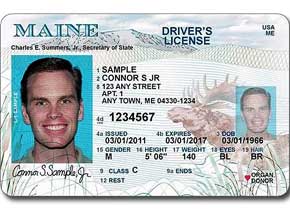
#16. To obtain a Maine driver's license, an applicant who has NOT completed an approved driver education course must be at least:
You must be at least 18 years of age if you have not completed an approved driver education course.

#17. What is the first thing you should do if your gas pedal sticks?
If your gas pedal becomes stuck or jammed:
- Keep your eyes on the road.
- Shift to neutral.
- Put on the brakes.
- Find a safe place to pull off the road.
- As you bring your car to a stop, turn off the engine.
- If you cannot free the pedal so that it does not get stuck again, call for assistance and do not try to drive the car.

#18. You must obey directions, signals, and instructions from:
If you see police directing traffic, do as they direct. Police have authority to direct all traffic and pedestrians as needed. It is illegal to refuse or fail to obey police orders.
You must also obey when a school crossing guard or a flagger directs you.

#19. What does this sign mean?
There is a crossroad/intersection ahead. A road crosses the main highway ahead. Look in all directions for other traffic.

#20. What should you expect ahead when you see this sign?
There is a stop ahead. When you come to this sign, you should slow down and be ready to stop at the stop sign ahead.

#21. If you are involved in a traffic crash, and someone is injured, you should:
Do not give an injured person anything to drink, not even water.

#22. At 30 mph, the force of a head-on crash is the same as hitting the ground from:
In a collision, your car stops but you keep going at the same speed you were traveling, until you hit the dashboard or windshield. At 30 mph, this is like hitting the ground from the top of a three-story building

#23. When driving at night, you must:
You must use extra caution and drive slower at night because you must be closer to an object to see it at night than during the day. Never drive so fast that you cannot stop within the distance you can see ahead with your lights.

#24. When making a left turn on a two-way street with multiple lanes, you should:
Turn into the lane that is closest to the lane from which you came. On a left turn, turn into the leftmost lane going in your direction, whether on a divided highway, 2- way or one-way street.
Do not cut the corner
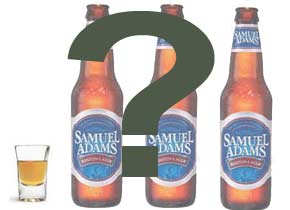
#25. The amount of alcohol in a 1 oz. shot of 100 proof liquor is generally equal to:
The kind of beverage you drink does not matter. What is important is the amount of alcohol you drink over a period of time. There is approximately the same amount of alcohol in a 12 oz. can of beer as there is in a 1 oz. shot of 100 proof hard liquor or 4 oz. glass of table wine (or a 10 oz. wine cooler).
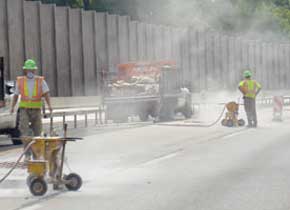
#26. Work and construction zones are commonly identified with:
Construction warning signs are posted to alert drivers of road construction or maintenance activity ahead. They also serve to guide a motorist safely through or around the work site. These signs are black symbols or lettering on an orange background and are often diamond shaped.

#27. Your following distance behind a motorcyclist should be:
You can tell if you are following too closely by using the two-second rule. In some situations, you should allow an extra cushion. A three to four-second (or more) following distance may be needed when following motorcycles or bicycles. If the cyclist should fall, you will need extra distance to avoid striking the rider. The chances of a fall are greatest on wet or icy roads, metal surfaces such as bridge gratings or railroad tracks, and on gravel.
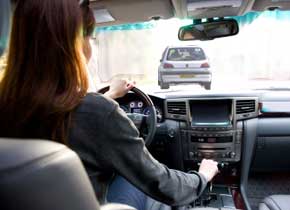
#28. In general, you should pass other vehicles:
In general, you should pass on the left. Passing on the right can be dangerous because other drivers do not expect it. Cars on the right side are also more difficult for a driver to see.
Remember, passing on the right is not always allowed.

#29. To ensure that children ride safely, you should:
Never put an infant less than one year old in the front seat of a car with a passenger side airbag.
A child in a rear-facing child-restraint system may only be placed in the front seat if the front passenger airbag is deactivated.

#30. You are in the right-hand lane and want to turn right at an intersection. You see this sign at the corner. What should you do?
No right turn. You cannot make a right turn at this intersection.
Remember, a red line through a red circle means that you cannot do something.
| This Maine Permit Sample Test | |
|---|---|
| Number of questions on each practice test: | 30 |
| Question pool: | 1,000+ |
| Type of test: | Random |

Facts about Your Maine Driver’s License Test
| Maine Knowledge Test for Learner’s Permit and Driver’s License | |
|---|---|
| Number of questions on exam: | 30 questions |
| Passing score: | 80 percent |
| Correct answers to pass: | 24 |
| Allotted time to complete test: | n/a |
| Wait time before retest: | No official wait time |
Maine Practice Tests for Permit and Full License
Each preparation test on this website has 30 questions based on the Motorist Handbook & Study Guide and real BMV tests.
You will get instant feedback after each question. If your answer is wrong, you will also see a brief explanation. If you keep the Motorist Handbook handy throughout your studies, you can compare answers with the information in the Handbook.
Make sure you get the latest version of the Study Guide from your BMV office or download it online .
The passing score in Maine is 80 percent, which means must answer at least 24 questions correctly. All questions are from the Motorist Handbook & Study Guide.
It is a good idea to aim higher on a practice test. At a minimum, you should aim for 92 percent. But it is, of course, best to aim for the perfect score of 100%.
Read more about study tactics .

What You Should Know about the Knowledge Examination in Maine
The knowledge test will check your knowledge of common road signs, rules of the road, Maine’s DUI laws, the dangers associated with distracted driving, and Maine traffic laws.
Traditionally the test had 10 separate questions about road signs and 20 questions about road rules and traffic laws. Expect the same numbers on the new test.
The test should take about 15 minutes to complete.
If you are enrolled in a driver education, you typically take the test as part of your education class at a driving school. You don’t have to take another written test.
Maine does not offer online testing from home.
If you transfer a license from another country or are required to pass the exam for other reasons, you must take the test at a BMV location.
If you fail the test, you may be able to take it again the same day at the discretion of the examiner. There is no official wait time to retake the knowledge test.
The knowledge test is a closed book test, and you cannot used books, manuals, notes, or digital devices in the testing area.
The test is available in several languages, but Maine BMV has made no effort to publish them. Any applicant who requires accommodations for the written or road test should contact the Exams Division of the BMV by phone, inquire in person at any BMV branch, email the Exams unit at license.bmv@maine.gov or mail Bureau of Motor Vehicles, State House Station 29, Augusta, Maine 04333.
Who Must Pass the BMV Test?
First-time applicants who have not been licensed before.
You must take all tests, including vision screening, knowledge test, and driving test, when you never had a license or permit before.
Drivers who let their license expire more than 5 years.
If you had a driver’s license issued in Maine or another state and let that license expire for more than 5 years, you must apply for a new driver’s license and take all tests again.
Drivers who hold a foreign driver’s license.
New residents with an out-of-country license from a foreign country other than Canada must take all tests to convert their license to a Maine driver’s license. They must show proof of address in Maine and documents that show their legal presence.
Drivers with a suspended / revoked license.
When your license is suspended for certain violations, BMV may require a new knowledge test and driving test before your license is reinstated.
When is the BMV Knowledge Test Waived?
If you apply for a driver’s license in Maine and hold a license from another state, US territory, or Canada, the knowledge test and road skills test are usually waived.
Is the BMV Knowledge Test Hard?
The failure rate on the BMV knowledge test is about 30 percent, which means that one out of three fails the test the first time they take it. The difficulty level is graded moderate to hard, so it is a good idea to prepare well.
Don’t Forget Your Documents
Before you can pass the vision screening and the knowledge test, you must have all your paperwork in order. It is common that applicants are sent back home from the BMV service center because they didn’t have all the necessary documents .
You must show:
2 different proof of identity – at least one must indicate your date of birth and the other must have your written signature.
Proof that you are a Maine resident.
Proof that you are a U.S. citizen or are in the country lawfully (legal presence).
Maine Graduated Driver Licensing (GDL) Laws
1 Learner’s Permit
| Minimum Age (Years) | Minimum Duration (Months) | Required Supervised Driving Hours (Night Hours) |
|---|---|---|
| 15 | 6 | 70 (10) |
2 Intermediate License
| Minimum Age (Years) | Nighttime Driving Restriction | Passenger Restriction (except family, unless noted) |
|---|---|---|
| 16 | Midnight – 5 a.m. | First 9 months: no passengers |
3 Full License
| Minimum Age (Years, Months) |
|---|
| 16 years, 9 months |
Videos Maine Driver’s License Test Questions & Answers


