
Kentucky Written Permit Test Practice – Knowledge Test Questions
Results
This is a passing score. Do you want to take another one?
This is not a passing score. Do you want to try again?


#1. If your car starts to skid, what is the most common cause?
Skids are caused by drivers traveling too fast for the conditions. Most skids happen when you try to turn or stop suddenly on slippery pavement. Keep your tires on the road by slowing down when it rains and having tires with the proper air pressure and good tread.

#2. If your car stalls on railroad tracks and a train is approaching, you should leave your vehicle and move quickly:
If you do get boxed in or stalled on a crossing, abandon your car immediately and run away from the track in the direction the train is coming, in order to avoid being hit by flying debris.
Once you are at a safe distance, call the 800 number posted on or near the crossbuck, or call 911, to alert the dispatcher of your stalled vehicle. Do not attempt to restart your vehicle until a dispatcher indicates it is safe and no trains are approaching.
Remember, if a collision is imminent, the safest direction is toward the train but stay off the tracks. That way you will be least likely to be hit by your vehicle or any debris from the collision.

#3. If you are less than 18 years of age, your license may be suspended as soon as your driver's record accumulate how many points?
If a person of eighteen or more years accumulates twelve points within a period of two years, or a person less than eighteen accumulates more than six points in a period of two years, the Cabinet may suspend the driving privilege for a period of six months for the first accumulation of points, one year for the second accumulation of points, and two years for any subsequent accumulation of points within a two-year period.
For any offense for which the suspension of the driving privilege is six months or less for the first offense, the second conviction of a similar offense shall result in a suspension period of not less than one year, and any subsequent conviction for any similar offense not less than two years. If the Cabinet suspends the driving privilege of a person more than one (1) time, the suspension times shall run consecutively.
Note that seven points are required (more than six points).
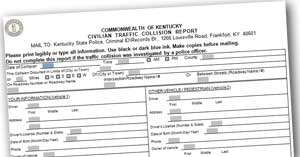
#4. A traffic crash report must be filed when an investigation is not conducted by a law enforcement officer and the crash resulted in property damage that appears to be:
Any person operating a motor vehicle on the highways of this state who is involved in an accident resulting in any property damage exceeding $500 in which an investigation is not conducted by a law enforcement officer, shall file a written report of the accident with the Department of State Police within ten days of occurrence of the accident, using forms provided by the Department.

#5. When is a good time to adjust all inside and outside rear-view mirrors?
Adjust your seat, rear-view mirror, and side mirror before you start to drive.
Adjust your seat so that you can see the pavement 12 to 15 feet in front of the vehicle. Your chest should be located 10 to 12 inches from the center of the steering column, and your shoulders should be no lower than the top of the steering wheel. Sliding the seat forward will raise it. Do not adjust the seat while the vehicle is in motion. If it is still too low, use a seat cushion. Do not move the seat so far forward that you cannot easily steer.
Adjust your seat belt and shoulder strap so they fit snugly and properly.
To guard against glare from the headlights of a vehicle behind, use a day-night mirror. Adjust it before you drive.

#6. Always allow extra room in front of your vehicle when:
There are some situations where you should allow more space. In these situations a four- to five-second following distance is needed.
- On Slippery Roads.
- Following Motorcycles.
- Passing.
- Blocked View.
- Heavy Load or Towing.
- Following Large Vehicles.
When you have a heavy load or you are pulling a trailer, the extra weight increases your stopping distance.

#7. When driving on a clear night with a steady stream of oncoming traffic, you should use:
Dimming headlights when meeting or following other vehicles is required by law, as well as being a sensible driving practice.
Use your high beams only when there are no oncoming vehicles.
Remember, when approaching an oncoming vehicle at night, you must use the low beam the last 500 feet before meeting and passing.

#8. A white cane or walking stick may only be used in a public place by someone who is:
A white cane is used by many people who are blind or visually impaired. Its primary uses are as a mobility tool and as a courtesy to others.

#9. The most considerable risk with airbags is:
The biggest risk is being too close to the airbag. If your vehicle is equipped with an airbag, move the seat back. The driver’s seat should be as far back from the dashboard as possible while still being able to operate the vehicle safely. Your chest should be located 10 to 12 inches from the center of the steering column.

#10. An orange and red sign like this on a vehicle means:
A slow-moving vehicle is a vehicle moving 25 miles per hour or less. All slow-moving vehicles, farm operated equipment or horse drawn carriages, are required to display a slow-moving emblem to the rear of the vehicle. Watch for the sign, it can save your life.

#11. When another vehicle is in danger of hitting you, you should:
Use your horn whenever it will help prevent a collision. If you feel there is a real danger, sound a SHARP BLAST on your horn.

#12. What should you do when approaching a bicyclist from the rear on a two-lane road?
Pass a cyclist only when it can be done safely, and give ample room (3 feet) between your car and the cyclist.

#13. When passing a motorcycle, you should:
Motorcycles have as much right to the road as other vehicles and need as much space. When you pass a motorcycle, give it an entire lane. Do not try to pass in the same lane.

#14. You are driving on a one-way street. You may turn left onto another one-way street only if:
You may turn left into a left-moving, one-way street if there is no sign to prohibit the turn.
Remember, do not turn against traffic.

#15. If you have been drinking alcohol, what will help you to sober up?
There is no way to sober up quickly. Things like coffee, fresh air, exercise, or cold showers will not help. Sleep will not help either, except to pass the time.
Time is the only thing that will sober you up.
This is a very common question on DMV tests.
| This Kentucky Permit Practice Test | |
|---|---|
| Questions per test: | 15 |
| Question pool: | 500+ |
| Type of test: | Random multiple-choice |

| The Official Kentucky Written Knowledge Test | |
|---|---|
| Questions on real exam: | 10 + 30 |
| Passing score: | 80 percent |
| Correct answers to pass: | 8 + 24 |
| Allotted time to complete test: | – |
| Wait time before retest: | 1 day |
How Many Questions are on the KY Written Knowledge Exam?
The written knowledge test in Kentucky is a multiple-choice test with 40 questions.
On the first part, the test has 30 questions about traffic signals, Kentucky vehicle laws, and common safe-driving practices.
The second part asks about the highway signs described in the Kentucky Driver Manual. You will be asked to identify 10 road signs based on their color, shape, symbols, or word messages.
You take both tests on a computer.
What is the Passing Score on the Kentucky Written Test?
The passing score on the Kentucky knowledge test is 80%.
You must correctly answer 24 of the 30 multiple-choice questions. On the road signs test, you must correctly identify 8 of the 10 signs.
To pass the test, you must correctly answer at least 32 questions in total.
Is There a Time Limit on the Kentucky Permit Test?
There is no time limit on test. You should allow yourself enough time to read all questions very carefully before you answer. Expect the test to take 15-20 minutes. It will take even less if you are well prepared.

Where Can I Take the Test?
You must take the test at the Department of Kentucky State Police in the county where you live.
To take the test in another county, you need a written permission by the Transportation Cabinet and the State Police in that county must agree to arrange the test.
Can I Take the Kentucky Permit Test Online?
Kentucky State Police does not offer the permit test online.
What Kind of Questions are on the Test in Kentucky?
The Kentucky written knowledge test has questions about driving rules, regulations, procedures, and safe driving practices. Answers to all questions are found in the Kentucky Driver Manual.
An additional test has questions about highway signs and their meaning, including how colors and shapes are used to convey basic messages (like warning, regulations, guidance, and directions).
How Should I Study for the Test?
You should start by studying the Kentucky Driver Manual. Contact the Circuit Court Clerk’s office in your county of residence or download the latest version online .
When you’ve studied the manual, use these practice tests to check your progress and if you are ready for the real knowledge test or not.
What is this Practice Test?
This practice test focuses on the knowledge part. You can practice the road signs here: Kentucky Road Sign Recognition Test .
Each test has 15 random questions each (half of the real exam). Test questions are based on the information in the Driver Manual and real exam questions.
After each question, you will get instant feedback. If miss a question, there is also a brief comment to help you learn faster. Use this information to look up more information in your manual.
You can see your score at the end of each test.

How Can the Practice Tests Help Me?
Practice tests are a proven way of increasing your chances to pass the permit test the first time. You will familiarize yourself with the kind questions the Department of Kentucky State Police will ask. By taking several tests, your score will also get better and better, which will boost your confidence and make you less nervous.
It is always a good idea to aim a little higher than 80% on this practice test.
Remember that the test is random, which means you will get a new set of questions each time you take it.
Learn more about how you can ace the exam .
How Many Practice Tests Should I Take?
Keep practicing until you feel comfortable with all answers and are able to reach a full score on each test.
Don’t rely on memorizing questions and answers. You never know which questions you will get on the real exam since each test is random. Questions and answers can also be worded slightly different, which can trip you on the real exam unless you truly understand the rules.
Who Must Take the Kentucky Written Knowledge Test?
All first-time applicants.
All first-time applicants must pass the Kentucky knowledge test, road test, and a vision exam.
Holders of an expired, suspended, or revoked Kentucky license.
You must pass all tests, including the written knowledge test, if you let your Kentucky driver’s license expire for more than one year or if the state has revoked or suspended your license for more than one year.
Holders of a foreign license.
Non-citizens who hold a foreign license may normally drive in Kentucky up to one year after the become residents.
Note that your home country must be part of the Foreign License Reciprocity. If not, you must apply for a Kentucky license within 30 days.
If you are a permanent resident with a valid license from a foreign reciprocity country, you must take the written test and the vision exam. Otherwise, you must pass all testing.
What if I Hold a License from Another State?
If you have a valid out-of-state license, the written test and road test are normally waived. Should you let your out-of-state license expire only one day, you must pass the written and vision tests.

What Happens if I Fail the Test?
If you fail any part of the written permit test, you can usually take it again the next day, if your county office is open for testing that day.
You can, however, not attempt the written test more than six times in a row.
If you fail the written test six times, you must wait six months before you can try again.
Languages
The official test is available in the following languages:
| Languages |
|---|
| Albanian |
| Arabic |
| Bosnian |
| Cambodian |
| Chinese |
| Croatian |
| English |
| French |
| German |
| Japanese |
| Korean |
| Laotian |
| Persian |
| Polish |
| Romanian |
| Russian |
| Somali |
| Spanish |
| Thai |
| Turkish |
| Vietnamese |
If you have trouble reading, you can ask for an oral test in English.
At What Age Can I Get a Learner’s Permit?
| License | Age | Period |
|---|---|---|
| Permit | 16 years | 180 days |
In Kentucky, you must be at least 16 years to apply for a learner’s permit.
You must hold the permit for a period of at least 180 days before you can apply for a license.
What Documents Do I Need to Apply for a Permit?
To apply for your first learner’s permit you must provide proof of your identity and date of birth. You must also have your social security card with your social security number, if you have one.
If you are under 18 years, you also need a school attendance form, and a parent or guardian must accompany you and sign the application form.
Must I Take a Driver Education Course?
If you are under 18 years, you must complete a driver education program before moving to the full, unrestricted licensing phase.
Currently (spring 2021), the Kentucky Division of Driver Licensing has halted all in-person state traffic school and graduated license courses. You may continue to complete the programs via online learning or instructor-led virtual learning. DDL has migrated all classes from in-person instruction to instructor-led virtual learning.
When Can I Get an Intermediate Driver’s License?
You must be at least 16½ years and have had a learner’s permit for at least 180 days.
During the permit phase you must have completed at least 60 hours of practice driving, of which at least 10 hours must be at night.
You must submit a driving log that is signed by both you and a parent/guardian.


Why is it s hard for me to get my license back, Joseph Lott.
Please help me ! I’m in Kentucky, I just don’t know what to do!