
2026 Alaska DMV Test & Permit Practice Tests
Results
Well done! This is a passing score.
This is not a passing score but you will get there!


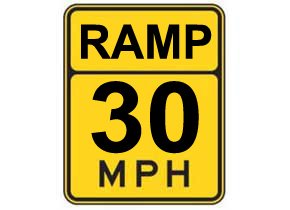
#1. This is:
This is an advisory speed sign. It shows the recommended speed, at which the exit ramp from an expressway may be traveled safely.

#2. If a traffic signal light is not working, you must:
If a traffic signal light is not working, proceed as if the intersection is controlled by a stop sign in all directions. Meaning, you must stop, and may only proceed when you can do so safely.

#3. Always turn your front wheels toward the curb when you are parked on a grade and facing:
This how you park on hills:
- If you park facing uphill where there is a curb, you should set the parking brake and turn the wheels away from the curb.
- In any other situation turn the wheels toward the curb or edge of the road.
See illustration in the DMV Driver Manual.

#4. When approaching within 100 feet of a posted narrow tunnel, you must:
Do not pass when approaching within 100 feet of a posted narrow bridge, viaduct, or tunnel.

#5. What is true about seat belts?
Using seat belts reduces the risk of being thrown from your vehicle in case of an accident. It is a myth that it takes long to unbuckle a seat belt or that seat belts are not needed when driving around town.
A seat belt can keep you from being thrown into the path of another car. In case of an impact, you will keep on going at the same speed you were traveling until you hit the dashboard or windshield. Your chances of surviving an accident are five times as good if you stay inside the car.
An impact could push you back and forth across the seat. A seat belt can keep you in a better position to control the car in case of an accident.

#6. Whose responsibility is it to know how your medications will affect your driving?
When taking prescription medicine, ask your doctor about any possible side effects that relate to driving. Drugs, including some allergy remedies and cold pills which you can buy without prescription may contain compounds that can affect your driving. It is your responsibility to know the effects of the medications you take.

#7. What do the light gray areas in the picture mark?
Turn your head before changing lanes, because your mirrors have blind spots. These blind spots can hide a motorcyclist or a bicyclist. Do not drive in another driver’s blind spot.

#8. What is an SR22?
An SR-22 is a certified statement of motor vehicle insurance from your insurer. This type of insurance filing requires the insurance company to notify the Division of Motor Vehicles if your liability insurance coverage lapses or is canceled.

#9. What color are traffic signs that warn a driver of temporary traffic conditions due to highway construction or maintenance work?
Orange is used for construction and maintenance warnings. Work in the road and temporary conditions requiring special alertness are indicated by these signs. Adjust your speed and prepare for special conditions.

#10. Always look carefully for motorcycles before you turn at an intersection because:
Motorcycles are not easily identified in traffic. Drivers turning left in front of oncoming motorcyclists cause a large percentage of car/cycle crashes. Drivers often fail to pick the cyclist out of the traffic scene, or inaccurately judge the speed of the oncoming motorcycle. Being alert to this perceptual problem and consciously looking for motorcyclists will help avoid collisions.

#11. When entering or crossing a road from a driveway:
When entering from an alley, driveway or private road, you must stop at a sidewalk, or if there is no sidewalk, at a point prior to entering the roadway.

#12. To avoid getting tired on a long trip, you should:
Take regular rest stops, even if you are not tired.

#13. What is the leading cause of car skids?
Unsafe speed is the most common cause of skidding accidents.

#14. Alaska law requires that you turn on headlights:
Headlights must be turned on from 1/2 hour after sunset to 1/2 hour before sunrise. Headlights must also be turned on in daytime when visibility is reduced to 1000 feet or less by fog, rain, snow, smoke, or dust. A good idea, and also the law in many states, is to turn on headlights every time you use windshield wipers due to bad weather.

#15. What does this sign mean?
Slippery when wet.
In wet weather, drive slowly. Do not speed up or brake hard. Make sharp turns at a very slow speed. This sign is often located near bridges and overpasses.

#16. What does this sign mean?
This is an example of a warning sign. It means that to you can expect a pedestrian crossing or a shared use of the roadway by pedestrians.

#17. When driving near a pedestrian who is carrying a white cane or using a guide dog, you should:
Pedestrians using guide dogs or white canes with or without a red tip must be given the right of way at all times, regardless of the traffic signal or traffic situation. Don’t give the blind pedestrian verbal directions. The blind pedestrian listens to all traffic sounds before deciding to cross the street.

#18. When a truck makes a turn:
When any vehicle makes a turn, the rear wheels follow a shorter path than the front wheels. The longer the vehicle, the greater the difference.

#19. On a highway with two-way traffic, you may cross a broken yellow center line:
Keep to the right of a yellow center line. You may cross the broken line when passing another vehicle or when the right half of the roadway is closed to traffic. But you may only cross when it is safe to do so.
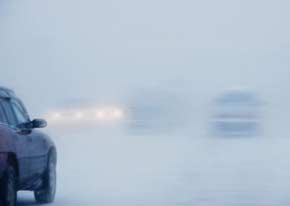
#20. Roads freeze more quickly when they are:
In cold, wet weather, be extra careful driving on sections of road shaded by trees or buildings. Bridges and shaded areas freeze more quickly, and dry last.
Quick Facts about the Alaska DMV Permit Exam
| What You Should Know | |
|---|---|
| Number of questions on exam: | 20 |
| Passing score: | 80 percent |
| Correct answers to pass: | 16 |
| Allotted time to complete test: | 25 minutes |
| Wait time before retest: | 1 day |
| Number of questions on each practice test: | 20 (randomized) |
| Question pool: | 500+ |
Alaska Permit Practice Tests
Each practice test has 20 random questions based on the Alaska Driver Manual and actual Alaska DMV tests.
After each question, you will get instant feedback. If you miss a question, there is also a brief comment to help you study.
The Alaska Driver Manual Matters
Before you start practicing, you should get the latest version of the Driver Manual . The manual introduces you to the principles of a motor vehicle’s safe and lawful operation. It gives you all the information you need to pass the knowledge test.
After studying the manual, use the practice tests to check your progress and whether you are ready for the examination.
The passing score in Alaska is 80 percent, which means you must answer at least 16 questions correctly.
On a practice test, you should aim higher. Try to reach a perfect score of 100%. This way, you will know if you have learned all the contents of the manual or not.
Read more about practicing and acing the real DMV test .

Who Must Pass Alaska Written Test?
First-time applicants.
When you apply for your first permit or driver’s license, you must pass the written knowledge test.
If your license has expired.
If you let your license in Alaska or any other state expire for more than one year, you must take and pass the written exam again.
If your license has been revoked.
When the DMV revokes your license, you can only get the license back by applying for a new license and passing all tests again.
If you hold a license from another state or country.
Drivers with a valid out-of-country or out-of-state driver’s license may drive in Alaska for 90 days before converting their license to an Alaska license.
Unlike many other states, applicants must pass the written knowledge test before DMV issues an Alaska driver’s license.
Drivers with a driver’s license from a country other than the United States, Canada, or a US Territory must also pass the road skills test in addition to the written test.

What is on the Alaska Written Test?
DMV bases all questions on the driver’s manual information, including traffic laws, safe driving practices, and common highway signs and signals.
There may also be questions about permit restrictions and the dangers of drinking and driving.
If you are under 21, your first driver’s license expires 90 days after your 21st birthday. Before DMV renews your license, you must pass an alcohol awareness test.
What Languages are Available?
DMV offers online examinations in several languages.
If you need an interpreter or have difficulty reading, you may bring someone to read the questions. You must independently answer the questions. Contact DMV ahead of your test for guidance.
What if You Fail the Test?
If you fail the knowledge test, you can try again the next day.
Alcohol and Drug Awareness Knowledge Test
If you are 21 years or older, you must also pass an alcohol awareness test. The test is mandatory after your 21st birthday when you want to renew or upgrade from a permit to a license.
Exemptions exist for applicants 21 and older who are transferring their license from another state.


Thank you
Super easy its literally common sense, still study because they randomize questions
It is my first time doing this Neva brown