
Nebraska Knowledge Exam – Driver’s License Written Test – 2026
Results
Great job. This is a passing score. Do you want to try again?
This is not a passing score. Do you want to try again?


#1. When entering a high-speed roadway, you should avoid the following:
Do not drive to the end of the ramp and stop. This will not leave you enough room to get up to the speed of traffic. Also, drivers behind you will not expect you to stop. If they are watching traffic on the main road, you may be hit from the rear.
This question asked what you should not do.

#2. It is always safe to drive a vehicle if you have just one or two drinks.
There is no alcohol concentration at which it is considered safe to operate a vehicle. Even one drink is likely to affect your ability to drive safely. Most individuals exhibit signs of significant impairment and intoxication well below the unlawful intoxication level of .08 blood alcohol concentration (BAC).
Simple reaction time is impaired at .04 percent. When the driver must choose from a number of responses (choice reaction), impairment begins at .03 percent.

#3. What do you use the three-second rule for?
Keep a cushion of space from other vehicles to have time to react to emergencies and avoid collisions. Use the three-second rule to determine safe following distance.
The three-second rule is a minimum requirement and should be increased by one-second for each adversity factor encountered (rain, heavy traffic, etc.).

#4. When are you allowed to drive around a lowered gate at a railroad crossing?
Never drive any vehicle through, around or under any gate or barrier. It is dangerous and against the law.
All crossings are required to have a sign posted with an emergency number to call and a crossing ID code. If the gate is malfunctioning, you must report it.

#5. When stopping on snow or ice, drivers who are operating vehicles equipped with antilock (ABS) brakes should:
Vehicles equipped with antilock (ABS) brakes: press brake pedal firmly – do not pump brakes.

#6. If you drive past this sign:
The wrong way sign supplements the Do not Enter sign. It is placed along the exit ramp or the one-way roadway farther from the crossroad. It tells you that you have already entered a one-way road and are driving in the wrong direction.

#7. This sign means:
Roundabout intersection is ahead. Slow down to recommended speed and yield to driver traveling counterclockwise within the circular roadway.
#8. A violation of the Child Passenger Restraint Law carries:
A violation of the Child Passenger Restraint Law carries a $25 fine plus court costs and 1 point is assessed against the operator’s driving record.

#9. If you are in a roundabout when an emergency vehicle with flashing lights approaches from behind, you should:
If you are within an intersection, including a roundabout, clear it before you pull over.
Do not stop in an intersection or within a roundabout.

#10. When must you use your headlights?
Use headlights any time you have difficulty seeing other vehicles. By law, you must use headlights when visibility is less than 500 feet.
Remember, if you turn on your wipers due to weather, you should turn on your headlights.

#11. When sharing the road with a motorcyclist, it is unsafe and illegal to:
Allow the motorcyclist a full lane width. Although it may seem as though there is enough room in the traffic lane for an automobile and a motorcycle, remember the motorcycle needs the room to maneuver safely. Do not share the lane. It is illegal and unsafe.
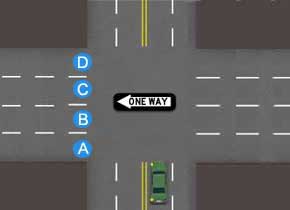
#12. Which is the correct lane to enter when turning left from a two-way street onto a one-way street?
Be in the proper lane well in advance of intended turn.
Remember to turn from the lane that is closest to the direction of travel and turn into the lane closest to the lane from which the turn is initiated. Do not turn from the middle lanes, unless lawfully available.

#13. Signaling before turning is:
Signaling is required by law.
The law requires that you signal when turning or moving right or left upon a roadway, or when stopping or suddenly decreasing the speed. (60-6,161)
Any stop signal or turn signal required by the Nebraska Rules of the Road must be given either by means of the hand and arm or by signal lights.

#14. On a road with lanes separated by white lines:
Broken white lines separate lanes of traffic going in the same direction, and may be crossed with care. A solid white line between lanes of traffic means that you should stay in your lane unless a special situation requires you to change lanes.

#15. Which road signs have a horizontal rectangular shape?
Horizontal rectangles are generally used to give directions or information.
When vertical, signs are generally used to give instructions or tell you the law.

#16. A solid green signal light means:
A steady green light means you may proceed through an intersection in the direction indicated by the signal if the roadway is clear. If you are stopped and then the light turns green, you must allow crossing traffic to clear the intersection before you go ahead. Never block an intersection.

#17. When you park headed uphill and there is a curb, you should turn your front wheels:
Headed uphill, turn your front wheels away from the curb (toward the travel lane) and let your vehicle roll back a few inches. The curb will stop the car from rolling anywhere.
Remember, when you park on a hill, the general rule is to turn your wheels sharply toward the side of the road or curb. This way, if your vehicle starts to roll downhill, it will roll away from traffic. However, when headed uphill at a curb, you should turn the front wheels in the opposite direction, away from the curb and towards the road.

#18. Windshields that are dirty, foggy, or icy at night will usually:
A clean windshield, inside and out, helps reduce the glare from oncoming vehicles.

#19. A pedestrian has entered a crosswalk where there are no signs or signals. Who should be given the right of way?
Yield to all pedestrians within crosswalks. Slow down and be ready to stop if needed. Always yield to pedestrians before making a turn.

#20. When you approach a school, you should:
Always use caution where children may be present.
School signs are located near schools for a good reason. Children are often not careful around traffic and do not understand the dangers of moving vehicles. Reduce speed, obey all signs, and be prepared to stop anytime.

#21. Which of the following convictions carries the highest number of points on your driving record?
Failure to render aid in a crash in which you are involved will result in six points on your driving record.
Failure to submit to an alcohol content test and running a red light will result in 1 point. Violating school bus crossing results in 3 points.

#22. What is the best thing you can do if your wheels run off the pavement?
If you run off the road, do not panic.
- Hold steering wheel firmly and steer so wheels straddle the edge of the roadway.
- Do not attempt to turn back onto the roadway immediately.
- Reduce speed.
- Check traffic.
- Gradually turn back onto roadway when it is safe to do so staying in the driving lane.

#23. What should you do when you approach this road sign?
Hill – Downgrade ahead. This sign warns you of a dangerous hill. It may be very long or steep, or it may have sharp curves. Slow down before you start down the hill. It may be a good idea to shift to a lower gear to control speed and preserve brakes.

#24. What is the meaning of this sign?
Traffic signal ahead. This sign warns of traffic signals at the intersection ahead. Slow down. Poor visibility is likely.

#25. A truck's blind spots:
Truck drivers have huge blind spots around the front, back and sides of the truck. So be safe and do not hang out in the No-Zone.
Blind spots may exist up to 20 feet in front of the cab, on either side of the tractor trailer, particularly alongside the cab, and up to 200 feet in the rear.
| This Nebraska License Sample Test | |
|---|---|
| Questions on each practice test: | 25 |
| Question pool: | 750+ |
| Random questions | |
Facts about Your Nebraska DMV Written Test
| Nebraska Written Knowledge Test for a Permit or Driver’s License | |
|---|---|
| Number of questions on exam: | 25 questions |
| Passing score: | 80 percent |
| Correct answers to pass: | 20 |
| Allotted time to complete test: | No limit |
| Wait time before retest: | 1 day |
The Purpose of the Online Nebraska Practice Test
We have designed these practice tests to help you study and ultimately pass the written knowledge exam for a Nebraska permit or driver’s license.
Each test is random. Our system draws questions from a larger pool, similar to how DMV creates the official written test. Each test is slightly different from the previous one.
You can take the Nebraska practice tests as often as you like. The tests will help you to get comfortable with everything you need to learn for the written examination.
The practice tests are a learning tool. Use them after reading and studying the Nebraska Driver’s Manual, not as an alternative to studying the manual. You need both.

Nebraska Driver’s Manual
Make sure you get the latest version of the official Nebraska Driver’s Manual. Your driving school typically provides the manual as part of your driver’s education. You can also get a copy from any DMV office or download a copy online from dmv.nebraska.gov.
Nebraska DMV draws all questions on your written exam from this manual’s information. Please read it carefully. Understanding Nebraska traffic laws, rules of the road, and other information in the manual is an essential first step toward successfully passing the exam.
How to Use the Nebraska Practice Test
After reading the manual, take a few practice tests to check how much you have learned.
You will get instant feedback after each practice question. Should you make a mistake, there is also a brief explanation to help you understand the correct answer. Use the manual for more information if you need clarification on the right answers. Being active during a study session is a proven way of learning faster.
At the end of the practice test, you will see your score. Your score is a rough indication of your level of readiness.
You need 20 correct answers to pass your official written test. When practicing for the exam, practice you should only be satisfied once you reach a score of 100%.
Reading questions and choices twice is a good idea, even if it is just a practice test. The most common mistake on the exam is rushing through the test without carefully reading questions and answers.
You are not in a hurry!
Using the Nebraska practice tests to learn how to pace yourself during a test is a good idea. You have plenty of time to complete your written DMV exam.

It also helps to discuss standard rules and safe driving practices with a friend, teacher, parent, or licensed driver. Being active improves learning. The more you know, the easier it will be to pass the examination.
Is the Written Nebraska Examination Hard?
The Nebraska written test is known to be complicated. More than 32 percent of all first-time applicants fail the Nebraska written test. So, you should prepare well.
The true-and-false questions in the manual are not a good representation of the actual exam.
Read more about How to Ace the DMV Test.
Who Must Take the Written Test?
There is a separate written test for each class of license. You can find more information about different tests in the driver’s manual.
First-time applicant
As a first-time applicant, you must always take and pass a written knowledge test.
- Learner’s Permit – Type LPE: must pass vision and written tests.
- Learner’s Permit – Type LPD: must pass vision and written tests. DMV will waive the written test if a school learner’s permit (LPE), school permit (SCP), or learner’s permit (LPD) is valid or has not expired for more than one year.
- School Permit – Type SCP: waived if the applicant has completed a DMV-approved driver safety course.
- Provisional Operator’s Permit – POP: DMV waives the test if the applicant has completed a DMV-approved driver safety course.
- Operator’s License (Class O): waived if the applicant held a POP.
Drivers with an expired out-of-state license
If you have an expired out-of-state driver’s license, you must also take the test before you can get a Nebraska license.
Drivers with a Nebraska license expired more than one year
DMV will waive the written test when you renew a valid Nebraska operator’s license. If you let your license expire for over 12 months, you must take the written test again.
Drivers with a revoked license
After a revocation, you must apply for a new license and retake all tests.
Drivers with a foreign driver’s license
Drivers who move to Nebraska and hold a license from a foreign country other than Canada, Germany, or Mexico must pass all tests before DMV issues a Nebraska driver’s license.

What You Must Know about the Exam
The official test has 25 multiple-choice and true-or-false questions. The passing score is 80%. You must be aware that there can be questions with more than one correct answer, which is the case when you see “All of the above” as the last choice. Ensure you read everything before answering.
The Nebraska written test is a closed-book test. You cannot use your driver’s manual or other books during the examination. Any electronic device, such as your cell phone, is also banned.
If you cheat on the examination, the examiner will end and postpone your exam.
The Nebraska written test has no time limit. You can take as much time as you need to complete the test. Typically, you will finish in less than 15 minutes.
Should you fail your exam, you must retake it on a different day.
You typically take the test as part of your driver’s education, but you can also take the test at a DMV office.
Nebraska DMV does not offer online testing from home.
Nebraska Graduated Licensing Laws

If you are between 14 and 16 years, you can apply for a School Learner’s Permit (LPE). This permit allows a student to legally practice driving for a School Permit (SCP). The School Permit can be issued if you live outside a city of 5,000 or more or attend a school outside a town of 5,000 or more. With a school permit, you can drive unsupervised to and from your school.
The other route to your full driver’s license starts with a standard Learner’s Permit (Type LPD). You must be at least 15 years to apply for the LPD.
The Learner’s Permit allows you to practice driving for a Provisional Operator’s Permit (POP), Operator’s (Class O), or Motorcycle (Class M) License.
A Provisional Operator’s Permit (POP) is the intermediate step between your first learner’s permit and a full unrestricted driver’s license. You must be at least 16 years before DMV issues the provisional permit, and you must have held an LPE, LPD, or SCP for at least six months.


