
Rhode Island Permit Test & DMV Practice 2026 – 100% Trusted
Results
80% or more is the passing score in Rhode Island. Do you want to try another test?
This is not a passing score in Rhode Island. Do you want to try another test?


#1. This hand signal means:
Slowing or stop – left arm extended downward, with the palm to the rear.

#2. When you park on a hill headed downhill, and there is no curb, you should turn your front wheels:
This how you park on hills:
- If you park facing uphill where there is a curb, you should set the parking brake and turn the wheels away from the curb.
- In any other situation turn the wheels toward the curb or edge of the road.
See illustration in the driver’s manual.

#3. What does this sign mean?
School Crossing. Slow down and watch for children crossing the road. The arrow shows the actual location of the crosswalk. The traditional yellow school sign is being transitioned to neon green.

#4. When entering or crossing a road from a driveway:
When entering the roadway from a private road or driveway, you must stop at the sidewalk before continuing to the curb line where you are mandated to stop again. Stopping at the sidewalk will allow you to check for pedestrians in the sidewalk and stopping at the curb will allow you to check for oncoming traffic.

#5. When can it be a good idea to give your horn a light tap?
Use your horn sparingly. A couple of short taps may be perceived as less aggressive than one long blast. If there is immediate danger, blow the horn to alert the other driver. Do not blast your horn as you approach a cyclist as the loud noise can startle them and cause them to swerve. Do not sound your horn or cause other loud noises when approaching a horse being driven or ridden upon a public highway.

#6. If you have a tire blowout while driving, you should:
If you experience tire failure, your task is to drive to safety:
- Grip the steering wheel firmly with two (2) hands.
- Ease up on the accelerator to slow the vehicle. Do not brake. Braking can cause the vehicle to swerve. Let the vehicle slow gradually.
- Check the traffic situation as you gain control of the vehicle.
- Drive off the roadway slowly, braking gently.
- Turn on hazard flashers. Drive slowly to a location where you can stop safely.
Remember, keep the vehicle going straight until you have full control.

#7. The best way to increase visibility when backing up is to:
While backing, you should look over your right shoulder, partially turning your body, while maintaining proper control of your vehicle.
When backing in a straight line, you should periodically check all mirrors to be sure that no other vehicles, pedestrians, or obstacles are in your path of travel.

#8. A bicycle rider:
Bicyclists are entitled to share the road with motor vehicles.
They have the same rights and responsibilities as motorists.
They must obey all traffic signals and stop signs.
They must ride in the same direction as other traffic, not against it.

#9. If you are going on a very long trip, it is a good idea to plan a rest stop every:
On long trips, stopping periodically can temporarily offset fatigue. You should be able to drive a reasonable distance without difficulty if you stop for at least 10 minutes every two hours or every 100 miles and make regular stops for fuel, food, and restrooms. The problem with long-distance driving is that many people do not know, or choose to ignore, how much driving is too much. There is no rule to say how far you should drive at any given time, but no destination is worth gambling with your life. Do not overextend yourself. Determine a reasonable distance in advance and stop driving when you reach it.

#10. If your vehicle stalls on railroad tracks, why should you stay clear of the tracks and run toward the train?
If your vehicle stalls on railroad tracks and you know a train is approaching, you should get yourself and any passengers out of your vehicle and off the tracks, and move as far from the tracks as possible. To avoid being hit by debris from the collision, exit your vehicle and run, far away from the tracks, in a parallel line in the opposite direction from which the train is moving. The debris field from the collision of train and motor vehicle will travel in the same direction that the train is moving – you want to be as far away as possible in the opposite direction.

#11. What is the meaning of this sign?
Slippery when wet. When pavement is wet, you should reduce your speed and not brake hard or change direction suddenly. Increase the distance between your car and the one in front.

#12. If you drive past this sign:
If you drive past the wrong way sign you are going in the wrong direction and could get into a head-on crash with vehicles headed your way. Cautiously turn around.

#13. If you see or hear an emergency vehicle with flashing lights and siren approaching, you must:
If an emergency vehicle is approaching, pull over to the right, stop and wait for it to pass. Before re-entering the flow of traffic, you should activate your turn signal, glance over your shoulder to ensure another emergency vehicle is not coming, then proceed.
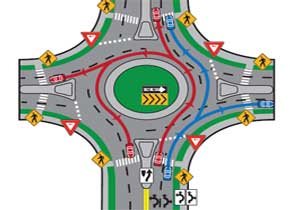
#14. When you exit a roundabout or traffic circle, you should:
- Slow down to the posted speed. Yield to pedestrians and other motorists, they have the right-of way.
- Ensure you have an adequate safe gap. Move to the proper lane position upon entering, maneuvering and exiting the roundabout.
- ENTER: Yield to vehicles in the roundabout. Wait for a gap in traffic, and then merge into traffic in the roundabout in a counterclockwise direction.
- PROCEED: Continue through the roundabout until you reach your street. Never stop in a roundabout unless it is an emergency.
- EXIT: Signal, then exit the roundabout to the right. Yield to pedestrians.

#15. A flashing yellow traffic signal at an intersection means:
A flashing yellow will tell motorists to use caution. Slow down, cover the brake, then proceed with caution.

#16. The three-second rule refers to how you should:
The three-second rule refers to a following distance. If the roadway is wet or slippery, you will need additional distance.

#17. What should you expect ahead when you see this sign?
One of the most important caution signs is the stop ahead sign. It is placed far ahead of a stop sign when the driver’s view of the stop sign is blocked by a curve or other objects.

#18. If you are involved in crash, you must always:
What to do after a collision:
- Try to stay calm.
- Stop your vehicle immediately.
- Make your identity known to any interested person. Severe penalties are imposed against drivers who choose to leave the scene of a collision without properly identifying themselves.
- Report all collisions to the nearest state or local police immediately.
- Request rescue assistance if personal injury is involved.
- In the event of a minor collision, if possible, drive your vehicle off to the side of the roadway and notify the police.

#19. What must you do ahead?
The sign indicates traffic is permitted to pass on either side of a traffic island or an obstruction.

#20. If an oncoming vehicle crosses the center line and drives into your lane, you should:
Never pull into the opposing lane, because the oncoming driver may pull back sharply into that lane. Instead, you should:
- Maintain vehicle control. Brake hard, but do not lock the wheels. Slowing lessens the force of the impact, gives the other driver space, and time to recover control.
- Blow the horn and flash the headlights. These actions might alert an impaired driver. Continue braking and move to the right if the driver does not heed your warning.
- Steer right toward the shoulder or curb-line. Do not steer left. The other driver likely will try to steer back into the proper lane. Prepare to drive entirely off the roadway to the right, if necessary.

#21. You should drive slower at night because:
Your driving speed needs to be lower at night than it is in the daytime because you cannot see as far ahead at night.

#22. Rhode Island has a primary seat belt use law, which means that:
The Seat Belt Use Law is a primary law for all ages, meaning you can be pulled over if anyone is unbuckled.

#23. A shared center left turn lane can be used:
A shared turn lane is the center lane of traffic set apart from the travel lanes by solid single yellow lines on the outside and broken yellow lines inside the shared turn lane. The lane also has arrows painted on the pavement and usually signs indicating restriction for use of the lane for turning only. Motorists wishing to turn shall not enter the lane unless they intend to turn within 100 feet.

#24. The Implied Consent Law means that you:
Implied consent means that any person who drives a motor vehicle in Rhode Island has given consent to a chemical (breathalyzer-blood-urine) test to determine the amount of alcohol/drug, if any, in their blood if arrested for suspected driving while intoxicated (DWI).

#25. What does this sign mean?
The Flagger ahead sign warns drivers that there is a flagger ahead, and to be especially alert in the work zone.
| Rhode Island Permit Test Practice | |
|---|---|
| Questions per test: | 25 |
| Question pool: | 500+ |
| Type of test: | Random multiple-choice |
| The Official Rhode Island Knowledge Exam | |
|---|---|
| Questions on real exam: | 25 |
| Passing score: | 80% |
| Correct answers to pass: | 20 |
| Allotted time to complete test: | 90 minutes |
| Wait time before retest: | 8 days |
Rhode Island Permit Practice Test
This RI permit practice test has 25 random questions from a large pool of real DMV questions and answers. The system generates a new set of questions each time you re-start the test. You can take the test as often as you want or need at no charge.
We have designed test questions specifically for Rhode Island, and you will find all answers in the Rhode Island Driver’s Manual.
Read the manual carefully. Everything you must learn for your official knowledge exam is in the booklet.
You can get a hard copy of the Driver’s Manual from the Cranston DMV headquarters, or you can download a free PDF copy online.
Read the manual before you attempt the practice tests. All tests are a supplement to the manual and not something you should use instead of reading it. Trying to memorize questions and answers is one of those risky study tactics that are likely to cause you to fail.
After each question on the test, you get instant feedback and will know if your answer is correct. There is also a short explanation if you pick the wrong answer.

How Many Questions Are on the Rhode Island Knowledge Test?
The official written test has 25 questions; you can have up to five incorrect answers if you want to pass (80% passing score).
On your practice tests, you should aim for a full score (100%) on at least a handful of tests. It gives you a safety margin when you attempt the real thing.
Who Must Take the Rhode Island DMV Test?
When you apply for an initial Rhode Island driver’s license or permit, you must pass the computerized knowledge exam.
If you are 16 but under 18, you must complete the 33-hour driver education course certified by the Community College of Rhode Island. The knowledge test is part of this course. Other first-time applicants must take the examination at the DMV main office in Cranston.
When you move to Rhode Island and hold an out-of-state driver’s license that you let expire for more than one year, you must apply for the Instruction Permit by taking the Rhode Island knowledge test at the DMV main office in Cranston.
The department waives the knowledge test if your out-of-state license is valid or expired for less than a year.
Anyone holding a valid driver’s license from a foreign country may keep the foreign country license but must apply for the Instruction Permit and successfully pass the knowledge examination and the road test.
If you hold a license from Canada, Rhode Island waives the test requirements.

The Computerized DMV Test
The computerized knowledge test has questions about the motor vehicle laws of Rhode Island and the standard rules of the road. Make sure you study the driver’s manual to prepare for the test. While Rhode Island doesn’t record failure rates on the DMV knowledge test, researchers agree that the Rhode Island DMV test is challenging compared to other states.
The test on a computer is available in English, Spanish, and Portuguese.
If you need a test in another language, contact the Cranston DMV office in advance. DMV offers tests in more than 30 different languages on paper. You can see which languages are available and schedule such test here . If you take the foreign language knowledge exam, someone who can translate for you before and after the test must accompany you. No translators are allowed during the test.
Remember, all tests are now by appointment only. Walk-ins are no longer accepted. If you have special needs, check with the Cranston DMV office beforehand.
What Happens if I Fail the Test?
If you fail the DMV knowledge exam in Rhode Island, you must wait eight days before you can try again. The waiting time is among the longest in the United States.
Cheating on the DMV Test?
When you take the test, no other person can be with you in the testing area. You cannot bring books, the driver’s manual, or other papers. Talking or using any wireless device is also prohibited.


