
North Dakota NDDOT License & Permit Practice Tests
Results
Good job! This is a passing score in North Dakota. Do you want to try another test?
This is not a passing score. Do you want to try again with different questions?


#1. Does a posted speed limit of 65 mph mean you may always drive 65 mph on that highway?
Speed limits are maximum limits to be traveled only when driving conditions are ideal. Sometimes conditions may require you to drive slower than the posted speed limit allows. Never drive faster than the posted speed limit or conditions allow.

#2. What does this pattern on an arrow board mean?
There is a work area ahead. Drive with extra caution.
Large flashing or sequencing arrow panels may be used in work zones both day and night to direct drivers into certain traffic lanes and to inform them that part of the road or street ahead of them is closed. The arrow panel may also be used in a caution mode.

#3. What should you do when approaching a railroad crossing and seeing a vehicle with this sign ahead?
School buses, vehicles carrying explosives or flammable liquids such as gasoline trucks, and buses carrying passengers must stop at railroad crossings. These vehicles must stop within 50 feet and not less than 15 feet from the tracks. Watch out for them and do not pass them when they are stopped at the crossing.
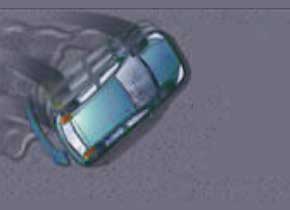
#4. You are driving on a slippery road when the rear of your vehicle starts to skid. It would help if you eased off the accelerator and:
If you start to skid ease off the gas pedal, stop braking, and turn the steering wheel in the direction of the skid. If your rear wheels start going to the right, turn your front wheels to the right.
Steering into a skid is the same as steering in the direction you want to go, or simply steering down the road.

#5. When parking close to a flashing beacon, you must keep this distance:
The distance you must keep from a flashing beacon is more than 15 feet. Parking is not allowed within 15 feet of a flashing beacon, a stop sign, or a traffic control signal placed on the side of the roadway.

#6. You approach an emergency vehicle with flashing emergency lights parked at the scene of a crash. What should you do?
When an emergency vehicle is parked at the scene of a crash with its emergency lights flashing, you must drive to the right-hand side of the roadway and stop.
Once stopped, you may pass at your risk when the roadway is clear. If there is a police officer directing traffic at the scene, you must obey the officer’s instructions.

#7. Drivers entering a roundabout:
The purpose of roundabouts is to slow vehicle speed, give drivers more time to judge and react to other vehicles or pedestrians. When approaching a roundabout, reduce your speed. Yield to pedestrians and bicyclists. When entering the roundabout, yield to circulating traffic.

#8. During summer, the temperature inside a parked vehicle:
Even in cooler temperatures, your vehicle can heat up to dangerous temperatures very quickly. An outside temperature in the mid- 60s can cause a vehicle’s inside temperature to rise above 110 degrees Fahrenheit. The inside temperature of a vehicle can rise almost 20 degrees Fahrenheit within the first 10 minutes.

#9. Which is one factor that significantly affects your stopping distance?
Many things affect your stopping distance. Perception and reaction is affected by human factors such as tiredness, alcohol, fatigue, and concentration levels. The braking distance is affected by speed, tires, brakes, and road conditions.
A posted speed limit does not affect your stopping distance, only your actual speed does.

#10. This sign means:
Stop signs are always octagonal (8-sided). A stop sign means that you must bring your vehicle to a complete halt at the marked stop line. If there is no marked stop line, stop before entering the crosswalk on the near side of the intersection. If there is no crosswalk, stop at a point nearest the intersecting roadway where you have a clear view of approaching traffic on the intersecting roadway before entering the intersection.

#11. Backing a vehicle on interstate highways:
Never back up on the Interstate or on an access ramp.

#12. A combination of these two signs indicates
Pedestrian crossing. A separate downward-pointing arrow plaque indicates the actual location of the crosswalk.
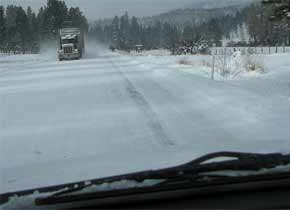
#13. When moving off in freezing weather you should start slowly and:
Get the feel of the roadway. Try your brakes while driving slowly and adjust your speed to how much traction you have.

#14. A blind spot is the area of the road:
Your blind spot is the area to the side of a vehicle which cannot be seen in mirrors. A blind spot exist on both sides of your vehicle. When changing lanes or making a turn, glance over your shoulder to be sure no one is in the blind spot.

#15. What does this sign mean?
A One-Way sign tells you that traffic on that particular road flows in the direction of the arrow only. You may only drive in the direction of the arrow. Never turn against the arrow.
The sign is placed parallel to the one-way street at all alleys and roadways that intersect one-way roadways.
Unless placed at a T-intersection, the sign does not indicate that turning is required.

#16. After passing another vehicle and before returning to the proper lane, it is best to:
Do not return to your lane until you can see the image of the entire front of the vehicle you passed within the inside rear-view mirror.

#17. You are at a stop sign. A motorcycle approaches from the left and signals a right turn into the road you are about to leave. What should you do?
Don’t be fooled by a flashing turn signal on a motorcycle. Motorcycle signals usually aren’t self-cancelling, and riders sometimes forget to turn them off. Wait to be sure the motorcycle is going to turn before you proceed.

#18. Where will you find a sign with this shape?
Crossbuck signs are found at railroad crossings.

#19. Children can move from a car seat to a booster seat when they are:
Children should be at least 40 pounds and at least 4 years of age to move from a car seat to a booster seat.

#20. Bicyclists must always ride:
Bicyclists are required to follow the same road rules as motorists. They must ride as near to the right side of the roadway as feasible, but may take the entire lane when hazards, road width, or traffic speed dictate.
Remember to reduce speed when encountering bicyclists.

#21. On a road with yellow center lines:
Broken yellow center lines are used on two-lane, two-way roads. You may cross them only to turn left or to pass another vehicle.
One solid line with one broken line means no passing when you are in the lane with the solid line. The solid line may be crossed only to turn left.
Two solid yellow lines on a two-lane road means no passing in either direction. Crossing the center line is permitted only as part of a left-turn maneuver.

#22. When approaching an intersection where the traffic light changes from green to yellow, you should:
A yellow indication means warning or caution. The light is changing to red. If you have not entered the intersection, you should stop if you can do so safely. If you have already entered the intersection, continue moving and clear it safely. Speeding up to beat the light is dangerous and unlawful.
Remember, some states require you to always stop if you can do so safely.

#23. The blood alcohol level at which it is illegal for any person under 21 years to drive is:
The per se alcohol concentration in North Dakota is 0.08 percent. For drivers operating a commercial vehicle, the alcohol concentration limit is 0.04 percent, and for operators under 21 years of age, the alcohol concentration limit is 0.02 percent.
Remember, even if someone is operating a vehicle with lower alcohol concentrations than those listed, that person may be charged with DUI if they are under the influence of alcohol and/or drugs to a degree which renders them incapable of safely driving.

#24. What does this sign mean?
A roadway joins from the right. Be alert for vehicles entering the roadway.

#25. When you are following another vehicle at night, at what distance must you dim your lights?
Dim your headlights at least 500 feet before meeting traffic and within 300 feet when following another vehicle.
| This North Dakota Practice Test | |
|---|---|
| Questions on each practice test: | 25 |
| Question pool: | 500+ |
| Type of test: | Random multiple-choice test |

Facts about Your NDDOT Test
| North Dakota Written Knowledge Test for Permit and Driver’s License | |
|---|---|
| Number of questions on exam: | 25 questions |
| Passing score: | 80 percent |
| Correct answers to pass: | 20 |
| Allotted time to complete test: | 60 minutes *online |
| Wait time before retest: | 24 hours |
North Dakota Practice Tests
This practice test has 25 random multiple-choice questions based on the information in North Dakota Noncommercial Driver’s License Manual and real exam questions.
After each practice question, you will get immediate feedback on whether your answer is correct. If your answer is wrong, a short explanation also helps you understand the right answer.
NDDOT draws test questions from a large pool of questions, making each practice test unique. Use this in your favor and use our practice tests until you can easily reach a 100% score. That way, you will have seen hundreds of questions covering all possible items on the knowledge exam.
Practice questions cover all essential items that may appear on your exam. Still, they may not include all possible questions. Since tests are random, a practice test will never precisely match your final test.
You should also be aware that driversprep.com is not affiliated with any North Dakota or Government Entity. A test on this website is not official and will not generate a certificate of completion if you pass.
North Dakota Official Knowledge Test
The official knowledge test in North Dakota has 25 questions. The passing score is 80 percent, which means you can only miss 5 out of the 25 questions.
Questions are multiple-choice with a possibility of a few true-or-false questions.
There is no allotted time for the test, so you should have plenty of time to read all questions and answer alternatives. Take your time with the test. Test takers usually make more mistakes when they don’t take their time to read questions all the way through.
You will not be allowed to start the test one hour before closing for lunch or closing at the end of the day.
Should you fail the knowledge exam, there is no official wait time to retake the test. Still, examiners will usually not allow you to retake the test the same day.
You must pay a new testing fee each time you take the knowledge test.
The automated test is available in several languages, including:
Chinese
English
French
Russian
Serbo-Croatian
Somali
Swahili
Turkish
Vietnamese
Automated American Sign Language and Audio testing are available at the Fargo, Jamestown, Bismarck, Dickinson, Williston, Minot, Devils Lake, and Grand Forks driver’s license offices.
North Dakota Online Driver Exam
Most applicants over 18 years can complete their driver’s knowledge exam at home.
It is simple to register, and the online exam is available 24/7. You can use the knowledge test from anywhere with internet access. Still, you must have a laptop or a desktop computer. The test will not work on a mobile device.
The online test will let you choose between English and Spanish. Audio playback is also available.
You have 60 minutes to complete the online exam.
NDDOT allows you to take the online test up to five times within one year.

1 Start by Reading the Manual
Always get the latest North Dakota Noncommercial Driver’s License Manual. You can get it from your nearest Driver’s License Site or download it online .
Read it from the first page to the last. Using it as a reference when you take the practice tests is also a good idea.
Remember, everything in the manual is there for a reason. NDDOT draws questions to your final test from all parts of this manual. It isn’t easy to pass the knowledge test unless you have studied the manual.
2 Use Practice Tests Wisely
This practice test is a learning tool. It should be used together with the Driver’s License Manual, not instead of it.
A common mistake and poor strategy is to try to memorize all questions and answers. You’ll never know which questions and answers you will get on your test, and wordings may differ.
If you want to pass the exam and become a safe driver, your best strategy is to learn the essential rules of the road and common ND traffic laws.
Get some more study tips from Joni stark .

Who Must Take North Dakota Knowledge Test?
First-time Drivers
When you apply for your first original North Dakota driver’s license, you must always pass a vision screening and the written knowledge test.
Drivers who let their license expire more than one year
When you renew your driver’s license, NDDOT only requires a new knowledge test if you let it expire for over a year.
Drivers with a revoked license
If NDDOT has revoked your driving privileges, you must wait for the revocation period to end, meet all reinstatement requirements, and take the written and road tests before NDDOT issues a new license.
After a suspension, you will get driving privileges back after the suspension period has ended and you meet all reinstatement requirements. No tests are necessary.
Drivers with a foreign driver’s license
Suppose you move to North Dakota and hold a driver’s license issued by a country other than the United States or Canada. In that case, you must apply for an original North Dakota license and pass all tests.
Drivers Who Wish to Transfer an Out-of-State License
NDDOT usually waives the written knowledge test if you move to North Dakota and want to transfer your valid out-of-state license.
Should you let your out-of-state license expire for more than one year, you must apply for a new ND license and take all necessary tests as a first-time applicant.
Suppose your out-of-state license is in the process of being revoked, suspended, or canceled. In that case, you cannot transfer to a North Dakota license.
Your First Permit
If you are at least 14 years old, you can apply for an instruction Class D permit.
Before NDDOT issues the permit, you must pass a vision and written test. If you are under 18, your parent or legal guardian must sign and approve your application.
Until you are 16, you can only drive a vehicle owned by your parents, legal guardians, grandparents, siblings, aunts, or uncles.
If you are under 16 years, you must hold the instruction permit for 12 months or until you are 16 years, whichever comes first. A minimum holding period of six months always applies.
If you are 16 or 17 years, you must hold the instruction permit for six months or until you turn 18, whichever comes first.
Applicants who are under 16 years must complete at least 50 hours of supervised driving during the permit phase. Your parent/legal guardian must accompany you to the road skills test and sign
that you have completed this requirement.

