
Nevada DMV Permit & Driver’s License Tests
Results
This is a passing score. Do you want to try another test with new questions?
This is not a passing score. Do you want to try again with new questions?


#1. Which is true about alcohol?
Alcohol is a mind-altering drug that works as a sedative. It changes the way you think and act. It affects judgment and coordination.

#2. When changing lanes, you can check your blind spot by:
Check blind spots by looking over your shoulder and change lanes when traffic is clear.

#3. Road signs with a four-sided diamond shape show:
Diamond shaped signs warn you of special conditions or hazards ahead. Slow and proceed with caution.

#4. In most situations, on which side should you pass another vehicle going in the same direction?
When passing is allowed, you usually pass other vehicles on the left. Passing on the right is very dangerous if the other driver does not see you and decides to change lanes.

#5. What does this sign mean?
Pedestrian Crossing Ahead. This sign tells you that you are near an area where a large number of pedestrians cross the street. Slow down and watch for people crossing the street on foot. Pedestrians in crosswalks must be given the right-of-way at all times.

#6. Yellow lines separate traffic:
Yellow lines mark the center of a road and separate lanes of traffic moving in opposite directions.

#7. Near schools, watch for:
Near schools, you should be extra careful and look for: bicyclists, school crossing guards, stopped school buses, and children crossing the street.

#8. If your car has mechanical problems, you should:
If you have car trouble, move to the shoulder or emergency stopping area as soon as you safely can. Turn on your 4-way flashers to warn other traffic. If possible, it is better to stay in or near your car on the far side from passing traffic. Walking along a freeway is dangerous. If you stay with your car, a Nevada Highway Patrol trooper will stop to help you.

#9. Assuming you are traveling 55 mph and suddenly need to stop (emergency stop). How far will your car usually go before you react and start braking (2.5 seconds)?
The average time for a driver to react in an emergency is 2 to 2.5 seconds. In that time (2.5 seconds) a car have traveled approximately 202 feet.

#10. You should fasten your seat belts and make sure all passengers are using seat belts or child restraints:
Before you start the engine: buckle up! And make sure your passengers do, too.

#11. When you proceed straight ahead on a solid green light, you must:
A green light means GO. You may proceed through an intersection in the direction indicated by the signal if the road is clear. You must yield to vehicles already in the intersection. Don’t enter the intersection if it is blocked. Make sure you look right and left for oncoming traffic.

#12. You approach this sign. You see a school crossing guard at a crosswalk. You must:
You must obey the reduced speed limit of 15 mph any day, at any time children are present. Signs and signals clearly show these speed limits and either designate the hours when the speed limit is in effect or state that the speed limit is in effect when children are present.

#13. When brakes fail, you should:
When brakes fail, do not panic. Try pumping the brake pedal. If the brakes still do not respond use the emergency parking brake and, if possible, shift to a lower gear.

#14. When can a motorcycle operator use a complete traffic lane?
Motorcycle operators have the right to use a complete traffic lane.

#15. Parking on a crosswalk in the middle of a block is:
You may not park your car on a crosswalk or within 20 feet of a crosswalk.

#16. The use of a cell phone while driving is legal if you:
Nevada law prohibits the use of handheld cell phones and texting while driving.
The use of a cellular phone or other handheld wireless communications device to engage voice communications is prohibited unless the device is used with a hands-free accessory.
The use of a cellular phone or other handheld wireless communications device to manually send, read, search the Internet, or engage in non-voice communications with another person, including texting, electronic messaging and instant messaging is prohibited.

#17. What type of driver's license permits a person to drive a motorcycle?
Class M driver’s license permits a person to drive a motorcycle.

#18. To avoid getting tired on a long trip, you should:
One of the greatest dangers is fatigue. On long trips you can become sleepy or hypnotized by the constant hum of the wind, tires, and engine. It is a good idea to take regular rest stops, even if you are not tired.

#19. When may you drive faster than the maximum speed limit?
It is always against the law to drive at a speed exceeding a posted speed limit.

#20. What is generally true about large commercial vehicles?
Large commercial vehicles take more time and space to slow down or stop.

#21. When you hear a bell and see flashing lights at a railroad crossing, you should:
Do not cross when red lights are flashing, bells are sounding, or a gate is lowered.
By law, you must stop when:
- A clearly visible electric or mechanical signal device gives warning of the immediate approach of a railroad train
- A crossing gate is lowered or when a human flagman gives or continues to give a signal of the approach or passage of a railroad train
- A railroad train approaching within approximately 1,500 feet of the highway crossing emits a signal audible from such distance and such railroad train, by reason of its speed or nearness to such crossing, is an immediate hazard.
- An approaching railroad train is plainly visible and is in hazardous proximity to such crossing.
If there is a stop sign at the crossing, you must always stop and not proceed until it is safe.

#22. A driver turns at an intersection without traffic lights, and a pedestrian is crossing. Who must yield?
Pedestrians in crosswalks and at intersections have the right-of-way over vehicles. A crosswalk exists anywhere two streets intersect, even at a T intersection. A crosswalk exists even if it is not painted or marked.
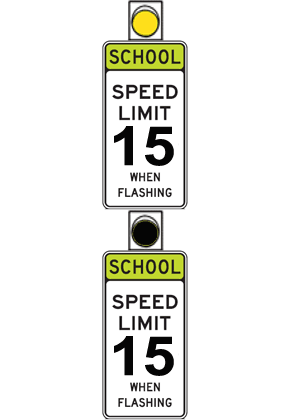
#23. You are driving in a school zone marked with this sign. The yellow light is flashing. Can you make a U-turn and go back in the opposite direction?
Nevada law prohibits the operator of a vehicle from making a U-turn in a school zone except when there are no children present, it is a day when no school is in session, on school days from half an hour after schools ends to a half hour before the next school session begins or when the signs/lights designate that the school zone is currently not in effect.

#24. What should you do when you see red lights flashing in the rear-view mirror?
When you see red lights flashing in the rear-view mirror, you must pull over and stop!

#25. If you encounter a flooded roadway, you should:
If you encounter a flooded roadway, do not attempt to drive through it. Turn around and seek an alternate route or wait until the water subsides. Although it may look like just a few inches of water on the roadway, you have no idea if the road has washed away underneath providing a hazardous situation for drivers.
We offer all the necessary Nevada DMV practice questions and answers to prepare for your written DMV test.
| This Nevada DMV Sample Test | |
|---|---|
| Questions on each practice test: | 25 |
| Question pool: | 500+ |
| Random questions | |
Facts about Your Nevada DMV Driver’s License Test
| Nevada Written Knowledge Test for a Permit or Driver’s License | |
|---|---|
| Number of questions on exam: | 25 questions |
| Passing score: | 80 percent |
| Correct answers to pass: | 20 |
| Allotted time to complete test: | No limit |
| Wait time before retest: | No official wait time |
The Official DMV Test in Nevada
The official DMV written test in Nevada is limited to 25 questions. You need 20 correct answers (80%) to pass the test.
The test will end when you have reached 20 correct answers or six incorrect ones.
DMV will ask you to take the test on a computer with a touch screen. The computer system also offers audio-based testing if you need it.
If you need help reading or understanding a written test, you can contact your local service office and ask for an oral examination ahead of the test.
The test has no allotted time limit, so you should proceed carefully and read the questions and all answer alternatives. Be especially alert when the last option is “all of the above” or “None of the above.” Expect the test to take about 15 minutes to complete.
Should you fail the test, you can retake it on the same day. Unfortunately, the booking system in Carson City, Henderson, Las Vegas, and Reno may not allow you to do that, and taking the test on a walk-in basis at other locations often means long waiting times. There is also a re-testing fee each time you retake the test. So, prepare well and try to pass the test the first time.
You may also have the option to take an online test from the comfort of your home. Results from such online tests are automatically transmitted to the DMV to issue instruction permits or driver licenses. The online tests are available in English and Spanish.
Please note that you must use a computer with front-facing cameras or camera peripherals.
Languages
Nevada DMV knowledge tests are available only in English and Spanish.
You may bring an interpreter if you need help understanding either of these languages. Interpreters must present a letter from the approving agency attesting that they are approved by a governmental agency, court, educational institution, or non-profit advocacy group.
The cost of an interpreter must be paid by you (the applicant).
Read more about the Knowledge Testing .
Is the Nevada DMV Test Hard?
About 40 percent of first-time test takers fail the Nevada DMV test, which makes the test more challenging than in states like Illinois and New York and more manageable than in many other states.

The Nevada Driver Handbook
You can find all answers to the official knowledge test questions in the Nevada Driver Handbook. We recommend that you start by reading it. You can get a copy of the handbook at your nearest DMV office or download it from the DMV website .
The handbook covers Nevada’s most important traffic laws, safe driving tips, road signs, signals, and pavement markings. It also provides information on driving under the influence and defensive driving recommendations. The handbook offers tips for handling your vehicle in any situation.
The handbook is a must-read if you want to pass the knowledge test.
The Nevada Practice Test
Each practice test is random. We draw questions from a large pool of questions specific to Nevada.
After each question, you will get instant feedback on whether your answer is correct. If you miss a question, there is also a brief explanation to help you learn faster. Often, you will find the same information in the Nevada Driver’s Handbook. Reading up on things you don’t understand is a good idea.
The passing score in Nevada is 80% (20 correct answers). On a practice test, you should aim higher, preferably a 100% score. It gives you a good chance of passing the real exam the first time.
Wait until you get the perfect score before you attempt the actual test.
Studying for the Exam
The thought of taking a knowledge exam is stressful to most people. Some think it doesn’t matter how much they study, read the handbook, or take practice tests. They fear that the test is too difficult and even impossible to pass. But trust us – anyone can ace the exam . It is all about determination, confidence, and avoiding some risky study behaviors .
Who Must Take the Nevada Knowledge Test?
If you are a new driver who has never had a license in Nevada or the United States, you must take and pass the written knowledge test.
The following drivers must also pass the knowledge test:
- Licensed in Puerto Rico, a U.S. territory or foreign country.
- Licensed in the U.S. and less than 21 years of age.
- Any driver licensed in the U.S. but without a license in their possession.
- A driver with three or more moving violations in the last four years.
- Any suspension, revocation, cancellation, or disqualification in the last four years.
- Any DUI conviction within the past seven years.
- License restrictions that require reevaluation of driving skills.
- Renewing an instruction permit expired more than 30 days ago.
- Renewing a license that expired more than one year ago.
- A driver with six or more moving violations within the last four years who wishes to reinstate the license.
- Reinstatement when DMV suspended, revoked, denied, or canceled the license for over a year.
- Reinstatement when the driver was at fault in any accident during the year immediately preceding the date of reinstatement.
The DMV examiner can ask any driver to retake all tests depending on factors such as driving history or medical conditions.


Writing test