
Kansas DMV Driver’s License Tests & Permit Practice
Results
This is a passing score in Kansas. Do you want to try again?
Sorry, this is not a passing score in Kansas. Do you want to try again?


#1. On a highway with two-way traffic, you may cross a broken yellow center line:
Passing with caution is permitted next to a broken line. You may only cross when it is safe to do so.
Remember, broken lines are permissive in character. Solid lines are restrictive in character.

#2. The following are true about large trucks except:
It is not true that the driver of a large truck can see the road better.
Many motorists falsely assume that truckers can see the road better because they sit higher than the driver of a car. Trucks have serious blind spots into which a car can disappear from view.
This question asked which statement is false.

#3. Which of the following is a likely effect of drinking alcohol?
Alcohol and other impairing drugs affect those areas of your brain that controls judgment. This is one reason why drinking alcohol and taking certain types of drugs is so dangerous. Alcohol also affects things like vision, color distinction, and reaction time.

#4. The two-second rule refers to how you should:
The two-second rule refers to a following distance.
The law requires that you keep a safe distance between your vehicle and the vehicle in front of you. Kansas driver’s manual recommends you to use the two second rule for measuring safe following distance under normal conditions. Under adverse conditions use the four-second-following rule.

#5. What should you do when you approach this sign?
Stop sign ahead. When you come to this sign, slow down to be ready to stop at the stop sign.

#6. When a traffic signal is showing a flashing red light, you must:
A flashing red signal light means stop.
You must come to a complete stop. Look both ways, yield to traffic and pedestrians and proceed when it is safe to do so.
The signal does not change color, it stays red.

#7. What should you expect if you see an orange road sign on the highway?
Orange is used for construction and maintenance warning. The signs are usually diamond shaped. They notify drivers of unusual or potentially dangerous conditions near work areas.

#8. What is the speed limit on a separated multi-lane highway outside towns and cities?
The speed limit is 75 mph on any separated multi-lane highway as designated and posted by the Secretary of Transportation.

#9. If you injure a deer on the road, you should:
Report the crash to the police if it involves a large animal such as a deer or farm animal. If the animal is a domestic pet and homes are nearby try to notify the pet’s owner, if possible.

#10. This blue sign with an emergency telephone number is posted:
The Blue Emergency Notification System (ENS) sign is at every highway-rail grade crossing, and provides the public with a 24/7/365 telephone number to call to report problems or emergencies at these railroad locations. ENS signs may be located either on the black and white cross buck or near the actual crossing.

#11. When should you use your horn?
The horn may be used when necessary to insure safe operation of the vehicle and for no other purpose.
Remember, the horn is not intended to take the place of brakes.
Do not use your horn to alert a bicyclist of your approach in a non-emergency situation. A loud horn can cause a bicyclist to lose control.

#12. The cars in this illustration arrive at the same time at a four-way stop. Which one should have the right-of-way?
The white car should have the right-of-way (the green car must yield). If two vehicles reach the intersection at the same time, the driver on the left yields to the driver on the right.

#13. This picture illustrates:
Always finish turning in the proper lane.
Enter the left lane going your way (just to the right of the center). Do not cut the corner or turn so wide that you get into the right lane going your way.
After completing the turn, you may gradually move over to the right-hand lane.

#14. When entering a freeway, you should check traffic by:
Check the outside mirror and check your blind spots by glancing over your shoulder toward the left rear or right rear before changing into another lane.

#15. If you have a tire blowout while driving, you should:
Do not slam on the brakes. Remove foot from accelerator and concentrate on steering. Hold the wheel tightly and slowly apply your brakes. When you have slowed down enough, pull completely off pavement.
Remember, it is dangerous to brake or steer off the road before your vehicle is under control.

#16. What can you do to help prevent injured persons from going into shock at the scene of an accident?
To prevent an injured person from going into shock, keep the person warm. Cover the individual with a blanket or warm clothing such as a coat or jacket.

#17. This sign means:
This sign indicates that a left turn is permitted when you face a green signal, but you must yield to oncoming traffic.

#18. When parking uphill on a two-way street with no curbs, your front wheels should be:
Headed either uphill or downhill and there is no curb, turn the wheels to the right so the car will roll away from the center of the road if the brakes fail.
Remember, when you park on a hill, the general rule is to turn your wheels sharply toward the side of the road or curb. This way, if your vehicle starts to roll downhill, it will roll away from traffic. However, when headed uphill at a curb, you should turn the front wheels in the opposite direction, away from the curb and towards the road. Then, let your vehicle roll backwards until the back of your front wheel touches the curb. The curb will stop your car from rolling into traffic.

#19. Kansas has a primary safety belt law, which means that:
Kansas law requires that all occupants use safety restraints in passenger vehicles. Seatbelt use is a primary violation in Kansas. If a law enforcement officer sees an unrestrained adult in a front seat, or an unrestrained child anywhere in the vehicle, then that vehicle can be stopped solely for that violation.
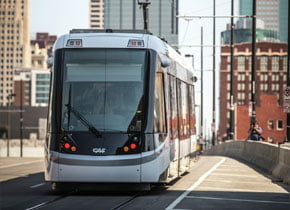
#20. Which of these statements is true about passing a light rail vehicle?
Do not overtake and pass any light rail vehicle or streetcar on the left side, whether it is moving or standing. Exceptions:
- When you are on a one-way street.
- When the tracks are so close to the right side that you cannot pass on the right.
- When a traffic officer directs you to pass on the left.

#21. What does this sign mean?
Sharp turn. There is a sharp turn to the right in the road ahead.
Reduce speed. The turn is too sharp to take at the regular highway speed. An advisory speed sign may be attached.

#22. Why is it wise to slow down a little at night?
The distance you can see ahead is greatly reduced at night. Therefore, your speed should be reduced in proportion. Never overdrive your headlights.

#23. What does this sign mean?
Low clearance. Do not enter if your vehicle is taller than the height listed on the sign.

#24. If you have a Kansas driver's license, you must report the change of name within:
You are required by law to notify the division of vehicles, in writing, of any change of name and/or address within 10 days of the change.

#25. True or false? When passing a motorcycle, you must signal and change lanes, just like you would when passing a car.
Motorcycle/scooter/moped operators have the right to use a complete traffic lane. Do not pass a motorcycle/scooter/moped in the same lane. The motorcycle/scooter/moped needs space to react to other traffic.
| This Practice Test | |
|---|---|
| Number of questions on each practice test: | 25 |
| Question pool: | 750+ |
| This is a randomized practice test | |

Facts about Your Kansas Knowledge Test
| Kansas DOV Knowledge Test for Learner’s Permit and Driver’s License | |
|---|---|
| Number of questions on exam: | 25 questions |
| Passing score: | 80 percent |
| Correct answers to pass: | 20 |
| Allotted time to complete test: | n/a |
| Wait time before retest: | 1 day (New fee is required) |
Kansas Practice Tests for Your Learner Permit & Driver’s License
This sample test is intended as a learning tool when you study for the Kansas DOV knowledge examination.
It draws 25 random questions from a question bank containing all essential items in the Kansas Driving Handbook.
You can find everything you need to learn for your written knowledge in the handbook. So, you should always start by getting a copy from a service center, your driving school, or download a copy online .
Always ensure you have the latest manual version and that you got it from the Kansas Department of Vehicles (DOV). The handbook is the best resource to help you prepare for the knowledge test.
You should use these Kansas practice tests as a supplement to the manual, not a replacement.
The passing score on the actual exam is 80 percent. When you study with our practice tests, you should aim for a 100% score on each test.
This practice test covers all critical items in the Driver Handbook. Still, it may only include some questions Kansas DOV may ask during the official knowledge examination. Since both this practice test and the real test are random, you never know which questions you will get. But the more you practice, the more you will cover, and the more likely you will pass the examination on your first try.
After each question, you will get instant feedback. If your answer is incorrect, there is a short explanation. You can use this explanation to look up information in the handbook and learn from your mistakes.
You will see your total score at the end of the practice test.
Read more: Acing the Exam .

What You Should Know about the Examination
Is the knowledge test timed?
There is no time limit on the Kansas knowledge test. It typically takes 15 minutes to complete.
Your scheduled appointment will make sure you can finish the test before closing.
Is the Kansas test hard?
There are no official data about the failure rates, and DOV has not responded to such requests.
We estimate that more than 50% of all first-time test takers pass the exam and we grade the difficulty level as “moderate.”
Can I take the test online from home?
Yes, you can complete the Kansas driver’s license and other knowledge exams online at knowtodrive.com
To take the online test from home, you must have a desktop or laptop computer with a front-facing camera. The test does not work on a mobile device.
Is the knowledge test available in other languages?
The online test is available in English and Spanish. You can also activate audio playback.
What happens if I fail the test?
You can retake the test the next day. You must pay the testing fee each time you attempt the test. It is a good idea to prepare well for the test.
Be aware that you only have four opportunities to pass the exam within six months. If you fail a fourth time, you must wait at least six months before starting the process again.
What questions are on the test?
There are 25 multiple-choice questions on the test. They focus on your understanding of the safe operation of a motor vehicle. You should expect questions about road signs, including the meaning of shapes and colors. Other questions will address traffic signals, pavement markings, Kansas traffic laws, and standard rules of the road.

Who Must Take the Kansas Written Test?
New drivers
First-time applicants must always pass all examinations, including the written test on Kansas traffic laws and road signs.
Drivers with an expired license
If you let your Driver’s License expire for more than one year, you must pass all tests again, including the vision screening, knowledge exam, and road skills test.
Drivers with a revoked license
If the state revokes your license, they indefinitely remove your driving privilege. After a revocation period, you may apply for a new license. With a new application, you must pass all tests again.
A suspension is a limited withdrawal of your driving privilege. After the suspension, the state will give back your driver’s license. You don’t have to retake all tests.
Drivers with a foreign license
If you move to Kansas and hold a foreign license, you must apply for a state license and pass all tests. Kansas DOV does not waive any tests for holders of a foreign license.
When is the Kansas Written Test Waived?
Kansas waives the written test for a driver already licensed in another state and applying for a Kansas License. The driver must have a valid out-of-state license – not canceled, suspended, or revoked.
You don’t have to pass a knowledge test when you renew your Kansas license.
Kansas Graduated Driver’s Licensing Law
The Graduated Driver’s Licensing (GDL) system is a step-by-step program designed to improve road safety by allowing beginner drivers to get their initial driving experience under lower-risk conditions. As a young driver gets older and gains more driving experience, the state places fewer restrictions on the driving privilege.
The program typically involves these three steps:
Instruction permit (or learner’s permit)
Restricted driver’s license (or provisional license)
Full, unrestricted driver’s license
In Kansas, you can apply for a first instruction permit when you are 14 years old.
You can also get a limited farm permit when you are 14. A farm permit allows you to drive to or from a farm job, farm employment, or other farm-related work. You can also go to or from school on school days, but only over the most direct and accessible route between your home and school.
Your First Kansas Instruction Permit – Requirements 14 – 16 Years Old
When you apply for your first instruction permit, you must:
Be at least 14 years old
Present acceptable proof of identity
Have approval by parent or legal guardian
Pass a vision screening
Pass the written knowledge test
Kansas does not require a driver’s education.
Your First Kansas Instruction Permit – Restrictions
You cannot drive alone
An instruction permit does not allow you to drive on your own. A supervising driver at least 21 years old must always accompany you.
The supervising driver must hold a valid driver’s license and have at least one year of driving experience. They must always be seated in the front seat beside you, and no person other can be in the front seat.
You cannot use a cell phone
You cannot use any wireless communication device while driving unless you need to report illegal activity or summons medical or other emergency help. The prohibition applies even if your car has hands-free devices. The state lifts the restriction for anyone 18 years or older.
Remember that Kansas law prohibits all reading, writing, or sending text messages while behind the wheel, even for adults.
No night curfew – or passenger restrictions
There is no night curfew or other passenger restrictions during the instruction permit phase.
Hold the permit for one year
If you are under 17 years, you must hold the instruction permit for a minimum of one year before DMV lets you advance to the next level in the graduated driver licensing (GDL) program – the restricted driver’s license.
Read more: Graduated Driver’s License Requirements.
Check Your Knowledge
Question: An Instruction Permit allows you to:
- A. Operate a motor vehicle when supervised by another driver
- B. Operate a motor vehicle without supervision if you drive to or from work
- C. Observe another driver operating a motor vehicle

