
2026 Iowa MVD Test & Permit Practice – 100% Free
Results
Congratulations, this is a passing score on the Iowa knowledge test. Do you want to try again?
Sorry, this is not a passing score on the Iowa knowledge test. Do you want to try again?



#1. It is a very windy day. A dust storm blows across the highway, reducing your visibility. You should drive slower and turn on your:
During dry periods of the year, gravel roads can become extremely dusty. Vision can be reduced. It is recommended that drivers use low beam headlights to make the vehicle more visible to others.

#2. When must you stop at a railroad crossing?
You are required to stop when:
- Warning devices are flashing.
- The crossing gate is lowered.
- A human flagger is warning of an approaching train.
- An approaching train is clearly visible and is in close proximity to the railroad-highway grade crossing.
Do not proceed until you can do so safely.

#3. You have given consent to take a test for determining the alcoholic level in your blood:
If you are arrested for DUI, you are subject to the Implied Consent Law. Under the Implied Consent Law, anyone who operates a motor vehicle in Iowa consents to certain tests. Additionally, Iowa law says that you consent to taking a preliminary breath test, even if you have not been arrested.

#4. You may be ruled a habitual offender if you within a two-year period are convicted of:
You may be ruled a habitual offender if you are convicted of three or more certain violations in a six-year period. Another way you may be considered a habitual offender is if you are convicted of six or more moving violations within two years. If the six moving violations include speeding, the speeds must be at least 15 mph over the legal speed limit.

#5. This sign tells you:
No Left Turn.
You must not make a left turn at this intersection.

#6. From which lane should you turn right on a four-lane highway?
The correct lane for the right turn is the lane next to the right edge of the roadway.

#7. When approaching a stopped school bus that is picking up or dropping off children and traveling on your side of an undivided highway with four or more lanes, you must:
If the red lights are flashing or if the stop arm is out, you must come to a complete stop at least 15 feet from the bus. You must remain stopped as long as the red lights flash or the stop arm is out.
The only exception to this is where you are approaching the bus from the opposite direction on a road with at least two lanes in each direction.
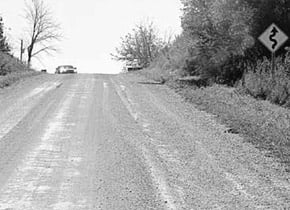
#8. As you approach the top of a hill, you should:
Hills and curves on rural roads are often steeper and sharper than on highways. Before reaching the crest of a hill or before entering a curve, slow down, move to the right side of the road and watch for oncoming vehicles.

#9. When an emergency vehicle using flashing lights approaches you from a crossroad, you should:
Pull over to the right edge of the road, or as near to the right as possible, when you see or hear an emergency vehicle approaching from any direction.

#10. Where is it illegal to park a vehicle?
Parking is not allowed in front of a public or private driveway.

#11. When you see this sign, you should expect a railroad crossing before coming to the T-intersection ahead.
This sign tells you there is a railroad crossing if you turn right at the T-intersection ahead.

#12. You see this sign attached to the back of a vehicle ahead. What should you do?
It is common to encounter slow moving and large vehicles such as farm equipment, animal drawn vehicles and road maintenance equipment on rural roads. It is important to identify these vehicles early and slow down when meeting them or coming up behind them. Slow moving equipment may make wide turns, either left or right at unmarked entrances. Some farm equipment is wider than the road itself. Make sure the driver of the slow-moving vehicle can see your vehicle before passing. Always use extreme caution when passing.

#13. If another vehicle is following too close, you should:
If you are being tailgated, move slightly to the right and give the tailgater a better view of what is ahead and signal early for turns, stops or lane changes. Try slowing down and encouraging the driver behind you to pass. If all else fails, pull out of the traffic flow.
Never brake hard to discourage a tailgater. You could get hit from behind.

#14. You approach an intersection. Where should you stop if there is a stop sign but no stop line or crosswalk?
Stop at the pedestrian crossing area or stop line if there is one. If there is no stop line or crosswalk, stop before moving into the intersection.

#15. You should avoid using your horn:
Use your horn whenever it will help prevent an accident.
There are several occasions when you should not use your horn. They include:
- To encourage someone to drive faster or get out of the way.
- To scold another driver for an error.
- To greet a friend.
- Around pedestrians who are blind.
- At bicyclists.
- Around horses.
This question asked when you should not use your horn.

#16. Using an unpaved shoulder to pass another vehicle on the right is:
Passing another vehicle by driving off the pavement is illegal.

#17. It can be dangerous to leave a motor running in a garage because of:
Cars produce carbon monoxide, a deadly odorless and colorless gas. Fumes from a leaky exhaust system can cause death in a short time. Never run the motor in your garage, or sit in the car with the motor running, without opening a window.

#18. A traffic signal with a flashing yellow arrow means:
A flashing yellow arrow means you may proceed with caution in the direction of the arrow. You must first yield to oncoming traffic and pedestrians. Oncoming traffic has a green light.

#19. A driver with an intermediate license is generally not allowed to drive unsupervised between:
With an intermediate license, you may drive without supervision from 5 a.m. to 12:30 a.m. Driving is permitted between 12:30 a.m. and 5 a.m. only with a parent or guardian, family member over 21, or designated adult over 25. With a waiver, you may drive to and from work or school-related extracurricular activities.

#20. What does the basic speed rule mean?
The speed you can drive your vehicle depends on the posted speed limit, the road conditions, and the weather. The posted speed limit is the fastest speed you can legally drive under ideal driving conditions.
By law, you must drive at a careful and prudent speed not greater than nor less than is reasonable and proper, having due regard to the traffic, surface, and width of the highway and of any other conditions. This is known as the basic speed rule.

#21. To prevent skidding on slippery surfaces, you should:
To prevent skidding on slippery surfaces you should adjust your speed, avoid fast turns and quick stops.

#22. Who has always the right-of-way on Iowa roads?
The law states who must yield the right-of-way. It does not give anyone the right-of-way.
Right-of-way is something to be given, not taken.

#23. What does this sign mean?
Traffic signal ahead. This sign warns of traffic signals at the intersection ahead. Slow down. Poor visibility is likely.

#24. What does the marking in the left-hand lane (A) mean?
Special arrow markings may be present at intersections to show which lanes must be used when turning or proceeding straight.
If your lane is marked with both a curved and straight arrow, you may either turn or go straight. If you are in a lane marked with a curved arrow and the word ONLY, you must turn in the direction of the arrow.

#25. Road signs with a yellow background indicate:
Yellow is used for general warning and advisory of unexpected roadway conditions.

#26. What does this road sign mean?
Hill – Downgrade ahead.
This sign is a warning to all vehicles that the road ahead goes down a hill. You should check your brakes before going down the hill.
| This Iowa Practice Test | Number of questions on each practice test: | 25 |
|---|---|
| Question pool: | 750+ |
| The Iowa practice test is random | |
Facts about the Iowa MVD Knowledge Examination
| MVD Knowledge Test for Permit and Driver’s License | |
|---|---|
| Number of questions on the permit exam: | 35 |
| Passing score: | 80 percent |
| Correct answers to pass: | 28 |
| Allotted time to complete test: | No limit (but must start 30 minutes before closing) |
| Wait time before retest: | 1 day [761-604.20] |
Practice Tests for Your Iowa Instruction Permit and Driver’s License
Studying for your driver’s license or instruction permit just became much easier with more sample questions and answers based on the official driver’s manual and actual examinations from the Iowa Motor Vehicle Division (MVD). You can pass the Iowa knowledge exam the first time with these practice tests.
Each practice test has 25 random questions from a large bank of verified questions and answers. After each test question, you will get instant feedback, including a short explanation if your answer is incorrect, which will help you learn the Iowa rules of the road a lot faster.
Remember, don’t try to simply memorize questions and answers. You will be much better off if you also understand why an answer is correct. Check the information in the driver’s manual when you need clarification.
Read more: Risky Study Tactics .

1 Start by Getting the Driver’s Manual
You will only pass the test with a good overview of the contents in the official Driver’s Manual.
Start by getting the latest version of the manual. You can get it online or from any MVD service center.
Read it several times over a few days or 1 – 2 weeks, depending on how much you already know.
2 Use Practice Tests Wisely
When you’ve read the manual, you should use these practice tests to check your progress and see if you are ready for the real examination or not.
But use the practice tests wisely.
Besides giving you an idea of the questions asked on the examination, they are a learning tool. Questions will challenge your understanding of Iowa traffic laws and the highway signs that regulate, warn, and direct traffic.
On the real knowledge exam, you must pass 80%, but on practice tests, you should always aim for 100%. You may miss questions about details that seem unimportant for safe driving or miss questions because you didn’t read them carefully enough. Those are common mistakes on the actual examination as well.
Remember, everything in the manual is there for a reason. Iowa Motor Vehicle Division draws questions from all parts of the manual.
3 Active Learning
Active learning can take many forms but centers around writing, talking, problem-solving, or reflecting.
Studies show that the more you engage in an active learning process, the faster you learn, and the better your new knowledge will stick.
Think beyond the knowledge test and focus on understanding how you can be a safe driver. Discuss traffic rules with friends and family, make your own quizzes, etc. Give yourself plenty of time to learn. It will pay off.
3 Testing Strategy
Your best strategy for taking the examination is to rest the day before the test. Don’t try to cram the night before the test.
If you take your test at an MVD location, arrive there in good time for your scheduled appointment.
If you take the test at home, steer away from all distractions. Turn off your phone and ensure you have plenty of time to finish the test without rushing through questions.
After reading a question, try to answer it on your own before you look at the choices. Then read the possible choices and look for the correct one.
Always make sure that your answer choice makes sense.

Who Must Pass the Iowa Written Knowledge Test?
You must take the MVD knowledge test:
As a first-time applicant
You must pass all tests if you apply for your first learner’s permit or full driver’s license.
Applicants under 18 years will follow Iowa’s graduated driver’s license (GDL) program. The program includes three steps allowing increased driving privileges as the driver accumulates skill and demonstrates responsible driving practices.
If you hold a foreign driver’s license
If you move to Iowa and hold a foreign license, you must transfer to an Iowa license. You must pass all tests if you hold a license from a country other than Germany or Canada.
If you hold an out-of-state driver’s license that has expired
Holders of an out-out-state license are usually exempt from taking the knowledge test. If the license is invalid or expired for over a year, you must pass the entire examination as a first-time applicant.
If you want to replace a revoke license
If the state revokes your license, you must apply for a new one and pass all tests again.
The same applies if another state revoked your license.
You must wait until the revocation period has passed to apply for a new Iowa license.
Moving to Iowa
Remember, when you move to Iowa and wish to drive, you must apply for an Iowa license.
MVD usually waives the knowledge and driving tests if you have an out-of-state license valid for the same driving privilege you are applying for in Iowa.
You are considered an Iowa resident for purposes of driver licensing if you have any of the following:
- Registered to vote in this state.
- Enrolled your children in public school.
- Accepted a permanent job in the state.
- Lived in Iowa continuously for 30 days.
You do not need an Iowa driver’s license if you are:
- Driving a military motor vehicle while on duty with the U.S. Armed Forces.
- Driving farm equipment between the home farm and any nearby (not more than two miles) farmland or farm operation.
- A student or visitor with a current license from your home state or country.
The Purpose of the Written Test
The official knowledge exam will determine how well you know and understand highway signs and Iowa traffic laws.
Iowa DOT offers computer-based tests for both permits and driver’s licenses. A traditional written test on paper may still be available in some locations.
While the number of questions on Iowa tests may vary, the test for a new learner’s permit has 35 questions. Twenty questions address traffic laws and safe driving techniques. The remaining 15 questions are about signs, signals, and markings.
Our practice tests mix questions corresponding to a 25-question test. There may be fewer questions about road signs than on the official permit exam – but we cover all road signs from the driver’s manual in our tests.
Practice tests at driversprep.com are similar to the practice test you will find on MVD’s website, but with more questions.

Take the Written Knowledge Test at Home
Minors up to 18 years may take the knowledge test for an Iowa learner permit in their home.
This is what you need:
You need to be at least 14 years old and under 18 years.
An internet connection and a computer (not a phone or tablet).
An application submitted by a parent.
A parent must complete and submit the Application to Proctor Knowledge Exam form. The parent must also administer the test and ensure you follow the rules.
Once the application is approved, MVD will email instructions for taking and administering the test. It takes about 7-14 days before you get the email.
MVD will also email the test results and further instructions after you have completed the test.
The option to take the knowledge test at home is not available if you are 18 or older.
Knowledge Test at MVD
If you are 18 or older, you must make an appointment and take the test at a service center. Make an appointment .
Remember that you can do business at any available location, not just the one nearest you.
Iowa First-Time Instruction Permit Requirements
The following is a summary of the requirements for the first step in the Iowa GDL program:
You must be at least 14 years old to apply for an Instruction Permit.
The permit requires the written approval of parent/legal guardian.
You must pass vision screening and a knowledge test.
Iowa First-Time Instruction Permit Restrictions
The following is a summary of the permit restrictions and the requirements for the next step in the Iowa GDL program:
You must hold the permit for a minimum of 12 months.
All driving must be supervised.
Number of passengers limited to the number of seat belts in the vehicle. All passengers must buckle up.
You must log 20 hours of supervised driving, of which two hours must be between sunset and sunrise.
You must complete an approved driver education course. The course must include thirty hours of classroom training and six hours of laboratory.
You must drive accident- and violation-free for six consecutive months immediately before applying for an intermediate license.
Remember, under no circumstances can you practice driving alone. A supervising driver must always accompany you. The driver must sit in the front seat beside you.
You can drive with a parent or legal guardian, any family member over 21 years, a licensed driver education teacher, or any licensed driver who is at least 25 years old and has written permission from your parent or legal guardian.
When you practice driving, you must always have your instruction permit.
Frequently Asked Questions
What is the passing score on the Iowa permit test?
You must correctly answer at least 28 of 35 questions (80%) to pass the Iowa MVD permit examination.
At what age can I take the Iowa permit test?
The Iowa instruction permit is available when you are 14 years old.
What happens if I fail the Iowa permit test?
If you fail the Iowa permit knowledge test, you must wait at least one day before you can take the test again.
Can I take the Iowa permit test from home?
Iowa MVD has a online testing program you can take from home if you are under 18 years. If you are 18 years or older, you must visit a MVD office to take your knowledge test.
Is the Iowa knowledge test hard?
The difficulty level on Iowa knowledge test for a permit is rated moderate. It is estimated that one-third of all first-time test takers fail the exam.
If I have an Iowa permit, can I practice driving with a licensed driver who is 21 years old?
If you don't practice driving with a parent or legal guardian, a family member over 21 years, or a licensed driver education teacher, the supervising driver must be at least 25 years old. The driver must be licensed and have a written permission from a parent/legal guardian to supervise you.
How many hours must I practice driving before I can get an Iowa Intermediate License?
Under the Iowa Graduated Driver Licensing (GDL) program, you must log at least 20 hours of supervised driving while you hold the instruction permit. A minimum of two hours must be between sunset and sunrise.


