
Hawaii Permit Test Practice & License Sample Test Questions
Results
Great! This is a passing score. Do you want to try again?
This is not a passing score. Do you want to try again?


#1. On which side should you pass a vertical panel like this?
The diagonal stripes on the barricade or vertical panel guide the driver towards the direction to which traffic is to pass. Stripes sloping downward to the right mean the driver should bear to the right. Conversely, stripes sloping downward to the left mean bear to the left.

#2. What does this sign mean?
The Keep Left sign tells you that you must pass only to the left of a roadway feature or obstruction.

#3. If your vehicle’s power steering fails, you should:
Power steering failure usually occurs in combination with engine failure or loss of the belt driving the power unit. In any case additional effort will be required to maintain steering control.
- Reduce speed.
- Drive to a safe area and stop.

#4. Which of the following must you obey over the other two?
When a flag person or police officer directs traffic, you must obey his or her signals or directions.

#5. What should you do when following a motorcycle on gravel roads?
Extra care should be used when driving on wet, slippery, or gravel-covered road surfaces. Due to its vulnerable nature and the difficulty motorists have in judging a motorcycle’s speed and distance, space between the two vehicles should be increased to avoid sudden braking. Both riders and drivers are more likely to make incorrect decisions if there is not enough stopping distance or ability to see and react to conditions. This leads to accidents.

#6. When you want to exit a freeway, you should:
When you want to get off a freeway, plan ahead and watch the exit signs so you can choose the proper exit.

#7. A sign with this shape means:
A yield sign is a triangular red and white sign indicating that other traffic has the right-of-way. Be ready to stop when you approach this sign.

#8. A flashing yellow traffic signal at an intersection means:
A yellow flashing signal means that you may proceed cautiously.
Remember, you do not need to stop for a flashing yellow light, but you must slow down and be especially alert before entering the intersection.

#9. What does Hawaii's basic speed law mean?
The basic law means you must not drive at a speed that is greater than is reasonable and prudent.
You must drive at a safe appropriate speed depending on the area in which you are driving, the type and condition of the road traffic, the presence of pedestrians, the weather, and light conditions.

#10. When stopped, you should keep your front wheels pointing straight unless you are:
When you park on a hill or sloping driveway, make sure your car does not roll into traffic if the brakes do not hold. If you park downhill, with or without a curb, turn your front wheels to the right (to the side of the road). If you face uphill, with a curb, turn your front wheels away from the curb (to the travel lane). If there is no curb, turn your front wheels to the right, toward the edge of the road.
Always set the parking brake. Shift to the PARK position if you have one. If not, shift to reverse or low gear.
Please note that the latest version of the Hawaii Driver’s Manual may have a less accurate recommendation when it comes to parking uphill with a curb.

#11. When changing lanes near heavy trucks, drivers must make allowances for:
Large vehicles require greater stopping distances than other vehicles. When changing lanes or at intersections other drivers and highway users must make allowances for the increased stopping distance required by the large vehicles.

#12. A right turn against a solid red light:
A steady red light means that you must stop.
After stopping, you may turn right except when a sign prohibits such movement. You must yield to all pedestrians and all vehicles when making such a turn.
After stopping you may also turn left on a red light from a one-way street into a one-way street where traffic is moving to the left, except when a sign prohibits such movement.

#13. If you see a pedestrian with a white cane attempting to cross the street, you must:
You should always give blind persons the right-of-way, regardless of the traffic signal indication or traffic situation.

#14. When oncoming traffic prevents you from making an immediate left turn, you should:
When making any left turn, yield to all oncoming traffic that is so close as to be a hazard.

#15. Holders of provisional licenses must ensure that:
Holders of provisional licenses must ensure that all occupants of the vehicle use safety belts or child restraints.

#16. You should always signal before you:
When slowing down, stopping, turning, or changing lanes, you must signal to let others know what you plan to do. You must signal every time, even when there are no other vehicles in sight.
Signals must be given for at least 100 feet before you change lanes, turn, or stop. It is advisable to signal for a greater distance when driving at higher speeds.
Signals shall be given either by means of the hand and arm or by signal lamps.
Hand signals must be used when the vehicle turn signals are not operating.

#17. True or false? Looking straight ahead at all times is a good defensive driving practice.
One of the most common mistakes drivers make is looking in front of the car instead of up the road. Expert drivers try to keep looking 10 to 15 seconds in the city, 10 to 15 seconds is about one block.

#18. What is true about driving on a wet roadway?
Partial hydroplaning may start at 35 miles per hour (56 km/h). The extent of hydroplaning increases with speed and with the amount of water on the highway. At 55 miles per hour (89 km/h) in a heavy rain the tires may lose all contact with the pavement. When this happens, you cannot brake, accelerate, or turn. To prevent hydroplaning you should reduce the speed of the vehicle. Hydroplaning occurs most frequently at higher speeds. Slowly step off the gas pedal. Never hit the brakes or turn suddenly. You may lose control and skid.

#19. Why is it dangerous to drive with a defective exhaust system?
The exhaust system carries exhaust gases to an exit point located to reduce entry of fumes into the passenger compartment and reduces the noise to an acceptable level. To prevent carbon monoxide poisoning, keep your exhaust system free of leaks.

#20. Any driver under 21 will face penalties for having a blood alcohol concentration (BAC) of:
Drivers under 21 are prohibited from operating a motor vehicle with a blood alcohol content level of .02 or more.

#21. When you get behind the wheel of an unfamiliar vehicle and notice any defects:
Take a few minutes to familiarize yourself with the location and operation of the turn and hazard warning signals, headlamps and beam selector, windshield wipers and washers, brakes, gear selector and horn. Any defects should be corrected before the vehicle is driven.

#22. When driving away from a rising or setting sun, it is a good idea to:
For a short period before the sun rises and after the sun sets there is not enough light to see objects clearly. This condition is worse when the sky is cloudy. During this time of the day you should turn the headlamps on low beam so others can see you. Be alert for unlighted objects and pedestrians.

#23. To stay alert behind the wheel, you should keep your eyes:
To avoid accidents, you, as a defensive driver, should keep your eyes moving in order to be aware of developing traffic situations around you at all times.

#24. In cold and wet weather, the roadways on bridges and overpasses:
Ice may accumulate on or under bridges even when the rest of the road is clear. Snow and ice melt more slowly in shady areas. Watch for shiny spots in the road – they could be icy.

#25. This sign tells you that:
Lane ends or road narrows. There will be fewer lanes ahead. Traffic must merge left. Drivers in the left lane should allow others to merge smoothly.

#26. What are PMVIs?
Many service stations and garages are authorized to conduct PMVIs, also known as safety inspections.

#27. On a highway with two-way traffic, you may cross a broken yellow center line:
Single broken yellow lines are used to mark the centerline when there are only two lanes of traffic. You must drive to the right of this centerline but when it is safe you may cross this line to pass another vehicle.

#28. If you are involved in a collision, you must show your driver's license to:
Do not leave the scene of an accident without identifying yourself and rendering assistance.
Drivers must give their name, address, and vehicle registration number, and if requested, exhibit their driver’s license to any person injured in the accident or to the driver or occupant of or person attending any vehicle or other property damaged in the accident
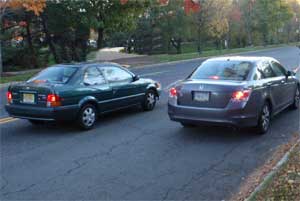
#29. If the driver ahead of you stops at an unmarked crosswalk for a pedestrian, you should:
Never pass a vehicle stopped to allow a pedestrian to cross the street. (Prohibited by law)
Stop, then proceed when all pedestrians have crossed the street.
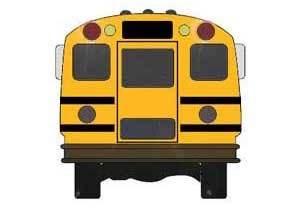
#30. When the red lights on a school bus stop flashing and the stop sign folds back, you should:
Remain stopped until the lights stop flashing or the stop sign folds back. Even after the warning signals have stopped, you should proceed with caution and be on the alert. There is a possibility of waiting children darting in front of traffic.
Hawaii Driver’s License Knowledge Test – Quick Facts
| What You Should Know | |
|---|---|
| Number of questions on exam: | 30 |
| Passing score: | 80 percent |
| Correct answers to pass: | 24 |
| Allotted time to complete test: | No limit |
| Wait time before retest: | 7 days |
| This Practice Test | |
|---|---|
| Number of questions on each practice test: | 30 |
| Question pool: | 1,000+ |
| Each test is random | |
The Hawaii Driver’s Practice Test for the Written Knowledge Examination
Driver’s Prep has designed these permit practice tests for use as a guide to help you become a safe driver and qualify for the Hawaii instruction permit or full driver’s license.
Each permit practice test has 30 random questions based on the Hawaii Driver’s Manual, the Complete Test Questions and Answers from Dept. Of Transportation, and real knowledge examination.
The test is easy to use. After each question, you will see the correct answer. If your answer isn’t correct, there is also a brief explanation.

By reading the official Hawaii Driver’s Manual and using these practice tests to check your progress, you increase your chances of passing the real written test the first time.
You can download a PDF-version online or buy a hard-copy from your local licensing office.
Acing the Hawaii Knowledge Test
The Hawaii passing score is 80 percent. To pass, you must answer at least 24 questions correctly.
Since this is only a practice test, don’t stop at this level.
You should answer at least 29-30 questions correctly on two or three practice tests before you are ready. A common mistake by first time applicants is to attempt the real knowledge test too soon.
Spreading your study sessions and practice tests over a longer period helps long-term memory. Instead of cramming for the DMV test just a few days before the real thing, start at least 4 weeks before your real exam. Study the manual and take a practice test or two each day.
Read more: How to Ace the DMV test .
Who Must Take the Hawaii Written Test?
First-time applicants
If you apply for an original Driver’s License and have not been licensed before, you must pass the written test consisting of recognition of traffic control devices and knowledge about rules of the road.
Holders of an expired driver’s license
When you renew a Hawaii driver’s license, you must do so within a year after the expiration date. If you let your license expire more than a year, you must follow the procedure for an original license and take all tests again.
Holders of a foreign driver’s license
When you have driver’s license from a foreign country other than Canada, you must pass all tests when transferring to a Hawaii license.
Who are Exempt from Taking the Hawaii Written Test?
Holders of a driver’s license issued by another state
Hawaii now waives the tests for holders of a valid U.S. or Territory driver’s license.

The Graduated Driver Licensing Program
Like all states, Hawaii has a graduated licensing law. The purpose of the law is to let new drivers under 18 years to gradually gain driving experience under adult supervision and with restrictions that limits high-risk driving situations.
The Hawaii graduated licensing program has three stages:
Phase I: Learner’s (Instructional) Permit
Phase II: Provisional License
Phase III: Full Driver’s License
Phase I: Learner’s (Instructional) Permit – Requirements
To apply for the Hawaii learner’s Permit, you must be at least 15 years and six months old.
To complete the application process you must show proof of:
Your full legal name
Date of birth (birth certificate is required if under 18 years)
Your social security number
Hawaii residency
Legal presence, if applicable
Parental approval if under 18 years (An Affidavit form must be submitted)
After paying the fees, and passing the vision test and the knowledge test, the department issues an instruction permit which is valid for one (1) year. If you wish to renew the permit you must do so no later than 90 days after the expiration date of the permit.
Phase I: Learner’s (Instructional) Permit – Restrictions
With the learner’s permit you can practice driving.
Whenever you drive you must be seated next to a person who is at least 21 years of age and licensed to operate the same type of motor vehicle. Under no circumstances can you drive alone.
You must have all occupants wear their seat belts and children under 4 years of age must be properly restrained within a safety seat.
There are no passenger restrictions and no night curfew. If you drive between the hours of 11:00 p.m. and 5:00 a.m., you must, however, be accompanied by a supervising parent or legal guardian.
When you practice driving you must always carry the permit with you.
Phase II: Provisional License – Requirements
To be eligible for the Hawaii provisional license, you must:
Be at least 16 years (and under 18 years)
Have held a learner’s permit for 180 days
Have completed a State certified driver’s education course
Pass a road skills test at a Driver Licensing Center
Pay the appropriate fees
Remember, you must schedule an appointment for the road-test exam.
Phase II: Provisional License – Restrictions
With the provisional license you can drive alone without a supervising driver, but the license comes with some restrictions:
No more than one passenger under 18 years.
Exceptions to this rule apply if (1) the passengers are household members or (2) you are being accompanied by a licensed parent or guardian.
No driving between 11:00 p.m. and 5:00 a.m.
You must not drive between the hours of 11:00 p.m. and 5:00 a.m.
There are however some exceptions to this rule:
- When driving to or from a place of employment
- When driving to or from a school-authorized activity
- If accompanied by a licensed a parent or legal guardian
If going to or from work, you must have a signed statement from the employer. When you drive to or from school activities a statement from a parent or guardian is necessary.
No driving without the license in your possession
All occupants wear seat belts or child restraints
The provisional license expires at your 19th birthday.
Phase II: Provisional License – Requirements
You are eligible for a full and unrestricted Hawaii driver’s license if you:
Is at least 17 years old
Have held the provisional license for at least six (6) months
Have no pending violation that might result in a suspension or revocation
Pass the vision exam (again)
Pay the appropriate fees
With a full and unrestricted Hawaii driver’s license all previous restrictions are lifted from your driving.
Frequently Asked Questions
How old must you be to get a Hawaii Learner's Permit?
To apply for the Hawaii learner's Permit, you must be at least 15 years and six months old.
What passenger restrictions are placed on a Hawaii Learner's Permit?
A holder of a Hawaii Learner's Permit must always be accompanied by a person who is at least 21 years of age and licensed to operate the same type of motor vehicle. If driving at night between the hours of 11:00 p.m. and 5:00 a.m, the supervising driver must be a licensed parent or legal guardian.
What are the passenger restrictions if you have a Hawaii Provisional License?
You can drive with NO more than one passenger under 18 years. Exceptions to this rule apply if (1) the passengers are household members or (2) you are being accompanied by a licensed parent or guardian.
What are the night time driving restrictions if you have a Hawaii Provisional License?
You must not drive between the hours of 11:00 p.m. and 5:00 a.m. Exceptions to this rule may apply if you drive to or from an employment, to or from a school-authorized activity, or if you are accompanied by a licensed a parent or legal guardian.
When are restrictions lifted from a Hawaii Provisional License?
A provisional licensee may be issued a full driver's license if the provisional licensee has satisfactorily held the provisional license for at least six (6) months and has no pending violation that might result in a suspension or revocation
How many questions are on the Hawaii permit test?
The Hawaii knowledge test has 30 questions. The passing score is 80 percent. To pass, you must answer at least 24 questions correctly.
What is the passing score on the Hawaii permit test?
The passing score on the Hawaii knowledge test is 80 percent. The test has 30 questions. To pass, you must answer at least 24 questions correctly.
If I fail the Hawaii permit test, how long must I wait before I can take test again?
You can retake the Hawaii knowledge test after waiting 7 days.

