
Arkansas Driver’s License & Permit Practice Tests – 100% FREE
Results
Good job. This is a passing score. Do you want to try another test?
This is not a passing score. Do you want to try another test?


#1. When a police officer is directing you to drive against a red light, you should:
Traffic controls include traffic signals, traffic signs and pavement markings. Traffic control also can be provided by law enforcement, highway personnel or school crossing guards. You must obey directions from these persons.

#2. What does this sign mean?
Divided highway ahead (divided highway begins).
The highway ahead is divided into two one-way roadways. Keep to the right.

#3. A yellow and black circular sign indicates that you are approaching:
The round black-on-yellow warning sign is placed ahead of a public highway-rail intersection. The Advance Warning sign tells you to slow down, look and listen for the train, and be prepared to stop at the tracks if a train is coming.

#4. If you miss your exit when trying to leave a high-speed roadway:
If you miss your exit, do not stop and back up. Keep going until you get to the next exit.

#5. What should you do if you are involved in a traffic crash, and someone is injured?
If any person is injured or killed, call for help. Make sure police are notified with a precise location of the crash scene and provide to the dispatchers any cautionary information such as gas spills, fire or downed electric lines.
Do not move the injured unless they are trapped inside a burning vehicle or other immediate form of danger.

#6. How many drinks does it generally take to affect your driving ability?
Drinking even a small amount of alcohol increases your chances of causing a crash.

#7. In which situation is it necessary to always allow extra room in front of your vehicle?
You should increase your following distance if you have a heavy load or are towing. The extra weight increases your stopping distance.

#8. When approaching an intersection where the traffic light changes from green to yellow, you should:
A steady yellow light means caution. It indicates the traffic signal is about to change. The driver of a vehicle must stop if such a stop can be executed safely without blocking the intersection.
If the driver is within the intersection when the yellow light changes, the driver must not stop, but proceed through the intersection.
Remember, do not enter the intersection if you can stop safely.

#9. What is true about a shared center lane?
Shared center lanes are reserved for making left turns and can be used by vehicles traveling in either direction.
Lanes are marked on each side by solid yellow and dashed yellow lines.
In Arkansas it is permissible for a vehicle making a left turn from an intersecting street or driveway to utilize a center left turn lane as part of the maneuver to gain access or merge into traffic lanes. It is not permissible to use the center left turn lane as an acceleration lane.

#10. What does this sign mean?
A yield sign is shaped like a downward pointing triangle. It is red and white with red letters. It means you must slow down and yield the right of way to traffic in the intersection you are crossing or roadway you are entering.

#11. Bicyclists must always ride:
Bicycles are required to travel on the right-hand side of the road with other traffic. Bicyclists are not allowed to travel facing traffic, since this is far less safe.

#12. What is the best thing to do if you feel tired while driving?
Never drive if you are sleepy. It is better to stop and take a nap than to take a chance thinking you can stay awake. If possible switch driving tasks with another driver so you can sleep while they drive.

#13. The minimum age that a person must be to obtain their first learner's license is:
The applicant for an instruction permit must be at least 14 years of age.

#14. When driving at night when there may be people along the side of the road, you should:
It is important to use high beams on unfamiliar roads, in construction areas, or where there may be people along the side of the road.

#15. What is the first thing you should do when your car starts to skid?
If your vehicle begins to skid, stay calm and ease off the gas. Stay off the brake. Until the vehicle slows, your brakes will not work and could cause you to skid more. Turn the steering wheel in the direction you want the vehicle to go. As soon as the vehicle begins to straighten out, turn the steering wheel back the other way. If you do not do so, your vehicle may swing around in the other direction and you could start a new skid. Continue to correct your steering, left and right, until the vehicle is again moving down the road under your control.

#16. Because motorcycles are smaller than cars:
The small profile of the motorcycle may make it appear farther away and traveling slower than it actually is. Drivers need to take a second look, and then a third. Always make a visual check (mirrors, too) of blind spots before entering or leaving a lane of traffic and at intersections. Intersections are the most likely places for car/motorcycle crash to occur. This usually is the result of a car driver NOT SEEING the motorcycle and turning into the motorcycle’s path.

#17. When you drive through a construction zone, you should:
Adjust your speed to traffic conditions. Proceed with caution. Obey all instructions provided by signs, traffic signals and flaggers. Do not follow other vehicles too closely. Remember to be prepared for the unexpected when traveling through work zones.

#18. The posted speed limit on a road is 55 mph. When there is packed snow on this road:
When the road is slippery, the tires do not grip as well as on a dry road. On a wet road you should reduce your speed about 10 mph. On packed snow you should cut your speed in half. On ice, you must slow to a crawl. It is very dangerous to drive on ice.

#19. When oncoming traffic prevents you from making an immediate left turn, you should:
If you are turning left, make sure there are no vehicles or pedestrians blocking your path. You do not want to be caught waiting for a path to clear while being stuck across a lane that has an oncoming vehicle moving in your direction. Drivers turning left must always yield to oncoming cars traveling straight ahead.

#20. When two vehicles from different directions arrive at the same time at a four-way stop, which should have the right-of-way?
At four-way stops, the first vehicle to stop should move forward first. If two vehicles reach the intersection at the same time, the driver on the left yields to the driver on the right.

#21. You approach a railroad crossing. There is heavy traffic ahead. You must stop before the crossing when:
Never start to cross until there is enough distance for your vehicle on the opposite side of the track. Never stop your vehicle on the railroad tracks.

#22. It is illegal for anyone, regardless of age, to use a cell phone for text messaging while driving:
Text messaging is banned, regardless of age.

#23. This sign tells you:
No Left Turn.
You cannot make a left turn at this intersection.
Remember that a red circle with a slash means no. The sign shows you what is not allowed.

#24. Where is it illegal to park?
Parking is not allowed where you block a driveway, alley, private road, or area of the curb removed or lowered for access to the sidewalk.

#25. If you plan to turn after an intersection, you should:
Do not confuse other drivers by signaling too early. If there are streets, driveways, or entrances between you and where you want to turn, wait until you have passed to signal.
| This Practice Test | Number of questions on each practice test: | 25 |
|---|---|
| Question pool: | 500+ |
| Each test is random | |
Each practice test at Driver’s Prep has 25 random questions picked from a large database.
Answers to questions are found in the Arkansas Driver’s License Study Guide.
Many questions are from the official Arkansas State Police Driver’s Testing exams.
After each practice question, you will see the correct answer. If your answer is wrong, you will also get a brief explanation.
Before you take on the practice tests, make sure you have studied the latest version of the Arkansas Study Guide. Get a copy from your nearest test location or get it online .
You must have a good understanding of the information in the manual to pass your driver exam.
After studying the guide, use these practice tests to check your progress.
Online practice tests are the best way to study for a driver’s license exam but be careful not to just memorize answers. You must also understand the facts behind the answers.
Keep in mind that safe driving on Arkansas highways requires both skill and knowledge.

How Many Questions are on the Arkansas Knowledge Test?
| What You Should Know | |
|---|---|
| Number of questions on exam: | 25 |
| Passing score: | 80 percent |
| Correct answers to pass: | 20 |
| Allotted time to complete test: | No limit |
| Wait time before retest: | 1 day |
The Arkansas written knowledge test has 25 questions. The passing score is 80 percent, which means you must answer at least 20 questions correctly to pass.
When you use the practice tests, you should aim for a higher score. We recommend that you keep studying until you can correctly answer at least 24 questions. A full score is, of course, even better.
More than 40% of all first-time test takers fail the test. So, you should prepare well.
Who Must Take the Official Knowledge Test?
If you are a first-time applicant
You must take the written, vision, and road examination when you apply for an Arkansas driver’s license for the first time or upgrade to a different class of license.
When you want to renew an expired license
When you wish to renew your driver’s license, you must take the written test if your license is expired for 31 days or more.
When you have a license from another country
Drivers with an out-of-country license must, in general, pass all examinations, including the knowledge test.
Arkansas state police offers exemptions for drivers with a valid license from Manitoba Canada, Germany, France, Taiwan, and South Korea. They are not required to take the test.
Holders of a Valid Out-of-State License
If have a driver’s license from another state and move to Arkansas, you can surrender your out-of-state license in exchange for an Arkansas driver’s license. You don’t have to take the tests.
Your out-of-state license must be valid or expired no more than 31 days.
If your out-of-state license is expired over 31 days or you don’t have a license to surrender, you must take the knowledge test and pas the vision examination. The road test is normally waived unless your license is expired more than one year.
Remember, when you become a resident of Arkansas, you must get your Arkansas driver’s license within 30 days.

Lying about a Previous Driver’s License
If you don’t disclose information about a previous driver’s license or present any false information or altered documents, you can lose all future driving privileges in Arkansas.
Where and When Can You Take the Test?
Testing dates and times differ by location. You should call ahead and check when you can take the test. Test schedules are also found here .
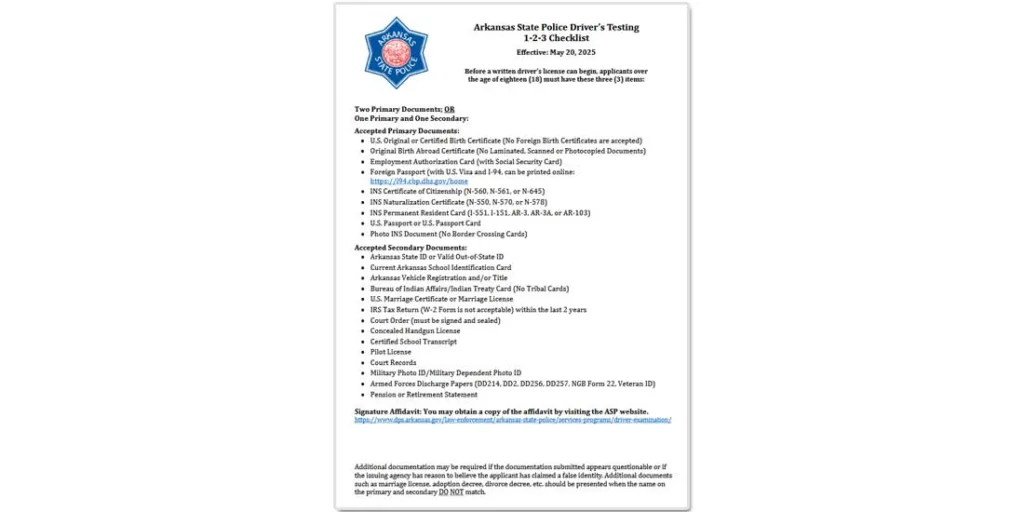
Documents You Need When under 18 Years
When you apply for a permit or driver’s license, you must show proof of your full name, birth date, and legal presence. The application of a minor under 18 years must also be signed by a parent or legal guardian.
If you are under 18 years, you need the following:
1 Original or certified copy of a Birth Certificate.
Note that hospital birth certificates or birth registration cards are not accepted. The certificate must be original or certified, no photocopies or scanned documents.
Non-U.S. Citizens must present Passport with U.S. Visa and current I-94, Permanent Resident Card, Employment Authorization Card, Naturalization Certificate or Certificate of Citizenship.
2 Accepted Secondary Identification
A secondary identification to prove your full name and birth date is usually an Arkansas state ID, A work or school ID with photo, or a certified school transcript.
3 Signature of parent or legal guardian
Parent may be present with a state driver’s license or state ID. Legal guardians must be present and show court documents establishing guardianship and a state driver’s license or state ID.
4 Attendance form for students (school form)
Full list of documents if you are under 18 years
Documents You Need When 18 Years or Older
If you are 18 years or older, you need to bring two primary documents or one primary and one secondary document to establish your birth date, full name, and legal presence.
1 Primary Documents Examples:
U.S. Passport or U.S. Passport Card
Foreign Passport (with U.S. Visa and I-94)
INS Permanent Resident Card
Employment Authorization Card
INS Certificate of Citizenship
INS Naturalization Certificate
2 Secondary Documents Examples:
Arkansas state ID or Valid out-of-state ID
Photo work or school ID
Vehicle registration and/or title
IRS/State tax forms
Certified school transcript
Full list of accepted documents

Understand the Arkansas Graduated Driver’s License Program
Like all states, Arkansas has a graduated driver’s license program.
The purpose of the graduated driver’s license program is to allow drivers to gradually become safe and experienced drivers with a step-by-step process.
1 First step – Instruction Permit
As a first step, Arkansas state police always issues an instruction permit. The permit allows a new driver practice driving together with a supervising driver.
To apply for an instruction permit, you must be at least 14 years old. When your application is accepted, you must pass the knowledge exam and vision test to receive your instruction permit.
With an instruction permit you may practice driving with a licensed driver 21 years or older. The supervising driver must always sit beside you in a front seat.
The permit is valid for one year and cannot be extended.
If you are under 16 years and pass the skills test, you may proceed to step 2 and get your first learner’s license.
2 Step 2 – Learner’s License
Arkansas state police issues a learner’s license after you have passed the skills test and if you are between 14 and 16 years old.
When you hold a learner’s license, you must always be accompanied by a licensed driver who is at least 21 years old and all passengers must wear seat belts.
The Learner’s License is restricted to supervised driving until your 16th birthday AND until six months of supervised driving is completed.
3 Step 3 – Intermediate License
You may get an intermediate license if you have passed all tests, have held the instruction permit, and are between 16 and 18 years old.
The intermediate license is also restricted to supervised driving unless the six-month period with supervised driving has already been met when the applicant turns 16.
If the intermediate license is restricted to supervised driving, you must be accompanied by a licensed driver who is at least 21 years old until the period of six months is complete.
After the six-month period, you may drive alone.
With an intermediate driver’s license, you may, however, not drive alone between the hours of 11:00 pm and 4:00 am unless you are driving to and from school activity, church activity, job, or in an emergency.
There is also a passenger restriction when you drive alone. You cannot drive with more than one unrelated minor passenger. An unrelated minor passenger is a person under 21 years old who is not a sibling, step-sibling, or a child who lives in the same household as the driver.

4 Step 4 – Unrestricted Class D License
The Class D license is a non-restricted license issued to persons 18 years or older.
Before you can get an unrestricted license, you must have held a valid Instruction Permit indicating a completion of the knowledge exam, vision, and skills test.
You must also be free of serious accident and conviction of a serious traffic violation for at least 12 months prior to application.
FAQ – Arkansas Graduated Driver’s License Program
What is the Arkansas Graduated Driver Licensing law?
The Graduated Driver Licensing (GDL) law helps provide a safe environment for young drivers by placing strategic restrictions on when and with whom they may drive. The process of receiving a teen driver's license contains three levels: learner's license, intermediate license, and unrestricted/regular driver license.
A learner's license is issued to teens between 14 and 16 years old. With a learner's license, a teenager must always drive with a supervising adult. The intermediate license allows a teenager to drive alone, but with a curfew between 11:00 pm and 4:00. With the intermediate license they are also restricted from having more than one unrelated passenger under 21 years.
At what age can I get an Instruction Permit in Arkansas?
You must be at least 14 years old to apply for an Instruction Permit in Arkansas. State police will issue the permit after you pass the knowledge exam and vision test. The permit is valid one year.
What do I need before I can get my Arkansas Instruction Permit?
You must be 14 years old, pass the knowledge exam and vision test before the state issues an instruction permit. Study the Arkansas Driver License Study Guide well ahead of your exam and take several practice tests to make sure you can pass.
When you apply, you must must present an original birth certificate, an Attendance Form for Students (school form), and a parent or legal guardian must sign your application.
When can I get a Learner's License in Arkansas?
To get your first learner's license, you must be between 14 and 16 years old and have a valid Instruction Permit. The permit must show that you have passed the knowledge test, the vision exam, and the skills test.
At what age can I get an Intermediate License in Arkansas?
To get an Intermediate License in Arkansas, you must be between 16 and 18 years old. You must have a valid Instruction Permit indicating a completion of the knowledge exam, vision and skills test. Your driving record must also be clean, with no serious traffic violations or at fault accidents during the previous 6 months.
What are the restrictions on an Intermediate Driver License in Arkansas?
If you have not held a learner’s license or permit for at least 6 months, you are restricted to supervised driving only. This restriction is lifted after six months of supervised driving.
You cannot drive between the hours of 11:00 pm and 4:00 am unless accompanied by a licensed driver, driving to and from school activity, church activity, job, or an emergency.
The use of a cell phone, whether it is talking or texting, is prohibited by law except for an emergency.
No more than one unrelated minor passenger is allowed, unless you are accompanied by a licensed driver. Unrelated minor passenger is a person under 21 years old who is not a sibling, step-sibling, or a child who lives in the same household as you.
At what age can I get an unrestricted Driver License in Arkansas
In order to get a Class D License in Arkansas, you must be 18 years old and a valid Instruction Permit indicating a completion of the knowledge exam, vision and skills test. You must also be free of serious accident and conviction of a serious traffic violation for at least the previous 12 months prior to application.
Can I get an Arkansas Class D Driver License without having an Instruction Permit?
If you have not been licensed before, you must always start by applying for an Instruction Permit. To get the Instruction Permit, you must pass the knowledge test and the vision test. The permit allows you to practice driving with a supervising driver who is at lest 21 years old and sits beside you in the front seat.
When you are 18 years old and have passed the skills test, Arkansas state police can issue a Class D Driver License without restrictions.
Do I need to take a Driver Education course to get a Driver License in Arkansas?
No, a driver education course is not mandatory in Arkansas. You must, however, pass a knowledge test before the state police issues a learner's permit and teens must practice driving for at least six months before they can be eligible for a license.


