
2026 Wisconsin DMV Tests & Permit Practice Tests
Results
You reached the passing score. Do you want to try another test?
You did not reach the passing score. Do you want to try another test?


#1. If your vehicle breaks down on a highway:
If your vehicle breaks down on a highway, make sure that other drivers can see it. Turn on your emergency flashers to show that you are having trouble. Get your vehicle off the road and away from traffic if at all possible. If you cannot get your vehicle off the roadway, try to stop where other drivers have a clear view of your vehicle (do not stop just over a hill or just around a curve). Stand by the side of the road where you are safe from traffic and wave traffic around your vehicle. Never stand in the roadway. Lift the hood or tie a white cloth to the antenna, side mirror or door handle to signal an emergency.

#2. Orange road signs are used:
Orange is used for construction and maintenance warning. The signs are usually diamond shaped. They notify drivers of unusual or potentially dangerous conditions near work areas.

#3. When driving inside a roundabout, you should:
Stay in your lane. Do not attempt to overtake or pass any vehicles inside a roundabout.
This question asked what you should not do.

#4. A traffic light with a green arrow means:
A green arrow means you can turn in the direction of the arrow. There should be no oncoming or crossing traffic while the arrow is green. This is known as a protected turn.
Remember, it does not mean that all other traffic is stopped by a red light.
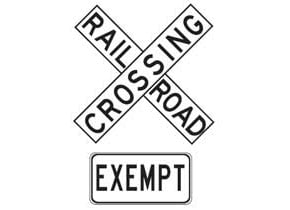
#5. An exempt sign beneath a Crossbuck sign means:
Leave extra room for vehicles required to come to a stop at railroad crossings, including transit buses, school buses or vehicles carrying hazardous materials (gasoline tankers, etc.). If you are following this type of vehicle, you should be prepared to stop.
These vehicles are not required to stop before crossing tracks marked exempt or tracks out-of-service.

#6. A truck's blind spots:
While truckers can see ahead better, and trucks have bigger mirrors, they have very serious blind spots. A car can disappear from their view while it is up to 20 feet in front of the cab, on either side of the truck (especially alongside the cab), and up to 200 feet behind! These areas are all part of what is called the No Zone.

#7. When you see this sign, what should you expect ahead?
Stop ahead. When you come to this sign, you should slow down to be ready to stop at the stop sign ahead.

#8. During adverse driving conditions, you should keep a following distance that is:
You need more distance to stop a vehicle on slippery roads, therefore, leave more space in front of your vehicle. If the vehicle ahead suddenly stops, your vehicle will need the extra distance to stop safely.

#9. Which car or cars have the position for a right turn on this one-way street?
On a one-way street, use the center lanes for through-travel and the outside lanes for turning.
Remember, where there are no signs or lane markings to control turning, you should turn from the lane that is closest to the direction you want to go and turn into the lane closest to the one you came from.

#10. When is it essential to use high-beam headlights?
It is important to use high beams on unfamiliar roads, in construction areas, or where there may be people along the side of the road.

#11. Lanes marked on both sides by double-dashed yellow lines are known as:
Some travel lanes are designed to carry traffic in one direction at certain times, and in the opposite direction at other times. These lanes are called reversible lanes and are usually marked by double-dashed yellow lines.

#12. When overtaking and passing a bicycle, the law requires you to allow the following space between your vehicle and the bicycle:
You must give a bicycle at least three feet of room when you pass.

#13. Which greatly affects your stopping distance?
The process of stopping your car has three main components: perception, reaction, and braking. Perception and reaction can be affected by human factors such as tiredness, alcohol, fatigue, and concentration levels. The braking ability of vehicles can vary widely due to type and condition of the pavement surface, vehicle weight, the type and condition of tires and brakes, and other factors.
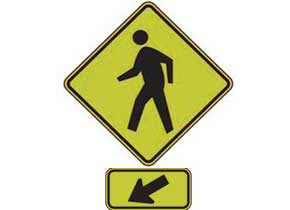
#14. This sign means
Pedestrian crossing. Watch for people crossing your path. Be prepared to slow down and stop. Signs may display horizontal lines showing the point where a crosswalk exists.

#15. Unless otherwise posted, the speed limit in an alley is:
Unless otherwise posted, the speed limit in an alley is 15 mph.

#16. If you are traveling in lane B (beneath a steady yellow X), you must:
Lane-use control signals are special signals posted by the side of the road or overhead. They indicate whether you should or should not drive in a specific lane. A green arrow means you can use the lane. A red X means you cannot.
A flashing yellow X means the lane is only for turning. A steady yellow X means that the use of the lane is changing, and you should move out of it when it is safe to do so.

#17. To prevent skidding on slippery surfaces, you should:
Skids are caused by drivers traveling too fast for the conditions. The best way to prevent skids or hydroplaning is to keep your speed down, avoid fast turns and quick stops, and have good tire tread.

#18. This sign means you are traveling:
The sign means you are eastbound on Highway 12 at mile marker 224.2.

#19. If you encounter an aggressive driver on the road, you can put yourself in danger if you:
Do not return gestures.
Make a difference in keeping the roads safe for everyone. Act responsibly!
This question asked what you should not do.

#20. If you were parking your car next to the curb here, which way should you turn your wheels?
Turn your wheels sharply to the left if there is a curb and you face uphill. Turn your wheels sharply to the right if there is no curb or if you face downhill. This way, if your vehicle starts to roll, it will roll away from traffic. See the illustrations in the Motorist’s Handbook.
Set your emergency brake and place your vehicle in park. If your vehicle has manual transmission, shift into reverse if parking downhill or into the lowest gear if parking uphill.

#21. If a school bus with flashing red lights has stopped on the other side of a four-lane roadway without median separation, you must:
You must stop a minimum of 20 feet from a stopped school bus with its red lights flashing. You must stop whether the school bus is on your side of the road, the opposite side of the road or at an intersection that you are approaching. Unless signs say otherwise, you are not required to stop for a school bus if you drivein the opposite direction on a divided highway.
A divided highway must have a raised median, grassy area, or actual barrier between opposing lanes of traffic.

#22. What is a suitable restraint system for a child seven years old and weighing 60 pounds?
Booster seat is required when the child is at least 4 years-old but less than 8 years-old, weighs at least 40 pounds but less than 80 pounds, and is not 57 inches (4 feet, 9 inches) or taller.

#23. What is the best way of dealing with a situation where you have had too much to drink?
Let somebody else drive.
The best advice is if you drink alcohol – do not drive. There are ways of dealing with social drinking situations. Arrange to go with two or more people. Agree ahead of time which one of you will not drink alcohol. You can rotate among the group being the designated driver. Otherwise, use public transportation or a cab, if available.

#24. If a vehicle comes toward you with high beams on, you can be blinded if you:
Look toward the right side of the road. This will keep you from being blinded by the other vehicle’s headlights and will allow you to see enough of the edge of the road to stay on course until the other vehicle has passed.
This question asked what you should not do.

#25. If you are convicted of 4 or more major traffic violations or 12 or more minor violations within 5 years, your license will be:
If you are convicted of 4 or more major traffic violations or 12 or more minor violations within 5 years, the DMV will declare you a habitual offender. Your license will be revoked for 5 years.
| This Wisconsin Permit Practice Test | |
|---|---|
| Questions per test: | 25 |
| Question pool: | 500+ |
| Type of test: | Random multiple-choice |
| The Official Wisconsin Written Knowledge Test | |
|---|---|
| Questions on real exam: | 50 questions |
| Passing score: | 80 percent |
| Correct answers to pass: | 40 |
| Allotted time to complete test: | 45 minutes |
| Wait time before retest: | 1 day (5 attempts) |
Free Wisconsin Practice Test
This Wisconsin preparation test for your driver’s license or learner’s permit has 25 random questions from an extensive database. After each question, you will get instant feedback that tells you whether your answer is correct. There is also a short explanation of the rules and the best answer if you need help understanding a question.
Remember that the actual knowledge examination has 50 random multiple-choice questions, which means you should take more than one practice test to cover everything that may appear on your final test.
You can always find answers to test questions in the Wisconsin Motorists’ Handbook. Get a copy at any DMV office, your driving school, or driver’s education course, or download it from DMV’s website .
The handbook is a necessary read to understand everything you need to learn for the examination. Many rules and practices will already be familiar; others may be new. The practice test will help you discover what you need to focus on.

True Understanding of Rules and Laws
Remember, the actual exam and the practice tests have questions from a vast question bank. It is best to avoid trying to memorize answers since questions and answers can appear in different shapes and be worded differently. Understanding rules and safe driving practices is a safer way to succeed on the knowledge exam. A true understanding of rules and laws also helps you become a responsible and safe driver.
It is also good to start studying a few weeks before the test and not try to cram a few nights before the big day.
Read more: Risky Study Tactics

Wisconsin Passing Score is 80%
The passing score in Wisconsin is 80 percent. On the actual exam, which has 50 questions, you must get at least 40 questions correct. Once you have reached your passing score, the test will end.
When you study for your exam, you should aim higher. Try to get a full score (25 correct answers) on several tests. It will give you a good margin on the actual test.
Go back to the handbook when you need help understanding the correct answers.
Allotted Time for the Wisconsin Written Test
There is an allotted time of 45 minutes for your test, but don’t let that scare you. Fifty questions and 45 minutes may seem a lot, but most applicants finish in 20 minutes. If you time yourself on a practice test, you will likely complete 25 questions in 5 minutes.
With the proper preparations, you will have no trouble passing.
What Happens if You Fail the Test?
The failure rate on the Wisconsin knowledge test is between 25 and 30 percent, which means that one out of four first-time test takers fail the exam.
The main reasons for failing are lack of preparation (about half of all applicants who failed did not prepare with practice tests) and poor reading comprehension.
If you fail the test, you can generally try again the next day, but remember that you will get a different test on your next attempt. Test questions will be different. Read everything with care.
You’ve got five chances to pass the exam within one year.
Who Must Pass the Wisconsin Knowledge Test?
The following must pass the Wisconsin written knowledge test:
- First-time applicants getting their initial instruction permit.
- New Wisconsin resident with a license from a foreign country other than Canada and Germany.
- New Wisconsin resident with an out-of-state license expired more than eight years.
- Drivers want to add a new class or endorsement to their driver’s license.
- Drivers with a Wisconsin license expired more than eight years.
New Wisconsin residents with a valid license from another state can replace their license and get a Wisconsin license without passing the knowledge or skills tests.

The Purpose of the Wisconsin Knowledge Exam
The purpose of the knowledge test is to determine your knowledge of Wisconsin traffic laws and safe driving, including knowledge of the following:
| What is on the test |
|---|
| Rules of the road |
| Highway signs |
| Vehicle equipment requirements |
| Driving techniques |
| Fuel efficient operation of motor vehicles |
| Effects of alcohol or controlled substance use in connection with driving |
| The need for anatomical gifts |
| The need for vehicle control near sight-impaired pedestrians |
What You Should Know about the Test
DMV Tests are typically given on a walk-in basis, even if appointments are highly encouraged to limit the number of customers in the lobby.
Wisconsin offers all tests on a computerized system with touch screens. After each question, you will know if you answered it correctly or not.
If you have trouble reading, the DMV can offer the test with an audio option. Make sure you ask about it before you start your exam. Examiners will lend you a headset.
If you fail the knowledge test, you cannot retake it until the next day. If you fail five times within a year, you must get special permission before retaking the test. In such a situation, you must show what you have done to improve your ability to succeed on your next attempt.
Class D (regular license) knowledge and signs tests are available in the following languages:
| Languages |
|---|
| Burmese |
| Chinese |
| Croatian |
| English |
| Hmong |
| Polish |
| Russian |
| Serbian |
| Somali |
| Spanish |
| American Sign Language |
Wisconsin Graduated Driver’s License Program
The Graduated Driver’s License (GDL) program in Wisconsin helps young drivers gain driving experience and develop their skills over time and in lower-risk environments.
The program applies to all new drivers under 18 years of age.
It contains three steps, from the first instruction permit to a full, unrestricted driver’s license.
| License | Minimum age | Hold |
|---|---|---|
| Instruction Permit | 15½ | 6 months |
| Probationary License | 16 | Until first renewal |
| Class D License | 19 | – |
Your First Instruction Permit
You can apply for your first Wisconsin instruction permit when you are 15 years and six months old.
Where Can I get My Instruction Permit?
It would be best if you started online with the interactive Driver’s License Guide to learn what you need to bring your DMV office.
You can pre-fill the required application online and submit the form electronically.
Make sure you have all the necessary documents before you schedule an appointment.
After you are approved, have paid the fee, and have passed a vision screening, the DMV will let you take the knowledge test.
Requirements for Applicants under 18 Years
If you are under 18 years old, the GDL rules apply. You must enroll in or have completed a driver education class.
You must also enroll in a school program or high school equivalency program, have graduated from high school or been granted a declaration of high school graduation equivalency, or be enrolled in a home-based private education program and cannot be identified as habitually truant.
An adult sponsor, usually your parent or legal guardian, must approve your application.
Restrictions on the Instruction Permit
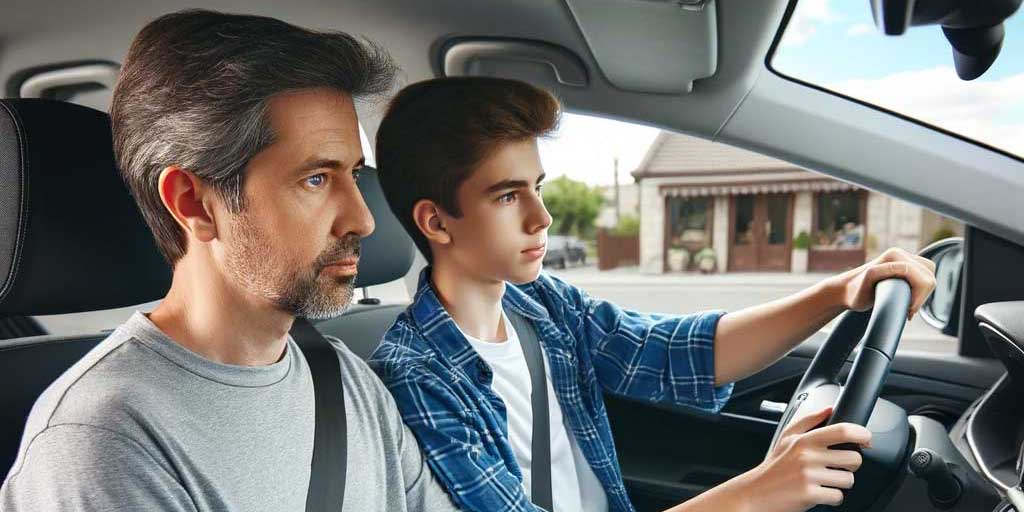
Under no circumstances can you practice driving on your own while you hold an instruction permit.
A supervising driver who occupies the seat beside you must accompany you. The supervising driver must have a valid regular (non-probationary) driver’s license and have at least two years of driving experience.
The supervising driver must be at least 21 years old unless the driver is a qualified driving instructor, a parent, guardian, or spouse, for which a minimum age of 19 years applies.
When you drive with a parent, guardian, or spouse, your immediate family members may occupy the rear seats.
No other passengers are allowed if a person other than a parent, guardian, or spouse supervises you. The licensed person accompanying you must also have written authorization from your parent or legal guardian to supervise you.
When driving during darkness, a qualified driving instructor or a licensed person who is at least 25 years old and has two years of licensed driving experience must accompany you.
When you hold an instruction permit, all cell phone use (hands-free and handheld) while driving is prohibited except for reporting an emergency.
How Long is the Instruction Permit Valid?
A Wisconsin instruction permit is valid for 12 months. You can renew once for another 12 months.
You need proof of enrollment or completion of a driver’s education course to renew your instruction permit.

When Can I Get a Probationary Driver’s License?
You must hold an instruction permit for at least six months before applying for your probationary license (minimum age: 16).
Your driving record must be clear of any violations in the six months before applying for the probationary license.
You must also have practiced driving for at least 30 hours (10 during darkness) and be certified as a parent, guardian, or adult sponsor.
You must complete an approved driver-education training course.
When you have fulfilled these requirements, you must pass the driving skills test.
What are the Restrictions on a Probationary Driver’s License?
GDL restrictions apply only for the first nine months if you drive violation-free.
Night Curfew
There is a night curfew between midnight and 5 a.m.
During the night curfew, you can only drive alone if you must drive between home and school or work.
A supervising driver must accompany you if you drive anywhere else during the curfew.
Passenger Restriction
In addition to any number of immediate family members, you can only carry the following:
- One person who holds a valid, regular license with at least two years of licensed driving experience and who is:
- a qualified instructor or spouse 19 or older, or
- a person 21 or older
- One other person
Cell Phone Restriction
Cell phone use (hands-free and handheld) while driving is prohibited except for reporting an emergency.


Driver’s License FAQ
At what age can I get my first Wisconsin learner's permit?
You may apply for a Wisconsin instruction permit when you are 15 years and 6 months old or older.
Where can I get my Wisconsin instruction permit?
You will get your permit at a DMV customer service center. Pre-fill an application online and gathered all necessary documents. Then schedule an appointment with a service center. If approved, you will get your permit after passing a vision screening and a knowledge test.
How long is the instruction permit valid?
A Wisconsin instruction permit is valid for 12 months. It can be renewed once for another 12 months.
What are the restrictions on a Wisconsion instruction permit?
You must always drive under supervision of a licensed driver.
If you drive together with an authorized instructor, parent, legal guardian, or spouse, the supervising driver must be a least 19 years.
If you drive together with another adult, the supervising driver must be at least 21 years.
If you drive at night (during darkness), the supervising driver must be at least 25 years.
The supervising driver must always have a valid regular (non-probationary) driver's license and have at least two years of driving experience.
You can only carry passengers that are immediate family, and only when driving under supervision of an authorized instructor, parent, legal guardian, or spouse.
Cell phone use while driving is prohibited, except to report an emergency.
Can I use a hands-free cell phone if I have an Instruction Permit?
In Wisconsin, handheld or hands-free cell phone use while driving is against the law for drivers with a probationary license or instruction permit, except to report an emergency.
When can I get a probationary driver's license in Wisconsin?
You must hold an instruction permit for at least six months before to applying for your probationary license. Your driving record must be clean of any violations during the six months prior to applying.
What are the restrictions on a probationary driver license?
Night curfew between midnight and 5 a.m. unless driving directly from/to home and work or school.
If you drive anywhere else you must drive accompanied by a supervising driver.
Passenger restrictions: only one non-family member that is not a supervising driver.
No cell phone use.


It’s giving the same test all the time!
There should be no caching problem on the server side. Checked with the most common browsers and android this morning. Caching means keeping a copy of data on your device that you’ve already received, to avoid having to ask for it again.
Try to hit refresh in your browser before you start a new test. If that does not work, check your caching settings.
Worked for me. I took my test today and passed
give us different tests not the same one we pass the test that is given and that same test appears.
We are truly sorry for this inconvenience. The test had a caching error which affected only some web browsers, like Windows Edge. This is now fixed.