
2026 Delaware Permit Practice & DMV License Tests
Results
Congratulations! This is a passing score. Do you want to take the test again?
This is not a passing score. Do you want to take the test again?


#1. After you have made a slight turn or lane change, you should:
After you have made a turn or lane change, make sure your turn signal is off. After small turns, the signals may not turn off by themselves. Turn it off if it has not clicked off by itself. If you don’t, other drivers might think you plan to turn again.

#2. Which of the following acts could be aggressive driving?
Aggressive driving is defined in terms of existing Title 21 offenses such as failure to yield, unsafe lane change, disregard of a traffic control device, failure to stop at the command of a police officer, following too closely, passing on a shoulder, and speeding. Individuals convicted of three or more of these offenses as a result of continuous conduct are guilty of aggressive driving and are subject to increased penalties.
Offenders will be fined between $100.00 and $300.00 for the first offense. Additionally, offenders are required to complete a behavioral modification/attitudinal-driving course within 90 days after the conviction for aggressive driving. Failure to attend the course will result in suspension of the individual’s driving privilege.

#3. If the engine dies while you are driving:
If the engine dies while you are driving, keep a strong grip on the steering wheel. Be aware that the steering wheel may be difficult to turn, but you can turn it. Pull off the roadway. The brakes should still work, but you may have to push very hard on the brake pedal.

#4. What does this sign mean?
The road will curve to the right. Note the difference between Curve and Sharp Turn signs.

#5. Your lane ends ahead, and there is a large truck in the lane beside you. What is the best thing to do?
When cars cut in too soon after passing, then abruptly slow down, truck drivers are forced to compensate with little time or room to spare. Because it takes longer to pass a large vehicle, you should maintain a consistent speed when passing, and be sure you can see the cab of the truck in your rear-view mirror before pulling in front.
Trying to beat a truck through a single-lane construction zone, for example, removes the truck driver’s cushion of safety and places you in danger.

#6. Flashing Do Not Walk or Raised Hand lights mean that a pedestrian:
The flashing DON’T WALK signal means that if the pedestrian has started to cross the street, they should finish crossing as rapidly as possible. If they have not started to cross, they should not start. A driver must yield the right-of-way to any pedestrian within a crosswalk, stopping if necessary.
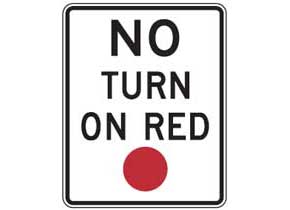
#7. What does this sign mean?
No turn on red. Where this sign is posted, you must wait until the signal turns green before proceeding or making turns.

#8. The risk of hydroplaning and skidding increases:
When it is raining or the road is wet, most tires have good traction up to about 35 mph. However, as you go faster, your tires will start to ride upon the water, like water skis. This is called hydroplaning. In a heavy rain, your tires can lose all traction with the road at about 50 mph. Bald or badly worn tires will lose traction at much lower speeds. The best way to keep from hydroplaning is to slow down in the rain or when the road is wet.

#9. What does this sign mean?
When you come to a stop sign, you must make a complete stop at the stop line. If there is no stop line, stop at the crosswalk. If there is no crosswalk, stop before entering the intersection. Before starting you must yield the right-of-way to any vehicle or pedestrian in or approaching the intersection. Be careful to look for less visible vehicles such as bicycles, mopeds, and motorcycles.

#10. How do you check your blind spots while driving?
You must turn your head and look to see vehicles in your blind spot. Look over your shoulder in the direction you plan to move. Check quickly. Do not take your eyes off the road ahead for more than an instant. Traffic ahead of you could stop suddenly while you are checking traffic to the sides, rear, or over your shoulder.

#11. What light beam should you use when driving at night in heavy fog?
Use your low beams when following another vehicle or when in heavy traffic. You should also use the low beams in fog or when it is snowing or raining hard. Light from high beams will reflect, causing glare and making it more difficult to see ahead. Some vehicles have fog lights that you also should use under these conditions.
Do not drive at any time with only your parking lights on.

#12. You can park and leave your car:
Parking is not allowed on a sidewalk or on a crosswalk.

#13. If you are under 18, you cannot get a class D operator's license until you have held the level one learner's permit for at least:
A permit holder who is at least 17 years old, but less than 18 years old, may obtain a Class D operator’s license when the driver has held a level one learner’s permit for at least 12 months, the sponsor has not withdrawn his/her endorsement, and the applicant’s driving privileges are not suspended, revoked, or canceled.
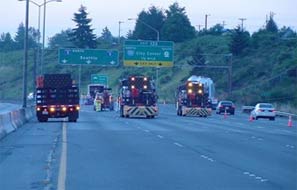
#14. What should you do when you approach a work zone?
Stay alert for changing traffic patterns and slowing or stopped traffic. Stopped traffic may be hidden around a curve or over a hill. Pay close attention to traffic signs and other devices, such as cones, that are placed to safely guide you through the work zone. Watch for slower speeds limits. Maintain a reasonable spacing between vehicles. You may have nowhere to go if you are traveling too fast or following too closely and the vehicle in front of you suddenly slows or stops.

#15. This sign tells you to:
Two-direction arrow. You cannot go straight ahead. This sign is placed at a T-intersection. Yield right of way or stop before turning right or left.

#16. When you drink alcohol, it passes into the bloodstream and reaches your brain:
Immediately after an alcoholic beverage is swallowed, the alcohol starts to move from the stomach into the bloodstream. The rate of this movement and how much alcohol gets into the blood depends primarily on how much alcohol is in the drinks taken. The alcohol reaches your brain in 20 to 40 minutes.

#17. After stopping and yielding, you may turn right at a red light unless:
You may make a right turn at a red light unless there is a no turn on red sign, or a steady red arrow is displayed.

#18. When should you share a lane with a motorcyclist?
Never move into the same lane alongside a motorcycle even if the lane is wide and the cyclist is riding far to one side. It is not only illegal, but also extremely hazardous.
Lane usage for the motorcyclist is critical. Motorcycles are entitled to the same full lane width as all other vehicles. A skilled motorcycle operator is constantly changing positions within that lane to maximize his ability to see and be seen, and to compensate for objects in or near the road

#19. When crossing railroad tracks in heavy traffic, you:
Never start to cross if there is not room for your vehicle on the far side, or if you will have to stop on the tracks. Do not block the crossing. Wait until there is room for your vehicle on the far side.

#20. On a four-lane divided highway, solid white lines mark the traffic lanes. You should know that a solid white line:
Multiple lanes of travel in the same direction are separated by white lane markings.
A dashed (broken) white line between lanes of traffic means that you may cross it to change lanes if it is safe to do so.
A solid white line between lanes of traffic means that you are discouraged from changing lanes.
Double solid white lines prohibit lane changing.
Solid white lines are also used along the side of the road show you where the outside edge of the travel lane is located.

#21. When traveling 55 mph and passing another vehicle on a two-lane road, your gap in oncoming traffic should be at least:
At a speed of 55 mph, you need about 10 seconds to pass. That means you need a 10-second gap in oncoming traffic and sight distance to pass. You must judge whether you will have enough space to pass safely.

#22. If you are involved in a collision, you must always:
If you are involved in an accident, you must stop. If, after reasonably ascertaining that there are no injuries or deaths, and if the damaged vehicle is obstructing traffic, the driver of the vehicle must make every reasonable effort to move the vehicle or have it moved so as not to obstruct the regular flow of traffic more than necessary.

#23. You should use a car horn:
Use your horn whenever it will help prevent an accident. Do not use your horn to show other drivers that they made a mistake or because you want another driver to go faster.

#24. At a traffic stop, you and your passengers should:
You and your passengers should remain in your vehicle at all times unless instructed otherwise by the officer.

#25. What is the background color of a general warning sign like this?
General warning signs are usually yellow with black lettering or symbols and most are diamond shaped. These signs warn you to slow down and be prepared to stop if necessary. They warn you that a special situation or a hazard is ahead.

#26. When are road surfaces usually most slippery during rainfall on a hot day?
If it starts to rain on a hot day, pavement can be very slippery for the first few minutes. Heat causes the oil in the asphalt to come to the surface. The road is more slippery until the oil is washed off.
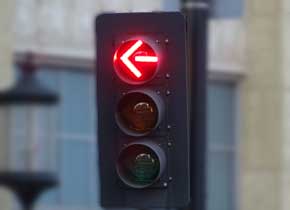
#27. A traffic light is showing a red arrow. What does it mean?
Delaware does not allow turning against a red arrow.
A full stop is required when a steady red arrow is displayed. You may not proceed in the direction of a steady red.
Note: This turn may be allowed in other states.

#28. When does an anti-lock braking system start to work?
Whenever the vehicle’s computer detects that one or more wheels are locking, the system automatically pumps the brakes at a faster rate than the driver could. Press on the brake pedal as hard as you can and keep pressing on it. You might feel the brake pedal pushing back when the ABS is working. Do not let up on the brake pedal. By removing steady pressure from the brake pedal or pumping the brakes will disengage or turn off the ABS.
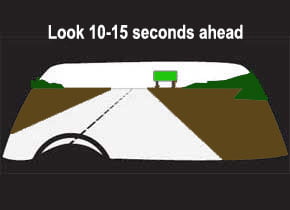
#29. By looking at least 10 seconds ahead on the roadway:
To avoid last-minute braking or the need to turn, you should look well down the road. By looking ahead and being ready to stop or change lanes if needed, you can drive more safely, save fuel, help keep traffic moving at a steady pace, and allow yourself time to better see around your vehicle and alongside the road. Looking well down the road will also help you to steer straighter with less weaving. Safer drivers tend to look at least 10 seconds ahead of their vehicle.

#30. When the roads are covered with ice, you must:
Because you need more distance to stop your vehicle on slippery roads, you must leave more space in front of you. If the vehicle ahead suddenly stops, you will need the extra distance to stop safely.
Delaware DMV Permit Test – Quick Facts
| What You Should Know | |
|---|---|
| Number of questions on exam: | 30 |
| Passing score: | 80 percent |
| Correct answers to pass: | 24 |
| Allotted time to complete test: | No limit |
| Wait time before retest: | 10 days |
| This Practice Test | Number of questions on each practice test: | 30 |
|---|---|
| Question pool: | 1,000+ |
| Each test is random | |
Delaware Class D written knowledge test has 30 multiple-choice questions. You must correctly answer at least 24 questions to pass the test.
The passing score on the Delaware knowledge test is 80 percent, slightly higher than it used to be. But don’t let this discourage you. Just remember to read the manual and take many practice tests until you feel comfortable with all the questions and answers.

Delaware Permit and Driver’s License Practice Tests
This practice test draws 30 random questions from an extensive database with questions and answers based on the information in the Delaware Driver Manual and official state tests.
After each question, you will see whether your answer is correct. If your answer is wrong, there is also a short explanation to help you learn faster and look up the corresponding item in the driver’s manual.
Remember that the practice test supplements the manual. You should not use it instead of the manual.
1 Always Start by Reading the Manual
Before taking practice tests for your Learner’s Permit or Operator’s License, we strongly recommend that you familiarize yourself with the contents of the Delaware Driver Manual and read it carefully.
You can pick up a copy of the manual at a DE DMV office or download it online from www.dmv.de.gov .
It is easier to pass the exam if you know all the rules and laws described in the Driver Manual.
When studying the Delaware manual, you can use the practice tests to verify your progress and identify weak spots.
Don’t attempt the actual exam too soon. Aim for a full score on a few practice tests. It gives you a good margin for passing the actual knowledge examination.
Is the Delaware DMV Test Hard?
The difficulty is considered moderate. We are convinced you will pass after studying these free DE DMV practice test questions.
Most of our visitors do!
Learn more: How to Ace the Test

Who Must Take the Delaware Knowledge Test?
All new drivers who haven’t had a license before must pass the knowledge test.
You must apply for a new license to get a revoked Delaware driver’s license back. This means you must start all over by retaking all tests, including the written knowledge test.
The DMV also requires a new knowledge test after some suspensions.
The examiner may also ask for a new knowledge test when renewing an expired Delaware driver’s license.
The written knowledge test is always necessary when you move to Delaware and wish to transfer a driver’s license from a country other than the United States, U.S. Territories, Germany, Taiwan (Republic of China), and France.
The DMV will waive the written knowledge test if you have a valid driver’s license from another state in the United States, Germany, Taiwan (Republic of China), and France. But if your license has expired, the DMV examiner will usually ask you to take the test.

What’s on the Delaware Knowledge Test?
On the test, you must identify some highway signs only by their shape, color, or the symbols appearing on them. You must also understand the meaning of these and other highway signs, traffic signals, and pavement markings.
A second part of the test covers Delaware motor vehicle laws and general safety practices.
You should expect ten road sign questions and 20 questions about standard road rules, traffic laws, and safe driving practices.
There will also be two questions related to traffic stops by a law-enforcement officer, including some of the following:
Your constitutional and other legal rights during a traffic stop, including rights related to searches and seizures, to remain silent, and to an attorney.
Laws regarding questioning and detention by a law-enforcement officer.
The role of a law-enforcement officer in general and during a traffic stop and the procedures a law-enforcement officer must follow during a traffic stop.
How to interact with a law-enforcement officer during a traffic stop.
How and where to file a complaint against or compliment on behalf of a law enforcement officer.
Read more:
What Should You Do at a Traffic Stop by the Police?
DMV bases all questions on the information in the Delaware Driver Manual. You should study this manual carefully. The test will contain questions from all sections of the manual. Make sure you discuss anything unclear with a friend or a parent. It helps you learn faster.
Read more:
Is it the Same Questions on the Real Test?
What If I Fail the Knowledge Test?
If you fail any part of the driver’s examination test, you must wait at least ten days before the DMV will let you retake the test. Use this time to prepare yourself even better. Remember which questions you missed on the exam and read up on these areas.

Delaware Graduated Driver’s License Program
Like all other states in the USA, Delaware has adopted The Graduated Driver’s License (GDL) program. Its purpose is to reduce the high accident and fatality rate among young drivers. In the GDL program, new drivers will get a supervised driving experience and reduced exposure to high-risk driving situations. The way toward a basic Delaware driver’s license has different steps.
Delaware has designed the program for new drivers under 18 years old. Participation is optional for any person who is 18 years or older. If opting out of the program, a new driver 18 years or older must pass the knowledge and road skills exam at DMV.
Delaware Level One Learner’s Permit
Requirements for the Delaware Learner’s Permit:
Be between 16 years and 18 years old.
You must be 16 to apply for a level one learner’s permit in Delaware. DMV issues the permit to applicants between 16 and 18 years old or up to 22 years old if they are part of an Individualized Education Program (IEP).
Passed a certified Delaware Driver Education Course.
You must pass a certified Delaware Driver Education Course before you apply. Present the Delaware Driver Education Certificate (Blue/White Certificate) as proof.
Provide necessary documents.
You must show proof of full name, birth date, and social security number. Unless you live at the same address as your sponsor (usually a parent or legal guardian), you must also show two proofs of your address in Delaware.
If you are under 18 years old, you must show a document that also has your parent(s) or legal guardian(s) name(s). You should bring an original U.S.-issued birth certificate or a certified copy. In the case of legal guardians, bring court documents in original.
Applicants 18 years or older may bring a passport, U.S. Citizen Identification Card or State/Province/Territory issued photo I.D. card. See full list .
In addition to documents that prove your identity and birth date, the DMV wants your social security number from your Social Security Card, W-2 tax form, SSA 1099 form, or a pay stub with your name and whole SSN.
Unless you are a minor who lives with your sponsor, you must also show two proofs of Delaware residency. You can achieve this by bringing utility bills, credit card statements, bank account records, employment records, rental agreements, etc.
Alien residents must show valid proof of legal presence in the United States, such as a Resident Alien Card or Temporary Resident Identification Card. See full list .
Application must be signed by a sponsor.
A sponsor is usually a parent, legal guardian, or court-appointed custodian. The sponsor must sign the application in the presence of a Division licensing employee.
Pay the license fee.
The fee for a license application in Delaware is currently $40.00
Pass a vision test.

