
2026 Oregon DMV Test Questions & Answers – Permit Practice
Results
Great – this is a passing score. Do you want to try again?
Sorry – this is not a passing score. Do you want to try again?


#1. What parts of a road might hold frost and ice while the rest is dry?
Watch for danger spots ahead. A bridge or shaded area freezes first and may be icy when the rest of the road is free of ice.
Remember, reduce your speed on winter roads. Allow extra space between your car and the car ahead. Do not brake or turn suddenly.

#2. When approaching this sign, you are NOT allowed to:
Do not pass. This sign marks the beginning of a no passing zone. You may not overtake another vehicle.
A yellow pennant-shaped sign may be on the left-hand side of the road or highway in addition to a Do Not Pass sign or pavement markings.

#3. When you see this sign, you should:
A five-sided sign marks school zones and warns you about school crossings.
These signs may display horizontal lines indicating the point at which a crosswalk exists.
Two signs may be used together to show the actual location of the crosswalk.
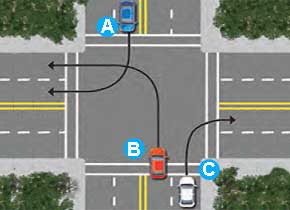
#4. In this illustration:
All vehicles are turning into wrong lane.

#5. When brakes fail:
If your brakes stop working:
- Pump the brakes. This may build up enough pressure to get them working again.
- Shift to a lower gear so the engine can help slow you down.
- Slowly apply the parking brake.
- Use your horn or lights to warn others that you are out of control.
- Once you have slowed, ease onto the shoulder.
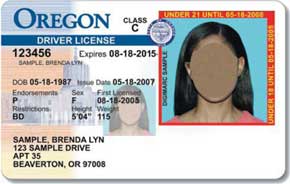
#6. To get a class C provisional license in Oregon, you must be at least:
DMV issues a class C provisional license to persons 16-17 years of age.

#7. After stopping and yielding, you may turn right at a red light unless:
A steady red signal means stop. Remain stopped until the signal changes. You are allowed to make the following turns on red after coming to a complete stop unless a sign or police officer states otherwise.
- When entering a two-way road, you may turn right.
- When entering a one-way road, you may turn right or left in the direction of the one-way road.

#8. What is true about signaling before suddenly reducing speed?
Remember, the law requires that you give an appropriate signal before stopping or suddenly decrease your speed. You can signal with your hand and arm or with your vehicle’s brake lights.
Only use hand-and-arm signals in daylight and when you can clearly see people and vehicles at a distance of 1,000 feet. You must use turn signal lights at night or when visibility is poor. Hand-and-arm signals should not be used any time you are driving a wide or long vehicle.

#9. When passing a horse rider, you should:
Animals can be unpredictable. Be prepared to brake or slow down as you pass an animal. Stop your vehicle if a person riding on horseback or leading an animal raises a hand or it is obvious the animal is frightened, unless stopping would cause a crash. A raised hand means the animal is frightened.
Do not use your horn or make other loud, sudden noises near the animal.

#10. What does this sign mean?
Stop sign ahead. When you come to this sign, you should slow down to be ready to stop at the stop sign ahead.

#11. If you see a pedestrian with a white cane attempting to cross the street, you must:
You must give the right of way to a blind or partially blind pedestrian who is carrying a white cane or using a guide dog. Stop if the person is about to cross or is crossing the road. Remain stopped until the person has crossed the entire road, even if you have a green light.

#12. When parking close to a fire hydrant, you must keep what distance?
You cannot stop or park your vehicle within 10 feet of a fire hydrant.

#13. You must pull over and stop for an emergency vehicle using a siren:
You must yield right of way to emergency vehicles, such as fire trucks, police vehicles, and ambulances, when they approach from any direction using a light or siren.
When you see or hear an emergency vehicle warning, you must immediately drive as close as you safely can to the right side of the road and stop.
Stay stopped until the emergency vehicle has passed or until an officer tells you to move.
Do not stop in an intersection.

#14. Why should you allow more space in front of your vehicle when following a large truck?
The drivers of large vehicles may not be able to see you when you are directly behind them. These vehicles also block your view of the road ahead.

#15. A poor physical or mental condition:
Your mental and emotional state, as well as your physical health, affects the way you drive. Your overall health, fatigue, and even emotions, such as anger or worry, are a few of the conditions that can make you an unsafe driver.

#16. When can you drive off the paved portion of a road to pass another vehicle?
When passing another vehicle on a two-lane road, you should pass only to the left of the vehicle. When passing on the right is permitted, there must be sufficient space for you to pass without leaving the paved portion of the road or driving in a bike lane. The shoulder should only be used in an emergency.
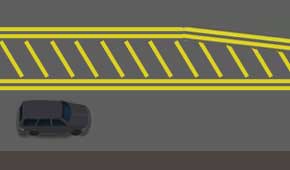
#17. You may drive across a painted median with double solid yellow lines and yellow diagonal stripes:
Yellow diagonal stripes are used within a painted median to inform you of fixed objects in the road ahead or other areas that are prohibited from vehicle use. It is illegal to use or make a turn across a painted median with yellow diagonal stripes.

#18. Why should you be prepared to stop if you see a school bus at a railroad crossing ahead?
Some vehicles, such as school buses, school activity vehicles, tank vehicles, or trucks carrying hazardous materials, must stop at all railroad crossings. If you are following this type of vehicle, be prepared to stop.

#19. If a school bus with flashing red lights has stopped on the opposite side of a four-lane roadway without median separation, you:
If you are on a divided highway with two roads separated by an unpaved median strip or barrier, you must stop only if you are on the same side of the road as the bus. A painted median strip or turn lane does NOT create two separate roads. In this case, all lanes of traffic must stop.

#20. A truck or bus driver has serious blind spots in which a car can disappear from view:
Many motorists falsely assume that truck and bus drivers can see the road better because they sit higher than the driver of a small vehicle. Although a truck or bus does enjoy a better forward view and has bigger mirrors, it has serious blind spots into which a small vehicle can disappear from view.
| This Oregon DMV Practice Test | |
|---|---|
| Number of test questions on each test: | 20 |
| Question pool: | 500+ |
| Type of test: | Random multiple-choice |

| Oregon DMV Written Knowledge Test | |
|---|---|
| Number of questions on exam: | 35 questions (all applicants) +20 questions (under 18) |
| Passing score: | 80 percent |
| Correct answers to pass: | 28 (all applicants) +16 (under 18) |
| Allotted time to complete test: | Online: 60 minutes |
| Wait time before retest: | Online: 2 attempts/day Office: 1 day |
Oregon Practice Test
This Oregon written practice test has 20 random multiple-choice questions.
Driversprep has designed this test to cover all essential topics in the latest version of the Oregon Driver Manual and help you pass your written driver examination for a permit or full driver’s license. It covers the original 35-question test for all applicants and the additional test for teenagers under 18.
After each practice question, you will get instant feedback on whether your answer is correct. If your answer needs to be corrected, there is also a short comment to help you understand the correct answer.
It is a good idea to keep the Oregon Driver Manual handy when you take the test and look up more information when you miss a question. That way, you will learn faster and remember facts better.
Get the Latest Version of the Oregon Driver Manual
Remember always to get the latest version of the Oregon Driver Manual. Don’t use old copies. Visit a local office for a hard copy or download a PDF-version online .
After you have studied the manual, it is time to start using these practice tests to check your progress and level of readiness.
Don’t use the practice tests instead of the manual. A practice test supplements the manual, not a replacement.

Is the Oregon DMV Test Hard?
The failure rate on the written DMV test in Oregon is almost 50%, meaning the examination is challenging for young first-time applicants. Serious preparations are necessary to pass your test the first time.
You have two attempts in 24 hours if you use the online test. Should you fail the test at a DMV office, you must wait at least one day before you can retake it. Sometimes, the wait can be longer. It depends on the testing resource availability at the DMV office.
The real written test in Oregon has 35 questions, and the passing score is 80%, meaning you must have 28 correct answers to pass. If you are under 18, there is an additional knowledge test with 20 questions.
What is the Additional Safe Driving Practices Test?
Teenagers under 18 must take two knowledge tests when applying for an Oregon driver’s license.
The first has 35 questions about general rules and Oregon laws, including traffic signs, signals, and sharing the road with others. This test is the same for all applicants.
The Oregon additional knowledge test for an applicant under 18 years old has 20 questions about safe driving practices. You may expect questions about following distances, use of turn signals and headlights, speed, and driving in bad weather. There is no fee for this additional test. The passing score is 80 percent (16 correct answers).
The Official Online Test
You can take the Oregon DMV test online from the comfort of your home or school.
If you are under 18 years old, you need a proctor to supervise the test. The proctor can be anyone at least 21 years old, with a social security number, and who has proctored under six DMV tests in the past 12 months.
Test takers 18 or older don’t need a proctor during the exam.
DMV gives you two chances to pass the test in 24 hours but no more than four attempts. After four failures, you must take the test at a DMV office.
You can take the online test if you have a PC or laptop with a keyboard, mouse, and webcam and unless your license is revoked in another state or suspended for cheating on a test. You cannot use a smartphone or tablet with touchscreens.
The Best Way to Study
Another good idea is to spread your study sessions over time. Don’t try to digest everything only a few days before the examination.
You will be much better prepared if you work with the manual and the Oregon test questions for a few weeks.
If you want to ace the DMV test, these tips can help:
Who Must Take the Oregon Knowledge Exam?
First-time applicants.
For an Oregon original license of any type or an upgrade to a different kind of license, you must always pass the following tests: a vision screening, the written knowledge test, and a road skills test.
Applicants under 18 must also take the Safe Driving Practices Knowledge Test before Oregon DMV issues a driver’s license. You can take this test 30 days before you turn 16.
Drivers with an expired license.
Drivers who let their license expire for more than one year must pass the knowledge test again.
Drivers with a foreign driver’s license.
Drivers who move to Oregon and hold a license from a country other than Canada, Germany, or the United States must pass all tests.
The DMV waives the road skills test for drivers with a valid license from Germany but not the knowledge test.
Drivers with a valid license from another state, territory, or Canada are not required to take the written knowledge or road skills test.

More about the Oregon Knowledge Test
The Oregon class C knowledge test has questions about road signs and signals, Oregon traffic laws, and other information you need to know to drive in this state.
You should always expect questions about the following:
- Pedestrians who are blind.
- Traffic signs described in the manual.
- Traffic signals described in the manual.
- How to act in different emergencies.
- Vehicle safety equipment and its use.
- Safe driving around pedestrians and bicyclists.
- Safe driving around motorcyclists (2 questions).
Remember, you will find the answers to all questions in the Oregon Driver Manual.
Oregon DMV offers the knowledge test on a touchscreen computer, with or without audio assistance.
Languages
The Oregon online test is available in English and Spanish only.
At a DMV service center, the test is available in the following languages:
| Arabic |
| Chinese |
| English |
| Japanese |
| Korean |
| Russian |
| Spanish |
| Vietnamese |
With permission from DMV, you may use a foreign language translation dictionary or an authorized interpreter. Contact your local DMV office for further details. You should also contact DMV if you require any other special accommodation.
Don’t Cheat on the DMV Test
Only people taking the test are allowed into the testing area at the service center, except for authorized interpreters.
During the test, you cannot talk, use a cell phone or any other electronic device, write, or take notes. Follow the rules and instructions the staff gives. Otherwise, examiners may immediately stop your test. If they decide you have been cheating, they will not allow you to test again for 90 days. It’s a lengthy period if you want your learner’s permit.
What the Law Says about Your Examination
ORS 807.070 – Examinations
The examination for each class of license or endorsement must include all of the following as described:
(1) A test of the applicant’s eyesight. This subsection does not apply to an applicant with a limited vision condition as defined in ORS 807.355 (Definitions).
(2) A test of the applicant’s knowledge and understanding of the traffic laws of this state, safe driving practices and factors that cause accidents. The following all apply to the test under this subsection:
(a) The test may not cover any subject that is not presented in the publications of the department intended for the instruction of applicants for licenses and driver permits.
(b) The test for each class of license and endorsement must include, but is not limited to, a test of knowledge and understanding of traffic laws that relate specifically to the type of driving privileges granted under the specific class of license or endorsement sought.
(c) The test must include, but is not limited to, the following subjects:
(A) Rights of pedestrians who are blind.
(B) The meaning of official traffic signs and signals.
(C) Proper operating procedure in emergency situations.
(D) Vehicle safety equipment and its use.
(E) Practices necessary for safe operation of a vehicle around pedestrians and bicyclists.
(F) Practices necessary for safe operation of a vehicle around motorcyclists.
(d) The test must include at least two questions pertaining to the practices necessary for safe operation of a vehicle around motorcyclists.
(e) The test may include a question regarding fuel efficient driving techniques.
(f) The department may waive the test under circumstances described in ORS 807.072 (Waiver of certain examinations, tests and demonstrations).
(3) A test that is an actual demonstration of the applicant’s ability to operate a motor vehicle without endangering the safety of persons or property. The following apply to this subsection:
(a) The actual demonstration for each class of license shall be performed in a vehicle that may be operated under the class of license sought, but that may not be operated under lower classes of license.
(b) An actual demonstration for a passenger endorsement shall be performed in a vehicle that may be operated under the endorsement.
(c) An actual demonstration for a school bus endorsement shall be performed in a school bus.
(d) An actual demonstration required for a commercial driver’s license may be performed by a person only if the person has held for at least 14 days a commercial learner driver permit that was issued by the department or by another jurisdiction that authorizes operation of the vehicle used for testing.
(e) The department may waive the demonstration under circumstances described in ORS 807.072 (Waiver of certain examinations, tests and demonstrations).


Here’s some more advice: 1. Stay out of the passing lane unless you’re passing. 2. If you’re driving slow on a two lane road, don’t speed up when you get to a passing lane. 3. Unless there is bad weather, turn off your #€%*! fog lights. 4. Signal a few seconds before braking and turning. Don’t just slam on the brakes first. 5. Put down your stupid phone!
you should help me pass I’m 16. name is kai.
This was very helpful. Passed with no mistakes.
Are your answers and questions similar to the ones on the actual test?
https://driversprep.com/questions-real-dmv-test/
How many questions can you miss on the permit test in Oregon?
Read above. “The passing score in Oregon is 80 percent, which means you must answer at least 28 questions correctly.”
It means you can miss no more than 7.
My son just got his permit and he’s going to be 18 in March 09, how long he needs to wait to be able to take the drive test.
Short answer: March 9.
If you are under 18, you must hold an instruction permit for at least six months and complete 50 hours of supervised driving practice. Then you must complete an approved driver training course OR complete another 50 hours of supervised driving practice plus pass an ODOT-approved traffic safety education course.
Once you are 18, the above no longer applies. After you’ve passed the knowledge test, you can schedule a road test. Driver Education and Permit are optional.
Yo e hecho el test 5 veces y siempre me asen falta dos preguntas para pasarlo puedo seguir realizando el test teorico