
Ohio BMV License Test & Permit Practice Tests | 100% Free
Results
Great! This is a passing score. Do you want to try again?
Remember: the real knowledge test has 40 questions.
Great! This is a passing score. Do you want to try again?
Remember: the real knowledge test has 40 questions.


#1. Written evidence of financial responsibility is needed:
Owners and operators of motor vehicles in Ohio must carry a minimum amount of liability coverage in order to legally operate or permit the operation of a motor vehicle.

#2. If there are two railroad tracks next to each other:
If there is more than one track, a sign below the crossbuck indicates the number of tracks at the crossing. Make sure all tracks are clear before crossing.

#3. The three-second rule helps a driver know:
A driver must maintain sufficient distance between his or her vehicle and the vehicle ahead. Some safety experts advise drivers to allow one car length ahead for each 10 mph of speed. Others suggest following the three-second rule. To use a three-second rule, you should watch the vehicle ahead pass a stationary object, such as a lamppost, counting ne thousand one, one thousand two, one thousand three. If you pass the lamppost before you say three, you are following too closely and should slow your speed. In bad weather, increase the space to four- or five-seconds traveling time.

#4. What is true about a violation of the child safety seat law?
A child safety seat law violation is a primary offense. It can be the main cause for a traffic stop, no other violation is needed.

#5. What is true about driving too slowly?
No person shall operate a vehicle at such a slow speed as to impede or block the normal and reasonable movement of traffic, except when reduced speed is necessary for safe operation or to comply with the law.

#6. You approach this sign. What should you expect ahead?
Sharp tight turn. Slow down and be prepared for a sharp right turn in the road ahead.

#7. To avoid glare from high-beam headlights of an approaching car at night:
If a car approaches you with bright lights on, do not stare at the lights. Steer by the line at the outside edge of the road to prevent being temporarily blinded.

#8. What does this sign mean?
The side road sign tells you that there is an intersection ahead. Another road enters from the right. Watch out for traffic entering from the side road and oncoming traffic turning.

#9. If you run off the pavement, you should:
It is possible that at one time or another, your vehicle’s wheels will run off the pavement onto the berm or soft shoulder. If this occurs, follow these tips to return safely on the road:
- Do not try to jerk the tires immediately back onto the road.
- Stop accelerating. Allow the vehicle to coast to a slower speed.
- When the car has slowed, gradually steer back onto the roadway.
- As soon as all four wheels are on the pavement, straighten the front wheels and proceed with traffic.
Remember, do not overreact. Do not try to swerve back onto the pavement right away, because you may lose control of your vehicle.

#10. When you plan to exit a freeway, you should:
Plan ahead. Watch for signs, signal your proper turn-off, and move to the correct exit lane. Use your turn signal to indicate when and where you will be exiting. The heavier the traffic, the earlier you should move into the proper lane. Stay at the speed of traffic until you reach the exit ramp, then slow down

#11. When you approach a traffic signal displaying a steady yellow light, you must:
A steady yellow traffic light means caution. The red stop signal will be exhibited immediately after the yellow light appears. Adjust speed to come to a smooth stop.
Remember, stop if it is safe to do so. Do not speed up to beat the light.
If you are already in the intersection when the yellow light comes on, do not stop, but continue cautiously through the intersection.

#12. An unbroken yellow line on the right-hand side of the centerline means:
If the solid yellow line is closer to you, you cannot cross the lines. If the broken line is closer to you, you can only cross the line to pass another vehicle when it is safe to do so.
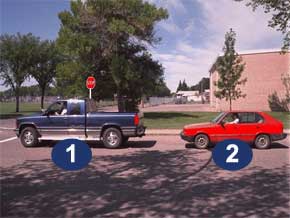
#13. You approach a stop sign. The car in front of you proceeds after stopping. You should:
You must come to a complete stop at the sign, stop line, pedestrian crosswalk, or curb. Wait for any vehicle or pedestrian to clear the way.

#14. When can you start using studded tires?
Studded tires are legal in Ohio from November 1 through April 15.

#15. What is the background color on a warning sign like this?
Warning signs adjacent to the roadways alert motorists to potentially hazardous conditions. Most of these signs retain their traditional yellow color as well as their diamond shape.

#16. This sign warns you of:
Two-Way Traffic. On this road, traffic is moving in both directions.
Remember, you should drive in the right-hand lane and expect oncoming traffic in the left-hand lane.

#17. This sign means:
U-turns are not permitted. You cannot turn around and go in the opposite direction.

#18. When parking your vehicle on a one-way street, you may park:
On one-way streets, vehicles may be parked parallel to and not more than 12 inches from the right or left curb.

#19. This sign tells you that the center lane must be used for:
Two-way left turn lane. This sign tells you that the center lane is reserved for the exclusive use of left-turning vehicles in either direction. The lane cannot be used for passing, overtaking, or through travel.

#20. After passing a motorcyclist you want to make a right turn ahead. You should:
Leave ample room when turning after passing a motorcyclist so the motorcyclist is not cut off when the motorist slows for the turn.
| This Ohio BMV Sample Test | |
|---|---|
| Questions on each practice test: | 20 |
| Question pool: | 500+ |
| Type of test: | Random multiple-choice test |

Facts about Your Ohio BMV Test
| Ohio Written Knowledge Test for Permit or Driver’s License | |
|---|---|
| Number of questions on exam: | 40 questions |
| Passing score: | 75 percent |
| Correct answers to pass: | 30 |
| Allotted time to complete test: | 25 minutes |
| Wait time before retest: | 1 day |
This Ohio Permit Practice Test
Each practice on this website has 20 random questions.
We base all practice questions on the information in the Ohio Digest of Motor Vehicle Laws and real examinations. After each question, you will get instant feedback on whether your answer is correct. If you miss a question, there is also a brief explanation to help you learn faster.
Like the actual exam, about half the questions will check your knowledge of common signs, signals, and markings—the other half addresses standard road rules and Ohio traffic laws.
The passing score in Ohio is 75%, but you should aim higher on the practice test to ensure you can pass the first time.
Each set of practice questions are from an extensive question bank, meaning each test is unique, and you can practice as often as you need to get comfortable with all questions and answers. A 100% score on several tests will boost your confidence before the real examination.

1 Get the Ohio Handbook
Start by getting the latest version of the Digest of Ohio Motor Vehicle Laws.
It is the official Ohio Driver’s Handbook issued by the Ohio Department of Public Safety.
You can get a hard copy from a local BMV office or download a PDF-version online .
Unfortunately, surveys show that students spend less time with the Ohio Handbook than ever before. Many students find the Digest of Ohio Motor Vehicle Laws difficult to “digest” with a lot of information that is off the target and offers little help in learning safe driving or understanding standard road rules.
Even if the handbook outlines all the information a first-time permit applicant needs for the examination, many rely on online information and practice tests such as this practice test instead.
We recommend that you refrain from bypassing the Digest of Ohio Motor Vehicle Laws altogether, even if it is boring and is a poor study guide.
It is best to use practice tests as a supplement to the handbook, not instead of it.
2 Use the Practice Tests
A mock theory test or practice test has two purposes:
- It lets you familiarize yourself with the test format.
- It gives you feedback about your current knowledge level.
Experts agree that practice tests also help you learn faster. They boost your confidence and make new knowledge stick better.
It is an excellent example of the advantages of active learning.
Challenging practice tests help you more. They will improve your test-taking endurance, and you will learn to pace yourself and read everything twice. When test takers make errors on the knowledge exam, they often knew the answer but didn’t read all the way through and answered in hast.
3 Write Your Own Explanations
Writing or taking notes is another approach to active learning. Some will say you should keep notes short and simple. Some also say that notes serve one purpose – to help you remember information.
This is not true.
You should use notes to rewrite the information in your own words. The longer, the better. It triggers a reflecting process that promotes learning. You don’t necessarily have to go back to the notes afterward.
Short and automatic notes you scribble down and read repeatedly won’t help. No matter how well you organize them. They have the same low effect on your learning as highlighting, underlining, and rereading the text in your textbook. It becomes static.
We have collected some more good advice in this article: How to Ace the DMV Test .

What You Should Know about the Ohio Knowledge Test
The test is random. You’ll never know which questions you will get.
You must correctly answer 30 questions out of 40 (75% passing score). Half of the questions will address signs and signals.
There is an allotted time of 25 minutes for each test (most finish in 10-15 minutes).
If you fail the test, you can take it again the next day.
The Ohio knowledge test is available in several languages:
Chinese
English
Japanese
Russian
Spanish
Please get in touch with your local driver’s license exam station for tests in any other language.
Remember that you must always be able to understand directions and read traffic signs printed in English.
If you cannot read or write well enough to take a knowledge test may be permitted to take an audio version of the test in English. You must still be able to read and comprehend the traffic signs.

Who Must Take the Written Knowledge Test?
All persons applying for a first permit or driver’s license must pass a written test that is given in two parts and covers Ohio motor vehicle regulations and traffic signs.
These requirements also apply to drivers who have allowed their license to expire for more than six months and to persons who must apply for a new license after losing it due to a suspension or revocation.
If you hold a driver’s license from a country other than the United States or Canada and wish to convert to an Ohio driver’s license, you must pass all required tests (vision, knowledge, driving, and maneuverability). The maneuverability test is, however, waived for holders of a license from Germany, France, or Japan.
What Documents do You Need?
When you apply for a temporary permit or full driver’s license at BMV, you must show proof of your:
Full legal name
Date of birth
Legal presence in the US
Social Security number
Ohio street address
Bring your Birth Certificate or U.S. passport (they prove your name, date of birth, and legal presence), your Social Security Card, and at least two documents showing your name and street address.
As proof of your address, BMV will typically accept pay stubs, bank statements, credit card statements, and school records (more examples ). Note that you need two documents from different sources.
If you are a minor, a certified statement of your Ohio address from your parents or legal guardian is enough.
As a resident alien, you need your green card or visa to prove your legal presence in the U.S.
Once BMV has accepted your documents, you can proceed with the knowledge test and the vision screening.
 Road Sign Quiz on Video


Can I get the test